

@LatamCardano DREP | @IntersectMBO Steering Committee & Civics Committee
Joined July 2017
- Tweets1.9K
- Following891
- Followers708
- Likes4.5K





Jose De Gamboa retweeted

The Parameter Committee is running the first of its kind Public RFP (Request for Proposal) for Cardano Research!
...and YOU can apply, including setting your own price.
We are looking for a researcher (team) who can answer the question on HOW LOW we can go on the utxoCostPerByte (minUTXO) parameter under current and planned protocol rules.
Expected deliverables for the work:
- An assessment of the lowest technically and economically sustainable utxoCostPerByte value.
- Analysis of the risks, trade-offs, and limitations associated with reducing the parameter, including economic and/or security concerns where relevant.
- Analysis of the impact of not reducing the parameter.
- Evidence-based recommendations, including potential safeguards or mitigation measures.
Expected content of the application:
- Description of your research approach and methodology.
- Your experience.
- Your estimated time of completion.
- Fixed-price quotation in ada.
Apply here: tinyurl.com/utxoCPB-RFP
Deadline: 4th of November
Ask questions here, in my DMs, or on the Forum post for the RFP: forum.cardano.org/t/public-r…

@ATADA_Stakepool well done! It's been 4 years since I first heard about this from @LATINSoporte
This is urgent for SPOs sustainability and for Cardano's decentralization.
Hope it makes it to the next hardfork.

Shout-out to @ATADA_Stakepool who in todays hard fork working group brought up the topic of adding minPoolMargin to the scope of the next hard fork!
While it's currently out of scope I think it makes a lot of sense to add it in!
MinPoolMargin is necessary to actually allow for fairer competition between stake pools.
Pledge aka "skin in the game" has to matter for pools

I don't recommend anyone scramble to move their funds to new wallets today. But we should take the risks to cryptography from AI-accelerated math seriously, and minimize our exposure to not just quantum-vulnerable cryptography, but also potentially AI-vulnerable cryptography.
The core new area of risk from this viewpoint is, unfortunately, ML-DSA / FHE / lattices.
(and it's also another reason, along with quantum, why ECDSA might fall even faster than expected, hence the "fresh address" recommendation)
So far most people have been in the mode of thinking "elliptic curves broken, hashes safe, lattices safe". But there is a good chance that the concrete security of lattices will take serious hits from the next two years of AI math.
The basic threat model is: factoring is something that naively takes 2^(n/2) time, but over decades smart people have found and optimized number field sieves, and degraded that to 2^O(n^(1/3)), which is why RSA keys and signatures need to be ~400 bytes (and not 64 bytes). What if there are skeletons in the closet like that, both for elliptic curves and lattices, that we are simply not smart enough to discover - but bots soon will be?
This is a major part of the reason why for the past year ethereum's lean roadmap has been going in the "hash-only" direction: no lattices, no ML-DSA, no Falcon, no lattice-based commitments inside ZK proofs, etc. Signatures in lean ethereum are all hash-based, either WOTS or SPHINCS-.
For signatures and proofs, we already know how to go hash-only. The bigger challenge is for *public-key encryption* - and this goes far beyond blockchains. Secure communication, anonymizing protocols, lots of things need public-key encryption.
And unfortunately there are long-standing mathematical theorems showing why public-key encryption cannot be done with hashes alone. You have to have some kind of trapdoor object that has at least one form of usable "structure" - either group theory (incl. isogenies) or lattices or code-based or potentially in the future even more newfangled and spooky things (local mixing?). But for anything that has structure, you should assume that AI will make at least some progress in breaking that structure. Here, one reasonable inference is that if you want to make something plausibly long-term secure, multiply the key sizes by 10.
To me that's a very plausible world and something not at all extreme to predict. If AI will bring us 50 years of math in 2 years, then that 50 years of math may very plausibly include a "naive factoring -> GNFS" level of improvement to our ability to break lattices. In that world, lattices will still exist, but they will have to be significantly bigger to guarantee the same level of safety.
And at those new larger sizes, hash-based constructions will beat lattice-based constructions on concrete efficiency in every use case where hash-based constructions are possible at all.
Theoretically, of course it's possible that hashes are broken too (eg. P = NP would imply that). But I think P = NP is very unlikely. And intuitively, it's much more likely that a mathematical object has exactly no exploitable structure (like hashes are intended to), than that a mathematical object has exactly ~3 forms of exploitable structure (for elliptic curves: associativity, Schoof, pairings) and not some secret fourth form of structure we have not yet discovered that greatly degrades its security (for elliptic curves, ECDLP and pairing security). Similar for LWE, SVP, RLWE and the zoo of lattice problems.
For this reason, we do not yet see any reason to worry and start padding the byte size of hashes (if we start to worry more, we would pad the round count first before doing anything to the byte size).
Concrete TLDR, my own personal views:
* Hash-based > lattice-based, in those situations where hash-based is possible at all
* For anything lattice-based, be much more paranoid on param sizes. Remember that blockchains are only a small portion of the cryptography story; this point goes far beyond blockchains and applies to eg. access to websites, secure messaging, Tor / VPNs ...
* For privacy protocols, strongly favor NOT putting encrypted notes onchain. Instead, send them offchain through some third-party mechanism.
* If it's not difficult for you, keeping your funds in addresses which have not yet been used to make a transaction is a good idea. If it's easy for you, do it. **But be careful about migrations; I personally have lost more money in botched migrations than I have lost in all hacks combined**.
* For multisig wallets, doing confirmations offchain is better than onchain, because this way the signatures of signer wallets do not get exposed to the public, so if ECDSA falls to AI much faster than expected, at least the multisig "gracefully degrades" to a 1-of-1 where the 1 is whoever was gathering the signatures - a much better place to be than "anyone can take the money"
firefly.social/post/x/210783…

Jose De Gamboa retweeted

Until now, a hard fork meant new code and a vote to turn it on. This time that's not enough. Dijkstra brings new protocol parameters, and our current Constitution has no idea they exist. If we upgrade without fixing that, we get new features nobody is allowed to adjust.
So the Constitution has to change alongside the protocol. That's CAP-12.
The part I find interesting is that this isn't just paperwork. Every new parameter has to be put somewhere, and where it goes decides who has a say over it later. DReps only, or DReps and SPOs. That's a real choice, one that can be influenced now.
It's in consultation on the CAP Portal. Read it, poke holes in it, leave a comment:
cap.intersectmbo.org/#/detai…
Jose De Gamboa retweeted

AI coding agents often give outdated answers about Cardano due to stale training data.
In this Developers Office Hour, Giovanni Gargiulo (@CryptoJoe101) introduces cardano-dev-skills: vetted context for AI dev agents.
Full video below.
Schedule: addevent.com/calendar/TG8072…
We had a great pool of candidates this time around. It's amazing to see the community step up.
I am immensely grateful for the support I had, it reaffirms my commitment to see Cardano and @IntersectMBO thrive!
I'm happy to join the race for a @IntersectMBO board seat. Please take a look and consider supporting my candidacy.


Congrats to all the team! Thank you for your contribution, huge potential in that space.
Where can we find the complete document?
Jose De Gamboa retweeted

👉 SPOs can read the documentation for SPO voting here: developers.cardano.org/docs/…

Jose De Gamboa retweeted

🚨 URGENT SPO ACTION REQUIRED 🚨
Please cast your SPO vote for governance action "Update Constitutional Committee 2026" before Epoch 652 ends.
⏰ Deadline: Last block of epoch 652, prior to 21:44 UTC on September 1 (🇯🇵 06:44 JST on September 2),
30 hours from now.
🔗 Action Details: cardanoscan.io/govAction/gov…
💻 CLI Voting Command:
```
cardano-cli latest governance vote create \
--yes \
--governance-action-tx-id "729daaf2f9f89f842a61f6e3ebf7e57d16d6fa4116e29c13114780cb39090850" \
--governance-action-index 0 \
--cold-verification-key-file cold.vkey \
--out-file gov-action. vote
```
(Use --no or --abstain instead of --yes as you see fit)
➡️ Then submit the vote in a transaction as usual.
Why your vote is important:
🧑🤝🧑Quorum Risk: 4 Constitutional Committee (CC) seats expire in Epoch 653. Without replacements, the CC drops to 3 members—falling below the 5-member minimum quorum.
⛔️Governance Gridlock: Without a functional committee, governance halts entirely. Treasury withdrawals, parameter changes, hard forks, and constitutional amendments will freeze.
🗺️ Roadmap Impact: An active CC is mandatory for the Dijkstra rollout and Leios. For example, a Proposal to update the Constitution to include all the new protocol parameters for Dijsktra era is planned on the next few weeks. It cannot proceed without a CC.
Your vote directly keeps this timeline on track. Thank you for your support! 🙏
To all Dreps and SPOs:
Pls vote and provide a rationale. Even if you don't supported this govaction. It helps the rest of the community to have clarity of sentiment and finding a path forward.
@DRepForum @dreptalkcom

We are now less than a week away from the September 1st deadline for the update CC governance action.
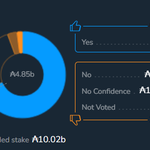
Support has improved to 43.35% Yes from DReps and 15.53% Yes from SPOs, but the action still needs 67% Yes from DReps and 51% Yes from SPOs to pass.
Reaching one threshold alone isn't enough. The action needs to clear both.
So what happens if it doesn't?
When the current members' terms expire, the Constitutional Committee will fall below its required minimum size. At that point, most Cardano governance actions will no longer be able to pass because the required Constitutional Committee approval cannot be obtained.
There is no constitutional workaround that allows governance to simply continue without a functioning committee. Voting is required to restore it.
That means another governance action would be needed to elect or appoint enough members to bring the committee back above the minimum size, and that process itself requires the necessary votes and approvals.
So this isn't just about ratifying an election result. It's about keeping Cardano's governance machinery operational.
DReps and SPOs, please vote before September 1st.
gov.tools/governance_actions…
Thank you for what you guys are doing for my country in a time of need.

Community effort in action.
@WorldMobilers , @ChristianRees and community volunteers have installed the first AirNode at the main relief centre in Darién, Colombia.
The team is working to bring free WiFi online so people can contact family and friends.
Jose De Gamboa retweeted
DReps and SPOs: 7 days remaining ⏳
Cardano governance is driven by DReps, Stake Pool Operators, and Constitutional Committee, with different actions requiring different voters.
Two actions expiring September 1 require separate approval from both DReps and SPOs:
🔹 Update Constitutional Committee 2026
🔹 minPoolCost and Plutus memory limits update
For these actions, DRep >67% and an SPO threshold >51% is required - documentation available to support SPO voting can be found 👇️
developers.cardano.org/docs/…
Jose De Gamboa retweeted
The governance action to update the Constitutional Committee expires in 8 days.
With only 11% Yes from SPOs and 41% from DReps, there is a real risk it won’t pass.
The striking part is that those who have voted are overwhelmingly in favor. So what’s holding participation back? Timing? Governance fatigue? Technical issues?
This isn’t a treasury withdrawal where ratification primarily benefits the submitter. It’s a necessary step to keep almost all of Cardano governance functioning.
I’m not telling anyone how to vote. But if you don’t want to see Dijkstra potentially delayed, Ikigai face another failed ratification and more, please participate.
This is a responsibility we all share.