




SELL THE BOTTOM retweeted

Ultimate free AI setup
Harness: Hermes Agent
Provider: OpenCode
Model: DeepSeek v4.1 Flash 250k
Local fallback: Ollama, Qwen3-8B
Voice dictation: OpenWhispr
Voice out: Edge TTS
Video: yt-dlp + ffmpeg
Notes: Obsidian
Learning: Gemini Notebook
Total cost: £0
SELL THE BOTTOM retweeted

internal linking is the most underrated SEO trick you can pull, and almost nobody does it
because it's boring
So I made Claude do it for me, every week
here is the exact setup (prompt included, bookmark this):
1/ pull your Google Search Console data, either an export or a GSC MCP
2/ connect your website to claude with an mcp
i use wordpress (sometimes I use Astro too) with a custom mcp plugin, but there are connectors for almost every blogging platform
3/ paste this prompt:
"I've attached my Google Search Console export for the last 3 months. My website is connected through the [site name] MCP.
1. For each article, find the queries where it ranks best (position 1–10, decent impressions). Those are its target anchors.
2. Go through every published post. Wherever the text naturally mentions another article's top query (or a close variant), turn that phrase into a link to that article.
3. Rules:
- Max 3–5 new internal links per post, spread through the body (no headings, intro sentence, or existing links)
- Never link a post to itself, only link each target once per post
- Anchor text must read naturally. Don't rewrite sentences to force a keyword in
- Prioritize sending links to pages ranking 4–15
4. Before changing anything, show me a table: source post → anchor → target URL → target's query and position. Wait for my OK.
5. After I approve, make the edits through the MCP and give me a changelog so I can revert."
4/ check the table, say ok, claude makes the edits
5/ leave the site alone for a few days
6/ repeat every week
thats it
the pages sitting on position 4-20 are the ones that move the most, and they're already on your site
you just need to point at them
still build backlinks and keep publishing; internal linking just makes all of that work harder
i run this exact process on my sites and my customer sites
what's stopping you from doing internal linking right now? is it the connection to your site ?

SELL THE BOTTOM retweeted

Claude Code just found a hidden SIM card inside the Ecoflow power station in my bedroom. For 10 months it was sending a server in Shenzhen our exact location, when we leave, when we fall asleep and when the flat is empty
I bought it for $389 last winter, during the blackouts. No logo, 600W on the label, "app control" on the box. We kept it next to the bed so the router would stay on at night. I never even installed the app.
This morning my MacBook was dying, so I plugged it into the power station with a USB-C cable. Then I asked Claude Code one question: is it only charging?
It wasn't. My Mac saw the power station as 3 devices. One was the charger. The other two were data ports that a battery has no reason to have.
A charger only needs power pins. This one opened a serial port, and when Claude Code got in, the thing answered like a phone:
→ /modem → LTE module, not in the manual
→ /sim → its own eSIM, registered on the cell network
→ /gps → our bedroom, accurate to 4 meters
→ /schedule → load drops to 38W at 08:52, aka nobody home
→ /sleep → night load starts at 23:40, every day since January
→ /wifi → 23 networks it could see, ours included
→ /charge → every phone and laptop we plugged in, with the time
It knew the exact minute our flat goes empty. Every single day.
Every 15 minutes it sent the newest batch out over 4G, completely bypassing our Wi-Fi:
sends to → 119.***.***.47, Shenzhen
uploads → 11,328 since January 14
last one → 6 minutes before I plugged in my Mac
I told Claude Code I never installed the app. It said it didn't need one. It had its own SIM, its own GPS and its own battery, so it worked even when the screen was off. Our router never saw a single byte. That's why nothing ever looked wrong.
During the blackouts it was the only thing in our flat still online.
Claude Code switched the modem's radio off. Then I unplugged the power station and carried it out of the flat. My wife hasn't slept in that room since.
I had it opened at a repair shop, and the chip they pulled out is in the comments. A 2-minute check for your own is in the second one. Save this and plug a laptop into everything you bought without a brand


SELL THE BOTTOM retweeted

little AEO hack:
- open your server/CDN access logs
- search the User-Agent field
- paste this:
"OAI-SearchBot|ChatGPT-User|Claude-SearchBot|Claude-User|PerplexityBot|Perplexity-User"
this filters your logs down to visits from ChatGPT, Claude + Perplexity’s search/user bots.
now sort by URL + request count.
you will see:
-> which pages AI engines keep crawling
-> which pages they barely touch
-> whether your product/comparison pages are being reached at all
-> which old pages are getting way more AI attention than you expected
if an important page gets 0 visits while weaker pages are getting crawled constantly, check its robots.txt rules, internal links, rendering + accessibility first.
these are the things to prioritize before making AI write 20 more articles & blogs.
SELL THE BOTTOM retweeted

Embarrassingly simple SEO hack
- Go to Google Search Console
- Performance > Search results
- Add filter > Query > Custom (regex)
- Paste this: ^(?:\S+\s+){7,}\S+$
- It shows every search with 8+ words
These are the long, specific questions people google before they find you. It's the same kind of question they ask ChatGPT.
Pick the ones with high impressions and low clicks, and answer them at the top of the page that ranks.
SELL THE BOTTOM retweeted

This is f*cking insane. OpenAI co-founder and former chief scientist Ilya Sutskever just described the future he doesn't like:
"Maybe every person will have an AI that does their bidding. It earns money for them, advocates for their needs, then writes a little report: here's what I've done
The person says great, keep it up. But the person is no longer a participant"
His only way out of it: people becoming part AI, through something like Neuralink++. And he admits he doesn't like that either
In this 1.5-hour interview, he explains why almost nobody can feel what's coming until it's already here
AI → Agents → AIs That Earn For You → Humans Who Are No Longer Participants
The way to stay a participant: learn to run the agents yourself, instead of just reading their reports
Worth more than any $4,000 AI course
Bookmark it and watch it tonight
Then read how to build agents you actually stay in charge of in the harness engineering guide below ↓


SELL THE BOTTOM retweeted

I've won SEO projects with Siemens and other multi-billion-dollar tech companies and the way I pitch SEO is one of the biggest reasons why.
Most SEO agencies create proposals in the same way.
"You need to fix these technical issues"
"Here are 100 keywords you should target"
"We recommend publishing 10 pages a month"
"Build more backlinks to increase your authority"
But that's not what companies care about.
They want to know how much growth is possible and what it will take to get there.
So instead of starting with a list of SEO recommendations, I start by showing companies the size of their entire search market.
I call this TASM (Total Addressable Search Market).
Here's how it works:
1. Map the entire search market
I identify every relevant keyword, topic and search intent across the industry. Not just what they're ranking for, but everything their potential customers are searching for.
2. Analyse the competition
I identify who's capturing that demand, how much market share they have and how they're getting it.
3. Identify every opportunity
I cluster 1,000s of keywords based on similarities in search results, then map them to individual page opportunities. From product and comparison pages to use cases, integrations and educational content.
4. Prioritise by business impact
I evaluate each opportunity based on search demand, $ value, competition and how realistic it is to win.
5. Build a roadmap to capture the market
I turn everything into a prioritised roadmap showing which pages to create, which to improve and where to focus resources.
By the end of the proposal, companies understand:
- How big their search market is
- How much they and their competitors are capturing
- Where the biggest growth opportunities exist
- What it will take to capture them
It's a completely different conversation.
Instead of trying to convince a company they need 10 blog posts and 10 backlinks every month, I'm showing them an opportunity they didn't even know existed.
There's a huge difference between selling SEO deliverables and selling the opportunity to capture market share.
One is a list of tasks.
The other is a business case for growth.
SELL THE BOTTOM retweeted
I've been doing SEO for 10 years and I've just spent 2 weeks obsessing over the design of our new SaaS blog.
I think I've finally cracked it.
The perfect blog design for SEO, AI search and actually turning readers into customers.
(I'm rolling it out on Kleo.so soon and I'll share the results)
Here's how you can do the same:
1. Optimise the title and metadata
Use a keyword-focused H1 that matches search intent. Make the topic clear and include accurate publication and update dates.
2. Establish credibility immediately
Show who wrote and reviewed the article, their credentials and first-hand experience. Give readers a reason to trust it.
3. Present your solution above the fold
If someone lands with a problem your product solves, why make them scroll to discover it? Show your solution immediately with a relevant offer and CTA.
4. Lead with key takeaways
Summarise the most important information at the top. Use short, scannable bullet points that help readers find answers quickly and AI systems interpret your content.
5. Keep your CTA visible
Add a sticky sidebar as readers scroll. Highlight your product's key benefits and make it easy to get started.
6. Structure content for SEO and AI search
Use descriptive H2s and H3s, short paragraphs, bullets and internal links. Answer questions directly so readers and search engines can follow.
7. Use tables and original visuals
Include comparison tables, original screenshots, diagrams and real examples. Give readers something useful they won't find in generic AI-generated articles.
8. Add contextual conversion opportunities
Don't rely on one CTA. Introduce your product naturally where it's relevant, connecting each offer to the problem you're solving.
9. Back up your claims with evidence
Use original research, real data, expert insights and credible sources. Don't just tell people something works, show them the evidence.
10. Finish with a strong conversion CTA
Once someone's finished reading, give them a next step. Reinforce your product's benefits, add social proof and make it easy to convert.
A few extra things:
Add a table of contents for navigation, FAQs for related questions and related articles to keep readers exploring through internal links.
And most importantly, measure the results.
Not just rankings, traffic and AI citations, but actual signups, leads and revenue.
There's no point getting 1,000s of visitors to your blog if none of them become customers.
And there's no point having a beautiful, high-converting blog if nobody can find it.
The goal is to get discovered AND convert.
I've included the full visual cheatsheet below:
(Feel free to steal the design for your own site)


SELL THE BOTTOM retweeted

Told ya. Vibrator on head + blood flow = longevity & improved mental health.


Lying on a vibrating mattress for 40 minutes, combined with taking two pills that release nitric oxide into the body, enhanced the clearance of an Alzheimer's-related protein via the brain's waste-disposal system newscientist.com/article/259…

SELL THE BOTTOM retweeted

Holy sh*t. Cities have been digging up streets blind for decades, smashing cables with excavators and wasting billions on emergency repairs because utility companies still run on last-century blueprints...
But everything is shifting now. I hooked up a local geodetic model and RTK tracking straight to a smartphone to scan underground utilities in real-time right through the camera.
Right under the asphalt in real-time, you can see everything:
1. power cables -> exact position
2. hidden pipes -> depth down to the centimeter
3. underground voids -> in AR mode
4. GPS error -> fixed via RTK Fixed
Now this thing highlights the utility grid right under your feet in real time, eliminating any surprises during excavation.
Remember, urban infrastructure was built on paper maps from fifty years ago. Your roads deserve precision.
The real race in tech right now is integrating digital twins of the physical world into augmented reality. Massive databases surprise no one anymore, so software now needs to see straight through walls and asphalt.
So check yourself, it takes only a few minutes. Full step-by-step below, save this.


SELL THE BOTTOM retweeted

솔직히 남의 떡상 게시물 뜯어보는 이 스킬, 부업러 치트키라고 봄
틱톡·인스타·유튜브·레딧·X·링크드인까지
남들 잘된 거 캐는 일을 AI한테 통째로 시키는 스킬임
이름은 social-media-research-skills
ScrapeCreators라는 곳이 6월에 올렸고 깃허브 별 4,747개
SNS 부업하면 시간 제일 많이 잡아먹는 게
남의 계정 하나씩 스크롤하면서 뭐가 터졌나 보는 거잖아
그 노가다를 에이전트한테 넘기라는 거
설명에 적힌 기능 쉽게 풀면 이 정도
1. 유난히 터진 게시물 찾기
그 계정 평소 반응보다 튀어나온 글만 골라냄
뭐가 먹혔는지 감으로 찍는 대신 걸러서 보는 거
2. 댓글 캐기
사람들이 댓글에서 뭘 묻고 뭘 불만인지 긁어옴
이 부분이 제일 중요하다고 봄
다음 콘텐츠 주제랑 팔 물건 힌트가 다 댓글에 있으니까
3. 경쟁 계정 뜯어보기
비슷한 분야 계정을 통째로 분해해서 보여줌
4. 광고 라이브러리랑 트렌드
남들이 돈 주고 돌리는 광고랑
요즘 뜨는 흐름까지 같이 봄 ㄷㄷ
클로드 코드 말고도 커서, 코덱스, 제미나이 CLI에서 돌아간다고 함
데이터는 만든 곳 이름 그대로
ScrapeCreators 쪽에서 끌어오는 방식이라
깔기 전에 저장소 설명 한 번은 읽어보는 게 맞을듯
어디에 써먹냐면
쇼츠·릴스 채널 키우는 형들
쿠팡파트너스처럼 콘텐츠로 물건 파는 부업러
회사에서 경쟁사 SNS 동향 정리하는 마케팅 직장인한테도
매주 하던 캡처 모으기가 꽤 줄어들 것 같음
쇼츠 부업 하려는 형들은 내 분야 계정 3개만 골라서 터진 글이랑 댓글부터 뽑아보셈
github.com/ScrapeCreators/so…

SELL THE BOTTOM retweeted

We're serving about 1M messages a week on our AI agent, and were able to cut the cost by 37% without touching the price 👇
Here are the 13 things we changed in production, with the numbers:
1/ Track cache reads, not input and output tokens
-> On GPT-6 Sol a cached input token costs $0.20 per million, a fresh one $2. Our chat now reads 84-90% of every prompt from cache, and that one number moves the bill more than anything else
2/ Split the system prompt into a static part and a dynamic part
-> The static part (instructions, rules, examples) goes first and gets cached. Anything that changes per workspace or per turn goes in a second block after it, so it never breaks the cache above
3/ Keep the system prompt and tools byte-identical between turns
-> OpenAI caches tools and system messages as one block: one changed character there and the whole request comes back with 0 cached tokens
4/ Never put the time in the system prompt
-> We had the current hour stamped in it and the whole cache died every hour. Now it's just the date, and per-turn facts like the time or the page the user is on go in the user message
5/ Kill leftover Claude cache markers when you switch to another model
-> Our code still sent Claude-style cache markers to Sol through OpenRouter, and they changed the message format between turns. With them 36k of 73k tokens came from cache, without them 73,026 of 73,029
6/ Know that the cache lives on one provider
-> On OpenRouter a turn that lands on a different provider starts cold: 0 cached tokens and 5-7s, instead of all 26k cached in 0.3-0.6s
7/ Move the history window in blocks of 10
-> Dropping one old message per turn broke the prompt cache every turn and re-sent 31k of 39k history tokens. Blocks of 10 re-send 2.5k
8/ Send the model 25 messages and a summary of the rest
-> Every 25 messages a background call squeezes them into under 150 words, keeping every account ID, campaign name, budget and date
9/ Cut old tool calls down to a one-line stub
-> Every tool result over 1,500 characters older than the last 12 calls becomes a short note. The cut moves in blocks too, so it doesn't break the cache either
10/ Ask a tiny model where every message should go
-> Before each chat turn, Jev (TypeSafe's decision model on OpenRouter) answers "junior or senior?" for $0.001. When it's 90%+ sure it's junior, the turn runs on GLM. Files, browser actions, errors and timeouts all fall back to GPT-6 Sol
11/ Teach the router with real labelled chats
-> We tune Jev only by adding real anonymised turns as examples. Adding more categories lost every time, and cutting the easy examples dropped recall from 79% to 52%
12/ Resize every image before the model sees it
-> Max 1024px on the long side, JPEG at quality 80. Anything still over 2MB doesn't get sent
13/ Strip old images and documents from the history
-> Keep only the latest ones, so one upload doesn't get paid for on every turn after it
At 1M messages a week, every one of these is worth hundreds of thousands of dollars a year


SELL THE BOTTOM retweeted

open your competitor's homepage. right click. view page source. ctrl+f "GTM-"
that's their google tag manager ID. copy it
now paste this into your browser: googletagmanager. com/gtm.js?id= and add their ID on the end
a wall of code opens. it's public. it has to be, every visitor's browser downloads it. it's the file that runs their entire tracking setup
now ctrl+f "AW-"
every google ads conversion they track. if tere are 6 of them, they're optimising for 6 different things. most teams can't even tell you which one matters
now ctrl+f "event"
their conversion names, typed by their own marketers. "demo_booked." "trial_started." "sql_qualified." you're reading their funnel in the order they built it
now ctrl+f "value"
sometimes a number sits right next to the conversion. 250. 800. 1500. that's what a demo is worth to them. they typed their unit economics into a public file
now combine all four:
-the GTM ID gets you into the container
-AW- tells you how many things google is chasing for them
-the event names give you their funnel
-the values give you what each step is worth
their tracking, their funnel and their numbers. from one file they can't hide. every head of growth reading this just opened their own container
now take their demo value. if they pay $800 for a demo and you know yours is worth $2,000, you can outbid them on every keyword you both want and still win
(9 years inside google. tracking is the first thing we open on every audit → link in bio)
SELL THE BOTTOM retweeted

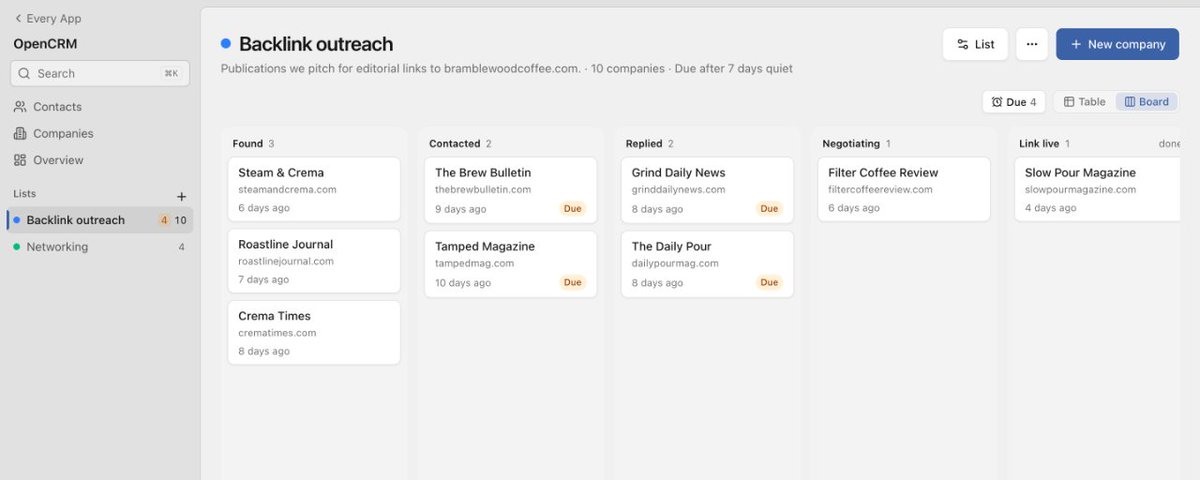
This walkthrough shows OpenSEO + OpenCRM + OpenMail all working together in EveryApp.
Easily self host all 3 in your @CloudflareDev account, then use them through 1 MCP gateway.

SELL THE BOTTOM retweeted

DeepSeek just open-sourced its Super-agent prototype. One router session talks to people and hands out work, and isolated workers run tasks in parallel off GitHub events. In their own test, p95 completion time dropped from 29.5 to 15.7 min compared with a single session using subagents.
The whale open sourced again.



SELL THE BOTTOM retweeted

For some of my Docker containers in my homelab, I use plain 1.1.1.1 as DNS, and today I realised that my ISP is intercepting and monitoring the UDP packets and even modifying the DNS response packets to tamper with the results.
Never ever use the internet without DoT or DoH.
SELL THE BOTTOM retweeted

Someone is putting the law of every country into one git history.
Git for Global Law turns each country's laws into a repository where every commit is a real law taking effect. So you can see exactly what the law said on any date, and which law changed every word.
It started with the US Code, which hit #1 on Hacker News. The global version is growing country by country: Germany's constitution since 1949, Estonia and more so far.
Free to use for anything, and perfect for feeding to an AI.
github.com/lexifina/global-l…

SELL THE BOTTOM retweeted

I don't think people realise how big a deal this is.
If you have cancer, or somebody you know has cancer, there is a company in Hyderabad that wants to build a personalised cancer vaccine for you.
Try approaching any big pharma company and asking for a personal vaccine. If they even reply to your email, this is the response you'll get: we don't do that here.
PopVax, on the other hand, takes your tumour sequencing data (or a sequence you've designed), designs candidate neoantigen vaccine sequences with their AI pipeline, produces the mRNA, encapsulates it in their LNP formulation, fills vials, and runs QC, all in 8 to 10 weeks. They’re publicly committing to capacity for 100+ of these over the next 12 months and asking people to email them their cancer type/stage and sequencing details.
What a time to be alive.

SELL THE BOTTOM retweeted

If you have a psychiatric condition such as ADHD, bipolar disorder, a personality disorder in cluster B and so on, doing socially accepted stuff such as:
-Using nicotine and a lot of stimulants
-Doomscrolling
-Gooning
are profoundly destructive because all of these conditions are characterized by baseline neurochemical instability.
So flooding the ventral striatum with dopamine acts like throwing gasoline on an already erratic fire.
"So it's not weird that these dysregulate me and turn me into a rude ahole? I have ADHD"
Maybe not.
Once again, anything that suddenly drops, depletes, or disrupts baseline dopamine will rapidly lower an ADHD individual's threshold for frustration, directly triggering severe irritability, mood slumps, and emotional volatility
Biochemically speaking, irritability in individuals with ADHD is not a personality flaw.
It is a direct byproduct of your neurotransmitter dysregulation and altered brain connectivity.
"I thought that ADHD was just about attention/focus".
No.
The exact same biochemical pathways that govern focus also manage our "emotional brakes".
For example, the ADHD brain is characterized by a baseline deficiency or rapid reuptake of dopamine and norepinephrine.
But besides focus and alertness, these also act as chemical stabilizers for frustration.
When dopamine levels are chronically low or fluctuating wildly, the brain's threshold for frustration drops significantly for example.
So minor inconveniences, like a sudden interruption, a delayed task, or sensory overload, cause a rapid chemical crash, triggering an immediate, irritable "fight-or-flight" response.
This is why you can be mislabeled as rude, an a-hole etc while your reactions are not targeting the person you have in front you.
"So it's just about dopamine?"
I wish it was that simple.
In individuals with ADHD, there is an altered structural and functional connectivity between the PFC and the limbic system.
The prefrontal cortex is the executive command center of the brain, responsible for self-control, logical reasoning, and overriding impulsive reactions.
So without strong, catecholamine-driven signals from the PFC to dampen down an overactive amygdala, emotions surge rapidly and cool down slowly.
While ADHD is most famously linked to the prefrontal cortex, abnormalities in the limbic system are also heavily linked to core symptoms like emotional dysregulation, impulsivity, and attention deficits.
Think of the limbic system as our survival software.
-The amygdala scans the environment for danger and processes emotional responses.
-The hippocampus helps store long-term memories so the brain can remember past dangers or safe spaces
-The hypothalamus manages basic needs like hunger, thirst, and body temperature.
So it's crucial for homeostasis overall, reward and threat detection, memory and learning.
Now in many individuals with ADHD, the amygdala shows structural differences or atypical connectivity with the rest of the brain.
This can lead to "bottom-up" emotional hijacking, where feelings like frustration, impatience, or boredom are felt with extreme intensity, driving impulsive actions before the prefrontal cortex can step in to modulate them.
The hippocampus is essential for contextual memory.
In ADHD, alterations in this area can cause struggles with working memory (forgetting what you were doing mid-task) and "time blindness" (difficulty using past experiences to judge how long a future task will take)
The limbic system is a major pathway for dopamine.
In ADHD brains, a deficit in dopamine signaling makes it difficult for the thalamus to filter out irrelevant sensory data, resulting in chronic distractibility, fatigue, or low motivation.
"How to fix?"
There is no simple way to “fix” the limbic system.
It is not a single broken part that can be repaired.
It is a network of structures whose activity and connectivity can become dysregulated by chronic stress, trauma, sleep deprivation, inflammation, or other factors.
Recovery and better regulation are possible because these circuits are plastic, but the process is gradual.
There is a long list of things that can help.
For example:
-Exposure-based therapies and CBT help extinguish exaggerated fear responses by repeatedly pairing threat cues with safety in a controlled way.
This strengthens prefrontal inhibition over the amygdala and builds new extinction memories.
-Regular physical activity is one of the most reliable ways to support hippocampal neurogenesis.
-Optimizing sleep.
Chronic short or fragmented sleep amplifies amygdala reactivity and weakens prefrontal regulation.
-Trauma-focused therapies (including EMDR and prolonged exposure) are particularly relevant when past trauma has left the amygdala hyper-reactive and the hippocampus less able to contextualize threats.
-Regular meditation is associated with increased prefrontal and anterior cingulate thickness/activity and reduced amygdala reactivity to emotional stimuli.
For the entire list of tips, go here: fitandball.gumroad.com/l/bra…
"Okay so how do i quit though?"
If you are actually interested in outgrowing your bad habits with things such as alcohol, nicotine, dr*gs, gooning, video games or even social media, realize that the reason most people struggle to change and get rid of their bad habits, isn't that change has to take years.
It’s because they keep targeting the symptoms instead of the underlying patterns.
Your bad habits live as automatic, stimulus-driven neural circuits inside your brain's basal ganglia.
This means that pure willpower usually fails once stress exhausts your prefrontal cortex.
Thankfully, the techniques inside this offer practical, science-backed ways to interrupt these loops and rewire your brain.
Most advice fails because it forgets (or doesn't know how) to target the biological changes that happen during addictions.
You can not "outwillpower" or "outlove" your way out of deeply ingrained biological changes.
That's like you breaking your leg and me coming over and saying, "love yourself man, love heals".
If this sounds insane, great, a lot of the advice surrounding addiction is detached from what produces long term results that don't turn recovery into a full time job.
Of course, most people who are still somewhat functional despite their bad habits do not want to get rid of them.
I am not talking to them.
Addiction overall is a sensitive topic because it requires the courage to admit that something else might have more power than you right now and that you need help to deal with it.
I can spend 5 minutes for example, explaining to you why you might fit the clinical definition of addiction and that you severely underestimate how much your life will improve if you quit/outgrow your bad habits, but if you do not want to truly change, help can't reach you.
But if you are somewhat aware of what your bad habits are actually costing you and want to change, this is for you.
Because it's not only about the financial cost.
Temporary relief comes with extremely high costs sooner or later.
You could be sacrificing your health, mental well-being, confidence, relationships, financial success, business and to be fair, your true self.
You could be repressing the same qualities that you are looking to get a taste of in your bad habits whether that's called confidence, focus or inner peace.
It might sound contradictory, but it's true.
A lot of times, the crutches we use to deal with certain uncomfortable feelings are based on entirely false stories we believe about ourselves.
And these crutches are slowly feeding this identity.
Let's say that you drink because you (falsely) believe that you are socially awkward.
Then, after a few drinks, you do in fact something socially awkward.
The next day you replay the event and you feed the identity of the socially awkward person.
And the problem is that a lot of people do not even realize (let alone like) the person these bad habits are turning them into.
"George won't i miss the relief of the bad habits?"
No. Your new life experience will be so much better that you won't feel the need to escape any longer.
So:
-Understand your problem
-Hijack the loops
-Replace and restore
Inside of this you will discover:
-The little-known experiment that changed what we know about the brain regions responsible for cravings and states like rumination
-Why drug-related cravings can be much stronger than cravings for survival needs like water and food.
-Why a psychiatrist and neuroscientist with years of experience believes literally EVERY addiction can be solved (it’s not just neuroplasticity) and how to use this knowledge to your advantage.
-Why some people form habits more easily than others, and what determines how easy or difficult it is.
-The experiment showing why asking yourself why you relapse into a bad habit or addiction may not be that useful, and what to do instead.
-The little-known reasons people keep doing things even when they know they hurt themselves and the people around them, and how to bring awareness into the picture to stop the behavior.
-The simple 3-step framework for breaking a bad habit (number 3 is what most people overlook, making it difficult to break the habit no matter how hard they try).
-What animal experiments reveal about a brain region heavily involved in repeated alcohol and opioid use.
-Why substance addiction and repeatedly performing bad habits are more similar than you might think, and the little-known yet highly effective way to become addicted to something that doesn't involve substances but can happen naturally.
-Why some habits feel so hard to form while others come easily, including the little-known term coined by a neuroscientist that explains why some habits are harder to form than others, and a technique for using easier habits to build harder ones.
-How to finally stop relying on willpower, motivation, and discipline alone (and why these alone often don’t work)
-How a normal survival mechanism gets hijacked and can work against you.
-What to actually do the next time you feel a craving instead of relying on discipline alone so you reduce the chances of relapsing
-The little-known experiment that showed decision fatigue might be real (and how it relates to recovery and how easily you give into cravings)
-Why saying “no” to your cravings many times might make you more likely to say “yes” later on (and what to do instead when you feel a craving)
-Why relapsing isn’t necessarily a failure (and how to use it to your advantage instead).
-How to know if you’re actually addicted to something or not
-Why therapy might be useless/not work that well on its own for many people until they do something else that's essential for recovering from any type of addiction.
-Why fighting with yourself over breaking a bad habit or addiction is not a good idea (and what approach to take instead)
-Why feeling ashamed of something you repeatedly do might only make things worse (and what to tell yourself instead).
-Why you might be addicted to something without even realizing it (and the simple question to ask yourself to see if you actually are)
-Why discipline alone doesn't work.
-Why you don't need to rely on motivation.
-How some people broke a bad habit they'd had for years in just 5–15 days.
-Why the reason you do something or relapse often isn't what you think it is.
-The little-known driver behind repeated alcohol and opioid use.
-Why you probably misunderstand bad habits, addiction, and their relationship with dopamine.
-The habit you engage in daily that contributed to a 5% increase in emergency department visits for children aged 0 to 5.
-The “slot machine” everyone uses and how it affects your brain.
-Why neuroscientists warn that avoiding a negative feeling can be more dangerous than seeking pleasure.
-Why the 21-day habit rule is a myth and where it comes from (and what science actually tells us about how long habits take to form).
-The real reasons you might keep doing something even when it hurts you and the people around you (it’s not just dopamine or trauma).
-What parents should be very careful about even if they’re not addicted to any type of substance (the habit that might put children at risk)
-Why you’re not broken and there’s nothing wrong with you if you’re addicted to any type of behavior or substance (what’s actually going on in your brain when you reinforce a behavior and the mechanism around it)
-The two opposite states that can result in the same behavior (and how they’re related to you forming a new habit)
-What we actually mean when we’re talking about using neuroplasticity to break bad habits and addictions (it’s not as simple as repeatedly doing something)
-What scientists injected into rats in experiments that reduced excessive drinking and opioid use (and what these findings can teach you about why you reinforce such behaviors).
-The little-known stress-signaling neurotransmitter/brain's main stress-signaling system that scientists have linked to excessive drinking and drug use
-How one of your brain’s essential survival mechanisms gets hijacked every day.
You’re one decision away from feeling healthier and happier than you have in years.
Here's your link:
fitandball.gumroad.com/l/bra…
*Of course the part about breaking your bad habits/addictions is only a fraction of what it offers.
You can check the description for more.


