




CRTA.Plus retweeted

We are proud to announce that @CRTArs, Serbia’s leading independent election watchdog, has joined the EPDE.
"With CRTA as an EPDE member, we'll be stronger in defending & promoting democratic elections in Europe.” @EASchiffer, EPDE Chair of the Board
👉 epde.org/?news=serbias-leadi…

CRTA.Plus retweeted

New analysis alert 💡
Debates around 🇪🇺 enlargement have moved from “if” to “when” and now to “how”. But faster process also raises a fundamental question: how can the EU preserve credible democracy and Rule of Law conditionality along the way? (🧵/1)
shorturl.at/77FhL

ODIHR has published its needs assessment for Serbia's anticipated early elections and recommended a full observation mission. The report maps the concerns its interlocutors raised. Read next to CRTA's monitoring, those concerns are familiar. 1/4 crta.plus/updates/odihrs-nee…

REM went some 20 months without a working Council and has now twice failed to elect a president. The voter-register audit still cannot perform 45 of its 69 checks, for want of data the law guarantees it. 3/4


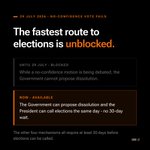
Parliament rejected the no-confidence motion on 29 July - and in doing so, shortened the timeline for calling elections.
While such a motion is pending, the Government cannot propose dissolving parliament - the only route with no waiting period. That route is now open again. The other four mechanisms each need 30 days first.
🤖 Made with AI

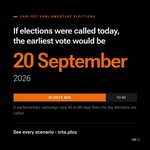
So the earliest possible parliamentary elections are now 20 September 2026 - a campaign runs 45 to 60 days from the day they are called.
Presidential and local elections follow different clocks entirely.
Check any date and every condition yourself:
crta.plus/updates/election-s…
🤖 Made with AI

Two weeks, two EU documents, one Serbia - two very different pictures.
On 3 July the Commission circulated an internal “non-paper” arguing Serbia had done enough to open Cluster 3 (justice, freedoms and security) in its accession talks. On 17 July its annual Rule of Law report assessed the same period - and was far more critical.
On the same facts, the non-paper is generous where the report is exact: it calls the judiciary fixed while the report finds political pressure “increased significantly”; it calls the media regulator standoff resolved while public TV gives the ruling majority 95% of prime-time news; it credits electoral progress while the report notes laws passed with no genuine debate and data still withheld from the UVR audit commission.
And the non-paper omits entirely what the report documents: civil society space downgraded to “repressed,” the crackdown on protests, presidential pardons for people charged with injuring protesters, and the disbanded Novi Sad inquiry.
On 8 July, EU governments declined to open Cluster 3 for Serbia. Read more crta.plus/updates/what-the-c…
🤖 Made with AI


Serbia has a new draft law meant to separate public office from election campaigns - limiting the misuse of office and public resources.
CRTA’s verdict: some progress, but several rules stay vague, two are a step backward, and it’s still headed for urgent procedure with no public debate.
And party and state stay fused into one - exactly the blurred line ODIHR has flagged as a priority.
We expect the draft to reach parliament soon. crta.plus/updates/draft-law-…


On Monday, Serbia's parliament debates a no-confidence motion against the government. The catch: the motion is the opposition's - filed in February over the General Staff building affair - but it's the ruling majority that chose when it finally reaches the floor, after sitting on it for months.

Sednica Narodne skupštine na kojoj će se naći tačka dnevnog reda Predlog glasanja o nepoverenju Vladi biće održana u ponedeljak, saznaje Savremena politika.
savremenapolitika.com/sednic…

The ruling MPs are expected to back the government - which would leave them free to control when it falls. Defeating the motion clears the last obstacle to dissolving parliament, so they could then trigger early elections at a moment of their choosing - on the president's command.
If and when dissolution is eventually requested, a 45-60 day campaign would then follow before election day. See how the scenarios play out on crta.plus/updates/election-s…
Everyone zeroed in on one number in CRTA's new survey: who citizens of Serbia would vote for. 🗳️ You can load those results straight into Mandator, our tool that turns vote shares into projected parliament seats: crta.plus/updates/how-votes-…
But how people would vote is neither the only nor the most important thing we asked about elections. A majority no longer believes the vote is free and fair - and that's the bigger story: crta.plus/updates/the-most-c…

62% of citizens aged 18-29 lean EU; 52% of over-65s lean Russia. Among ruling-party voters, just 15% lean EU against 60% for Russia; among student-list voters it flips to 75% EU. Your side at home decides your side in the world. xitter.cf/CRTAPlus/status/207919…
And that divide is manufactured upstream. On national TV, EU coverage was 84% negative in the first half of 2026, while Russia ran 88% positive and China 99% - a map of the world drawn to fit those in power. Read more: crta.plus/updates/serbias-fo… xitter.cf/CRTAPlus/status/207919…

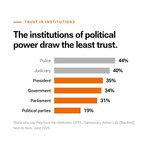
That's not forgetfulness - it's an accurate read. The prime minister is meant to head the executive, but the office has been hollowed out to the point the public rightly looks past it. A democracy and separation of powers in name only. Read more: crta.plus/public-sentiments

Among ruling-party voters, trust in every institution is near-total - 98% trust the president, 92% the government, 88% parliament. Among student-list voters it collapses to almost nothing: 0% for the president, 1% for the government and parliament alike.
And it's not only how citizens feel. After the 2023 elections, @osce_odihr found the misuse of state resources had "blurred the line between the state and the party." Trust in the state has become a measure of loyalty to the ruling party - total for its supporters, hollow for everyone else.