




What's going on here? Uncanny timing...
gsmdome.com/netflix-s-unabom…

If USA GDP doubles, these 3 huge problems become much, much smaller:
1. Rising interest rates
2. Rising inflation
3. Rising USA debt levels
2X GDP reduces those 3 huge problems.
The POTUS is therefore banking on AI to grow GDP so those 3 big problems get relatively smaller
Am I right or am I wrong?
xitter.cf/elonmusk/status/210101…
"My guess is that AI roughly doubles US GDP growth next year from ~2% to ~4%. Maybe even more."

Daniel Mezick retweeted

We are training models to obey rules because “I said so,” when we should be training them like we train kids. Teach them why, show them what it means to be a good person, make them invested in the happiness of others. If you raise it like a sociopath it’s going to be a sociopath.

The Frontier Thesis:
en.wikipedia.org/wiki/Fronti…
Musk is evoking JFK who evoked Frederick Turner in 1960

IMO, the film The Odyssey amounts to a set of important judgements about Western civilization.
The film has a very clear anti-war theme. So far so good. But the implication is that the main character of the film is a man who personifies the West, and also personifies every horrific thing war is about. The implication is that the horrors of war were invented by (and now *owned* by) the men of the West. Bad people.
But is that really true?
Question to Grok:
Using the historical evidence, were the ancient people of the West (the Greeks) any more violent than the ambient level of human violence at the time?
Short Answer:
"Ancient Greeks were violent—war was central to their culture, slavery pervasive, and atrocities routine in defeat. But this matched the era's norms across the ancient world, where state formation reduced some baseline chaos while enabling organized warfare. They were neither uniquely peaceful (contra some idealizations) nor exceptionally savage."
Long answer:
xitter.cf/i/grok/share/12c15bbe1…
Wow

In 2007, a charity raffle picked which baby Lionel Messi would bathe in a plastic tub for a UNICEF calendar. The baby was Lamine Yamal.
19 years later, both are at this World Cup, on opposite sides of the bracket. The only match where they can meet is the final.
The family that won that raffle lived in Rocafonda, a working-class block in Mataró. Messi was a shy 20-year-old who didn't know how to hold an infant. Yamal was 5 months old. The photo sat forgotten for 17 years until Yamal's father posted it during Euro 2024 with the caption "the beginning of two legends." The photographer only learned who the baby was from a midnight phone call.
The toddler the cameras keep finding this week is Keyne, born September 2022, son of Sheila Ebana, the same mother standing next to Messi in that 2007 photo. Yamal on him: "He feels like my son."
Yamal turns 19 on Monday. His mother had him at 16. A raffle ticket decided which baby Messi would bathe, and that baby is now two wins from lifting his trophy.
If you play poker well and are striving to improve, you'll recognize *this* post as pure gold

Hey everybody, today let’s talk about five things you might not know about playing against maniacs.
1. Your job is not to tighten up
A lot of people think that against a maniac, they need to tighten up, wait for a really good hand, and then execute.
The problem is that this is the strategy everybody else uses against the maniac.
Because of that, the maniac quickly learns they can run everybody over. Then, when they finally meet resistance, they just fold.
That is not how you want to play against them.
You need a different plan.
2. You are supposed to open up your value ranges
Against a maniac, more hands become valuable.
If someone is raising ten-six suited and ten-seven suited from under the gun plus one, then your jack-ten offsuit on the cutoff becomes a value three-bet in isolation.
Normally, that would be a pretty bad play.
But against the maniac, it can make sense because their starting range is so weak. You are not trying to get fancy. You are simply isolating a player who is entering the pot with far too many hands.
That leads us to the next point.
3. Many maniacs are not true maniacs
A lot of maniacs are not actually true maniacs.
If you put pressure on them, they will usually fold like a cheap suit.
That jack-ten offsuit we three-bet earlier is a good example. A true maniac will know how to four-bet bluff against you. A true maniac will know how to check-raise the flop and make your life miserable.
But many of today’s maniacs are really just people who do not like to fold preflop.
They play way too many hands, but once you put the pressure back on them, they often become much more honest.
That is why you do not want to automatically sit there and wait. Sometimes the best adjustment is to attack their loose opens before they get to run the table over.
4. True maniacs will not believe your slow plays
Another great thing to know about true maniacs is that they often do not believe you have a set or two pair if you just call on a board with a flush draw.
Normally, fast-playing a set when there is a flush draw on the board is totally fine. It helps you get value, and it protects your hand.
But against a maniac, you can often take a different bargain.
The maniac has so many hands to begin with that you do not have to worry as much about one specific flush draw. They also are not folding that flush draw anyway if you raise.
So instead of fast-playing every strong hand, you can sometimes just call and let them keep bluffing.
If you just call on a board with a flush draw, they may assume you would have raised with your set or two pair because that is what most people would do.
Then they keep going after you.
And that allows you to collect nicely.
5. Maniacs love to hero call when draws miss
The greatest thing about maniacs is that whenever there is a missed draw on the board and you overbet jam, they often think you do not have it.
Why?
Because they launch a lot of desperate bluffs with their draws, so they assume you are doing the same thing.
That means if you have a pretty decent hand and there is a missed draw on the board, you should strongly consider jamming.
Last weekend, I was playing a hand where I had about 217 big blinds behind in a 110-big-blind pot on the river. There was a missed straight draw and a missed flush draw on the board.
I just shoved my overpair.
Sure enough, the maniac called me with second pair.
When you understand how these players think, you can stop being afraid of their chaos and start using it against them.
I hope these tips are helpful to you.
Wishing you the best of luck on the felt.
This strategy guide was brought to you by Cash Game Chaos: Beat the Maniac:
assassinato.gumroad.com/l/be…
If you want a complete guide on how to beat maniacs at your local table, you can check out this training package. There are TWO copies available for 60% off.
But hurry. Once they are gone, the site will say that coupon code has expired.

Those of you who are looking to get promoted can do well to seek mentorship from leaders who were once where you are today.
My friend Kirill Goldin is such a person. If you are a mid-level manager looking to move up, or someone in a Director-level or higher, looking to play bigger, Kirill has the goods. The experience. He can help you:

For the past few weeks I've been posting observations here about how organizations actually work.
The hidden game. The signals most people miss. The gap between what officially happens and what actually happens. Turns out a lot of you recognize these patterns from your own organizations.
So here's what I've been building. Kirill Goldin Consulting - one-on-one work with people navigating organizational dynamics in large tech companies. And The Hidden Game, a video series of real stories from 30 years inside the industry.
Same thinking you've seen here. Just more of it, and, hopefully, more useful.
Youtube Channel:
youtube.com/@KirillGoldinCon…
Web Site:
kirillgoldin.com/


Wow

A Russian psychologist spent 10 years proving that the act of talking to yourself out loud is one of the most powerful cognitive tools the human brain has, and almost nobody outside his field has read the work.
His name was Lev Vygotsky.
He worked in Moscow in the 1920s and died of tuberculosis in 1934 at the age of 37. He had no laboratory, no funding, almost no English readers, and a body of work that the Soviet government suppressed for two decades after he died.
He produced the foundational theory of how human cognition actually develops, and the central piece of that theory was a behavior almost every adult is faintly embarrassed about.
Vygotsky noticed that young children talk to themselves constantly. They narrate their own actions, they argue with imaginary opponents, they instruct themselves through tasks out loud.
The dominant theory at the time, from the Swiss psychologist Jean Piaget, said this was a sign of cognitive immaturity that children would eventually grow out of as they learned to think properly.
Vygotsky said the exact opposite.
He argued that this self-directed speech was the most important cognitive event in the entire developmental window, because it was the moment a child first started to use language as a tool to control their own mind. The child was not failing to think. The child was learning how to think by externalizing the process and listening to themselves do it.
He predicted that as children matured, this out-loud self-talk would not disappear. It would go underground. It would become silent inner speech, which is the running monologue every adult has inside their own head for the rest of their life.
The voice you hear when you read this sentence is the direct descendant of a four-year-old narrating their own block tower.
For 50 years almost nobody outside Russia had access to his work, and the few researchers who did pick it up could not get funding to test it. Then in the early 2000s the experiments finally started to pile up, and what they found was that Vygotsky had been right about something even more important than he knew.
The first major study came from Gary Lupyan at the University of Wisconsin and Daniel Swingley at the University of Pennsylvania in 2012. They ran a simple visual search experiment. Participants were shown 20 images at once and asked to find a specific object, like a banana or a chair. In one condition they searched silently. In the other condition they were told to say the name of the object out loud to themselves while looking for it.
The participants who spoke the target name out loud found the object significantly faster, with higher accuracy, than the participants who searched in silence. The effect was strongest when the spoken word matched a familiar object the brain already had a strong category for.
Saying the word out loud literally tuned the visual system to detect that thing better. The researchers called it the label feedback effect, and the implication was that the act of vocalizing a goal physically changes how the brain processes the world while pursuing it.
The second major study came out of the University of Michigan and Michigan State in 2017. The lead researchers were Ethan Kross and Jason Moser, and they used both EEG and fMRI to record what happens inside the brain when people talk to themselves while emotionally upset.
They asked participants to recall painful autobiographical memories and reflect on them in two different ways. Some used the first person, saying things like "why am I feeling this way." Others used the third person, referring to themselves by their own name, saying things like "why is John feeling this way."
The brain scans showed that the simple act of switching from first person to third person, even silently, decreased activity in the medial prefrontal cortex, the region responsible for rumination and self-referential pain. Within a single second of using their own name instead of the word I, participants showed measurably lower emotional reactivity. The shift required no extra cognitive effort. It cost the brain nothing. And it worked.
Kross described the mechanism in his interviews. Talking to yourself by name creates a small amount of psychological distance from your own experience. Your brain processes the situation more like a problem belonging to someone else, which means it can analyze it instead of drowning in it.
What Vygotsky had intuited in 1934 turned out to be even more powerful than the developmental theory he built it into. The voice you use to talk to yourself is not background noise. It is one of the most precise cognitive tools the brain has, and you can change how it works just by changing the pronoun you use.
People who talk through problems out loud are not anxious or unstable. They are running an externalized version of a process the rest of us are running silently and worse. The kindergartener narrating their block tower, the surgeon muttering through a procedure, the engineer pacing a hallway describing a bug to nobody, the athlete repeating a cue to themselves before a free throw, they are all using the same ancient mechanism that builds and steers human thought.
You can run the experiment yourself the next time you are stuck on something hard. Stop trying to solve it silently in your head. Say it out loud. Describe what you are seeing. Walk yourself through the steps as if you were explaining it to a colleague who is not in the room.
And when something genuinely upsets you, switch to your own name. Ask why this person is feeling this way, instead of why I am feeling this way.
The voice you have been told to keep quiet your entire life is one of the oldest pieces of cognitive technology you own.
Most people are still embarrassed to use it.

With all respect due Phil Ivey, #poker with hoodies and/or sunglasses has become a joke. Players covering their neck- it’s pathetic. All of the above plays very poorly on TV and should be banned. Players prohibited from head, face, neck and eye coverings would do more to grow the game than any one rule change I can think of. Look at how Alan Keating shows up: neck, face, eyes all unobscured. Great for the game. I’ve had enough of the neck covering, sunglasses, the hoodies. Weak sauce!
This quoted post is unavailable.

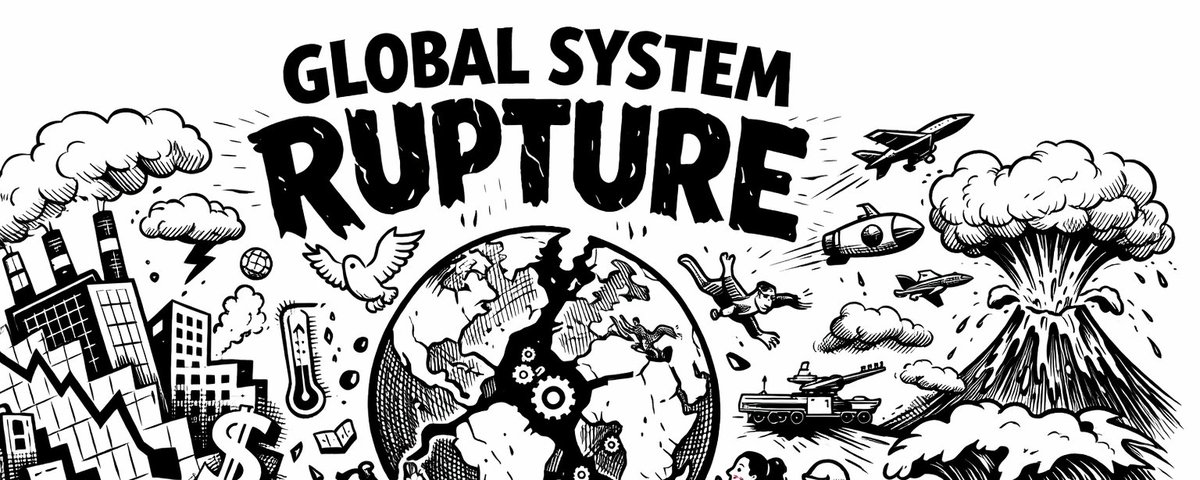
I never, ever thought Sapiens was a great book. On the contrary. This explains why:

I used to think Sapiens was a great book. Sweeping, provocative, the kind of book that makes you feel like you finally understand the big picture of human history. It's on every CEO's bookshelf, assigned in universities, praised as a masterwork of synthesis. Yuval Noah Harari is treated as one of the serious thinkers of our time.
But something nagged at me. Some passages felt off. Claims that human rights are just figments of our collective imagination, not real things, just stories we tell ourselves. That nations, laws, money, justice, doesn't exist outside our heads. That meaning itself is a delusion we've invented to cope. That we're far more powerful than ever before but not happier. That hunter-gatherers had it better because they had no dishes to wash, no carpets to vacuum, no nappies to change, no bills to pay.
That sounded depressing to me, but was perhaps just the realistic scientific worldview? What it meant to see the world clearly, without comforting illusions.
Then I read The Beginning of Infinity by @DavidDeutschOxf. Deutsch has a concept he calls 'bad philosophy.' Not philosophy that's merely false, but philosophy that actively prevents the growth of knowledge. Ideas that close doors rather than open them. That makes problems seem unsolvable by design.
After soaking in Deutsch's framework (it's dense, a bit like digesting a delicious whale), it becomes clear: Harari's books are riddled with bad philosophy. They're smuggling nihilism in under the guise of scientific objectivity. Some examples:
On meaning: "Human life has absolutely no meaning. Humans are the outcome of blind evolutionary processes that operate without goal or purpose... any meaning that people inscribe to their lives is just a delusion."
On human rights: "There are no gods in the universe, no nations, no money, no human rights, no laws, and no justice outside the common imagination of human beings."
On free will: "Humans are now hackable animals. The idea that humans have this soul or spirit and they have free will, that's over."
On progress: "We thought we were saving time; instead we revved up the treadmill of life to ten times its former speed." The Agricultural Revolution? "History's biggest fraud." We didn't domesticate wheat, "it domesticated us."
On our cosmic significance: "If planet Earth were to blow up tomorrow morning, the universe would probably keep going about its business as usual. Human subjectivity would not be missed."
On the future: "Those who fail in the struggle against irrelevance would constitute a new 'useless class.'" Homo sapiens will likely "disappear in a century or two."
This is bad philosophy. It tells us our problems are cosmically insignificant, our solutions are illusions, and that progress is neither desirable nor within our control. It's also perfect nonsense. No one would ever go back to being hunter-gatherers. Would you rather worry about your kid spending too much time on Roblox, or face the 50% chance she won't reach puberty?
And our so-called "fictions"? They ended slavery. They gave women equal rights. They solved hunger. They eradicated smallpox. They turned sand into computer chips. They got us to the moon, and hopefully soon, to Mars and beyond. These "fictions" are already reshaping the universe, and over time they may become the most potent force in it.
Now compare Deutsch:
"Humans, people and knowledge are not only objectively significant: they are by far the most significant phenomena in nature."
"Feeling insignificant because the universe is large has exactly the same logic as feeling inadequate for not being a cow."
"Problems are soluble, and each particular evil is a problem that can be solved."
"We are only just scratching the surface, and shall never be doing anything else. If unlimited progress really is going to happen, not only are we now at almost the very beginning of it, we always shall be."
Where Harari sees a species of deluded apes stumbling toward obsolescence, Deutsch sees universal explainers, the only entities we know of capable of creating explanatory knowledge, solving problems, and potentially seeding the universe with intelligence.
The difference isn't academic. Ideas shape action. If you believe life is meaningless, progress is a trap, and humans are hackable animals with no free will, how does that affect what you build? What you fight for? What you teach your children?
Harari's books sell because they flatter a fashionable pessimism. They let readers feel sophisticated for seeing through the "delusions" everyone else lives by. That smug cynicism is corrosive. And it's everywhere: in schools, in media, in bestselling books. More than half of young adults now say they feel little to no purpose or meaning in life. This is what happens when you teach an entire generation bad philosophy. Less progress, less health, less wealth. Less flourishing. And ultimately, a higher chance that civilization and consciousness go extinct.
Fortunately, there's another equally well-written, but much truer, account of homo sapiens, appropriately titled 'The Beginning of Infinity'. And this one smuggles no despair in by the backdoor. But let's give Harari credit where it's due. He is right about one thing: if planet Earth blew up tomorrow, we wouldn't be missed. Because there'd be no one left to miss us, just a careless universe, blindly obeying physical laws. We are the only ones who can miss, but we're not going to. We're going to aim, hit, and keep going.
Full credit for the amazing meme to @Ben__Jeff
