
Associate Professor@NCBS. Interested in signaling driven 3D chromatin dynamics and distal regulatory elements
NCBS, Bangalore, India
Joined November 2019
- Tweets423
- Following551
- Followers1.8K
- Likes1K


Dimple Notani retweeted

Very proud of this study!
Two fundamental processes in gene expression are less tightly connected than we thought. Their relationship may help explain surprising vulnerabilities of cancer cells.
Huge thanks to Agata and Deepshika for years of hard work, and to all collaborators

Two steps in gene expression that should move together…don’t. In our new paper we show that pre-mRNA cleavage and RNA polymerase II (RNAPII) termination shift in opposite directions – with a surprising link to gene expression and cancer cell vulnerability tinyurl.com/3pkeuctp

Dimple Notani retweeted

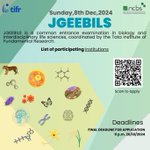
🔬 Interested in biological research? NCBS-TIFR’s 2-year MSc (by Research) programme offers research from Day 1, interdisciplinary training and a monthly scholarship. August 2027 intake applications open soon!
📩 [email protected]
@TIFRScience

Dimple Notani retweeted
🏆 Congratulations to Dr. Dimple Notani! @DimpleNotani on being elected as a Fellow of the
The National Academy of Sciences, India.

Dimple Notani retweeted

Check out our Roadmap for Condensates in Cell Biology 💧 🧫, which summarizes the stimulating discussions we had at @KITP_UCSB last summer! 🤓🌴
Big thanks to @ZwickerGroup for leading this effort!
journals.aps.org/prxlife/abs…

Dimple Notani retweeted

Excited to share our latest work on how signals from Mtb infected macrophages propagate to neighbouring bystander cells and promote population wide trained immunity like responses. Excellent collaboration with @DimpleNotani. Thanks @NCBS_Bangalore.
journals.asm.org/doi/10.1128…

Dimple Notani retweeted

🧬 Pleased to share our team's new paper published in #HumanGenetics: "Blending borders: reconstructing the genetic history of the Sindhi population." We present a high-resolution, genome-wide analysis of the demographic history and genomic architecture of the Sindhi diaspora. 🧵👇@bhupro @VCofficeBHU @GuDbfs540 @ChanchalD1998

Dimple Notani retweeted

(1/16) Our 3-lab collab (Mirny & Zechner) led by Harvey, Henrik & Jack is out:
Q: How do enhancers & promoters interact in space (contact vs. action-at-a-distance) and time (stable vs. transient)?
A: Transient E-P contact (~25-42 nm lasting ~10-20 sec): biorxiv.org/content/10.64898…

Dimple Notani retweeted

Surviving deletions are depleted not just for known essential genes, but some non-coding regions as well, giving us a direct, annotation-agnostic measure of what's essential in the genome of one human cell line.
We are able to put empirical bounds on dispensability of 50-96%!
Dimple Notani retweeted

Our new preprint: Chromatin at ~10–100 kb scales behaves far beyond standard polymer expectations. DNA-PAINT data reveal broad fluctuations and sharp local bends. Our study suggests emergent active forces at these scales and quantifies the nature and strength of this activity.

Dimple Notani retweeted

Excited to share this preprint from our team and collaborators at UCSD
Transcription initiation profiling defines the regulatory logic of astrocyte gene regulation biorxiv.org/content/10.64898…
We asked how do astrocytes decide which genes to turn on during inflammation?
Dimple Notani retweeted

A growing role for ER-Ca2+ release and store-operated Ca2+ entry in neuronal physiology and pathophysiology
now available at authors.elsevier.com/a/1mvCL…
@NCBS_Bangalore @DBTIndia


Dimple Notani retweeted

New Lab Alert! 🧬 labadelab.com/
Thrilled to start the Labade Lab at @AshokaUniv! @TSB_Ashoka @KCDH_A
Join us to explore expansion microscopy, nanoscale spatial genomics, and the epigenetics of aging.
PhD Program at Ashoka for 2026-27 intake. Apply by 20 April 2026: ashoka.edu.in/programme/phd-…
We’re investigating how "inflammaging" alters the epigenome and how to decipher and ultimately reverse those changes.
We build new technologies to visualize genome & epigenome changes at the nanoscale and explore ways to make the genome more resilient to aging.
#PhD #SpatialGenomics #ExpansionMicroscopy #Inflammaging

Dimple Notani retweeted
Happy to share our Current Opinion review on the key challenges in accurately predicting 3D distances between chromatin segments and computing their dynamics. Thanks to Daniel Jost @djost_physbiol & Luca Giorgetti for the invitation to write this review @DuttaShuvadip @BsbeIitb

Dimple Notani retweeted

♦️Tightly packed chromatin ➡️ lower chance of a particular harmful translocation♦️
Latest article from @LabRanjith, led by Anirudh, on how chromatin compaction and DNA breaks⚡ govern translocation statistics.
🔗sl1nk.com/5x9Dz
(1/5)

Dimple Notani retweeted

GCBA Seminar Series announces Dimple Notani, PhD, EMBO Global Investigator, National Centre for Biological Sciences - TIFR presenting "RNA as a Key Regulator of Enhancer Hierarchies and Promoter Priming." @DimpleNotani @UNMC_GCBA @UNMC_BISB

Dimple Notani retweeted

Check this new work on BRD4's role in preventing the premature activation of developmental transcription factors via #Polycomb, providing new mechanistic insights into the pathogenesis of neurodevelopmental disorder #CdLS #NDDs, #chromatinopathies biorxiv.org/content/10.64898…
Dimple Notani retweeted

Excited to share that my first-author PhD paper on genomic instability at CTCF/cohesin binding sites in cancer is finally published in @iScience_CP!
Huge thanks to @r_sabarinathan and @DimpleNotani for all the guidance and support throughout this journey
cell.com/iscience/fulltext/S…

Dimple Notani retweeted

🦈👀Eye-opening research about Greenland sharks — the longest-living vertebrate — may lead to new ways of preserving vision as we age! Learn more about this research by @DrDorotaSK at @UCIrvine School of Medicine. bit.ly/450mCYD

ALT Researcher in laboratory.
Dimple Notani retweeted

A lonely goodbye to Madhav Gadgil, one of the tallest environmentalists of our times.
Under the banyan trees of Navi Peth in Pune, Madhav Gadgil was taken for cremation last evening. The gathering was small, some forty, perhaps fifty people.
No ministers. No senior officials. No tricolour to drape the body. No guard of honour salutes. No ceremonial rifle volleys.
One expects a crowd, the usual press cameras and public mourning. Instead, there was a pause, a quiet uncertainty, as if this farewell were happening somewhere it wasn’t meant to.
State honours had been promised, but never quite arrived. Even the police escort lost its way. For nearly half an hour, Gadgil’s body lay waiting, wrapped in simple white, while the city carried on around it, indifferent.
For me, this was not the death of a distant public figure.
In the 1990s, when I was starting out as a science correspondent with the Press Trust of India in Bengaluru, Madhav Gadgil was already a towering presence at the Indian Institute of Science (IISc). At the IISc's Centre for Ecological Sciences, he stood out, not by volume or self-importance, but by intellectual rigour and moral clarity.
I walked into his office many a time in those years, notebooks open, deadlines close. He listened carefully, answered precisely, never spoke down. He believed knowledge carried responsibility, and that science without ethics was incomplete. Those conversations stayed with me, shaping how I understood both journalism and ecology.
This was also the man who later led the Western Ghats Ecology Expert Panel, producing a report that treated the mountains not as real estate or mineral stock, but as living systems. The Gadgil Committee Report spoke of ecological limits, decentralised governance, community rights, and long-term survival.
A Padma Bhushan awardee. A UN Champion of the Earth. A lifelong defender of forests, rivers, biodiversity, and uncomfortable truths. In death, he was treated as someone easily forgotten.
The trees were not.
The old banyans stood quietly, their leaves stirring in the afternoon air. Gadgil had given his life to them. Trees remember. Animals remember. They show up when people don’t.
Had this been a politician or an industrialist, roads in Pune would have been sealed, helicopters circling, television studios filled with tributes and theatrical grief. Power is never allowed to pass quietly.
But a man who tried to protect the land that sustains us all was sent off almost unnoticed.
The trees stood witness.
The rest of us moved on.
Goodbye, Madhav Gadgil.
Forgive us.
We did not know how to honour you.
(Photo Courtesy: R S Gopan)
