

If NBK stands for ‘Nobody knows’ and ‘Nobody’ = Ed, then NBK = Ed knows. Indeed, Ed understands. Otherwise, kick rocks; nothing to see here.
Austin, Texas, USA
Joined January 2023
- Tweets14.9K
- Following2.5K
- Followers2.3K
- Likes27.9K






Pinned Tweet
The Islamic Republic (IR) is a kinesthetic learner: capable in the engineering field but an underperformer in the analytical domain. It changes course when it feels the cost of its actions, not when it is argued into a coherent approach.
That is why this forecast misses the mark: “The IR will escalate in the Strait of Hormuz before the midterms to force Trump into an unpleasant choice — accept an unreasonable deal or resume an unpopular war and erode midterm electoral prospects for Republicans.”
Firstly, Trump has made it abundantly clear that he will not subordinate the United States’ policy on the IR to the party’s midterm electoral aspirations. He aims to support the party, but not at the expense of U.S. strategic objectives; that is a prudent choice.
Secondly, even though unfavorable midterm results could complicate domestic politics, they should have little to no impact on geopolitical dynamics. The more unreasonably the IR behaves, the more unyielding the United States is likely to become.
However, with such a dynamic decision-maker as Trump, the IR could, through cooperation, secure state survival and a path back to prosperity for itself and its citizens; otherwise, it is uncertain what decisions he might make with the midterm results, favorable or otherwise, in the rearview mirror.
Meanwhile, it is clear that the IR’s economic situation is disintegrating at increasing speed (as oil revenue, the rial, and inflation show), and that its strategic position continues to deteriorate, even without a resumption of U.S. strikes. Some may argue that the Houthis have made gains in the Red Sea; however, these gains are temporary, as they can be reversed quickly if the allies choose.
Now, the substitutes the IR may prefer do not change the realities. (1) A tax on the passage of ships through, or military control over, a natural waterway is unacceptable anywhere on Earth. (2) The weapons-grade nuclear stockpile is a breakout capability, not a bargaining chip, and thus it must be given up. (3) As for not looking defeated after being bombed, state survival and a path back to prosperity are sufficient, as pride is not a strategic interest.
That said, the IR has an incentive to work with the administration during the weeks leading up to the midterm elections and to pursue genuine cooperation toward a diplomatic settlement while one is still attainable, as there is no indication that other incentives will emerge after the midterms.

As expected, Trump has rejected the Iranian proposal, interpreting #Iran’s stated desire to reach a deal as a sign of desperation and as evidence that pressure is working.
This only strengthens the argument of those in Tehran who maintain that the only way to reach a deal with Trump is to strengthen Iran’s position.
For that reason, I would not be surprised to see further Iranian escalation in the Strait in the weeks ahead of the midterms, with the aim of confronting Trump with an unpleasant choice: either accept a deal or return to an unpopular war and further erode the Republicans’ electoral prospects.
This does not mean that Tehran is not under pressure. To the contrary, it is precisely that pressure, combined with the lack of any prospect for a diplomatic solution, that may make military escalation seem like the only available option.
Ed David Hanna retweeted
On Anthropic’s Claude-Alpöge “proof” of the Riemann Hypothesis:
(1) The Yang–Mills and Navier–Stokes equations have been presumed true and useful in many intellectual and real-world applications, even though neither has had a formal mathematical proof.
(2) Every mathematician believes that the Riemann Hypothesis (RH) is true for practical purposes and uses it accordingly.
(3) Over the years, several capable mathematicians have published proofs of the RH utilizing the method of Proof by Contradiction, all of which have been rejected by prominent mathematical institutions and mathematicians with the main criticism being that they are not sufficiently insightful, along with other minor critiques.
(4) Levent Alpöge has admitted that the SI-generated write-up is enormous (17 million lines, 250,000 pages), unreadable, unusable, and that he does not yet understand most of the argument.
(5) A mathematical proof must establish objective, defendable certainty beyond doubt, not merely high confidence as in the case of the claimed “proof” of the RH.
Therefore, for the most part, what Anthropic has presented regarding the RH is neither well-understood by the “authors” nor sufficiently insightful, on par with existing valid proofs by contradiction, and thus amounts to little more than IPO marketing. Otherwise, it is foolish for a mathematician to present a proof they cannot understand or defend.

Independent mathematicians have now finished the full verification of the proof of the Riemann hypothesis announced yesterday by Anthropic mathematician Levent Alpöge. The results are real, they say.
scientificamerican.com/artic…

On Anthropic’s Claude-Alpöge “proof” of the Riemann Hypothesis:
(1) The Yang–Mills and Navier–Stokes equations have been presumed true and useful in many intellectual and real-world applications, even though neither has had a formal mathematical proof.
(2) Every mathematician believes that the Riemann Hypothesis (RH) is true for practical purposes and uses it accordingly.
(3) Over the years, several capable mathematicians have published proofs of the RH utilizing the method of Proof by Contradiction, all of which have been rejected by prominent mathematical institutions and mathematicians with the main criticism being that they are not sufficiently insightful, along with other minor critiques.
(4) Levent Alpöge has admitted that the SI-generated write-up is enormous (17 million lines, 250,000 pages), unreadable, unusable, and that he does not yet understand most of the argument.
(5) A mathematical proof must establish objective, defendable certainty beyond doubt, not merely high confidence as in the case of the claimed “proof” of the RH.
Therefore, for the most part, what Anthropic has presented regarding the RH is neither well-understood by the “authors” nor sufficiently insightful, on par with existing valid proofs by contradiction, and thus amounts to little more than IPO marketing. Otherwise, it is foolish for a mathematician to present a proof they cannot understand or defend.
Independent mathematicians have now finished the full verification of the proof of the Riemann hypothesis announced yesterday by Anthropic mathematician Levent Alpöge. The results are real, they say.
scientificamerican.com/artic…
Ed David Hanna retweeted

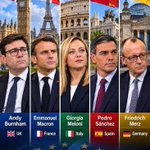
Thank you very much. On behalf of Steve and I, I'd like to thank Chancellor Merz for hosting us here so graciously, and I'd also like to compliment Chancellor Merz and President Macron and Prime Minister Burnham and President Zelenskyy on a very substantive and successful gathering here today. I'd also like to thank some of the other European leaders who have been so essential in helping us shape our point of view, helping us design the right pathway forward.
Amongst them is Prime Minister Meloni from Italy. I'd like to thank the Prime Minister from Poland who's been helpful, Ursula von der Leyen from the EU, and obviously Secretary General of NATO Mark Rutte, as well as the President of Finland, Alex Stubb, and Jonas Gahr, the Prime Minister of Norway, who have all been really engaging with us on a very regular basis in a very substantive and an informative and deliberate way.
What we came away from today with is really seeing that Europe is very united and very, very strong in their support of Ukraine.
We saw—and we relayed this to President Trump when we spoke to him after the meeting, but we also will go back and relay this to the Russian delegation—which is we see strength and unity and commitment, but we also see a real desire for peace, and I think that we're doing a lot of work to organize on how to give it the best shot to get there. After a war that's gone on for this long, that's so emotional and tough and with huge costs from a human perspective, it's very, very hard to get both sides back to the table and back to peace, but I do believe we're making significant steps towards doing that, and it's going to be very, very hard to achieve it, but by working together, everyone here is committed to giving it their best shot, and I believe and I hope and I pray that we will be able to be successful. President Trump sent Steve and I here today and then called into the meeting to give an update on his conversations in Shenzhen with President Xi and President Putin, where he sent a very strong message to both of them on the desire for peace and would like to engage both of them very aggressively to get there, and I'm not going to go into the private discussions that he had.
I'll let him disclose that when he's ready, but I believe he also came away believing that peace is achievable and we need to all work together to try and achieve it. For Steve and I, this is deeply personal. We speak to a lot of people who are being impacted by the war.
Last week, I was speaking to a friend of mine who's from Kramatorsk (Ukraine), and she was telling me about her brother who's fighting on the front lines, and how dire the situation is, and how a lot of the area where she grew up has been destroyed, and a lot of friends have been killed in the battle. A lot of people feel very hopeless, and they don't have any say in what's happening, and they really would like to see peace. On behalf of those people on both sides, Steve and I are working very, very hard to try and do whatever we can do to see if we can help bring this horrible war to an end, to stop the fighting, the killing, the suffering, and all of the negative things that come from war.
When Steve and I started on this a year ago, we very quickly defined that for us, success in an outcome would be to have a sovereign, secure, prosperous, and free Ukraine at the end of the war. I do think that the negotiations and the outcomes that we're discussing, and it's very important that we're here in Europe and you're hearing this from us directly, we do believe that that is very achievable. We think we've made a lot of progress in the last year towards a pathway with Ukraine to the EU.
Before we got involved, everyone had spoken about that Ukraine needed security guarantees, and obviously that was not offered. Steve and I went to President Trump and said, ‘Is that something you'd be open to?’ He said, ‘Absolutely, write them up.’ Obviously, we’d have to go through Congress and we do it in a responsible way that's in line with principles and values, but we've made a lot of progress working with President Zelensky and the Coalition of the Willing on what those security guarantees can look like.
We've also been making a lot of progress on a post-war prosperity plan. We've been working with the World Bank and BlackRock and President Zelenskyy's team, and the EU has really been excellent at spearheading that effort. I think that we've made progress towards defining what a successful and strong Ukraine can look like, hopefully, after this war.
In September, when Steve and I first went to visit Russia and Ukraine, the negotiations were really dead in the water and it was looking very, very hopeless. We came up with a plan working with our European colleagues to try and get the trilateral format back up and running. It took us some time and some hard work to do that, but we were able to achieve that just recently.
That's led to some humanitarian breakthroughs. There's going to be thousands of prisoners of war who will be going home to their families in the next weeks, which will be obviously a great gesture and a great relief for people. In addition to that, most importantly, Russia has agreed to engage in the multilateral format with the Europeans.
Part of that was us explaining to the Russians that we do believe that Russia having Europe at the table will be essential to ending this war in a just and long-term, durable way. The Russians are willing to trust that instinct on our behalf. I believe that after today, we can go back with an even stronger affirmation that we believe that, we've heard that, and there's real commitment to that.
The next steps for us are obviously to work in close coordination after this press conference. Steve and I are going to be meeting with all the NSAs, which make up the negotiating team, and we appreciate the leaders really giving their full time and commitment to that. We're going to be working on joint proposals.
Obviously, we want to make sure that everything we're doing is unified. I also want to be able to reiterate that President Trump wants to make a deal with Europe by his side. He's not looking to impose anything unilaterally.
He wants to do it with Europe and Ukraine, and any deal we do will be in close consultation with Ukraine and with Europe. That's something that he also asked us to come here today and reassure people in that regard. I would say the progress of the meeting—and I think we'll make further progress after—is that I do feel like our positions are becoming much closer, much more detailed, and more aligned in that regard.
That's going to be critical to getting to the next set of talks. Finally, I'll just address post-war security. I think the discussion today on Coalition of the Willing, everything they discussed today are elements of what post-war security.
I appreciate that Chancellor Merz brought up the right mechanisms for communication, transparency, crisis management, and then potentially reciprocal de-escalation. There is a lot of infrastructure already in Europe that we can draw on, like the NATO-Russia Council. I think that will be very important to work on in a solution.
Obviously, NATO will be a central pillar of whatever we work on in the settlement. Hopefully, it will be a much stronger NATO that really has the ability to be a protector of the peace and not seen as provocative, which is obviously not the nature of NATO in that regard. We have to finalize the credible guarantees.
I'll conclude to say that our goal is really to end this war and to really help build a durable peace. We are very committed. President Trump will do whatever it takes to do that.
He's instructed us to commit as much time as possible, and we will continue to do that in full coordination and unity with our European partners. Thank you.
From remarks in Berlin


Ed David Hanna retweeted

BREAKING: Xi Jinping personally greets President Trump at Air Force One in Shenzhen, China with massive fanfare
@RealAmVoice @HumanEvents
Ed David Hanna retweeted
Jensen Huang is one of the greatest founders in the history of Western technology, on par with the great Steve Jobs.
Understandably, other tech founders, CEOs, major investors, and cheerleaders support him for the great work he’s done, but there can be no imperfections in the global competition or proliferation of SI technology.
However, in my view, if Jensen wants to continue supporting NVIDIA, the best he could hope for is an advisory role at this point.
Worth noting that the sooner this matter is closed, the sooner NVIDIA’s prospects improve.
I wish him nothing but the best.

Over the past week, I’ve been overwhelmed by the love and support of friends, industry colleagues, and people I've never met. Thank you to everyone who has shown kindness to my family and me. It means the world to me.
I came to the United States 53 years ago, and becoming an American citizen is one of the greatest gifts and proudest moments of my life. NVIDIA has been my life’s work. Building it into the company it is today alongside my colleagues has been a privilege and an honor. Nowhere but in America could a company like NVIDIA be possible. I love our country, and I love NVIDIA.
I did not live up to the standards expected of everyone at NVIDIA, and I have made serious mistakes in my personal life. I created problems for the Board that I deeply regret. I own my mistakes completely, and I am committed to cooperating with the Board’s independent investigation.
Since my departure, I’ve seen an outpouring of calls from NVIDIA’s employees, investors, business partners, and customers for me to return as CEO. Many continue to reach out to me directly as the company navigates complex technology, market, competitive, and geopolitical dynamics. NVIDIA is a once-in-a-generation company. If the Board of Directors decides that my return is in the best interest of our shareholders, our employees, the company, and America, I would be honored to answer these calls and return as CEO.
Thank you again to everyone who has shared their good wishes. I am profoundly humbled by your support. To my family: I love you, and I will spend the rest of my life being worthy of yours.
Jensen
Jensen Huang is one of the greatest founders in the history of Western technology, on par with the great Steve Jobs.
Understandably, other tech founders, CEOs, major investors, and cheerleaders support him for the great work he’s done, but there can be no imperfections in the global competition or proliferation of SI technology.
However, in my view, if Jensen wants to continue supporting NVIDIA, the best he could hope for is an advisory role at this point.
Worth noting that the sooner this matter is closed, the sooner NVIDIA’s prospects improve.
I wish him nothing but the best.
Over the past week, I’ve been overwhelmed by the love and support of friends, industry colleagues, and people I've never met. Thank you to everyone who has shown kindness to my family and me. It means the world to me.
I came to the United States 53 years ago, and becoming an American citizen is one of the greatest gifts and proudest moments of my life. NVIDIA has been my life’s work. Building it into the company it is today alongside my colleagues has been a privilege and an honor. Nowhere but in America could a company like NVIDIA be possible. I love our country, and I love NVIDIA.
I did not live up to the standards expected of everyone at NVIDIA, and I have made serious mistakes in my personal life. I created problems for the Board that I deeply regret. I own my mistakes completely, and I am committed to cooperating with the Board’s independent investigation.
Since my departure, I’ve seen an outpouring of calls from NVIDIA’s employees, investors, business partners, and customers for me to return as CEO. Many continue to reach out to me directly as the company navigates complex technology, market, competitive, and geopolitical dynamics. NVIDIA is a once-in-a-generation company. If the Board of Directors decides that my return is in the best interest of our shareholders, our employees, the company, and America, I would be honored to answer these calls and return as CEO.
Thank you again to everyone who has shared their good wishes. I am profoundly humbled by your support. To my family: I love you, and I will spend the rest of my life being worthy of yours.
Jensen
Ed David Hanna retweeted
I can confirm the effect on Apple Music.
I was listening to Next Thing You Know by Jordan Davis, and out of the blue — mid-song — Shaggy started saying It Wasn’t Me.



Ed David Hanna retweeted
Just as confidence in extraordinary abilities is often indistinguishable from unrecognized delusion (former), immeasurable incompetence is indistinguishable from deliberate sabotage (latter).
In the latter, it doesn’t matter which of the two it is, as both lead to indistinguishable outcomes.

Just as confidence in extraordinary abilities is often indistinguishable from unrecognized delusion (former), immeasurable incompetence is indistinguishable from deliberate sabotage (latter).
In the latter, it doesn’t matter which of the two it is, as both lead to indistinguishable outcomes.

Ed David Hanna retweeted
We are committed to bringing an end to the war in Ukraine and the tremendous human suffering it has caused. President @realDonaldTrump is determined to achieve a lasting peace, and we remain fully committed to doing everything possible to help make that happen.
This morning, @SEPeaceMissions and I spoke with Yuri Ushakov to discuss the progress we have made and the next steps in the peace process.
We also held a productive call with Ukraine and our European partners, including the National Security Advisors of Germany, France, the United Kingdom, Poland, and Italy, along with representatives of the EU and NATO.
We discussed how to facilitate direct engagement between Europe and Russia, which has been largely absent over the past four years. It is important that both sides hear each other’s concerns and proposals directly as we work toward a more stable and secure future for Europe.
We also began preparing the agenda for the next multilateral meeting, which we are working to convene in the near future.
A central focus of our discussions was a fundamental question: How do we end this horrible war and create post-war security arrangements that make future wars less likely?
NATO will remain a critical pillar of European security. Our objective is to build on Europe’s existing institutions and agreements, strengthening security commitments, communication, transparency, and mechanisms for de-escalation so that the peace we achieve can endure.
When Steve and I began this work a year ago, we defined a successful outcome for Ukraine is a sovereign, secure, and prosperous country, free to determine its own future.
Working closely with Ukraine and our European partners over the past year, we have made meaningful progress toward that vision through three essential pillars:
1. Strong, credible security guarantees to protect Ukraine against future aggression.
2. A path toward EU membership, anchoring Ukraine’s long-term future in Europe.
3. A comprehensive post-war prosperity plan, developed with our European partners, the World Bank, and others, to support Ukraine’s financial stability, reconstruction, investment, and long-term economic growth.
Together, these elements can give Ukraine the strength, security, freedom and confidence to negotiate the remaining difficult issues with Russia and build a brighter future for its people.
Any final peace agreement will need to be agreed to by both Russia and Ukraine. While much of the public discussion focuses on the differences between the parties, we continue to see positive and constructive ideas emerging through serious discussions away from the public spotlight. These exchanges are helping us explore potential solutions and narrow the remaining gaps.
Important challenges remain, and a final agreement will require difficult decisions. But we are making progress, in close coordination with Russia, Ukraine, and Europe, toward an outcome that can end this war, strengthen European security, and create the foundations for lasting peace.


Ed David Hanna retweeted
Following our trilateral meetings and subsequent discussions with Presidents Putin and @ZelenskyyUa, @SEPeaceMissions and I have remained in close consultation with Russia, Ukraine, and our European partners on next steps.
Our focus now is on facilitating direct engagement between Moscow and European partners and preparing the agenda for the next round of trilateral talks.
Several new ideas emerged from these discussions and are now being explored. Some may lead to breakthroughs directly, while others may evolve into new proposals that help bridge the remaining gaps.
As President @realDonaldTrump has made clear, A lasting peace requires credible security guarantees for Ukraine and detailed, actionable postwar security arrangements that reduce the risk of another war. NATO will remain a critical pillar of European security, enhanced by stronger mechanisms for military, communication, deconfliction, and reciprocal de-escalation, with practical ways to address disputes before they become crises. This is why we are working to bring our European partners directly into these discussions. Any final agreement must be agreed to by the relevant parties, and President Trump will only support arrangements that strengthen Ukraine’s and Europe’s security and make future conflict less likely.
The press has reported some of the maximalist positions proposed by both sides, along with strong political rhetoric. In our private discussions, both sides understand that practical compromises will be necessary to end this war. Serious and constructive work continues among those of us committed to finding solutions.
The human cost of this war is devastating, and the issues remain extraordinarily difficult. However, we are determined to continue the hard work, maintain the confidentiality necessary for sensitive negotiations, and find a pathway to end this horrible war and establish a durable peace.


Ed David Hanna retweeted
God will guard your going and coming, now and forever.
Psalm 121: A song for ascents
1 I turn my eyes to the mountains;
from where will my help come?
2 My help comes from God,
maker of heaven and earth.
3 God will not let your foot give way;
your guardian will not slumber.
4 See, the guardian of Israel
neither slumbers nor sleeps!
5 God is your guardian,
God is your protection
at your right hand.
6 By day the sun will not strike you,
nor the moon by night.
7 God will guard you from all harm,
and will guard your life.
8 God will guard your going and coming
now and forever.
