

Building the recruiting agent for startups at https://xitter.cf/t.co/u5CdYqMo25
New York, USA
Joined October 2014
- Tweets525
- Following702
- Followers464
- Likes234



Pinned Tweet
Today we're launching Superposition. An AI headhunter better at finding talent than any human.
We made a short film to prove it. A fictional billionaire finally admits how he built his empire.
Spoiler: it was never about him. It was about the people he surrounded himself with.
Watch it. Then come find your perfect weirdos.
Your job ad is the least useful thing you have about the role you're hiring for.
We recorded a podcast instead, and it worked phenomenally well for hiring. My cofounder and I did one episode a week as long as we had open roles.
It made candidates more interested in us
It made the interviews much easier and more pleasant because they already knew who we are and how we work
A JD only describes the role, but candidates watching me and my cofounder solve a challenge or build an agent get a lot more info to figure out if they're a good culture fit and would enjoy working with us.
Doesn't matter what the format is (podcasts, livestreams, linkedin/x posts) just the frequency is important.
Make it public and keep it running while you're hiring.

I'm going to dinner with 2 of my competitors (and I bet even more future ones will be at that table)
I was selected for @a16z's inaugural Talent Engineer fellowship.
Everyone in that room is building agents to improve recruiting. Some like me sell it as a whole product, many are building it inside companies like @tryramp, xAI and @NotionHQ.
I think a bunch of them are latent founders we'll be competing with in six months.
Winner takes most. Much more fun if we all know each other.

stoked to announce the inaugural class of @a16z Talent Engineer fellows!
50 talent engineering leaders selected out of thousands of apps from talented people around the world.
many are talent engineers who built 0 to 1 AI-native talent systems and now lead those functions at top AI companies, like:
- jared long from cursor
- @dmccarthy7 at zapier
- @Danielleporeh at clay
- @forwarddeploy at xAI
- @chenxcynthia at decagon
some are technical leaders redefining talent, building agentic headhunters, career development platforms, and talent-matching systems at scale, like:
- @lijeffrey39 from Paraform
- @s16h_ at Metaview and Fillmore
- @sahil_seth at Talent Pluto
- @Edmund_Works at Superposition
finally, there are founders taking people graphs to the next level and scaling the infra behind how people and networks connect, like:
- @pouwerkerk at Happenstance
- @DasDzy) at Exa
huge congrats to the inaugural class!

Every founder I ever recruited for asked me for the "best talent". Best at what, for whom, at which stage?
I placed engineers who were superstars at one seed startup and unemployable at the next. "Best talent" is Tinder logic applied to the most important decision your company makes.

Average (not even bad) hires kill startups. Seven years as a headhunter and I can guarantee it all comes down to hiring unbelievable people that are the exact right fit for your startup. Not any startup. YOUR startup. Generically great is not good enough.

The worst thing you can do when you start hiring is text your friends.
They'll all reply, they'll all want a coffee, and almost none of them will actually leave their job for you. They have to be so sold on the company that they will risk the friendship. Reasonably, most people are not
Warm intros are a shortcut. Quick way to avoid the hard work of finding the right person.
Ask your friends for advice. Then go find your hire somewhere else.
An AI agent found their CTO. Start to finish, truly no human in the loop until the offer was sent.
Most people can't name one thing an agent has actually done for them end to end, let alone find one of the most important hires in your company.
Every bad hire comes from ignoring at least one of these four rules:
1. Be specific. There's no such thing as a good hire in the abstract.
2. Generally good is not good enough. There's no best, only best for you.
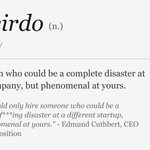
3. Find the right people. Your people. A car crash anywhere else, but phenomenal at your startup.
4. Ask the right damn question. Never how you did it, always who you did it with.
Founders need to learn some basic hiring etiquette.
When a founder slides into your inbox about a job, they're the one who should be selling.
Most candidates do the opposite and default to auditioning and explaining why they'd be lucky to be picked.
How does that make sense?
A founder you've never met.
At a company nobody's really heard of.
Is asking you to bet the next 2-5 years of your career on them.
And you're the one who needs to do the convincing?
Being good at your job won't save you from a layoff.
When a big company cuts 15% of its team, they usually let go whoever joined most recently and whoever's manager didn't play the corporate politics. The only place where you'll actually be judged by the quality of your work is a company with a small enough team.
If a company won't interview you because they haven't heard of your last employer, they just did you a favour. They're hiring a logo and they'll manage you like one too. The people worth working for care about what you actually build.
Recruitment agencies are paid to send you the wrong person.
They make far more money finding one candidate who's fine for six clients than finding the one person who'd be brilliant at your company and useless anywhere else. So that's what you get, AND you pay 25% of salary for it.
As a recruiter I was literally paid to NOT find you the perfect hire.
If I actually spent three weeks hunting for the one engineer who fits your company, that would only serve you. But if I found a reasonably good engineer instead, I could spray and pray to every client with an open role and someone will bite.
When you hire a recruiter, they already have a candidate in hand, they just need to put him somewhere. They're not looking for someone specifically for you.
This is well known amongst founders, right?
I made the first engineering hire at Brex. Except there was technically one engineer before him. That guy accepted his offer, then went to Burning Man and never came back.
Never trust you secured the hire until they walk through your office door on their first day.
Everyone keeps saying AI made them 10x faster. Individually, sure.
But don't lie that your company is operating at a 10x level.
We just moved the bottleneck from "person and their work" to "one person's agent and another person's agent."
Most of us now have our own AI agents. But they're all using different context and definitions about the company.
Individually fast. Collectively a mess. Most teams can't even agree on basic definitions like: what is a closed deal? Ask five people at your company how many customers you have right now. You'll get five different answers.
Their agents won't ask. They'll just pick whichever answer they inherited and run with it at scale.
I built a SaaS product with no intention of anyone using the interface.
When we built our AI headhunter (Superposition), the first thing I asked my cofounder: why would anyone leave their terminal or their Claude to go click around inside our UI?
So we shipped a bidirectional MCP server.
The best software disappears into the environment you already chose.
I've helped hundreds of founders hire their first engineer over the last 10 years.
The ones who actually close great people all do the same handful of things differently.
Here's what they all had in common:
1. They don't vet on the first call. They understand that the first conversation is a sales call from the company to the candidate. If you spend that call asking the candidate to justify themselves, you've wasted the one shot you had to get them excited about your company.
2. They don't spend weeks discussing candidates with their cofounder before moving them forward. That's wasted time. They treat it like a sales pipeline instead.
3. They have weirdly specific operating principles. "Decision frequency is better than decision quality." "No managers, ever, literally ever." Then they derive one killer interview question from those principles that tells them everything they need to know from that candidate.
4. They move absurdly fast. You cannot convince someone to reject a bigger company and join you. But you can get an offer before they even schedule their second round with the other company. Speed is the only axis where a small startup has an advantage over a brand name.
5. They look for people from companies nobody's heard of. If someone's resume says all the right names, everything is priced in. You're paying peak price for a known quantity. The alpha is in the person shipping interesting stuff nights and weekends at a company you've never heard of.
