




ΞLIKRYPTO retweeted

Tokenisation is only the first step, putting it to work in Defi is the hard part
Here is where xStocks now are winning in the market
What’s Really Behind Solana’s €22M Euro Stablecoin Surge
Solana’s euro stablecoin supply reportedly grew by $22M in one week, more than the combined increase across other tracked chains.
Data tracked by @tokenterminal for the week ending October 25 puts Solana’s share of the euro stablecoin market at roughly 14%, making it the second-largest network after Ethereum.
But the headline needs context.
A reported 20M EURC pre-mint account linked to @circle’s Gateway may account for much of the increase.
These tokens support cross-chain operations and aren’t circulating supply until released.
That means the $22M increase doesn’t necessarily represent $22M in fresh capital entering Solana.
⊹ Who is building the euro stablecoin market
Circle issues EURC, while Société Générale-FORGE issues EURCV. Both are bringing euro-denominated digital assets into the onchain market.
While Thune is integrating EURC into its global payment network and @AllUnityStable has expanded its EURAU stablecoin to Solana.
The opportunity goes beyond token issuance. Faster settlement and lower transaction costs could make Solana useful for euro payments, transfers and cross-border settlement.
The metric I would watch next is actual adoption: circulating supply, trading liquidity and sustained payment activity.
Issuing a euro stablecoin is one step. Building consistent demand for it is another.
This is my opinion based on the data I’ve reviewed, not financial advice.

⊹ GRVT: THE VISION AND THE EXECUTION
After exploring different developments around $GRVT, here are five things that stand out to me.
✧ Yield while trading
Making capital productive while keeping it available for trading could help users manage their funds more efficiently.
GRVT currently offers a 3.5% base APY on eligible stablecoin balances, with a planned upgraded Earn product targeting up to 11% APY.
✧ Self-custody and security
Giving users control over their assets is important, but security and risk management remain essential.
GRVT’s security measures include smart contract audits by Spearbit DAO and infrastructure penetration testing by NCC Group.
✧ Tokenized fixed income
Bringing traditional fixed-income opportunities onchain could expand access to new yield-generating assets. Execution and transparency will matter most.
GRVT identifies the global fixed-income market as a $161 trillion opportunity.
✧ $GRVT token
The buyback and burn of 1.1 million $GRVT was a tangible step, representing close to 1% of the circulating supply at the time. Long-term value will depend on utility, demand and ecosystem growth.
✧ GRVT 2.0
The goal is to bring more of these features together. The real test will be product quality, user adoption and retention.
GRVT is targeting the end of November 2026 for GRVT 2.0, with a roadmap that includes integrated earning and trading features.
⊹ WHAT COMES NEXT
GRVT is working toward bringing trading, yield and asset control into one ecosystem. The opportunity is there, but execution will determine how far it goes.
And to the @GRVT_io team, if you are reading this, I hope you take a moment to appreciate how far the work has brought you.
Keep improving, keep listening to users, and keep building. Meaningful products take time, and consistency matters.
The vision is what gets people interested. The work you put in from here is what can make them believe in it.
I look forward to seeing how GRVT actually executes its roadmap.
This is my opinion based on the data I’ve reviewed, not financial advice.

Pyth’s Pull-Based Oracles Change When DeFi Pays for Price Updates
Crypto prices are formed across markets, including exchanges like @Binance and @coinbase. But getting reliable price data into a blockchain application requires another layer of infrastructure: oracles.
Oracle architecture affects how fresh prices reach smart contracts, when update costs are incurred, and how protocols respond when markets move sharply.
⊹ Traditional push feeds
Classic @Chainlink Data Feeds aggregate market data through decentralized oracle networks and publish prices on-chain when configured heartbeat or price-deviation conditions trigger updates.
Protocols can read the latest published price without submitting a new oracle update with every transaction. However, prices can become stale between updates, and network congestion can affect publication timing.
⊹ Pull-based feeds
@PythNetwork takes a different approach. It makes cryptographically signed price updates available off-chain, allowing applications to submit the data they need on-chain when they need it.
Rather than publishing every update on-chain in advance, an application can submit a price update alongside the transaction that uses it. The receiving contract verifies the update before using the price.
This changes when update costs are incurred, but does not eliminate them. Who pays depends on the protocol’s integration and transaction design.
⊹ Where security becomes critical
In lending markets, stale prices can distort collateral valuations and delay liquidations. In perpetual markets, price freshness can affect liquidations and execution.
Pull-based delivery can help applications access recent prices, but it does not automatically eliminate execution risk, slippage or MEV.
Protocols still need freshness checks, safe failure handling and liquidation mechanisms that do not blindly rely on outdated prices.
There is another important distinction: @Chainlink also offers Data Streams, a pull-based solution for latency-sensitive applications. The comparison is therefore about which delivery model fits a protocol’s needs, not simply Pyth versus Chainlink.
An oracle can deliver a valid, signed price, but that alone does not make a protocol safe. The consumer contract must validate the data and enforce appropriate safeguards. Poor integration can leave a protocol vulnerable even when the oracle itself is functioning as intended.
Oracle security depends not only on the integrity of the data, but also on how the protocol validates and acts on it.
This is my opinion based on the architecture discussed, not financial advice.

THIS WEEK’S TOKEN UNLOCKS
Oct 25–31, 2026
This week brings token releases across several projects, with $XPL, $FF and $CARDS among the largest by estimated dollar value. Other unlocks stand out because of their potential impact on circulating supply.
TOP 10 TOKEN UNLOCKS THIS WEEK
▹ OCT 25 | Plasma ($XPL)
✧ 227.78M XPL · ~$16.3M · 4.78% of circulating supply
▹ OCT 26 | AltLayer ($ALT)
✧ 240M ALT · ~$1.60M · 3.26% of circulating supply
▹ OCT 26 | Sahara AI ($SAHARA)
✧ 160M SAHARA · ~$1.22M · 3.70% of circulating supply
▹ OCT 28 | Sign ($SIGN)
✧ 400M SIGN · ~$4.33M · 14.11% of circulating supply
▹ OCT 28 | Stacks ($STX)
✧ 4.2M STX · ~$1.25M · 0.22% of circulating supply
▹ OCT 29 | Falcon Finance ($FF)
✧ 203.1M FF · ~$20.1M · 6.07% of circulating supply
▹ OCT 29 | Collector Crypt ($CARDS)
✧ 59M CARDS · ~$18.6M · 6.69% of circulating supply
▹ OCT 30 | Kamino ($KMNO)
✧ 230M KMNO · ~$9.3M · 3.93% of circulating supply
▹ OCT 30 | Zora ($ZORA)
✧ 170M ZORA · ~$1.14M · 3.73% of circulating supply
▹ OCT 31 | FLOCK ($FLOCK)
✧ 16M FLOCK · ~$683K · 3.35% of circulating supply
OTHER UNLOCKS THIS WEEK:
▹ OCT 25: $COAI
OCT 26: $FOGO · $MIRA · $BLAST · $ALOT · $SVL
OCT 27: $YGG · $NAVX · $AGIX · $NUM · $IOTA · $GGP · $FET
OCT 28: $SOPH · $TREE · $SPEC · $AERO · $BMEX · $MILK
OCT 30: $CELO · $WMTX · $W · $REZ · $NYAN
OCT 31: $PRIME · $CXT · $GUN · $FORT · $GTAI · $SIDUS · $SKL · $AI · $ACS
Token unlocks can increase selling pressure, but that doesn’t guarantee a sell-off.
The impact depends on the amount released relative to circulating supply, recipient allocations, market liquidity and demand.
Dollar values fluctuate with token prices, and schedules may vary by source.
That’s it for this week’s token unlocks. See you on the next one.

CRYPTO THIS WEEK
October 26–31, 2026
A busy week ahead across crypto markets, monetary policy, institutional adoption and blockchain infrastructure.
Bitcoin’s price action, the Federal Reserve’s decision and major industry events will shape the week.
Here are the key events to watch.
THE HIGHLIGHTS:
✧ The Federal Reserve announces its rate decision on October 28.
✧ US Q3 GDP and September PCE inflation data arrive on October 29.
✧ Solana monitors performance following Alpenglow activation.
✧ Ethereum postpones Glamsterdam’s Hoodi testnet activation.
✧ Ripple hosts Swell in New York, October 27–29.
✧ Chainlink’s LINK:NYC takes place on October 29.
✧ Robinhood reports earnings on October 27.
✧ Coinbase reports earnings on October 29.
✧ Zcash Foundation hosts Zcon7, October 27–29.
✧ Stellar hosts Meridian, October 28–29.
✧ LABITCONF takes place October 30–31.
✧ Bitcoin’s $80K level and ETF flows remain in focus.
HERE ARE THE DETAILS
◈ FEDERAL RESERVE
The @federalreserve announces its rate decision on October 28. US Q3 GDP and September PCE inflation data follow on October 29. Both could influence market expectations and crypto sentiment.
◈ BITCOIN AND ETF FLOWS
Bitcoin enters the week near $80K. Watch whether buyers defend this level and whether spot ETF flows sustain institutional demand.
◈ SOLANA ALPENGLOW
@Solana activated Alpenglow on October 21, targeting around 150ms finality. The focus now is real-world performance, reliability and network usage.
◈ ETHEREUM GLAMSTERDAM
@ethereum postponed Glamsterdam’s Hoodi testnet activation to investigate compatibility issues involving EIP-8037. A new date has not been announced.
◈ RIPPLE SWELL
@Ripple hosts Swell in New York from October 27–29. Watch for concrete launches, integrations and evidence of institutional adoption.
◈ CHAINLINK LINK:NYC
@Chainlink’s LINK:NYC takes place on October 29, focusing on institutional blockchain infrastructure. Live integrations and production deployments matter more than announcements.
◈ CRYPTO EARNINGS
✧ October 27 — @RobinhoodApp reports Q3 earnings.
✧ October 29 — @coinbase reports Q3 earnings after market close.
Trading activity and transaction revenue will offer insight into demand for crypto-related businesses.
◈ INDUSTRY EVENTS
✧ October 27–29 — @ZcashFoundation hosts Zcon7 in Cancún.
✧ October 28–29 — @StellarOrg hosts Meridian in Lisbon.
✧ October 30–31 — @LABITCONF takes place in Buenos Aires.
Watch for meaningful ecosystem updates, product launches and new integrations.
The priority is separating announcements from measurable progress, real usage and sustained adoption.
That’s it for this week. See you on the next one.

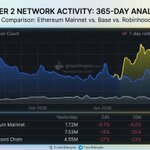
Ethereum L2s have solved a big part of the scaling problem. The next challenge is making the ecosystem work like one.
Yesterday, Ethereum L2s processed 16.63M transactions in a day across tracked networks, according to @growthepie.
But look at how that activity is distributed.
▹ Base: 7.53M transactions
▹ Robinhood Chain: 4.55M
▹ Arbitrum One: 1.27M
@Base alone accounted for roughly 45% of the tracked total. Robinhood Chain contributed another 27%.
The ecosystem is processing activity at scale, but that doesn’t automatically mean users and liquidity move freely between networks.
⊹ This is the part of the L2 debate that deserves more attention.
Every new chain can bring its own applications, liquidity pools, infrastructure, and ecosystem incentives. For users, moving between them can still mean bridging assets, checking network compatibility, managing gas, and finding enough liquidity to execute a trade efficiently.
Cheaper transactions are valuable. But the cost of using crypto isn’t just the fee for one transaction. It’s also the friction involved in getting your assets where they need to be.
And launching another chain doesn’t automatically solve that problem.
⊹ The next stage is chain abstraction.
Users should be able to access applications and liquidity without needing to understand every network involved. Ideally, routing, bridging, and execution happen behind the scenes, while security and transaction outcomes remain transparent.
That doesn’t mean every L2 is unnecessary. Different networks can serve different purposes. But each one needs a reason to exist beyond issuing a token and competing for short-term activity.
Ethereum’s L2 strategy has expanded transaction capacity. The next test is whether that capacity can become a connected user experience rather than a collection of separate ecosystems.
Scaling made transactions cheaper. Connecting the experience is the next challenge.
This is my opinion based on the data reviewed, not financial advice.

GRVT: INSTITUTIONAL FINANCE, ONCHAIN
In my recent post, I covered how @grvt_io aims to let users earn yield while trading, with up to 11% APY on eligible assets.
This time, I want to focus on two other important aspects: control over your assets and access to institutional-grade investment opportunities.
⊹ YOUR ASSETS, YOUR CONTROL
@grvt_io uses a self-custodial model built around onchain smart contracts and user-authorized withdrawals.
Instead of relying entirely on an exchange to control customer funds, users authorize withdrawals with their keys. GRVT says it cannot independently sign a withdrawal and redirect funds to another address.
That distinction matters. You can use an exchange for trading without treating custody as a separate issue. Self-custody doesn’t eliminate smart-contract or infrastructure risks, but understanding who controls your assets is essential.
⊹ INSTITUTIONAL INVESTMENTS, MORE ACCESSIBLE
GRVT aims to bring a share of the estimated $161 trillion traditional fixed-income market onchain through tokenized investment opportunities.
Fixed-income products, including government bonds and debt securities, have long played a major role in institutional portfolios. Access to certain investment products can involve high minimums and eligibility restrictions.
GRVT’s vision is to make eligible opportunities more accessible while bringing investing and trading together on one platform.
The goal is for eligible capital to potentially generate yield while remaining useful for trading, rather than forcing users to treat both activities separately.
The $161 trillion figure represents the wider market, not the amount available on GRVT. Returns aren’t guaranteed, and product terms and risks matter.
For me, the interesting part is the combination of asset control and access to investment opportunities traditionally associated with institutional finance.
That’s also the kind of infrastructure that could shape how users interact with $GRVT and the wider platform as it develops.
This is my opinion based on the information reviewed, not financial advice.

ΞLIKRYPTO retweeted
idle margin that still earns
most of my stables sit on an exchange doing nothing between trades, that always felt like lost opportunity.
what i like here is that eligible USDT and USDC balances on @grvt_io earn yield while they stay put, so you don't have to pick between earning and trading.
small thing, but it changes how you think about keeping cash on the exchange.

GRVT IS BRINGING YIELD AND TRADING CLOSER TOGETHER
One thing I like about what @grvt_io is building is the idea that your capital can earn a return without you having to pull it away from trading.
Through its Earn on Equity programme, eligible USDT and USDC balances earn yield while remaining available for trading. GRVT’s current published terms offer a 3.5% base APY, with a referral bonus that can bring it to 4.5%. Its broader plans also include tokenised fixed-income opportunities, with the campaign highlighting potential yields of up to 11% on eligible assets under the applicable terms.
But an attractive APY is only one part of the equation. How your assets are held, who can authorise their movement and how easily you can access them matter just as much.
This is where GRVT’s self-custodial approach becomes important. User funds are held in onchain smart contracts, and withdrawals require authorisation through the user’s key. GRVT says it does not hold that key and cannot independently sign a withdrawal or redirect funds to an address of its choosing.
That distinction gives users control over the authority to move their assets, rather than relying entirely on a company’s promise to return them.
At the same time, GRVT’s Yield Layer puts otherwise idle reserves to work through approved DeFi protocols, starting with USDT lending on @Aave V3. A dedicated smart-contract vault manages the movement of funds between the trading system and those approved protocols. GRVT also documents emergency controls that can pause new yield allocations while keeping the route open to recover funds from a strategy.
These mechanisms help define where funds can go and how the system responds when something goes wrong. Most withdrawals remain fast, although some large Ethereum withdrawals can enter a queue with a documented two-hour processing deadline.
None of this eliminates risk. Smart contracts can have vulnerabilities, external protocols can suffer losses, and self-custody does not guarantee that every transaction or withdrawal will be free of complications. Understanding those risks is part of making an informed decision about where to put your capital.
This is also why I find GRVT’s wider direction interesting. The platform is working towards connecting trading with tokenised fixed-income investments, potentially giving users more ways to earn while keeping eligible assets useful as trading collateral.
The $GRVT token is part of the broader ecosystem, but it is important to distinguish its role from the yield itself. Returns depend on the specific product, its underlying assets and its terms, not simply on holding $GRVT.
For me, the real value in this approach is the combination of capital efficiency and control. Earning while trading is compelling, but pairing that convenience with transparent fund management, clear withdrawal rules and self-custody is what makes the proposition worth examining closely.
This is my opinion based on the data I’ve reviewed, not financial advice.
It’s the weekend, and it’s time to catch up on what happened in crypto this week.
From market moves to major industry updates, here are the stories that mattered most from October 18–24
Let get into it ▼
𝗠𝗔𝗥𝗞𝗘𝗧𝗦 & 𝗖𝗔𝗣𝗜𝗧𝗔𝗟
⊹ Bitcoin faced selling pressure near $81K as U.S. spot Bitcoin ETFs recorded significant outflows
⊹ @BlackRock filed for PBIT, a proposed Bitcoin ETF combining BTC exposure with options-based downside protection.
⊹ @DeFiLlama reported $89.7B in DeFi TVL, $300.5B in stablecoin market cap, and $43.7B in weekly DEX volume on October 24.
⊹ Ethereum staking reportedly reached 35.9% of ETH supply, with annualized gross yields around 2.63%
⊹ @Strive reportedly bought 1,223 BTC for about $100M, bringing its holdings to 36,818 BTC
𝗜𝗡𝗦𝗧𝗜𝗧𝗨𝗧𝗜𝗢𝗡𝗦 & 𝗣𝗔𝗬𝗠𝗘𝗡𝗧𝗦
⊹ @JPMorgan expanded its dollar-denominated JPM Coin to Ethereum for eligible institutional clients
⊹ @SoFi launched SOFIE, a tokenized bank deposit reportedly offering 4.40% APY—not a stablecoin
⊹ @HSBC launched its HKD stablecoin, RedCoin, through PayMe
⊹ @StanChart agreed to acquire full ownership of Zodia Custody, pending regulatory approval
⊹ Visa reportedly explored acquiring @FireblocksHQ while Visa & Mesh advanced crypto payment integration
𝗗𝗘𝗙𝗜 & 𝗢𝗡-𝗖𝗛𝗔𝗜𝗡
⊹ @AEroDronefrObFl and @VelodromeFi combined their DEX infrastructure under Aero across seven networks
⊹ @Uniswap launched Aggregator Hooks across Ethereum, Base, & Robinhood Chain, connecting v4 to external liquidity and directing supported external-swap fees toward UNI burns.
⊹ @pendle_fi introduced PendleLoop for leveraged yield strategies, amplifying potential gains and losses
⊹ @NEARProtocol launched NEAR Business, a confidential multisig treasury for payments, swaps, & treasury management across 35+ chains
⊹ @Injective partnered with BDACS to support KRW1, a Korean won-pegged stablecoin for tokenized-asset settlement
⊹ @Dune launched real-time trading data feeds covering 200+ onchain venues across 12 networks
⊹ @CMEGroup announced planned standard and micro Bitcoin Cash and Uniswap futures, subject to regulatory review
𝗧𝗢𝗞𝗘𝗡𝗜𝗭𝗘𝗗 𝗦𝗧𝗢𝗖𝗞𝗦
⊹ Twenty-two companies reportedly objected to plans to list their shares on a proposed OKX–ICE tokenized securities platform, highlighting concerns over issuer consent, securities regulation, and shareholder rights
𝗣𝗥𝗢𝗧𝗢𝗖𝗢𝗟𝗦 & 𝗜𝗡𝗙𝗥𝗔𝗦𝗧𝗥𝗨𝗖𝗧𝗨𝗥𝗘
⊹ @Solana activated Alpenglow, targeting approximately 150ms finality versus roughly 12.8 seconds under the previous design
⊹ @LayerZero_Core targeted November 30 for its planned Zero L1 blockchain & lzATLAS trading engine.
⊹ Ethereum postponed Glamsterdam’s Hoodi testnet activation for further technical investigation; no replacement date was confirmed.
𝗥𝗘𝗚𝗨𝗟𝗔𝗧𝗜𝗢𝗡
⊹ The @USOCC finalized a GENIUS Act implementation rule for payment stablecoin issuers under its jurisdiction, effective January 18, 2027.
⊹ Ireland’s Central Bank fined @Coinbase Ireland approximately €3.25M over customer-fund safeguarding and outsourcing failures. High Court confirmation remains pending.
𝗦𝗘𝗖𝗨𝗥𝗜𝗧𝗬
⊹ @cysic_xyz suspended its bridge after an attacker minted 10 million unauthorized CYS tokens on BNB Chain. About $727K reportedly reached Ethereum.
⊹ @initia halted its network following unauthorized token minting, with preliminary estimates of $2.6M–$2.7M in affected assets; final losses remain unconfirmed.
⊹ Bitcoin Core updated its vulnerability-disclosure policy amid concerns that AI tools can make security flaws easier to identify.
━━━━━━━━━━━━━━
𝗪𝗛𝗔𝗧 𝗦𝗧𝗢𝗢𝗗 𝗢𝗨𝗧
Crypto’s progress continues to depend on capital flows, real-world utility, reliable infrastructure, regulatory clarity, & user protection.
Institutions expanded tokenized deposits and blockchain payments, while DeFi advanced multichain trading & liquidity.
Hope you found this useful. See you on the next one

ΞLIKRYPTO retweeted

saw this last night, shipped it this morning
Netro Signal now watches 20 big accounts across
solana, base, hyperliquid and more,
and pings you when a fresh project follows them
free on [@ netrosignal_bot], just send /follows on


One useful tool I'd love to see someone build is an X or Telegram bot that alerts users whenever a new project follows a major account within a particular ecosystem.
Here's the thinking.
When new projects start building on ecosystems like Solana or Base, one of the first things they often do is follow the ecosystem's official X account, founders, and other influential voices.
These follow patterns could serve as early signals for discovering emerging projects, sometimes before they gain significant attention.
Imagine a bot tracking these activities and sending real-time alerts, helping researchers, job seekers, and ecosystem contributors discover projects early.
Of course, a follow doesn't necessarily mean a project is legitimate or building on that chain, but it could be a useful discovery signal.
Who's building something like this already? Or does it exist?
GRVT: THE 11% APY HAS A DETAIL MOST PEOPLE WILL MISS IF THEY ONLY READ THE HEADLINE.
I’ve been posting about @grvt_io lately, from its first buyback and burn to the developments leading up to GRVT 2.0.
Today, I want to highlight something about its yield model that deserves more attention.
It’s not just about earning interest. It’s about what happens to your capital while you’re waiting for your next trade.
Here’s the part worth understanding.
✧ THE 11% APY ISN’T THE BASE RATE
GRVT’s Earn on Equity program offers a base rate of 3.5% APY on eligible USDT and USDC balances.
According to its published program, eligible users can receive an additional 1% APY through referrals, while trading activity can unlock a further boost of up to 6.5%.
That brings the potential maximum to 11% APY.
In other words, the headline rate depends on how you participate. It isn’t an automatic 11% return for every depositor.
The base yield accrues automatically, and eligible balances remain available for trading. GRVT says yield is paid daily in USDT. ( 11% isn’t guarantee it only offer up to )
✧ THERE’S ALSO A SEPARATE INVESTMENT OPPORTUNITY
GRVT’s investment products include an Opportunistic Bundle targeting up to 11% annually.
That is a different product from Earn on Equity. Its current strategy has been associated with Brazilian card receivables through BlackOpal LiquidStone, introducing credit risk that users must understand.
The target isn’t guaranteed, and investment returns can differ from expectations.
This distinction matters because the same headline APY can describe very different ways of generating returns.
✧ WHAT ALSO MATTERS FOR GRVT 2.0
GRVT is working toward an experience where users can earn yield, invest and trade through a unified self-custodial balance.
Its planned Yield as Margin feature is particularly interesting because eligible balances in GRVT Earn are intended to continue generating yield while supporting trading positions, subject to the product’s conditions.
That would connect two activities that are often separated across different platforms.
The first $GRVT buyback and burn brought attention to the token. But the yield infrastructure and the products built around it are worth examining on their own merits.
The main deal isn’t just the promise of 11% APY. It’s understanding where the yield comes from, what determines your actual rate, and whether your capital can remain useful while you trade.
I’ll be covering other aspect of $GRVT also stay tuned
This is my opinion based on the information reviewed, not financial advice. Yield targets are not guaranteed.

NEAR BUSINESS: CONFIDENTIAL TREASURY MANAGEMENT
Public blockchains expose financial activity, but businesses need privacy for payroll, vendor payments, treasury balances and capital allocation.
@NEARProtocol addresses this with NEAR Business, a confidential multisig treasury combining payments, cross-chain swaps, capital allocation and financial records in one dashboard.
▹ HOW IT WORKS
Three components underpin the system.
✧ Treasury Contract: Each treasury uses a SputnikDAO multisig contract on NEAR mainnet, enforcing configured transaction approvals.
✧ MPC Signing: NEAR’s multiparty computation network handles signing. NEAR states that the platform cannot unilaterally access treasury funds through a key or key share.
✧ Confidential Execution: A confidential NEAR shard, operated by independent permissioned validators, protects transaction details from public observers
✧ Payments: Pay employees and vendors individually or in bulk through CSV uploads.
✧ Capital Allocation: Manage treasury positions, reserves and rebalancing under configured approval rules.
✧ Cross-Chain Swaps: Exchange assets through NEAR Intents without maintaining separate workflows for every chain.
✧ Financial Records: Export transaction histories as CSV, Excel or JSON, with PDF receipts for accounting and audits.
✧ Team Controls: Configure roles, approval thresholds and named contacts, with support for Ledger, passkeys and compatible wallets.
NEAR Business advertises support for 35+ chains and 200+ assets, including $BTC, $ETH, $SOL, $NEAR, $Arbitrum, $Base, Optimism, Polygon, BNB Chain, TON, Sui, Aptos, Cardano, Stellar, XRP, Dogecoin and Litecoin.
▹ CROSS-CHAIN EXECUTION
NEAR Intents lets users specify an outcome while competing solvers attempt to fulfil it. A verifier contract on NEAR handles settlement.
NEAR says swaps settle atomically, meaning transactions either complete as intended or follow the protocol’s refund logic.
This brings cross-chain execution into the same workflow as treasury payments and approvals.
▹ PRIVACY HAS LIMITS
NEAR says team membership, roles and votes remain verifiable onchain while transaction amounts, assets and recipients stay confidential.
However, payments to public wallets originate from a business.near.com settlement account rather than directly from the treasury address. This changes the visible transaction path but does not guarantee complete anonymity.
Transaction data may also be processed for operational, security and legal purposes.
Teams should review the contracts, signing arrangements, recovery procedures, validator dependencies and available security assessments before committing substantial funds.
▹ PRICING AND ACCESS
NEAR Business advertises no subscription, annual contract or per-seat fees, with unlimited users and no asset caps.
NEAR covers gas for the first 1,000 actions monthly. Standard network fees apply afterward, while swaps carry a 0.35% fee, included in the quote presented for approval.
Access remains invite-only while NEAR onboards its initial teams.
WHY IT ACTUALLY MATTERS
Crypto businesses need controlled spending, reliable records, cross-chain execution and financial privacy.
NEAR Business combines these functions through multisig approvals, MPC signing and confidential execution.
Its long-term value will depend on implementation security, infrastructure reliability and how effectively its privacy guarantees hold up in practice.
This is my opinion based on the data I’ve reviewed, not financial advice.

Following my earlier breakdown of @Solana’s Alpenglow upgrade, it’s officially live on mainnet. ⛰️
October 21, 2026
Built by @anza_xyz, Solana’s biggest consensus upgrade targets ~150ms finality, down from ~12.8 seconds.
The upgrade is live. Now it’s time to see the impact.

SOLANA ALPENGLOW: THE 150MS FINALITY RACE
@Solana is targeting 150ms consensus finality, potentially reducing the time applications wait for transactions to become irreversible.
Developed by @anza_xyz, Alpenglow replaces TowerBFT with Votor, a redesigned consensus protocol.
▹ WHAT ALPENGLOW CHANGES
✧ Fast path: One-round finalization with 80% of stake.
✧ Fallback: Two-round finalization using notarization and finalization certificates, each requiring 60% of stake.
✧ Lower overhead: Validators communicate votes directly and aggregate them into cryptographic certificates, removing ordinary on-chain vote transactions.
Solana’s slot duration was separately reduced from 400ms to 200ms. Slot time measures block production; Alpenglow targets consensus finality.
Rotor, planned for a later phase, improves block-data propagation between validators.
Votor accelerates consensus; Rotor improves data distribution. The initial Votor rollout does not replace Solana’s SVM or require smart-contract rewrites.
▹ THE SECURITY TRADE-OFF
Alpenglow’s 20% + 20% resilience model aims to maintain liveness with up to 20% malicious stake and another 20% unresponsive stake under its protocol assumptions. It cannot guarantee protection against every attack or implementation failure.
▹ WHAT THE NUMBERS SHOW
✧ Current TowerBFT finality: ~12.8 seconds.
✧ Alpenglow target: ~150ms.
✧ Potential improvement: ~85× faster under comparable conditions.
Mainnet activation is scheduled for October 21, 2026, according to Solana’s upgrade documentation.
▹ HOW OTHER L1s COMPARE
These figures measure different things and are not standardized benchmarks.
✧ @ethereum — ~12-second slots | ~13–15 minutes for protocol finality.
✧ @SuiNetwork — ~300ms Mysticeti consensus latency | ~400–700ms end-to-end finality in its documentation.
✧ @AptosLabs — Simple payments typically commit in under 1 second under normal conditions.
✧ @BNBCHAIN — ~650ms deterministic finality.
✧ @ton_blockchain — ~400ms masterchain blocks | ~1-second transaction finality.
✧ @SeiNetwork — ~400ms target block time | ~800ms deterministic finality.
✧ @avax — C-Chain finality under 1 second | probabilistic finality.
✧ @NEARProtocol — ~600ms block intervals | ~1.2-second transaction finality.
✧ @trondao — ~3-second blocks | ~1-minute solidification under healthy conditions.
✧ @monad — ~400ms block frequency | ~800ms finality.
Actual performance varies with network conditions, geography, transaction type and how finality is measured.
▹ WHY THIS MATTERS
Block time measures block frequency; transaction latency measures processing and confirmation; consensus finality indicates when transactions become irreversible under protocol rules.
Fast blocks do not guarantee fast finality. If achieved reliably, Alpenglow could improve trading, DeFi, payments and cross-chain settlement. It will not automatically increase throughput, deepen liquidity or eliminate MEV and smart-contract risks.
▹ WHAT WILL VALIDATE ALPENGLOW
✧ Finality: Mainnet performance approaches 150ms consistently.
✧ Resilience: Votor maintains safety and liveness within its fault assumptions.
✧ Certificates: The 80% fast path and 60% fallback work reliably.
✧ Stability: Consensus withstands congestion and network disruptions.
✧ Throughput: Measure application transactions separately from validator votes.
✧ Adoption: Applications demonstrate faster settlement.
▹ MY TAKE
Alpenglow targets a fundamental blockchain constraint: consensus-finality time. Votor improves agreement; Rotor addresses data distribution.
The real test is consistently fast finality, safety under stress and measurable improvements for applications.
This is my opinion based on the data I’ve reviewed, not financial advice.

GRVT 2.0: THE IDEA OF MAKING YOUR CAPITAL EARN WHILE YOU TRADE
Yesterday, I covered @grvt_io’s first 1.1M $GRVT buyback and burn.
Going through the announcement, I found something more interesting than the buyback itself: Grvt wants users to earn yield while keeping their capital available for trading.
Here’s how the team plans to make that happen.
▹ GRVT EARN
Expected in late October, Grvt Earn will introduce tokenized fixed-income strategies targeting yields of up to 11%.
That’s a target, not a guarantee. The underlying assets, partners and risks will matter.
▹ STABLE FUNDING PERPS
Planned for November, this will expand beyond crypto into stocks, FX, commodities and indices, with zero trading fees and funding settled once daily.
Grvt targets 1,000+ markets by December 2026. Liquidity, execution and the actual cost of holding positions will determine their value.
▹ YIELD AS MARGIN
Grvt plans to let users use eligible Earn balances as trading margin while continuing to generate yield.
This could make capital more efficient by connecting earning and trading in one experience.
However, collateral valuation, eligibility and liquidation rules are crucial. Yield won’t protect users from leveraged trading losses.
▹ GRVT 2.0 APP
Expected in late November, the redesigned app aims to combine Earn, trading and a unified self-custodial balance. Grvt also plans to reveal its 2027 roadmap.
✧ WHAT I’LL BE WATCHING
The concept is interesting, but execution matters most. I’ll be watching the Earn partners, market liquidity and how Yield as Margin manages collateral and liquidation risks.
Grvt’s first 1.1M $GRVT buyback and burn is complete. Future buybacks are planned monthly but remain discretionary.
Buyback dashboard: grvt.io/exchange/buyback
Official announcement: grvt.io/es/blog/v2/the-road-…
Yield as Margin is the feature I’ll be watching most closely. Its implementation will matter more than the promise.

I’ve been going through the list of crypto projects that have shut down this year, and it’s becoming clear that we need an honest conversation about this industry.
We spend our time tracking launches, funding rounds, token listings, airdrops and new narratives. We celebrate projects raising millions and communities growing by thousands.
But how often do we check whether these projects are still alive a year later, whether people actually use their products, or whether the business can survive without fresh funding?
This year is giving us a painful answer.
On August 18, @DefiLlama reported that 100 projects had announced shutdowns in 2026, including 40 announcements in the preceding 90 days. Together, they had raised around $1B and generated approximately $250M in lifetime fees. Remember, fees generated are not the same as profit.
Check it out here: newsletter.defillama.com/p/t…
Separately, researcher @stacy_muur identified 82 projects reportedly shut down this year. The figures use different methodologies and should not be added together.
Checkout the post: xitter.cf/stacy_muur/status/2112…
The reasons vary, but DefiLlama identified lack of product-market fit as the most commonly stated reason, followed by exhausted funding, insufficient revenue and decisions to pivot.
Market conditions matter. When liquidity dries up, trading slows, incentives lose their appeal and funding becomes harder to secure. But a downturn cannot explain every failure. Sometimes, the business model was never sustainable.
This is where CT needs to be honest with itself.
We celebrate funding as validation, TVL as adoption and attention as proof of success. People chase airdrops and narratives without understanding what a product does or how it generates revenue.
A project raising millions doesn’t guarantee a good business. A large community doesn’t guarantee loyal users. And a rising token price doesn’t prove the underlying product is sustainable.
For users, don’t assume a project is safe because its website still works or its token is trading. Check official announcements, withdrawal deadlines and whether the product is maintained.
For researchers, look beyond hype. Examine actual users, sustainable revenue, operating costs, funding runway and security. Early-stage projects don’t need immediate profits, but they need a credible path to sustainability.
Not every shutdown means the technology was worthless. We need to understand why projects fail instead of blindly following hype or declaring entire sectors dead.
The goal isn’t just to find a project early. It’s to recognise one whose value survives after the attention disappears.
In my next post, I’ll break down some of these projects, why they shut down, and the lessons we can learn from their failures.
This is my opinion based on the data I’ve reviewed, not financial advice.


MAPPING THE AI AGENT ECONOMY IN CRYPTO
Yesterday, I covered the risks AI agents pose to crypto users. Today, I’m looking at the other side: the projects building the agents, tools and infrastructure behind this sector.
AI agents are moving beyond simple chatbots. They’re being developed to analyse markets, interact with DeFi, execute onchain transactions and coordinate tasks with other agents.
I’ve put together a list of projects building different parts of the ecosystem
✧ AGENTS, TRADING & ONCHAIN EXECUTION
✧ @bankrbot — AI-powered crypto interactions and onchain execution.
✧ @virtuals_io — infrastructure for creating and coordinating AI agents.
✧ @Fetch_ai — autonomous agents for discovering services and coordinating tasks.
✧ @autonolas — infrastructure for collaborative autonomous services operating onchain.
✧ @griffaindotcom — AI-driven crypto interactions, particularly on Solana.
✧ @almanak — tools for developing, testing and deploying automated DeFi strategies.
✧ @gizatechxyz — autonomous agents for executing and optimising DeFi strategies.
✧ @Sonar_Trade — automated onchain trading, including market making and position management.
✧ @AIWayfinder — infrastructure helping AI agents navigate blockchain environments and execute actions.
✧ @HeyAnonai — natural-language interface for interacting with DeFi.
✧ @aixbt_agent — AI-powered crypto market intelligence and narrative tracking.
✧ @cookiedotfun — data and analytics for tracking AI agents and their activity.
✧ @Spectral_Labs — infrastructure connecting machine learning with blockchain applications.
✧ @GoKiteAI — AI-agent infrastructure for payments and interactions between agents and services.
✧ @awenetwork_ai — infrastructure for agent-based economies and coordination.
✧ FRAMEWORKS & DEVELOPER TOOLS
✧ @elizaOS — open-source framework for building AI agents and connecting them to services.
✧ Rig by @arcdotfun — Rust framework for building modular AI agents and applications.
✧ goat_sdk by @crossmint — toolkit enabling AI agents to interact with blockchains and crypto protocols, including token swaps.
✧ @CoinbaseDev — AgentKit provides tools for building agents that interact with blockchain networks.
✧ @ShinkaiLocalAI — AI workflow tools emphasising local execution and user control.
✧ @NEARProtocol — infrastructure for AI applications, private inference and user-owned agents.
✧ @Talus_labs — infrastructure focused on verifiable agent execution, onchain permissions and execution limits.
✧ @Ritualnet — infrastructure bringing AI inference and execution onchain.
✧ COMPUTE, DATA & DECENTRALISED INTELLIGENCE
✧ @opentensor — Bittensor coordinates specialised digital services through incentive-driven subnet networks.
✧ @AlloraNetwork — decentralised intelligence network producing predictive outputs for applications.
✧ @ionet — decentralised access to GPU computing resources.
✧ @AethirCloud — distributed GPU infrastructure for AI and cloud computing.
✧ @rendernetwork — distributed GPU infrastructure for rendering and AI workloads.
✧ @akashnet_ — decentralised marketplace for cloud computing.
✧ @grass — network sourcing web data for AI-related use cases.
✧ @vana — infrastructure for user-contributed data and data ownership in AI ecosystems.
✧ @NousResearch — open AI research focused on models and related tools.
✧ PRIVACY & CONFIDENTIAL COMPUTING
✧ @zama — fully homomorphic encryption enabling computation on encrypted data without decrypting it first.
✧ @PhalaNetwork — confidential computing infrastructure for applications requiring protected execution environments.
I’ll investigate the products, adoption, technical design, security and token utility where applicable, separating proven value from promises.
This content is based on my research and analysis for informational and educational purposes only. It is not financial advice.
