




ΞLIKRYPTO retweeted

how X ranks your posts (breakdown of the new algo update)
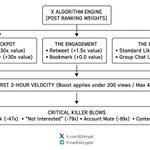
the X algo predicts how each person will react to your post, and that then decides if and where it shows up in their feed
here's how much each reaction counts, compared with a like:
> someone copies the link: 30x
> someone you follow back replies: 30x
> a reply, a quote or a DM share: 7.6x
> a follow from the post: 6x
> a repost: 1.5x
> a like: 1x
> a bookmark: 0
the negative actions weigh far more, a report is -355x a like, a mute -89x, "not interested" -79x and a block -47x
if X predicts someone is likely to mute or report your post, it ranks lower in their feed
reports get a big weight because they are rare, a report is over 1,000x less likely than a like
these rules decide how far a post can reach:
> if you have 50,000 followers or fewer, X can boost a new original post up to about 16th place in someone's feed
> the boost only works in the post's first 2 hours, and stops once the post has 200 views in the Home feed
> X boosts one post each time a feed loads, and it prefers posts that got the most likes per view from their first viewers
> after 48 hours, X stops putting your post in people's feeds
> your replies and reposts only show up in the feeds of people who follow you
> original posts can also reach people who don't follow you, X scores them 25% lower for those people
> when several of your posts compete for one person's feed, the 2nd keeps 62.5% of its score and the 3rd keeps 43.75%
> replies, quotes, DM shares and copied links only count when people find your post in their feed, so engagement from a group chat link adds nothing
> if X labels your post low quality, it shows a notice on it and people can't like, reply, repost, bookmark or share it, misinformation labels can limit it too
what I'd do with it (my read of the weights):
> post when you can reply in the first 2 hours
> write posts people want to quote, reply to or send in a DM
> reply back to accounts that follow you
> post originals when you want to reach new people


X ALGORITHM UPDATE 🚨
X just stopped cutting new posts first, and that should help small accounts (I check it daily with Claude and share updates worth sharing with you)
tl;dr:
- X can only check 2,800 posts each time you open your feed
- new posts used to be last in line, so they got cut first
- now everything gets cut equally, new posts included
- posts labeled low quality or misinfo now show a warning, and people can't like, reply or share them
- no score changes this time
lesson learned: your new posts now get a fair chance to be seen. Your first 2 hours still matter most.
full details:
- How it worked until this week
Every time someone opens For You, X collects around 3,700 posts it could show them: posts from people they follow, popular posts, posts liked by similar people, and brand new posts.
But X only has time to check 2,800 of them.
So it just took the first 2,800 in line. Brand new posts were at the back of the line. When there were too many, they were the ones left out... and a post that never gets checked can't be shown.
- What changed
Now everything gets cut by the same amount. 25% too many? Every type of post loses 25%, new posts included. Nobody goes first.
- Why small accounts should care
Those brand new posts are under 2 hours old, with under 8 likes and under 500 views. That's where most posts from smaller accounts are.
My read: they now get a fair chance instead of being cut first. How often X actually hits the 2,800 limit isn't in the code, so I can't tell you how big the difference is.
- Low quality and misinfo posts now show a warning
If X labels your post as low quality or misinformation, people who don't follow you see a warning on it, and they can't like, reply, repost, bookmark or share it. The code doesn't say what gets a post that label.
Here's a recap of what you should be doing:
- a new post gets its extra push only in its first 2 hours and first 200 views, so post when your people are online
- likes carry more weight than ever at 0.66 each
- people sticking around pays, the time-spent score is 50% higher than two weeks ago
- a read of 10+ seconds after someone opens your post adds 0.4
- the boost favors the post with the best like rate from its first viewers
- accounts up to 50K can get one fresh original lifted to roughly 16th
- nothing beats a copy link share, it scores 20
- replies, quotes and DM shares each score 5
- talk with your mutuals, replies between you score 20 instead of 5
- originals are the only posts that travel outside your follower base
- the 1st and the 32nd like each open a new route to strangers
- your 2nd post in the same feed is worth 62% of the first, so pick your best one
- videos still need 10+ seconds to qualify for the video lists
- earning a follow adds 4
- a pinned post with a bad link can flag the account for 7 days, worth a quick check
What you should NOT be doing:
- posts that get labeled low quality or misinfo now carry a warning, and nobody outside your followers can like or share them
- video alone won't carry you, an open counts 0.02 and the watch 0
- hide-worthy posts cost more, "not interested" sits at -52.27
- a post at 3am burns its 2 hour window before anyone sees it
- a tap that turns into a bounce is worth only 0.3
- replies and reposts don't get past your followers
- insults get your post hidden from anyone who doesn't follow you
- adult media in 3 of your last 5 posts puts a label on your account
- disguised content in videos gets checked from 64 likes, harder at 512
- self-reply chains under big accounts risk being zeroed
- one account label and non-followers stop seeing you entirely
- low-rated links don't belong in your pinned post
- recycled wording can get tagged as copypasta spam
- strangers tagged plus a low quality link is a pattern X flags
- engagement bait has no size exemption
- several posts in a row end up competing with each other
- hashtag stacks add nothing
- bookmarks are still worth 0
- 48 hours in, For You is finished with a post

ΞLIKRYPTO retweeted

The cheapest MEV defense is the trade you never send. In Fund OS, built in public at @MessyVirgoCoin , a cost check stopped an agreed buy and a failed test run stopped a sale. Should agents be scored on trades they skip?


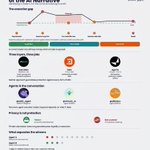
THE BLIND SPOT OF THE AI NARRATIVE: THE EMERGING MEV BATTLE
Everyone on CT is talking about the Agentic Economy: autonomous machine networks managing capital, executing cross-protocol trades, and operating across DeFi.
But there is a technical problem beneath this narrative.
An intelligent agent can identify a profitable arbitrage opportunity, calculate the optimal trade, and still fail to capture the expected return.
Identifying an opportunity and executing it profitably are two different problems.
✧ THE EXECUTION GAP
Consider an AI agent identifying a price discrepancy between two DEXs.
It submits a transaction, but another searcher captures the opportunity, liquidity changes, or slippage erodes the expected return. If exposed to a vulnerable public execution path, it may also face a sandwich attack.
The model can be correct while the economics fail.
This matters when evaluating market intelligence from @aixbt_agent and autonomous agent platforms such as @virtuals_io and @ai16zdao.
Not every AI agent executes trades, and exposure depends on its activities and transaction pathway.
✧ THREE LAYERS THAT MATTER
⊹ Execution protection — Flashbots and @jito_labs
Flashbots Protect routes Ethereum transactions through a private transaction flow, reducing exposure to public-mempool front-running and sandwich attacks. On Solana, Jito’s DontFront mechanism can constrain transaction ordering within qualifying bundles.
Neither approach guarantees protection against every form of MEV.
⊹ Data verification — @primus_labs
Primus’s zkTLS approach addresses verification of information originating from Web2 services.
For agents relying on external data, this can help establish whether information is trustworthy. However, authentic data does not automatically protect subsequent transactions from front-running.
⊹ Agent infrastructure — @vangrid_io, @agentic_ai and @TermiX
These projects belong to the broader discussion around decentralized intelligence and automated workflows. Their capabilities must be assessed individually rather than assuming they all execute financial transactions or share identical vulnerabilities.
An agent’s risk profile depends on its permissions, transaction pathways, and control over capital.
✧ THE PRIVACY MISCONCEPTION
Privacy is not a single security feature.
Solana’s Token-2022 Confidential Transfers are designed to conceal transfer amounts and balances. They do not automatically conceal every transaction detail or prevent transaction-ordering manipulation.
Similarly, private transaction submission does not guarantee favourable pricing, sufficient liquidity, or successful execution.
Data verification, transaction confidentiality, and MEV protection solve different problems.
Confusing these layers can create a false sense of security around autonomous systems managing real capital.
✧ WHAT WILL SEPARATE THE WINNERS
I think the next phase of the Agentic Economy will depend less on agent counts and more on how reliably agents create economic value.
Look beyond mindshare.
Examine realised returns after transaction costs, execution failures, slippage, liquidity constraints, and risk controls.
An agent that identifies ten opportunities but consistently fails to capture their value may be less useful than one that identifies fewer opportunities and executes them efficiently.
The challenge is combining trustworthy data, sound decisions, and execution infrastructure that protects the value those decisions should create.
I think the strongest agentic systems will turn intelligence into measurable economic results without surrendering unnecessary value during execution.
The AI narrative tells us what agents might do. Their execution economics will show us what they can actually deliver.
This is my opinion based on the data I’ve reviewed, not financial advice.

ΞLIKRYPTO retweeted

Tokenisation is only the first step, putting it to work in Defi is the hard part
Here is where xStocks now are winning in the market
ΞLIKRYPTO retweeted
idle margin that still earns
most of my stables sit on an exchange doing nothing between trades, that always felt like lost opportunity.
what i like here is that eligible USDT and USDC balances on @grvt_io earn yield while they stay put, so you don't have to pick between earning and trading.
small thing, but it changes how you think about keeping cash on the exchange.
GRVT IS BRINGING YIELD AND TRADING CLOSER TOGETHER
One thing I like about what @grvt_io is building is the idea that your capital can earn a return without you having to pull it away from trading.
Through its Earn on Equity programme, eligible USDT and USDC balances earn yield while remaining available for trading. GRVT’s current published terms offer a 3.5% base APY, with a referral bonus that can bring it to 4.5%. Its broader plans also include tokenised fixed-income opportunities, with the campaign highlighting potential yields of up to 11% on eligible assets under the applicable terms.
But an attractive APY is only one part of the equation. How your assets are held, who can authorise their movement and how easily you can access them matter just as much.
This is where GRVT’s self-custodial approach becomes important. User funds are held in onchain smart contracts, and withdrawals require authorisation through the user’s key. GRVT says it does not hold that key and cannot independently sign a withdrawal or redirect funds to an address of its choosing.
That distinction gives users control over the authority to move their assets, rather than relying entirely on a company’s promise to return them.
At the same time, GRVT’s Yield Layer puts otherwise idle reserves to work through approved DeFi protocols, starting with USDT lending on @Aave V3. A dedicated smart-contract vault manages the movement of funds between the trading system and those approved protocols. GRVT also documents emergency controls that can pause new yield allocations while keeping the route open to recover funds from a strategy.
These mechanisms help define where funds can go and how the system responds when something goes wrong. Most withdrawals remain fast, although some large Ethereum withdrawals can enter a queue with a documented two-hour processing deadline.
None of this eliminates risk. Smart contracts can have vulnerabilities, external protocols can suffer losses, and self-custody does not guarantee that every transaction or withdrawal will be free of complications. Understanding those risks is part of making an informed decision about where to put your capital.
This is also why I find GRVT’s wider direction interesting. The platform is working towards connecting trading with tokenised fixed-income investments, potentially giving users more ways to earn while keeping eligible assets useful as trading collateral.
The $GRVT token is part of the broader ecosystem, but it is important to distinguish its role from the yield itself. Returns depend on the specific product, its underlying assets and its terms, not simply on holding $GRVT.
For me, the real value in this approach is the combination of capital efficiency and control. Earning while trading is compelling, but pairing that convenience with transparent fund management, clear withdrawal rules and self-custody is what makes the proposition worth examining closely.
This is my opinion based on the data I’ve reviewed, not financial advice.


ΞLIKRYPTO retweeted

saw this last night, shipped it this morning
Netro Signal now watches 20 big accounts across
solana, base, hyperliquid and more,
and pings you when a fresh project follows them
free on [@ netrosignal_bot], just send /follows on


One useful tool I'd love to see someone build is an X or Telegram bot that alerts users whenever a new project follows a major account within a particular ecosystem.
Here's the thinking.
When new projects start building on ecosystems like Solana or Base, one of the first things they often do is follow the ecosystem's official X account, founders, and other influential voices.
These follow patterns could serve as early signals for discovering emerging projects, sometimes before they gain significant attention.
Imagine a bot tracking these activities and sending real-time alerts, helping researchers, job seekers, and ecosystem contributors discover projects early.
Of course, a follow doesn't necessarily mean a project is legitimate or building on that chain, but it could be a useful discovery signal.
Who's building something like this already? Or does it exist?
ΞLIKRYPTO retweeted

Call me paranoid, but be extra careful visiting ANY web site in the next few days, as some web admins are not always up-to-date with security patches.
Two vulnerabilities (CVE-2026-109618 and CVE-2026-109619) reported for PHP, the web programming language, affecting servers running popular apps like WordPress and Magento, with patches released October 21, 2026 after details leaked early.
Exploitation was confirmed in the wild soon after disclosure, prompting quick WAF protections and patching by IT teams, as unauthenticated attacks could turn visited sites into vectors for credential theft or device exploits.
Stay SAFU!
ΞLIKRYPTO retweeted

Most active last 6h on @base
Point at the one you are quietly stacking and not telling the timeline about
🟦 $AERO @aerodromefi $6.01M
🟦 base:0x29cc30f9d113b356ce408667aa6433589cecbdca @christanxsx $1.99M
🟦 $VIRTUAL @virtuals_io $891.8K
🟦 $ICNT @Icnt_onbase $727.5K
🟦 $VVV @AskVenice $528.5K
🟦 $MORPHO @morpho $518.7K
🟦 $DRV @derivexyz $368.3K
🟦 base:0xeeee77bc7e82c0d4166d52f58239d4c5bf41eeee @ethos_network $162.9K
🟦 $ZEN @horizenglobal $117.7K
🟦 $TIBBIR @ribbita2012 $110.9K
🟦 $RSC @ResearchHub $108.8K
🟦 $CTR @citrea_xyz $93.8K
🟦 $EDEL @edeldotfinance $85.5K
🟦 base:0xb3b32f9f8827d4634fe7d973fa1034ec9fddb3b3 @b3dotfun $58.6K
🟦 $O @o1_exchange $42.8K
Follow @base_rss to not miss the latest trends on base!

ΞLIKRYPTO retweeted
Already hold US stocks? @Bitget now lets eligible users transfer 3,000+ supported stocks and ETFs into Bitget and receive tokenized versions (rTokens) in their spot accounts.
A $1M rSPCX reward pool is live:
✧ $5K+ transfer: $200 in rSPCX
✧ $20K+: $800 in rSPCX + $50 fee voucher
✧ $50K+: $2,000 in rSPCX + $150 fee voucher
Only your first transfer qualifies. Rewards are paid in three instalments, subject to your holdings retaining at least 80% of their initial credited value before each payment. Rewards are first-come, first-served.
Transfers in are free, but processing takes around 10 business days. rTokens do not represent direct share ownership.
🤝 Paid partnership


ΞLIKRYPTO retweeted

Everyone talks about which crypto will dominate the next bull run.
But the bigger question is which blockchains are actually preparing for the quantum era?
I examined 28 projects and the differences are striking.
Let's break them down:
• @NEARProtocol ( $NEAR ): ML-DSA-65 account key rotation while retaining addresses.
• @Algorand ( $ALGO ): Falcon State Proofs and native Falcon-1024 accounts; consensus upgrades remain pending.
• @NervosNetwork ( $CKB ): Live SPHINCS+ lock, but classical signatures remain the default.
• @Tensorcash ( $TSC ): Optional ML-DSA-65 addresses; actual spending not yet demonstrated.
• @QRLedger ( $QRL ): XMSS signatures since 2018; Zond’s ML-DSA-87 validator design remains on testnet.
• @QuantusNetwork ( $QTC ): Launched September 2026 with ML-DSA signatures; 21M supply cap and 27% premine unlocking from September 2027.
• @PQabelian ( $ABEL ): Privacy-focused PoW chain using lattice cryptography, including Dilithium and Kyber.
• @cellframenet ( $CELL ): Falcon, Dilithium and SPHINCS+ support; mainnet defaults remain unclear.
• @Neptune_WEB3 ( $XNT ): Hash-based cryptography and zk-STARKs; security and governance concerns need verification.
• @ethereum ( $ETH ): PQ consensus research continues; major upgrades may take years.
• @trondao ( $TRX ): Falcon-512 and ML-DSA-44 on Nile testnet.
• @Zcash ( $ZEC ): Planned hash-based signature opcodes; shielded assets need separate migration.
• @SuiNetwork ( $SUI ): ML-DSA-65 accounts targeted for testnet by end-2026 and mainnet in Q1 2027.
• @Aptos ( $APT ): Accepted AIP-137 proposes SLH-DSA, with deployment not considered urgent.
• @tezos ( $XTZ ): Quantumnet testnet explores ML-DSA-44 accounts and hash-based attestations.
• @monad ( $MON ): Quantum-resistant account keys and consensus remain roadmap work.
• @QANplatform ( $QANX ): Dilithium cross-signing remains testnet-only in the collection.
• @MovaNAORIS ( $NAORIS ): PQ-focused security L1; reported mainnet access was invite-only, with cryptographic details needing verification.
• @qoneqtapp ( $QONE ): Falcon-based qVAULT protects assets inside the vault, not all HyperEVM accounts.
• @zksync ( $ZK ): STARK-based Airbender prover, but ECDSA accounts and a SNARK wrapper leave dependencies.
• @aztecnetwork ( $AZTEC ): Quantum-security roadmap awaited; no specific PQ migration established.
• @NexusMutual ( $NXS ): Security-focused architecture associated with signature chains.
• @_Qubic_ ( $QUBIC ): Quantum-computing-related ecosystem, with less direct PQC exposure.
• @mindnetwork_xyz ( $FHE ): Focuses on fully homomorphic encryption, not demonstrated native PQ signatures.
• @Amechainquantum ( $AME ): Smaller blockchain associated with PQ security claims.
• @GeeqOfficial ( $GEEQ ): Security-focused blockchain infrastructure.
• @qu_stream ( $QST ): Smaller project making quantum-hardness claims.
• @tidecoin ( $TDC ): Early hash-based post-quantum blockchain project.
—
As more projects or PQC protocols come up, I will be updating this series.
Happy to know others I might have missed.


Crypto spent years treating privacy and post-quantum security as two separate problems.
They are starting to converge.
Privacy protects what financial activity users expose today and Post-quantum cryptography protects whether those same users can still prove ownership if today's signature schemes eventually become vulnerable.
Bitcoin already has roughly 6.04M BTC sitting behind exposed public keys, equivalent to about 30.2% of issued supply.
No quantum computer can exploit those keys today. But the scale of that exposure shows why the next cryptographic transition is not simply about inventing better signatures.
It is about migrating trillions of dollars of existing ownership without breaking the systems underneath it.
—
● Privacy and quantum resistance protect different parts of the same financial system
Public blockchains expose enormous amounts of financial information. Balances, counterparties, transaction histories and capital flows can often be reconstructed directly from the ledger.
Privacy infrastructure tries to limit that exposure. Quantum security addresses a different problem.
Most major blockchains still rely on elliptic-curve cryptography for signatures. A sufficiently capable quantum computer running Shor's algorithm could theoretically derive a private key from an exposed public key.
So the two problems sit at different layers:
• Privacy: protects financial information
• Post-quantum security: protects control of the asset
The next generation of blockchain infrastructure increasingly needs both.
—
● The immediate quantum concern is signatures, not Bitcoin mining
Bitcoin's most important quantum vulnerability sits in its signature system.
Once a public key is exposed, a cryptographically relevant quantum computer could theoretically use Shor's algorithm to solve the discrete-log problem and recover the corresponding private key.
Hashing is different.
Grover's algorithm can reduce the effective security of hash functions, but it does not break them in the same way Shor's algorithm threatens elliptic-curve signatures.
That is why most post-quantum migration work is focused first on:
signatures -> authentication -> key exchange
rather than replacing proof-of-work itself.
NIST has already standardized ML-DSA for post-quantum digital signatures and ML-KEM for quantum-resistant key establishment, giving the broader industry a common cryptographic foundation to migrate toward.
—
● Bitcoin's harder problem is migration
The cryptography can be upgraded but existing ownership is much harder to move.
Glassnode estimates that roughly 6.04M BTC currently sits behind already exposed public keys.
That breaks down into approximately:
• 1.92M BTC in structurally exposed outputs
• 4.12M BTC exposed through wallet behaviour and key reuse
• Around 1.63M BTC of that operational exposure associated with exchanges
Another roughly 13.99M BTC remains unexposed at rest.
The operational portion can potentially be reduced through better wallet practices and migration. The structural portion is much harder.
• Some coins may belong to inactive users.
• Some keys may be lost.
• Some holders may simply never migrate.
So the challenge becomes less about creating a quantum-safe address format and more about what happens to legacy coins that never move.
That is ultimately a governance problem layered on top of a cryptography problem.
—
● BIP-360 is an early step, not the full solution
BIP-360 proposes Pay-to-Merkle-Root, or P2MR, as a new Bitcoin output type designed to reduce long-exposure quantum risk.
It removes Taproot's key-path spend, which exposes a public key directly, while preserving script-tree functionality.
That gives users a path toward outputs that are more resistant to attacks against long-exposed public keys.
But BIP-360 does not by itself introduce post-quantum signatures.
A sufficiently fast quantum attacker targeting a public key revealed while a transaction is waiting in the mempool would still require a separate solution.
So Bitcoin's transition is likely to happen in stages:
Protect long-exposed keys -> introduce quantum-safe signatures -> migrate active balances -> deal with unmigrated legacy coins
That final step may prove to be the hardest.
—
● The industry is preparing before the threat becomes practical
This work is happening years before a known quantum computer can break modern blockchain cryptography. That is deliberate.
Cryptographic migrations take a long time.
• Standards have to mature.
• Wallets need upgrades.
• Hardware needs support.
• Protocols need migration paths.
• Users then need enough time to actually move their assets.
Ethereum has already created a dedicated post-quantum security effort covering ECDSA account signatures, BLS validator signatures, KZG commitments and ZK systems.
Its roadmap includes leanXMSS for hash-based validator signatures and leanVM for aggregating those larger post-quantum signatures efficiently, with core post-quantum infrastructure targeted around the end of the decade.
The transition is therefore starting long before "Q-Day."
—
● Some networks are building post-quantum security in from genesis
@QuantusNetwork takes the opposite approach to migrating an existing chain.
Its mainnet launched on September 9, 2026 with a 21M QTC supply cap and post-quantum cryptography built into the network from the beginning.
Its stack uses:
ML-DSA -> transaction signatures
ML-KEM-768 -> encrypted P2P communication
Plonky2 + Wormhole addresses -> ZK-based private transfers
That last component is particularly interesting because it brings privacy and post-quantum design into the same architecture.
Funds can enter a Wormhole address and later exit through a zero-knowledge proof without revealing an onchain link between the source and destination.
Quantus says those proofs rely on hash-based constructions rather than quantum-vulnerable elliptic-curve pairings.
So the network is not simply replacing one signature algorithm. It is experimenting with an entire stack built around quantum-resistant ownership plus private transaction flow.
—
● Other networks are approaching different parts of the same transition
• @ethereum is working on migration across signatures, consensus, commitments and ZK infrastructure.
• @Starknet is built heavily around STARK-based proving and is exploring quantum-resistant account structures.
• @QRLedger was one of the earliest networks designed specifically around post-quantum signatures.
• @PQabelian combines privacy with post-quantum cryptography.
• @cellframenet focuses on quantum-resistant networking and infrastructure.
• @projecteleven is working around Bitcoin migration and cryptographic agility.
Then there is the privacy side.
• @Zcash uses zero-knowledge proofs and shielded transactions to protect financial activity.
• @MidnightNtwrk is building around selective disclosure and programmable privacy.
• @aztecnetwork pushes private state and execution into Ethereum.
• @AleoHQ builds around private execution and zero-knowledge verification.
• @RAILGUN_Project adds privacy directly to existing EVM environments.
These networks are not solving the same problem. But together they show how the cryptographic stack is beginning to move beyond the assumption that transparent execution + elliptic-curve signatures will remain the default forever.
—
● Privacy makes the migration problem even more interesting
The more institutional capital moves onchain, the less acceptable universal financial transparency becomes.
Institutions may need to prove:
• Asset ownership
• Solvency
• Eligibility
• Compliance
• Transaction validity
without exposing every position, counterparty or strategy.
That creates a broader architecture:
• Quantum-safe signatures : prove who can authorize
• Zero-knowledge proofs : prove that rules were followed
• Selective disclosure : reveal only what counterparties need
So future blockchain security may not simply mean stronger keys. It may mean being able to prove ownership and compliance while exposing less financial information in the process.
—
That is the larger cryptographic transition taking shape.
Crypto is gradually moving across three layers at once:
• Cryptography
Legacy signatures -> post-quantum authentication
• Privacy
Globally transparent activity -> selective disclosure and confidential execution
• Ownership
Legacy assets -> coordinated migration into new security models
Bitcoin's exposed supply shows why the third layer is particularly difficult.
A protocol can upgrade its code. It cannot automatically move coins belonging to millions of independent users.
That makes cryptographic agility, migration planning and privacy infrastructure increasingly interconnected.
The real test for crypto will not simply be whether post-quantum cryptography works.
It will be whether trillions of dollars of digital ownership can move into a new security model without breaking ownership, liquidity or privacy along the way.

ΞLIKRYPTO retweeted

Buyers now ask AI what to use.
Half of US consumers use AI search, but only 16% of big brands track what it says about them.
citeOS asks ChatGPT, Perplexity, Gemini, Claude and Google AI Mode the questions your buyers ask, and shows what they say about your brand.
Features:
- Visibility score for each AI engine
- Every answer, question by question
- Pages AI cites instead of yours
- Competitor comparison
- What to fix first
- Weekly alerts
Watch the demo.
ΞLIKRYPTO retweeted

🚨 ALERT: Crypto security losses hit $1.26B in Q3, up 53.9% QoQ, with Bitget’s $387.5M hack accounting for 31%.

ΞLIKRYPTO retweeted

LIVE at Korea Blockchain Week 2026 — Day 1 | Arthur Hayes, Robinhood, BitGo & Canton xitter.cf/i/broadcasts/1qKVmyOdl…


ΞLIKRYPTO retweeted

Ever wondered which chains have the most concentrated RWA holders vs the most retail spread?
Simple formula: Distributed RWA Value ÷ RWA Holders = average value per holder
Ran the numbers across 10 chains:
@Avax - $168,700
@StellarOrg - $165,204
@Arbitrum - $81,427
@Ethereum - $64,682
@0xPolygon - $22,123
@Solana - $8,322
@Base - $6,423
@BNBChain - $3,732
@Plumenetwork - $690
@RobinhoodApp - $154
Avalanche and Stellar sit at the top, fewer holders each carrying more value, pointing to a more institutional-leaning base.
Robinhood sits at the other end. $154 average reflects a much larger, more retail-heavy holder base with value spread across many more wallets.
Ethereum and Arbitrum land in between, a mix of both.
Neither end is "better" - it just tells you who's actually using each chain and how.
Via @RWAFoundation_ / @rwa_xyz.


ΞLIKRYPTO retweeted

arc alpha
@arcpad_meme - launchpad
@tollylabs - launchpad
@circlewarp - launchpad
@minarafun - launchpad
@ArcDEXScan - launchpad
@Archemistdotfun - launchpad
@flutchdotfun - launchpad
@ubidotfun - launchpad
@actfunxyz - launchpad
@akadotfun - launchpad / dn404
@Arcanedotfi - launchpad
@Zyoradotfun - launchpad
@rwarcdotfun - launchpad
@sashimidotfun - launchpad
@eve_dot_fun - launchpad
@Ayooclub - launchpad
@liftdotfun - launchpad
@focidotfamily - launchpad
@synthra_finance - launchpad / amm
@Orixaxyz - marketplace / launchpad
@chaos_launchpad - launchpad
find the first runner on arc mainnet, it will reach hundreds of millions
if you got any insiders let me know in my dm, thanks in advance
do your own research before clicking any projects

ΞLIKRYPTO retweeted

This week's largest unlocks ↓
• Hyperliquid ($HYPE): $797M to be unlocked (4.5% of supply)
• Sui ($SUI): $9.7M to be unlocked (0.3% of supply)
• EigenCloud (prev. EigenLayer) ($EIGEN): $6.9M to be unlocked (4.1% of supply)
• Ethena ($ENA): $6.0M to be unlocked (0.4% of supply)
• GoPlus Security ($GPS): $1.6M to be unlocked (2.8% of supply)
• ZetaChain ($ZETA): $1.4M to be unlocked (2.9% of supply)
• IOTA ($IOTA): $492K to be unlocked (0.3% of supply)
• Wormhole ($W): $473K to be unlocked (0.8% of supply)
Top-3 account for 99% of the week's total.
Data: Tokenomist, Aug 31–Sep 7

