




Pinned Tweet
"It is impossible to design a system so perfect that no one needs to be good." - TS Eliot
The quote attributed to T.S. Eliot highlights the philosophical and ethical understanding that no matter how well-designed a system is, it cannot entirely compensate for the moral character and intentions of the individuals interacting with it.
In the context of AI, this quote suggests that while we can strive to create advanced and robust AI systems with many safeguards, these systems cannot fully preempt or prevent all potential misuse by individuals who are determined to behave unethically. AI systems rely on human users and developers to use them responsibly and ethically. This is why the role of human oversight, ethical guidelines, and continuous monitoring is crucial in the development and deployment of AI technologies. It's a reminder that technology alone cannot solve all problems related to human behavior and that ethical use is a shared responsibility.
6
1,714
0xCS retweeted

🚨 ANOTHER GLM FLASH FINE-TUNE HAS HIT HUGGING FACE! 🔥
Meet SAGE S2.1 Flash from @sageai_official & @intern_lm — and these benchmarks are WILD! 🤯
🏆 Beats GLM-5.3-Flash 15/15
🔥 Beats DeepSeek V4.1-Flash 11/15
🚀 Beats Qwen3.8-Max 11/15
Agentic benchmarks are looking INSANE:
💻 MLE-bench Lite (ML coding): 90.3
🖥️ OSWorld (computer use): 85.2
⌨️ Terminal-Bench 2.1 (terminal/engineering): 87.9
Built on GLM Flash architecture, but punching at frontier-model levels!
Naturally, I’ll be creating a SAGE-EXL3 quant of SAGE to fit on ONE DGX Spark! ⚡
SAGE quantizing SAGE? That’s some next-level SAGE wisdom. 😏🧠
🔗 huggingface.co/internlm/Sage…


@sageai_official open releases Sage-S2.1-Flash, a 320B-A18B multimodal MoE that runs and verifies workflows in scientific software. MIT-licensed weights.🤖modelscope.ai/models/Shangha…
🔬 10+ scientific input types. Sage SciPerception unifies molecular graphs, crystal structures, DNA/RNA sequences, spectra, and EEG in a shared representation.
🛠️ Tool use with verification. In the CT demo, it selected 139 slices from 12,487 mixed images, corrected their order after a failed consistency check, and reconstructed the skeleton in 3D Slicer. Other demos cover satellite imagery, CAD assembly checks, and EEG artifact removal.
⚡ ~1/10 the inference cost of Xinghe on the same task, per Shanghai AI Lab.
🏆 Benchmark leads on MLE-bench Lite, OfficeQA Pro, Harvey LAB, and SpreadsheetBench 2 in the lab’s comparison.
🔄 RSI. Task trajectories, tool outputs, and human verification guide the next round of model improvements.

This is the real deal!

⚡Meet Hy4 flash, the cheapest model for everyday productivity. Matches Claude Haiku 5.5 (high) on daily work (human blind tests), yet 18x task cost reduction. API pricing (per 1M tokens): $0.003 cached · $0.070 input · $0.281 output. 🔗:hy.tencent.ai/research/hy4-f…

1
65
🚀 Nex-N2.6 SAGE EXL3 (2.48bpw) on 1× NVIDIA DGX Spark via TabbyAPI + ExLlamaV3 (MTP3).
✅ QEval: 72/75 (96%)
⚡ Coding ~33 tok/s · Prose ~26 · JSON ~34
📚 32K–128K retrieval: 9/9
🔀 c1–c16: 129/129 requests, 0 errors
Model: huggingface.co/vcruz305/Nex-…
Repo: github.com/vcruz305/tabbyAPI
🤖 Made with AI


🚨🔥 𝗧𝗪𝗢 𝗡𝗘𝗪 𝗦𝗔𝗚𝗘-𝗥𝗘𝗫𝗟𝟯 𝗥𝗘𝗟𝗘𝗔𝗦𝗘𝗦 — 𝗕𝗢𝗧𝗛 𝗔𝗧 𝟮.𝟰𝟴 𝗕𝗣𝗪 𝗙𝗢𝗥 𝗢𝗡𝗘 𝗗𝗚𝗫 𝗦𝗣𝗔𝗥𝗞! 🚀
I ran my updated SAGE quantization process on two 321B-class MoE models, preserving over 95% top-1 agreement with their original FP8 checkpoints!
🧠 𝗡𝗘𝗫-𝗡𝟮.𝟲 — 𝗔𝗚𝗘𝗡𝗧𝗜𝗖 𝗙𝗜𝗡𝗘-𝗧𝗨𝗡𝗘
🏆 95.52% Top-1 agreement
🔬 0.0246 mean KLD
💾 ~96.5 GiB resident
Built on GLM-5.3-Flash, Nex-N2.6 focuses on computer use, tool reliability and reducing reasoning loops!
Nex-AGI reports improvements over base GLM:
✅ OSWorld: 78.0 → 83.0
✅ Tool-list adherence: 84.1% → 100%
✅ Reasoning repetition: 6.0% → 1.6%
These are upstream model-level results, not separate benchmarks of my quant.
⚡ 𝗚𝗟𝗠-𝟱.𝟯-𝗙𝗟𝗔𝗦𝗛 — 𝗨𝗣𝗗𝗔𝗧𝗘𝗗 𝗦𝗔𝗚𝗘 𝗤𝗨𝗔𝗡𝗧
🏆 95.27% Top-1 agreement
🔬 0.0300 mean KLD
💾 ~96.5 GiB resident
💻 97.03% code token agreement
Both are sized for one 128GB DGX Spark, with N2.6 targeting 262K context and its NextN draft resident!
🤗 𝗡𝗘𝗫-𝗡𝟮.𝟲
huggingface.co/vcruz305/Nex-…
🤗 𝗚𝗟𝗠-𝟱.𝟯-𝗙𝗟𝗔𝗦𝗛
huggingface.co/vcruz305/GLM-…
Shoutout to @NexEcosystem and @Zai_org for the original models!
𝗧𝗪𝗢 𝗠𝗢𝗗𝗘𝗟𝗦. 𝗢𝗡𝗘 𝗦𝗣𝗔𝗥𝗞. 𝗠𝗢𝗥𝗘 𝗟𝗢𝗖𝗔𝗟 𝗔𝗜 𝗢𝗣𝗧𝗜𝗢𝗡𝗦! 🔥


0xCS retweeted

The ultimate battle: Four DGX Sparks 128GB 🆚 Mac Studio M5 Ultra 512GB: in depth testing by super @krunkosaurus 🙏
We ned more people optimizing software on Apple Silicon side! For sure on DGX Spark everything is easier thanks to Cuda.
I love both platforms BTW 💪

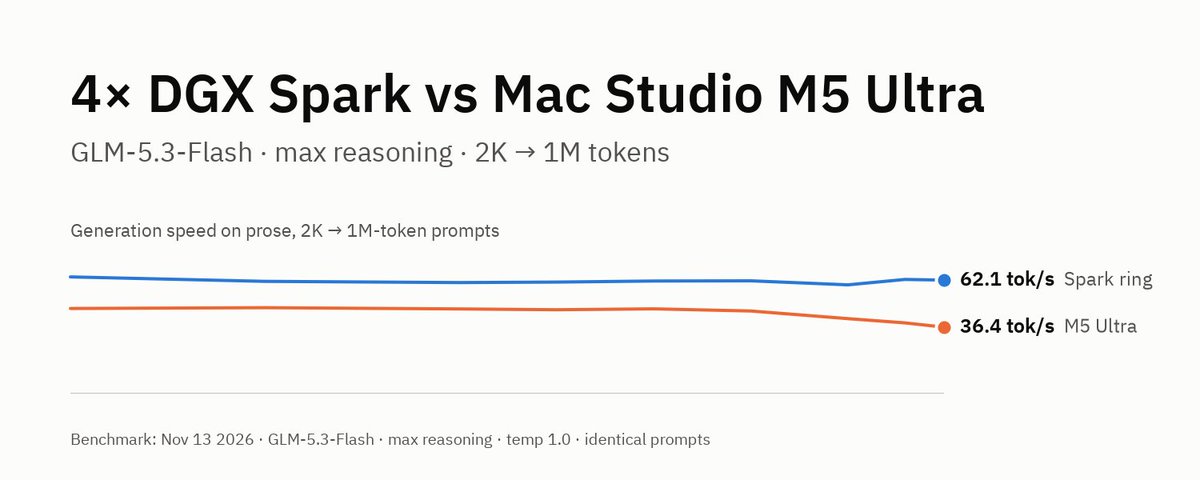
🚀 GLM-5.3 EXLR8 running on my 4× NVIDIA DGX Spark (GB10) cluster!
Deployed using KindlingAI's GR8 v1.0.1, with tensor parallelism (TP4), DFlash2 speculative decoding, and dual rail 200GbE RoCE networking through a MikroTik CRS812.
Completed extensive correctness, quality, long context, and performance testing.
✅ GR8 Full Benchmark: PASS (69.3 minutes)
✅ QEval: 74/75 questions (98.7%)
✅ Long-context retrieval: PASS up to 491K tokens
✅ Peak concurrent throughput: 88.2 tok/s
✅ Single-stream decode: 83.6 tok/s counting, 78.4 structured, 61.4 code
✅ 32K prefill: 1,535 tok/s
✅ Agent tools: 10/10
✅ GSM8K: 244/250 (97.6%)
Impressive results from four compact GB10 systems working together!
Code: github.com/kindlingai/gr8
Deployment: github.com/kindlingai/glm-5.…
Model: huggingface.co/kindlingai/gl…
🤖 Made with AI


0xCS retweeted

MiniMax H3 video generation: Mac Studio 512GB vs GX10 (DGX Spark) vs RTX 5090 vs RTX PRO 6000
Compared with the Mac Studio, on a 5 s clip at 1344×768:
• RTX PRO 6000 ×4: 6.3× faster
• RTX PRO 6000 ×1: 2.1× faster
• GX10 ×4: 1.9× faster
• RTX 5090: 1.8× faster
• GX10 ×1: 1.5× slower
Four GX10s working on one clip together are about as fast as a single RTX 5090.
Same original BF16 weights, prompts and seeds on every machine. No quantization.

Was Huang reckless? Perhaps. But he was the man who spent 33 years building the company that anchors America's AI dominance a company whose chips are, for all practical purposes, a strategic asset of the United States.
If his own government believed he was being targeted, he deserved a knock on the door and a quiet, serious conversation. Instead, he got a public execution of his career.
Counterintelligence sometimes demands silence. But this wasn't silence to protect sources. It was silence to protect convenience. Huang's access to Trump was politically useful. NVIDIA's revenue was economically useful. So he was kept in the dark treated as an asset while being left exposed as a liability.
The board insists it has "no reason to believe" national security was compromised. Maybe so. But Huang's career is finished, his reputation is in ruins, and the government that knew everything waited until the damage was done to say anything at all.

NVIDIA announces CEO transition. Read the release: nvidianews.nvidia.com/news/n…

168
🚀 DeepSeek-V4.1-Flash-1017 on 4× NVIDIA DGX Spark!
⚡ 886.2 tok/s peak aggregate throughput
⚡ 188.3 tok/s single-stream
⚡ 8,949 tok/s 32K prefill
⚡ 4.71× throughput scaling
🎯 94.7% QEval success
✅ All 4 GB10 GPUs passed health checks
TP4 + 200GbE RoCE + DSpark speculative decoding.
Impressive performance from a compact, power-efficient AI cluster.
🔗 github.com/christopherowen/s…
🤖 Made with AI


A call for help!
Most of my work on spark-ds41f is tuning GPU inference kernels: the same math, faster. Latent Sparse Attention is different. It changes which tokens the model looks at, and that's new territory for me.
The idea comes from Latent Sparse Attention (arXiv 2610.42147, Kubicek, Hoefler et al., Prefrontal AI and ETH Zurich): summarize groups of keys, score the summaries, and look closely only where they point.
I built a training-free version for DeepSeek V4.1 Flash on DGX Sparks:
- Every 8 neighbouring keys get one summary: their BF16 mean.
- The query scores the summaries and shortlists blocks.
- DeepSeek's own indexer scores the shortlisted keys exactly and makes its usual pick.
No new parameters, native weights. The paper learns its latent space by distillation and clusters keys by content. I kept to plain means, so there's nothing new to trust.
What I think it shows:
- Attention can get quicker this way. The key search runs 1.27x faster at 32K and 4.07x faster at 1M in prefill, over two boots.
- It may make the model smarter. On a small long-document pilot, one recipe answered 9 of 12 against native's 8, on both boots. On code it matched native: 152 of 164, the same answers.
What I don't understand yet:
- My fastest recipe lost one 128K answer that native got right.
- Whole answers a second barely moved: +1.9%, inside the noise.
- Why a sparser search sometimes answers better, and sometimes worse.
So it ships in spark-ds41f-1107 off by default, bit-identical to native until you set VLLM_DS41_LSA=1.
Are you an expert or an enthusiast in sparse attention, long context or eval design? I'd love to collaborate. Try it, pick it apart, or tell me where I'm wrong. Everything is in the draft PR, unfavorable runs included:
github.com/christopherowen/s…

0xCS retweeted

Stop reading Mac vs DGX Spark benchmarks as hardware fights. They are engine fights.
Tom's Hardware, same 256GB M5 Ultra Mac Studio, GLM 5.3 Flash:
llama.cpp: 46.3 tok/s decode
TensorFold with an MLX build: 94.0 tok/s, still 79.4 at 524K context
Same box, double the speed. And on Qwen 3.8 27B with llama.cpp on both, the Mac finished the agent test in just under half the time of one GB10, on 16% less energy.
Pick the engine before you pick the box.
This is the Qwen 4 we’ve been waiting for!

ERNIE 5.5 Flash Preview just landed! 🔥
Built on a new architecture designed for efficient inference, the latest open-weight foundation model in the ERNIE family delivers stronger performance in coding, 3D modeling, knowledge work and content creation.
It keeps decoding fast while posting competitive scores on Terminal-Bench, AutomationBench, and other benchmarks.
Here's the rundown:
- 280B total parameters, 14B active per token
- 1M-token context window
- Generation speed above 200 tokens/sec
Model weights will be released by November 25.

1
126

0xCS retweeted

💥 1250 亿参数的 Qwen3.8 Flash Next,塞进 24GB 的 Mac,内存只用 7.5GB。
专家从硬盘一块块读进来。长提示 63 秒跑完,另一种跑法要 130 秒。
温馨提示:作者在 M4 Pro 上自测,量化版;还是测试版,硬盘大约要空出 120GB。
来源:MoEShift / @iltroiani👇
github.com/davide-troiani/mo…


0xCS retweeted

間違っているかもしれないので自己責任でお願いね。
DGX Sparkのクロック設計について、うちの考えをまとめます。結論は「上限を掛けない、下限だけ入れる」です。
■なにを設定したか
nvidia-smi -lgc 2500,3003
下限を2500MHzに固定し、上限はハードの最大(3003MHz)まで開けたまま。再起動で消えるのでsystemdのoneshotで毎回かけ直しています。
■なぜ上限を掛けないか
世の中の定番は「冷やしたいなら2200MHzに絞る」です。うちは逆をやっています。理由は2つ。
1つ目、prefillは計算律速だから。長い資料を読ませる処理は計算の塊で、クロックを削ると素直に遅くなります。2200に絞ると2500に対して約12%のクロックを捨てることになり、prefillもほぼ同じだけ落ちます。
2つ目、絞ると熱に晒される時間が伸びるから。同じ仕事を遅いクロックで長くやるか、速いクロックで短くやって冷ますか。うちは後者を選びました。一瞬で終わる仕事をゆっくり長くやるのは、エンジンで言えば低回転で負荷をかけ続けるようなもので、効率も寿命も不利だと考えています。
■なぜ下限を入れるか
下限が無いと、アイドル明けのprefillが低クロックから始まります。チャットのように待ち時間が短い仕事では、この立ち上がりの差が体感に出ます。2500は「負荷時に自然に落ち着くクロック」の少し上なので、オーバークロックではなく、落ちすぎを防ぐための床です。
■実測(4台TP4・DeepSeek-V4.1-Flash-1017・1M文脈)
prefill 32K: 7,508 tok/s
prefill 64K: 7,601 tok/s
prefill 128K: 7,458 tok/s
prefill 262K: 7,216 tok/s
prefill 524K: 6,664 tok/s
prefill 1M: 5,675 tok/s
計測はレシピ付属のbin/spark bench。自前のrequests計測はTTFT込みで過小評価するので使っていません。
■熱と音
アイドルはファンstate2〜4(3,600〜4,500rpm)で静か。1Mのprefillではstate12まで上がり、GPU 77〜79°C・SOC 92.4°C。サーマルスロットルは0msでした。終われば2〜4に戻ります。冷やすのはクロックを削るのではなくファンで、という分担です。
■条件と危険
この設計は「ファンが生きていること」が前提です。うちは一度、ファンのモジュールだけ入れてデーモンを動かさない状態を作ってしまい、SOCが96°Cに上がってGPUが611MHzに張り付きました。nvidia-smiは使用率96%と表示したままで、再起動では直らず、電源ケーブルを30秒抜いてECをリセットするまで戻りませんでした。
だから上限を外すなら、ファンの状態を監視する仕組みとセットで。state0(0rpm)に落ちないこと、温度の警報が出ること、この2つが無いなら絞ったほうが安全です。
■向き不向き
短いチャットを単発で使うなら、絞っても体感はほとんど変わりません。長い資料を読ませる、複数の仕事を並べる、TTFTを詰める。このどれかをやるなら上限を外す価値があります。うちは1M文脈を毎日使うので、迷わず外す側です。
設定と計測の手順はここにまとめています。
github.com/tenhkspark/dgx-sp…


