




0xCS retweeted

🚨 ANOTHER GLM FLASH FINE-TUNE HAS HIT HUGGING FACE! 🔥
Meet SAGE S2.1 Flash from @sageai_official & @intern_lm — and these benchmarks are WILD! 🤯
🏆 Beats GLM-5.3-Flash 15/15
🔥 Beats DeepSeek V4.1-Flash 11/15
🚀 Beats Qwen3.8-Max 11/15
Agentic benchmarks are looking INSANE:
💻 MLE-bench Lite (ML coding): 90.3
🖥️ OSWorld (computer use): 85.2
⌨️ Terminal-Bench 2.1 (terminal/engineering): 87.9
Built on GLM Flash architecture, but punching at frontier-model levels!
Naturally, I’ll be creating a SAGE-EXL3 quant of SAGE to fit on ONE DGX Spark! ⚡
SAGE quantizing SAGE? That’s some next-level SAGE wisdom. 😏🧠
🔗 huggingface.co/internlm/Sage…


@sageai_official open releases Sage-S2.1-Flash, a 320B-A18B multimodal MoE that runs and verifies workflows in scientific software. MIT-licensed weights.🤖modelscope.ai/models/Shangha…
🔬 10+ scientific input types. Sage SciPerception unifies molecular graphs, crystal structures, DNA/RNA sequences, spectra, and EEG in a shared representation.
🛠️ Tool use with verification. In the CT demo, it selected 139 slices from 12,487 mixed images, corrected their order after a failed consistency check, and reconstructed the skeleton in 3D Slicer. Other demos cover satellite imagery, CAD assembly checks, and EEG artifact removal.
⚡ ~1/10 the inference cost of Xinghe on the same task, per Shanghai AI Lab.
🏆 Benchmark leads on MLE-bench Lite, OfficeQA Pro, Harvey LAB, and SpreadsheetBench 2 in the lab’s comparison.
🔄 RSI. Task trajectories, tool outputs, and human verification guide the next round of model improvements.


0xCS retweeted

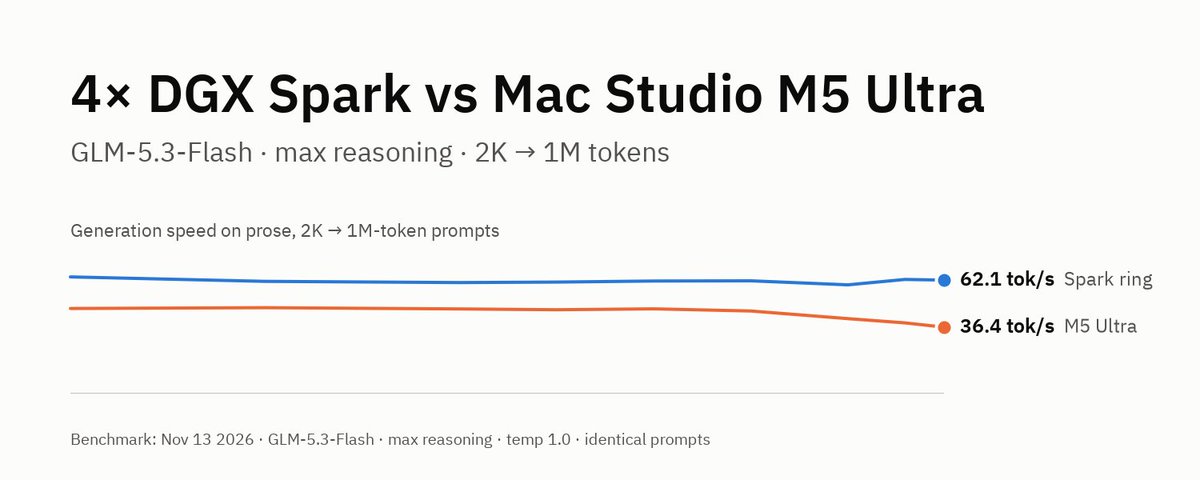
The ultimate battle: Four DGX Sparks 128GB 🆚 Mac Studio M5 Ultra 512GB: in depth testing by super @krunkosaurus 🙏
We ned more people optimizing software on Apple Silicon side! For sure on DGX Spark everything is easier thanks to Cuda.
I love both platforms BTW 💪

0xCS retweeted

MiniMax H3 video generation: Mac Studio 512GB vs GX10 (DGX Spark) vs RTX 5090 vs RTX PRO 6000
Compared with the Mac Studio, on a 5 s clip at 1344×768:
• RTX PRO 6000 ×4: 6.3× faster
• RTX PRO 6000 ×1: 2.1× faster
• GX10 ×4: 1.9× faster
• RTX 5090: 1.8× faster
• GX10 ×1: 1.5× slower
Four GX10s working on one clip together are about as fast as a single RTX 5090.
Same original BF16 weights, prompts and seeds on every machine. No quantization.

0xCS retweeted

Stop reading Mac vs DGX Spark benchmarks as hardware fights. They are engine fights.
Tom's Hardware, same 256GB M5 Ultra Mac Studio, GLM 5.3 Flash:
llama.cpp: 46.3 tok/s decode
TensorFold with an MLX build: 94.0 tok/s, still 79.4 at 524K context
Same box, double the speed. And on Qwen 3.8 27B with llama.cpp on both, the Mac finished the agent test in just under half the time of one GB10, on 16% less energy.
Pick the engine before you pick the box.

0xCS retweeted

💥 1250 亿参数的 Qwen3.8 Flash Next,塞进 24GB 的 Mac,内存只用 7.5GB。
专家从硬盘一块块读进来。长提示 63 秒跑完,另一种跑法要 130 秒。
温馨提示:作者在 M4 Pro 上自测,量化版;还是测试版,硬盘大约要空出 120GB。
来源:MoEShift / @iltroiani👇
github.com/davide-troiani/mo…


0xCS retweeted

間違っているかもしれないので自己責任でお願いね。
DGX Sparkのクロック設計について、うちの考えをまとめます。結論は「上限を掛けない、下限だけ入れる」です。
■なにを設定したか
nvidia-smi -lgc 2500,3003
下限を2500MHzに固定し、上限はハードの最大(3003MHz)まで開けたまま。再起動で消えるのでsystemdのoneshotで毎回かけ直しています。
■なぜ上限を掛けないか
世の中の定番は「冷やしたいなら2200MHzに絞る」です。うちは逆をやっています。理由は2つ。
1つ目、prefillは計算律速だから。長い資料を読ませる処理は計算の塊で、クロックを削ると素直に遅くなります。2200に絞ると2500に対して約12%のクロックを捨てることになり、prefillもほぼ同じだけ落ちます。
2つ目、絞ると熱に晒される時間が伸びるから。同じ仕事を遅いクロックで長くやるか、速いクロックで短くやって冷ますか。うちは後者を選びました。一瞬で終わる仕事をゆっくり長くやるのは、エンジンで言えば低回転で負荷をかけ続けるようなもので、効率も寿命も不利だと考えています。
■なぜ下限を入れるか
下限が無いと、アイドル明けのprefillが低クロックから始まります。チャットのように待ち時間が短い仕事では、この立ち上がりの差が体感に出ます。2500は「負荷時に自然に落ち着くクロック」の少し上なので、オーバークロックではなく、落ちすぎを防ぐための床です。
■実測(4台TP4・DeepSeek-V4.1-Flash-1017・1M文脈)
prefill 32K: 7,508 tok/s
prefill 64K: 7,601 tok/s
prefill 128K: 7,458 tok/s
prefill 262K: 7,216 tok/s
prefill 524K: 6,664 tok/s
prefill 1M: 5,675 tok/s
計測はレシピ付属のbin/spark bench。自前のrequests計測はTTFT込みで過小評価するので使っていません。
■熱と音
アイドルはファンstate2〜4(3,600〜4,500rpm)で静か。1Mのprefillではstate12まで上がり、GPU 77〜79°C・SOC 92.4°C。サーマルスロットルは0msでした。終われば2〜4に戻ります。冷やすのはクロックを削るのではなくファンで、という分担です。
■条件と危険
この設計は「ファンが生きていること」が前提です。うちは一度、ファンのモジュールだけ入れてデーモンを動かさない状態を作ってしまい、SOCが96°Cに上がってGPUが611MHzに張り付きました。nvidia-smiは使用率96%と表示したままで、再起動では直らず、電源ケーブルを30秒抜いてECをリセットするまで戻りませんでした。
だから上限を外すなら、ファンの状態を監視する仕組みとセットで。state0(0rpm)に落ちないこと、温度の警報が出ること、この2つが無いなら絞ったほうが安全です。
■向き不向き
短いチャットを単発で使うなら、絞っても体感はほとんど変わりません。長い資料を読ませる、複数の仕事を並べる、TTFTを詰める。このどれかをやるなら上限を外す価値があります。うちは1M文脈を毎日使うので、迷わず外す側です。
設定と計測の手順はここにまとめています。
github.com/tenhkspark/dgx-sp…

0xCS retweeted

2 minutes of continuous AI video with spoken dialogue, generated at home on two NVIDIA DGX Sparks.
Model: MiniMax H3
• 120 s, 1344x768, 24 fps, one continuous take, no cuts
• 12 windows of 11.5 s, each continued from the previous one
• 34 English lines: voices, lip sync and shop ambience come from the model itself (the piano bed is another H3 clip)
• ~8 h of generation: 7.9 h denoising + 11 min decode, FP8
Full recipe, code and every number: github.com/knapcio/MiniMax-H…
0xCS retweeted

Wow. Hitting nearly 2M downloads for kindlingai's exlr8 quants of GLM 5.3 and GLM 5.3 flash.
Not just supported by gr8 (github.com/kindlingai/gr8/), but also @wrldsuksgo2mars's CuteAFD, @ashxhart's TensorFold and more.

0xCS retweeted
I'm planning to buy 2 x M5 Ultra 512GB!
In the past I gave access to my M3 Ultra to various community members like @filipstrand to work on MFLUX or @Prince_Canuma for mlx-vlm and other friends to play with it.
Now for the same reason I decided to do this investment, for my own experiments, for future projects and to share access with builders out there.
Local AI is stronger than ever!
I'll figure out the way to share this in the right way.
Stay tuned! 💪

0xCS retweeted

Today MLX-VLM and MLX-Audio move to the @Neywalabs GitHub org 🏠
I started MLX-VLM on my M1 Air with a vision of what local inference and small models could do. I couldn't even run some of the models I was porting 😂
Then @lllucas and I built MLX-Audio because we had an itch to scratch.
Today they're used by 7M+ developers, and by teams at @IBMResearch, and many more.
We've also partnered with the teams behind the best open models such as @GoogleDeepMind/@googlegemma, @huggingface, @cohere, @OpenBMB, @Recursive_SI, @liquidai, @Open_MOSS and more.
These projects outgrew my personal account. Now a whole team wakes up every day to make them better.
My promise: MLX-VLM and MLX-Audio will remain open source under the same MIT license. That will never change.
"Helping people through technology" has always been my north star for decades. This is how we at @Neywalabs keep doing it, at a bigger scale.
Thank you all from the bottom of my heart. There is so much more on the way 🚀
github.com/Neywa-Labs


0xCS retweeted
We've really been pushing on multi-model support on gr8! Four DGX sparks, with three models to choose from.
Each model is accelerated with EXLR8 - faster decode and lightning fast boot (< 30s!)
github.com/kindlingai/gr8/
0xCS retweeted
Ready for EXLR8 for DeepSeek 4.1 flash?
We've been cooking on some insane performance boosts for GLM 5.3 and GLM 5.3 flash too.


0xCS retweeted

CAREFUL ‼️ Linux and DGX Spark users: turning off MPTCP isn't enough for CVE-2026-98432 (CVSS 9.8).
The bug is in the plain IPv4 TCP handshake on every unpatched kernel since 4.4. Ubuntu hasn't shipped a fix, and none is in progress for the Spark's kernel yet.
What to do 👇


‼️ Ubuntu and Red Hat still have no fix for a Linux kernel flaw that Anthropic says its unreleased AI model turned into a remote root exploit.
The bug, CVE-2026-98432, is a use-after-free in the IPv4 TCP handshake, rated 9.8 out of 10.
The exploit needs no credentials and targets servers with a multipath TCP listener, which Go 1.24 and later open by default.
The fix reached stable kernels on 11 October and Debian has shipped it. Ubuntu still marks every release from 16.04 to 26.10 vulnerable.
Red Hat now rates it Critical but has no patched kernel for RHEL 8, 9 or 10.
Anthropic has not released the exploit. By its count, it takes 48 minutes to leak a kernel pointer and five more to run commands as root.


0xCS retweeted

Qwen3.8-Flash-Next solo (TP=1) up to 130 tok/s ‼️
Same recipe involves 4 different quants all up for your taste.
🚀 If you prefer speed go for INT4.
🧠 If you prefer quality go for Nvidia FP4-local
⚖️ Middle Hybrid48 or Uncensored


Qwen3.8-Flash-Next from Nvidia (FP4-Local)
🚀 Peak up ~30%
🏭 Average up ~10%
💻 TTFT down ~10 times
Recipe includes FP4 / Int4 / Hybrid48 / Uncensored
⚡️ github.com/myllmbox/qwen38-f…

0xCS retweeted

BENCHMARKED: LFM3-1.7B by @liquidai.
Liquid AI published 1.6 GB for the KV cache at 128K context. I ran it on my Mac mini and measured 1.6 GB.
The whole model at 128K uses 3.15 GB of GPU memory, under 5% of the 64GB. It still generates 80 tok/s.
Only 6 of its 24 layers keep a full KV cache. The other 18 use short convolutions or sliding-window attention.
llama.cpp (Metal), Q4_K_M, M5 Pro 64GB, median of 3 runs
- 512 ctx: 184 tok/s, 0.09s to first token
- 4K ctx: 178 tok/s, 0.72s to first token
- 32K ctx: 141 tok/s
- 128K ctx: 80 tok/s
Q8_0 does 125 tok/s at 512, so 4-bit is 47% faster.

