

We're farmers fighting for accountability from the government and the largest food and ag corporations.
Missouri
Joined January 2020
- Tweets3.7K
- Following432
- Followers14.2K
- Likes2.7K




Iowa used to be built on hogs raised on family farms in every county, every corner, every community.
That money stayed local, on main streets and in small towns.
Then giant meat corporations moved in.
Farm Action Local Leader John Gilbert, an Iowa farmer, says it plainly:
"A very small handful of giant multinational... companies that are pulling all the profits out of Iowa."
When corporations siphon off the wealth, rural communities dry up, and farmers lose their independence.
@IowaPBS @MarketToMarket
Farm Action is fighting for independent farmers, ranchers, and consumers across the country.
We're on the front lines of the fight against corporate monopolies driving small farms out of business.
Take 30 seconds to join our newsletter below: farmaction.us/sign-up/

Rep. Thomas Massie is on the verge of securing a massive win for independent farmers.
“We’ve been working on this so long… ”
Bookmark this.
This could deliver a blow to the big four meatpackers’ monopolistic control of the beef industry.
How?
The PRIME Act would give states more control over regulations for small, local meat processors.
“It says that if the farmer and the processor and the consumer are all in the same state, that they can be regulated differently than having [these] giant USDA regulations that are meant to regulate the Oscar Mayer wiener factory.”
“Let the state or even the county health inspector regulate these small abattoirs.”
“Some of these small processors process less meat than a steakhouse in Washington, D.C. does on K Street at night.”
A pilot version of the PRIME Act was included in the House-passed Farm Bill.
Now, it’s up to the Senate to decide if it will make it into the final version of the bill.
@RepThomasMassie @chelliepingree
Independent farmers need our support now more than ever.
Corporate monopolies are putting farms out of business every day.
Subscribe to our newsletter below to keep up with our fight: farmaction.us/sign-up/
BREAKING:
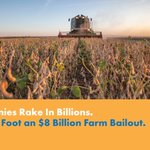
The Trump administration just announced another $8 billion bailout for farmers struggling with soaring fuel and production costs, on top of a $12 billion bailout earlier this year.
Bailouts don't fix a broken farm economy.
They just keep it on life support.
Farmers are getting crushed by fuel costs while big oil companies rake in billions, and taxpayers are footing the bill for corporate profits.
And with this money going mostly to commodity producers, many farmers will be left waiting or left out entirely.
It's time to stop celebrating record bailouts and start fixing the corporate power that makes them necessary.

"If you had your hand cut off and they put a Band-Aid over it... it'll stop the bleeding, but it's not gonna take away the injury."
Trump's executive order temporarily allows off-road red diesel, which is tax-exempt, to be used on highways without penalties.
That might ease some costs in the short term, but it doesn't fix why fuel prices spiked in the first place.
Years of refinery mergers and closures have left fewer competitors and less ability to ramp up production when supply gets tight.
"The damage has been done."
Temporary relief won't add refinery capacity or restore competition.
Farmers need fair fuel markets, not another quick fix.
Oil companies are reaping billions while farmers foot the bill.
Read why regulators need to look at refinery consolidation:
farmaction.us/high-fuel-pric…

When egg prices skyrocketed, major egg companies blamed bird flu, and most economists and the media went along with it.
Farm Action's President Angela Huffman didn't buy it.
"We said we should look at this, because we've seen this before, and there might be something here."
Once we looked, the math didn't add up. The egg-laying flock shrank only modestly, but prices jumped 138%.
In January 2023, Farm Action called on federal enforcers to find the real culprit behind the price spike.
Critics called it a conspiracy theory.
Now the DOJ and 17 states allege three of the biggest egg companies coordinated for nearly three years to drive prices up.
When a few giant corporations control a market, families at the grocery store and farmers on the ground pay the price.
@AngelaSHuffman @politico

@politico tells the full story of how Farm Action saw the alleged egg cartel coming while many blamed bird flu.
Read it here:
politico.com/news/magazine/2…

Tyson closed a beef manufacturing plant in Lexington, Nebraska, this year.
“6% of the nation’s beef came out of that plant.”
“And Tyson just closed it.”
“Putting 3,500 Nebraskans out of jobs.”
Bookmark this.
Nebraska Senate candidate Dan Osborn just sounded the alarm.
Tyson’s plant closure in Lexington reveals the damage that corporate monopolization in our food industry can do to rural America.
“There are four meatpackers that have formed a monopoly.”
“They work with the other ones.”
“They target plants that are going to close down to manipulate… what they pay, from the producers all the way to what we pay at the grocery store.”
“And this beef deal adds to the already problematic crisis of a thinning herd.”
“We got to break up the meatpackers to create an environment that has competition.”
We have been warning that President Trump’s beef import policy is a bad deal for both American ranchers and consumers.
Flooding our market with imported beef undercuts domestic ranchers, many of whom are already struggling to keep their operations alive.
And it is not meaningfully reducing prices for consumers.
The only ones who benefit from this policy are multinational corporations, like JBS, who pocket all of the profits.
We published a seven-point plan backed by ranchers, not corporations, to meaningfully reduce beef prices, restore our domestic cattle herd, and save ranchers.
Read it below and send it to your members of Congress:🧵
@osbornforne @briantylercohen
“A pound of ground beef costs 70% more today than it did six years ago.”
To solve this problem, we need much deeper structural reform than just importing foreign beef.
Read our full seven-point plan, backed by ranchers, not corporations, below: farmaction.us/lowering-beef-…

"The land is reaching the point that farmers just can't afford it anymore."
Outside money is pouring into farmland, and the next generation of farmers is getting priced out.
Investors, developers, and data centers are outbidding many young families trying to get started.
"These young people want to go home and farm or want to start a farm, and financially it's just not in the cards."
When farmland becomes a Wall Street asset instead of a working farm, everyone who eats loses.
The future of independent agriculture depends on keeping land in the hands of farmers.
@whiteoakpasture @AcresUSA
Farm Action is fighting for independent farmers, ranchers, and consumers across the country.
We're on the front lines of the fight against corporate monopolies driving small farms out of business.
Take 30 seconds to join our newsletter below: farmaction.us/sign-up/
“Four packers… control over 80% of the fed cattle market.”
“They’re able to leverage down the prices that they pay for cattle to U.S. cattle producers.”
“And they’re able to inflate the beef prices that they send downstream in the supply chain.”
“We find ourselves in an acute crisis situation right now.”
R-CALF USA CEO Bill Bullard just exposed why Trump’s foreign beef imports are simultaneously undercutting American ranchers and failing to lower costs for consumers.
“We market into one of the most highly concentrated marketing sectors of any economic sector in America.”
“And then we’ve got a highly concentrated retail sector.”
“As these cattle prices increase, we’ve seen retail margins reach record levels.”
“Retail margins have increased over 50%.”
“In a fully competitive marketplace, you would expect that if you increase supplies, you would in fact reduce prices to consumers.”
“But in a highly concentrated marketplace… they can capture what should be savings that would pass through to consumers as well as price increases that would pass to the U.S. cattle producers.”
“The market is dysfunctional today.”
This situation cannot change until one core problem is addressed:
Corporate consolidation.
Trump’s beef import policy is giving multinational corporations even more power to seize enormous profits and squeeze American ranchers.
It’s only making the situation worse.
@RCALFUSA @RMConservative
We’re fighting the biggest corporate monopolies in agriculture on behalf of independent farmers and ranchers across the country.
They need our support now more than ever.
Subscribe to our newsletter to stay updated on our mission: farmaction.us/sign-up/
“This is why a million ranchers and farmers have gone out of business… ”
“The three largest meat processors in the United States have all paid multi-million dollar fines within the last year.”
“But they’ve been allowed to… keep their cartel-like behaviors going.”
“The Department of Justice has been giving them essentially a free pass.”
Dr. Meryl Nass just revealed that Washington already has the tools to “break up monopolies and not let them control markets.”
“Antitrust laws.”
“There have been cases initiated and the companies have paid fines.”
“They paid fines for price-fixing.”
“They agreed with each other how to raise prices to grocery stores, to lower prices to farmers that they’re paying farmers for their cattle.”
These “cartel-like behaviors” are why beef prices are out of control and why dozens of farmers are going out of business every day.
And right now, the DOJ is on the verge of sweeping yet another alleged price-fixing scheme under the rug.
We’re rallying farmers and consumers to stop the DOJ’s proposed settlement with three major egg companies over a price-fixing conspiracy that robbed consumers of billions of dollars between 2022 and 2025.
You have until October 17 to make your voice heard and demand real consequences.
Take action below:🧵
@nass_meryl @ChildrensHD
TAKE ACTION:
Tell the DOJ that this alleged egg price-fixing scheme needs real consequences.
Their proposed settlement is a rounding error compared to the billions in profit that the three companies made from this alleged conspiracy.
You have until October 17 to make your voice heard: farmaction.us/tell-doj-egg-p…

Diesel just hit $6.20 a gallon, nearly $2.49 higher than a year ago.
Farmers need fuel to bring in the harvest, no matter the price.
And unlike the corporations above them, farmers can't pass those costs on.
Meanwhile, oil companies are raking in billions.
Phillips 66's pre-tax refining profits jumped from $208 million to $3.06 billion in a single quarter.
Years of refinery mergers and closures have left fewer competitors and more power to drive prices up.
Farmers shouldn't have to pay for every crisis that turns into another corporate windfall.

Farmers depend on fair markets, from fuel and fertilizer to the crops they sell.
Read how refinery consolidation is squeezing farmers, and what regulators need to do about it:
farmaction.us/high-fuel-pric…
This economist just exposed the real costs of Trump’s beef imports.
He estimates American ranchers are now making “$300 to $500” less per cow thanks to the influx of foreign beef.
And the data is unclear, but ground beef prices have hardly declined so far.
Kenny Burdine: “Farm Bureau put a report out last week that basically found a pretty small impact so far on retail ground beef price.”
“But it doesn’t change the fact that it’s hit these cull cow markets pretty hard.”
This is exactly what we warned would happen.
Foreign beef is undercutting American ranchers, yet increased imports are failing to meaningfully lower costs for consumers.
Why?
The real reason for skyrocketing beef prices comes down to one problem:
A small handful of multinational corporations control between 80-85% of the beef industry.
We have warned for months that massive consolidation in the beef industry would allow multinational corporations like JBS to take the profits from increased U.S. beef imports for themselves and leave American ranchers to shoulder the costs.
More imports are unlikely to significantly reduce beef prices.
Instead, Washington must finally address corporate consolidation and take steps to rebuild the domestic cattle herd.
We released a 7-point plan to lower beef prices, backed by American ranchers, not corporations.
Read it below and send it to your representatives:🧵
@KYCattleEcon @brownfield
Bookmark this.
Our 7-point plan to lower beef prices is backed by American ranchers, not Big Ag.
More foreign beef imports will not solve this problem.
We need to restore Mandatory Country-of-Origin Labeling.
Rebuild the domestic cattle herd.
Expand regional processing.
Address corporate consolidation and restore competition.
Read our full plan below: farmaction.us/lowering-beef-…