

Historian/writer. Senior Lecturer, York St John Uni, UK. Chair @NRWGCharity. Views own. Research conscription, Napoleonic Wars, revolution & history of conflict
Joined April 2021
- Tweets4K
- Following863
- Followers4.2K
- Likes25.5K





Pinned Tweet
Great start to the weekend - author copies have arrived!
The book is the story of those who made Napoleon's campaigns possible - the 2 million or so conscripts, and the system that brought them into the French army.
@Helionbooks have done a really great job putting it together!

26 October 1809. The aftermath of war.
Following campaigns earlier in 1809, the French 4e Ligne discharged 32 men with pensions. All are badly wounded.
They include a sergeant major, 2 sergeants & 5 corporals. 15 are Austerlitz veterans. Four have less than a year's service. 1/

The full pension was 182.50 francs for a private soldier - around half of what a family needed to survive on the breadline.
Most wounded men received between 25% (for infirmity) & 50% of a pension (for loss of use of a limb). Total loss of multiple limbs gave a 150% pension. 3/
Dr Graeme Callister retweeted

After long and arduous journey to Poland it finally arrived! Very excited to read it 😁 @GraemeCallister

Dr Graeme Callister retweeted

🥳 1 million downloads on @NapWarsPod 🥂
Thank you all for your support 🙏
Incredible milestone! Congratulations to @ZwhiteHistory @liamtelfer @lureynol and all involved with the @NapWarsPod!
Absolutely superb Napoleonic content for free on a weekly basis - here's to the next million!

Dr Graeme Callister retweeted

Extremely valuable work for anyone interested in the Napoleonic period - rush out and buy it !

Great start to the weekend - author copies have arrived!
The book is the story of those who made Napoleon's campaigns possible - the 2 million or so conscripts, and the system that brought them into the French army.
@Helionbooks have done a really great job putting it together!
Dr Graeme Callister retweeted

Had a magical Saturday MC'ing four brilliant historians presenting tales of Georgian-era #BlackHistory at Apsley House. From #London to #Haiti via Circuses & parishes, each was excellent. Real joy to bring great tales & research to such a grand venue. #history #authorlife


Dr Graeme Callister retweeted

Bought this by @GraemeCallister from the excellent @CaliverBooks at the Other Partizan on Sunday. From the introduction I can't wait to get stuck into the main text.

So how did Napoleonic conscription actually work?
Who was eligible?
How did they decide who should serve?
How did they get men from fields and farms to army depots?
Was there any resistance?
I talk about all this and more on @NapWarsPod's latest episode! open.spotify.com/episode/0T4…

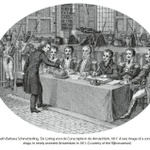
ALT Man in civilian clothes being examined for conscription by uniformed soldiers.
And if you'd like to know more, there's a whole book you can explore, now available from @Helionbooks!
helion.co.uk/military-histor…

Want to conscript a mildly dubious population?
Like Napoleon, you may need to persuade them it's in the national interest - indeed, that it is in *their* interests - and make sure you spread the word far and wide.
(And even then you may, like Napoleon, need to resort to force!)
How did Napoleon galvanise a nation?!
@GraemeCallister is back on the show to discuss his latest research
On Spotify & Apple podcasts🎧
Dr Graeme Callister retweeted

How did Napoleon galvanise a nation?!
@GraemeCallister is back on the show to discuss his latest research
On Spotify & Apple podcasts🎧


Not really.
Victor did well enough at Friedland, Blücher didn't turn the tide for the Prussians in 1807, and both would have been released after Tilsit anyway.
Would six more months in captivity have changed either career course? Maybe, but that's in the realms of speculation.

Was this a bad trade for Napoleon? 🧐
Prussian General Gebhard von Blücher and French General Claude Victor-Perrin were directly swapped for one another as prisoners of war in early 1807.
The Prisoner Exchange
• The Capture of Victor: In January 1807, during the War of the Fourth Coalition, Prussian partisans captured the future French marshal Claude Victor-Perrin near Stettin.
• The Capture of Blücher: Blücher had already been captured by French forces following the disastrous Prussian defeat at the Battle of Lübeck in late 1806.
• The Swap: Negotiated in early 1807 (with an agreement finalized around February/March), the two high-ranking commanders were traded man-for-man.
• The Aftermath: Following his release, Victor was elevated to Marshal of France later that year, while Blücher returned to Prussian service and eventually helped defeat Napoleon at Waterloo eight years later.
#blucher #prussia #prisonerswap #victor

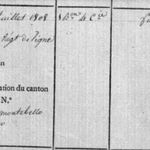
Conscript of the day: Auguste Orta from Montebello in the department of Marengo.
He was 12 when those two great French victories – Montebello & Marengo – occurred near his home.
He was 20 when he was hospitalised, and in all probability died, as a conscript of Napoleon’s army.

Napoleon was 5’6” in English inches - the 5’2” rumour probably comes from his height in French inches (which were slightly larger than English).
This actually made him 2 inches TALLER than the average line infantryman in his army’s 1st Corps at Waterloo!

Between 1805 and 1812, Napoleon’s war machine conquered much of Europe, from Lisbon to Moscow.
Although considered the finest force of the age, Napoleon’s French army was mostly made up of conscripts. Here’s 10 facts you (possibly) didn’t know 🧵

10. By the time of the Battle of Austerlitz in 1805, over three-quarters of the line army was made of conscripts. By 1812, conscripts made up over 95% of the rank and file.

And if you want to know more, please do have a look at my book 'Napoleon's Conscripts' - now available from Helion!
helion.co.uk/military-histor…
