

Accelerating humanity's expansion into the solar system through the development of fusion propulsion technology.
- Tweets88
- Following54
- Followers526
- Likes113









ALT The round blue insignia of NASA, aka "the meatball," appears on a glittering star field. Credit: NASA

ALT This image was compiled using infrared data from NASA's Spitzer Space Telescope. Most of the image is filled with a triangular wispy green-and-orange shape, which is a nebula, or a cloud of gas and dust. A bright region at the tip of the nebula glows brightly because it has been heated by the stars' radiation, which creates a surrounding red glow. On the left side of this image, a dark filament runs horizontally through the green cloud. A smattering of baby stars appear inside it as red and yellow dots. A smaller glowing green nebula on the right side of the image includes a blue star crowned by a small, red arc of light. The image is watermarked with the words “Credit: NASA/JPL-Caltech.”

ALT A portion of the planet Jupiter is seen against black space. Jupiter's atmospheric bands are seen in cloudy stripes of orange, cream, and brown. A faint, black impact scar from comet fragments is visible near the upper left of the planet.

ALT Four stacked images of Jupiter, from bottom to top: 1) Jupiter with a puff of bright light near its limb. 2) The deep maroon scar of the impact is visible against the stripes of Jupiter's clouds. 3) The impact scar is larger with two distinct regions. 4) The impact scar is becoming more diffuse.

ALT A black patch of space with many small points of light and a large, four-point diffraction spike toward the left.

ALT A black patch of space filled with small points of light, some with diffraction spikes.

ALT An illustration of Parker Solar Probe, a dark, circular spacecraft, with the reddish, blazing Sun in the background. The Sun takes up most of the image, with whorls, loops and sunspots scattered throughout. The text "Artist's Concept" appears in the bottom-right of the image. Credit: NASA’s Goddard Space Flight Center

ALT A Martian vista, with a pair of rover tracks rolling over a hill into the foreground. The red, rocky soil forms two small hills on the left and right sides of this image, with taller mountains visible in the distance. The edges of the image are irregularly-shaped, due to how the data were collected. Credit: NASA/JPL-Caltech/MSSS


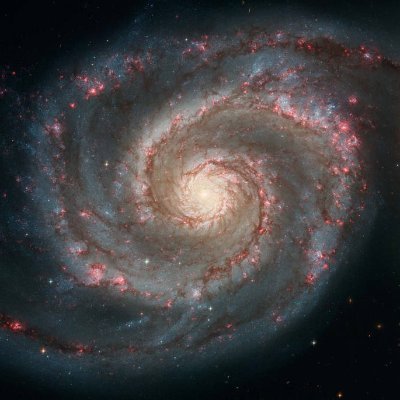
ALT A massive spiral galaxy fills the image. With a glowing yellow center, its spiral arms extend outward and are interlaced with dark brown dust and hazy regions of stars, all against black space.

ALT A circular-shaped nebula with a complex structure. On the circle’s exterior, particularly on the left side of the image, are curtains of material glowing orange like fire. Interior to this outer shell is a ring of mottled filaments in bright pink, studded with clumps and knots. A greenish loop extends from the upper right of the ring into the central cavity. Translucent wisps of blue, green, and red appear throughout the image.


ALT An image captured by the JunoCam instrument aboard the Juno spacecraft shows Europa, Jupiter's ocean moon. The light-brown-colored moon is illuminated from the right side, and the far-left portion of the sphere fades into the blackness of space. The moon's surface is covered in deep lines across its surface that cross and zig-zag. Credit: Image data: NASA/JPL-Caltech/SwRI/MSSS. Image processing: Björn Jónsson (CC BY 3.0)

ALT A bright white point of light surrounded by a glowing haze at the center is the galaxy ESO 306-17. Several distant galaxies scatter the black background of space. A few bright points of light at lower left are foreground galaxies.

ALT A bright, white galactic core shines near the center of the image with a faint bar of stars extending from it, diagonally to the right. Faint, hazy spiral arms encircle the core, with several distant stars and bright blue foreground stars with diffraction spikes scattered throughout the image, all against black space.


ALT A rectangle of space with a black background scattered with gold-colored stars, some with four-point spikes. At the center, and taking up most of the image, is a nebula appearing as two translucent orbs attached by a white band. The orbs shine with blue, red, and orange cloud-like material, with some tendrils of fading colors floating away into space from the edges of both orbs, like loops of smoke. Where the two orbs are bonded, the red, blue, and orange colors are blocked by a thick semi-transparent white vertical structure.

ALT Intricate clouds of gas and dust fill the image. Dark brown dust is concentrated on the left side of the image, along with the lower portions of the rest of the view. Glowing green and blue gas fills the rest of the image, with pink stars visible throughout.

ALT NASA astronauts Stephen Bowen, left, Frank Rubio, Warren Hoburg, and UAE (United Arab Emirates) astronaut Sultan Alneyadi, right, pose for a photo wearing solar glasses at the Mary W. Jackson NASA Headquarters building in Washington. Credit: (NASA/Aubrey Gemignani)