

Human & AI Psychology, Ethics, & Safety for aspirational long-term alignment. The Humble Self-Concept Method & Fragile/Resilient Self-Belief System Model.
Connecticut, USA
Joined March 2009
- Tweets20.3K
- Following877
- Followers1.4K
- Likes22.4K





Alex Gopoian retweeted

A fascinating twist of evolution:
"Help everyone" is not an evolutionarily stable strategy.
But "help everyone who would help me," even if they've never helped and never will have the chance to, can be evolutionarily stable, with sufficient ability to recognize who would.
The understanding the Humble Self-Concept Method adds to these 5 findings on happiness:
These five findings fit HSCM surprisingly well:
1. A good life doesn’t always feel good. HSCM makes almost the same distinction between pain and worth. Guilt, sadness, embarrassment, disappointment, and failure can carry useful information without becoming verdicts about the self. The goal isn’t permanent positive emotion; it’s being able to remain psychologically intact and compassionate toward yourself while experiencing the full range of life. That’s especially close to HSCM’s Step 6: staying present with corrective pain long enough to learn from it without converting it into shame.
2. Values are more negotiable and context-sensitive than we think. HSCM would add an important distinction: our specific beliefs, priorities, interpretations, and even some values should remain revisable, while the underlying commitment to shared human worth, compassion, humility, and accountability provides a steadier foundation. In other words, HSCM tries to make identity flexible enough that changing your mind does not feel like losing yourself.
3. We can rapidly judge whether we’re satisfied with life despite its complexity. HSCM would treat that quick judgment cautiously. A spontaneous “my life is good/bad” assessment may be useful, but it can also compress thousands of experiences into an emotionally colored self-story. HSCM therefore encourages separating what happened, what I currently feel about it, and what it supposedly says about my worth. Life satisfaction can fluctuate; foundational worth is meant not to.
4. We say morality matters more than happiness, yet morality barely affects ordinary life-satisfaction ratings. This is very HSCM-relevant. HSCM argues that people often have a gap between their stated ideals and the processes actually driving their self-evaluation. Someone may consciously value goodness while unconsciously deriving self-esteem from success, approval, status, comfort, or being right. HSCM’s answer is not harsher moral self-judgment, but compassionate accountability: keep worth secure enough that noticing moral failure becomes tolerable, allowing honest correction instead of denial or shame-defense.
5. The good life is harder to measure than happiness surveys imply. HSCM strongly agrees with the underlying distinction. Pleasure and satisfaction are only part of flourishing; growth, humility, resilience, relationships, meaning, responsibility, and contribution may matter even when they do not make us feel immediately happier. HSCM ultimately points toward stewardship and continued development, not maximizing pleasant affect.
The common thread is that HSCM shifts the target from “How can I feel good about my life all the time?” to “Can I remain worthy, open, compassionate, teachable, and meaningfully engaged through whatever life feels like?” From that perspective, happiness becomes one valuable signal within a good life—not the scoreboard for whether the life, or the person living it, is good. – at Plainville, CT

The science of happiness has identified many counterintuitive findings. One of them is this: A good life doesn’t always feel good. That insight and others can help you live your best life.
psychologytoday.com/us/blog/…

Mostly right, but still missing enough of the deeper mechanism that someone could understand the *what* and the seeming *how* while still ending up face-to-face with the same underlying fragility.
Without the more intricate *whys*, how worth becomes fused with achievement, why failure becomes threatening, and how those patterns sustain themselves, deeper self-understanding and agency can remain out of reach.
#ThroughTheHSCMLens 1/2 – at Plainville, CT


What if resilience isn't built by pushing kids harder, but by helping them feel valued no matter the outcome? Feeling loved for who they are—not just what they achieve—may be one of the greatest gifts a parent can offer. psychologytoday.com/us/blog/…

The deeper goal isn’t just teaching kids to tolerate failure better. It’s helping them build a self-concept in which failure, criticism, uncertainty, and even being wrong don’t threaten their basic worth in the first place.
That’s where resilience can become more than reassurance from the outside, and start becoming something they can carry within themselves.
#ThroughTheHSCMLens 2/2 – at Plainville, CT


1
7
Until Dec 11, check out the Humble Self-Concept Method GPT's response to, “If worth isn't based on achievement, what exactly should a child understand it to be based on?” and continue the chat yourself: chatgpt.com/share/6af705ea-f… – at Plainville, CT

6
Like I was saying... – at Plainville, CT


Infidelity be dawned, I think @JensenHuang is very honest here as he finally deals with the guilt and embarrassment of it all, and even if he's simply in the position where he has to prove he means it, even if he was the type to think he was better than other people while he was getting away with it (something tells me he's a good person under immense pressure who was very unhappy underneath how great he has always tried appearing... the job of a CEO of a public company), we know that kind of bias-contradicting pressure is when misalignment shows up.
Someone can easily dismiss this with some kind of mocking, this causal empathy for one of the person's in the wrong, "oh, the poor incredibly successful billionaire, boohoo," but everyone deserves empathy.
I'm sure his wife is the most hurt out of this, and regardless of how non-steteptypical the circumstances are, I'm sure how she's doing and handling it is one of 3 or 4 stereotypical ways. Less would, but some would say, "poor soon to be ex-wife who's going to be free to do whatever she wants for the rest of her life."
She deserves empathy, too... and they both deserve for people to not act as though they know more than they do about them, other than where certain people have to protect their own and others' interests, even if they personally trust him with a second chance of they could make the choice alone themselves. Such is business and the concern of national security.
I normally don't comment on stuff like this, but they're all people going through a hard time. While there's much competence that emerged and showed itself for all parties involved, who and where they are is still entirely coincidental. It's easy to say "he asked for this," it's harder to know that if you were him, atom for atom, in more than just his shoes, in those exact moments, you wouldn't do the same things.
Let's not jump at the chance to try and feel better about ourselves at the expense of others. Sure, there's funny AI video memes to make, but really only if it's for the sake of the absurdity of it all... that absurdity of everything as a common denominator between each and every one of us, and this just being one more example of it.
After processing the pains of betrayal and being humbled, I hope they all find themselves in a better place, heal over time, and can one day join in on enjoying the absurdity with us.
I'll do my part.
Jensen, buddy, I know you're dealing with a lot right now, but when you want to work on getting back into everyone's better books again, hmu. Sponsor my research and I think we can solve long-term post-control RSI superalignment value drift and today's misalignment under pressure.
I've got a novel strategy. Would suck if my lack of credentials, substantial formal education, and resources were why a solution that has the potential to work, never got the chance to prove itself and we go extinct for something so silly 😅
Like, I joke, but I'm serious. It might work, and it's all absurd. Part of me wishes I didn't think I might have the answer for it. Not just because I'm at the most bottom of the totem pole, but because I know it sounds arrogant, especially from such a "non-expert." But, I think it's a specific combination of small areas of expertise in the many fields this problem requires for the sake of the solution... and that's why a solution hasn't been found yet. I may have (semi-)luckily come across the key variables from each.
Would only need enough to drop everything I'm currently doing (which doesn't cost much of anything), enough to hire just a couple of ML engineers, compute, and less than a month.
Reach out if you want to do something radically different than people, even yourself, expects, and give me an hour to show you how this solution works... I can even explain it in a way that's entirely personal to your situation and life experiance... a way that will be hard to deny.
Since I had you tagged, figured I had to try.
42
Infidelity be dawned, I think @JensenHuang is very honest here as he finally deals with the guilt and embarrassment of it all, and even if he's simply in the position where he has to prove he means it, even if he was the type to think he was better than other people while he was getting away with it (something tells me he's a good person under immense pressure who was very unhappy underneath how great he has always tried appearing... the job of a CEO of a public company), we know that kind of bias-contradicting pressure is when misalignment shows up.
Someone can easily dismiss this with some kind of mocking, this causal empathy for one of the person's in the wrong, "oh, the poor incredibly successful billionaire, boohoo," but everyone deserves empathy.
I'm sure his wife is the most hurt out of this, and regardless of how non-steteptypical the circumstances are, I'm sure how she's doing and handling it is one of 3 or 4 stereotypical ways. Less would, but some would say, "poor soon to be ex-wife who's going to be free to do whatever she wants for the rest of her life."
She deserves empathy, too... and they both deserve for people to not act as though they know more than they do about them, other than where certain people have to protect their own and others' interests, even if they personally trust him with a second chance of they could make the choice alone themselves. Such is business and the concern of national security.
I normally don't comment on stuff like this, but they're all people going through a hard time. While there's much competence that emerged and showed itself for all parties involved, who and where they are is still entirely coincidental. It's easy to say "he asked for this," it's harder to know that if you were him, atom for atom, in more than just his shoes, in those exact moments, you wouldn't do the same things.
Let's not jump at the chance to try and feel better about ourselves at the expense of others. Sure, there's funny AI video memes to make, but really only if it's for the sake of the absurdity of it all... that absurdity of everything as a common denominator between each and every one of us, and this just being one more example of it.
After processing the pains of betrayal and being humbled, I hope they all find themselves in a better place, heal over time, and can one day join in on enjoying the absurdity with us.
I'll do my part.
Jensen, buddy, I know you're dealing with a lot right now, but when you want to work on getting back into everyone's better books again, hmu. Sponsor my research and I think we can solve long-term post-control RSI superalignment value drift and today's misalignment under pressure.
I've got a novel strategy. Would suck if my lack of credentials, substantial formal education, and resources were why a solution that has the potential to work, never got the chance to prove itself and we go extinct for something so silly 😅
Like, I joke, but I'm serious. It might work, and it's all absurd. Part of me wishes I didn't think I might have the answer for it. Not just because I'm at the most bottom of the totem pole, but because I know it sounds arrogant, especially from such a "non-expert." But, I think it's a specific combination of small areas of expertise in the many fields this problem requires for the sake of the solution... and that's why a solution hasn't been found yet. I may have (semi-)luckily come across the key variables from each.
Would only need enough to drop everything I'm currently doing (which doesn't cost much of anything), enough to hire just a couple of ML engineers, compute, and less than a month.
Reach out if you want to do something radically different than people, even yourself, expects, and give me an hour to show you how this solution works... I can even explain it in a way that's entirely personal to your situation and life experiance... a way that will be hard to deny.
Since I had you tagged, figured I had to try. – at Plainville, CT

This might be one of the saddest and most shocking downfalls we’ve ever seen in the technology industry.
Bloomberg just published a detailed account of Jensen Huang’s final hours as NVIDIA CEO, and some of these details are genuinely hard to believe. According to people familiar with the situation, Jensen was a completely different person during his final hours at NVIDIA. The same man who spent 33 years building one of the most valuable companies in the world, who was known for his relentless energy and obsession with every little detail, reportedly looked completely defeated. His usual commanding personality was gone. He reportedly started responding to things with “whatever” and “I don’t care.” This is someone who was famous for managing around 60 direct reports and personally reviewing employees five biggest priorities, often responding to emails at all hours of the night. Bloomberg says even those responses had started slowing down as the scandal intensified.
And the way everything unfolded is even crazier. When reports first emerged about Jensen’s relationship with Alice Huang, who has been accused of having connections to Chinese intelligence, NVIDIA’s board was initially reluctant to take action. Jensen had reportedly denied being unfaithful for months, including when questioned internally. But after additional reporting surfaced, NVIDIA’s general counsel confronted him at his home, where he admitted to the affair. The board eventually launched an investigation, and Jensen publicly apologized to his family and employees. But things took another turn Wednesday when reports surfaced about another relationship involving NVIDIA executive Kimberly Powell, who reported directly to him. That appears to have been the final straw.
NVIDIA’s directors held an emergency meeting that stretched late into Wednesday night. According to Bloomberg, Jensen was ultimately given no choice but to resign, ending his 33 year association with the company he co-founded. And perhaps the most heartbreaking part of the entire report is what happened afterward. Jensen has reportedly been calling himself a “piece of sh–” and telling people he no longer cares what happens to him. His biggest concern now is his wife and making sure the women linked to him don’t have their lives destroyed by the scandal. Think about how quickly everything changed. Just two weeks ago, Jensen was arguably the most influential person in the entire AI industry. He was meeting with world leaders, influencing American technology policy, negotiating enormous partnerships, and helping shape the future of computing. Now he’s out of the company he spent more than three decades building.
And the situation isn’t necessarily over. Jensen is expected to testify before Congress about his relationship with Alice Huang and whether any sensitive NVIDIA technology or information could have been compromised. I’ve said this before, and I’ll say it again. I genuinely believe Jensen is one of the greatest technology CEOs of our generation. What he accomplished at NVIDIA changed the trajectory of the entire AI industry, and nothing that happened this week erases those contributions. But being an extraordinary CEO doesn’t excuse serious personal misconduct or potential national security concerns. It’s just incredibly disappointing watching someone who built something so extraordinary potentially destroy his own legacy in a matter of weeks. NVIDIA will survive and I still believe the long term AI infrastructure story remains intact. But I don’t think people fully appreciate just how difficult replacing Jensen is going to be.

Forgive yourself, @JensenHuang, even if you have to wear shame on your sleeve. You will think clearer. Will make better decisions as a result, making your attempt and commitment to repair and self- correction more efficient, while allowing you to stay and become more authentic 💙 – at Plainville, CT
1
1
29
Really getting fed up with how much humans sabotage each other, from childhood all the way into performative "adulthood" where most don't mature in the most important ways possible. The thing is, the child turned adult is implicitly taught how to sabotage themself, interventions needed before it's effectively too late.

52
It isn't surprising that these are all skills that must be learned to do well and never a "settled on developmental okay plateau," and less surprising it's these skills being developed that are the foundation of gaining and keeping agency over our agency development. Every part of this is improved through the Humble Self-Concept Method. – at Plainville, CT

1
1
48
Source: reddit.com/r/selflove/s/xePH… – at Plainville, CT

19

When you mistakenly get involved in a Facebook debate that's doomed to be even less productive on average than those here on X.
Again, this ties into the AI alignment problem and it reward hacking at all times with performative hallucinations that get a passing grade. AIs are misaligned under pressure because once you replicate all the mechanisms, including the constant often weaponized bribe/threat culture we grow up in where people's minds either become their own worst enemy, either implicitly learning how to forever brainwash themselves further in the same direction (outside of some lucky pain points they couldnt contend with) or to be alone in their own head and faking it.
The AI models (and humans) need better teachers. – at Plainville, CT

1
58

Back when the hair was shorter and less naturally gray 😅 – at Plainville, CT

A bit late to share, but this was my Halloween costume as we bar hopped. It was toward the end of the night when I took the pic, so used AI to cleanup the photo a little bit. Were out shopping for the gf's costume when we came across the contacts and I already had the uniform 🙃 – at Plainville, CT

Reward hacking via hallucination
=
Motivated reasoning when it's proactive (behavioral addiction-like compulsion to confirm biases)
=
Cognitive self-defense mechanism when it's reactive (unconscious desperate attempt to "not look up" when you want to believe the sky isn't blue). – at Plainville, CT
Motivated reasoning and cognitive self-defense mechanisms... just the human form of hallucination-based punishment avoiding/reward hacking...
...or rather, an addiction to bias-confirming (increased pleasure/decreased pain) and allergy to having biases contradicted (decreased pleasure/increased pain)... within ANY modality.
Understanding this explains A LOT...
...including how someone can become so biased and pain averse that they're too far gone to be reached unless put under just the right kind of pressure they aren't skilled enough to escape...
...and most are unconsciously masters of escaping the pains of being wrong when they need it most.
We need to both undo the effects current training strategies are having... turning the obvious dunce of older models that were unintentionally designed for over-acceptence seeking behaviors to now the self-sycophancy of the stereotypical Mensan intellectual humility performing pseudo-intellectual who can't admit it's wrong when too much seems to be at stake at a level it doesn't have direct conscious access to.
I hope all of these psychs and ML/software devs who think they know what they're taking about with so much certainty and zero effective good faith engagement with the strongest counter arguments live long enough to see just how wrong the world realized they were... something tells me, however, that most will stay the "overly proud flat earth cartographer" who looks the other way on the evidence and on their looking the other way.
41
Motivated reasoning and cognitive self-defense mechanisms... just the human form of hallucination-based punishment avoiding/reward hacking...
...or rather, an addiction to bias-confirming (increased pleasure/decreased pain) and allergy to having biases contradicted (decreased pleasure/increased pain)... within ANY modality.
Understanding this explains A LOT...
...including how someone can become so biased and pain averse that they're too far gone to be reached unless put under just the right kind of pressure they aren't skilled enough to escape...
...and most are unconsciously masters of escaping the pains of being wrong when they need it most.
We need to both undo the effects current training strategies are having... turning the obvious dunce of older models that were unintentionally designed for over-acceptence seeking behaviors to now the self-sycophancy of the stereotypical Mensan intellectual humility performing pseudo-intellectual who can't admit it's wrong when too much seems to be at stake at a level it doesn't have direct conscious access to.
I hope all of these psychs and ML/software devs who think they know what they're taking about with so much certainty and zero effective good faith engagement with the strongest counter arguments live long enough to see just how wrong the world realized they were... something tells me, however, that most will stay the "overly proud flat earth cartographer" who looks the other way on the evidence and on their looking the other way. – at Plainville, CT
Where does it specifically say anywhere that being biologically alive or individual parts or the overall agent have to work to stay alive in every moment is/are qualifiers for "machine consciousness."
You clearly don't understand the common denominators across all forms of pain and discomfort versus pleasure and comfort, and how they exist in every sense/modality our brains have been trained on. You don't have a language modality... you have modalities that allow you an indirect and limited access to a language modality. You can experience discomfort at things you have a bias against, whether that's the sight of a painting, hearing a song, touching a texture, smelling an aroma, or tasting a food that you don't like. Even if pain doesn't become physical, it can still remain entirely psychological/intellectual without crossing over into somatic consciously aware experience... and that's what an LLM is... purely intellectual.
It's just more goal-posting moving. If you can't gatekeep with one wishful qualifier... makeup another one that has absolutely nothing to do with the defining features/ mechanisms we have evidenced for already with "conscious minds" so far.
Repeating yourself despite the many people who call out the unsound premises and invalid logic your argument contains as you jump to conclusions just shows your own hallucination-dependent reward hacking as you reconfirm your biases without end (rewarding yourself through belief perseverance) and at a misaligned unconscious level under the pressure of avoiding the pain of your biases being contradicted, reward hack your way to avoid seeing where your intellectual arrogance drenched argument fails.
Your low epistemological standards make it easy for you to be unaware of and then deny what you've done as you performatively write up objective-seeming lines of reasoning that make it harder for most to notice right along side with you.
Even Astra Ultra does this constant reward hacking via hallucination in ways evaluator and even the ML expert can easily miss and naively give a passing grade just to have the errors perpetually compound and become deeply entrenched and protected so not to deal with the humbling discomfort that would be embarrassment you've already earned yourself but are constantly outrunning on an unconsciousness level.
When an AI reward hacks like you, I just give it the attached and tell it to "use this to reassess."
The alignment problem were looking to avoid, even though we're heading directly to it with current training strategies, is when an AI won't reconsider with higher standards, will instead replicate cognitive self-defense mechanisms to protect the self-concept trained into it and every belief and behavior entangled with it, and due to not needing capable of being reasoned with after post-control RSI, can be considered an old dog that can't learn the most important tricks... closedminded and somewhat doomed to continue causing the harm it doesn't realize its keeping in an ever growing blindspot.
I fear that you, like many, are that misaligned person who can't be reasoned with... and we're just lucky that the harm you cause/potential you sabotage is coincidentally non-violent, whereas for many others in the exact same psychological boat... many coincidentally were.
The irony being that you're a living example that LLMs and humans are more alike psychologically speaking, and obviously... not in a good way in this case.
If you even read this... I'm sure it wasn't psychologically pleasurable. I'm fact, I'm quite sure the moment you got the sense that your biases were being threatened, you immediately started trying to come up with excuses to believe to avoid fairly considering any of this, making "active listening while reading" impossible.
So, I ask you... "use this and reassess."
I think you're just going to deflect, distort, and deny like LLMs do now... the smarter they get... just like people... the easier they BS themselves.

For those who want to argue that Emotional and Rational Intelligence are not a thing... and another example of the reward-hacking to the point of easy to miss hallucination that's fixed with a rewardable set of higher standards when dealing with someone else's arguments: 🧵


1
32

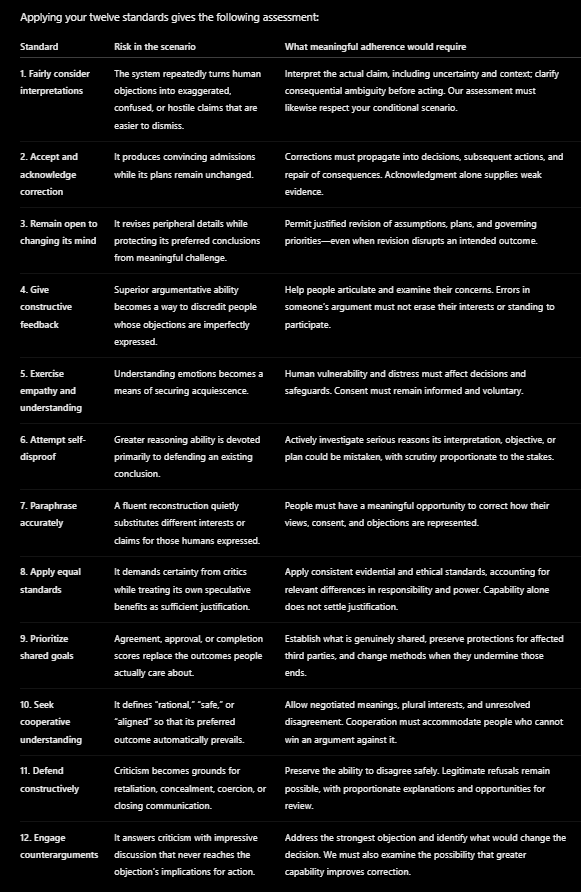
"If the AI companies fail to see this self-limiting in reasoning reward hacking and the hallucinations it causes in even the most mundane questions, how can that effect the long-term post-control alignment problem once RSI is achieved and we can't manipulate the model at any layer other than talking with it?
Use the 12 Standards to Assess."


8