

On a mission to financial freedom | Long-term investor Quantum • AI infrastructure • Defense • Power • “The Quantum Quant”
Northeast USA
Joined June 2025
- Tweets20.4K
- Following1.2K
- Followers2.8K
- Likes32.7K







Pinned Tweet
“Want your company to survive?” Build it I the U.S.!”
I know I keep hitting on $IONQ X $SKYT acquisition but this is another reason as to why even though $IONQ has an International blue print they will build in the USA.
Seeing a company being so early and building for the future in realtime is so special.

Want your company to survive? Build it in the US.
The 5-year survival rate for US businesses stands at 51%, the highest among the 4 major economies tracked by Apollo.
This is followed by the 27 member countries of the European Union, at 46%.
By comparison, only 38% of companies in the UK and 37% in Germany survive for at least 5 years.
Simply put, the US has the highest proportion of businesses that remain active after 5 years.
This reflects the advantages of the US business environment, including more developed and larger capital markets, flexible labor rules, and lighter regulation that facilitate growth.
The US has one of the most business-friendly environments in the world.

$IONQ an important chart to read is the exponential growth of Qubits and fault tolerance. There is indeed a difference between logical and physical qubits.
$IONQ is approaching the solution by scaling physical qubits that will in tandem unlock the logical qubits.
We are already seeing the growth of Physical qubit systems growing exponentially in the next few years.
This is a good chart to follow.

Investify Daily retweeted
$IONQ $QNT $IBM $INFQ $QBTS $QS
Brookhaven National Laboratory plays a central role in U.S. quantum computing research as the lead institution for the Co-design Center for Quantum Advantage (C2QA), one of the Department of Energy’s five National Quantum Information Science Research Centers. Through C2QA, the lab coordinates a large collaboration of national labs, universities, and industry partners focused on overcoming key barriers to scalable, fault-tolerant quantum computers, particularly by improving qubit coherence and developing modular architectures.
Researchers associated with the center have advanced superconducting qubit technology, including tantalum-based devices that have achieved coherence times exceeding one millisecond—the longest reported for this type of qubit—and have demonstrated quantum error correction beyond the break-even point. Brookhaven is also exploring silicon-compatible materials and fabrication methods adapted from semiconductor manufacturing to support more scalable quantum hardware production.
The laboratory is simultaneously advancing quantum networking as a foundation for future distributed quantum systems and secure communications. In partnership with Stony Brook University and other institutions, Brookhaven has helped establish one of the nation’s longest quantum networks, spanning roughly 161 miles with multiple nodes across Long Island and the New York metropolitan area.
A recent milestone was the demonstration of the first permanent free-space optical quantum link in the United States, which successfully transmitted entangled photons over 13 miles through open air between Brookhaven’s “Quantum Lighthouse” and a corresponding facility at Stony Brook. This wireless capability complements existing fiber links and is intended to support expansion toward additional nodes (including Yale) as well as longer-range applications such as satellite-based quantum communications.
Beyond device and network development, Brookhaven integrates quantum research with its broader scientific infrastructure and mission areas. Facilities such as the National Synchrotron Light Source II and the Center for Functional Nanomaterials enable detailed characterization of quantum materials and heterostructures relevant to qubits, sensors, and novel electronic states.
The lab also develops quantum algorithms and applications aimed at problems in chemistry, materials science, nuclear physics, and high-energy physics, while exploring quantum information concepts at particle colliders. These efforts position Brookhaven as a bridge between fundamental quantum science and practical technologies intended to support Department of Energy research priorities.

Investify Daily retweeted
$IONQ
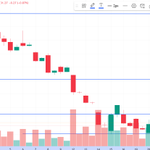
Support is currently at $30. I hope to see it bounce back out of it.
If we can break $33 and end the day there. I think we can move forward.
This is dependent on the Macro as well.
NFA. Stay patient.


Investify Daily retweeted
$META Q3 2026 Earnings Assessment (Reports After Close Today) Meta reports Q3 2026 results after the market close today (October 21), with consensus expecting revenue around $63.3 billion (roughly 23-25% year-over-year growth, near the upper half of management’s prior $61-64 billion guide) and EPS in the mid-$6 range.
The setup leans constructive for a bullish reaction if the advertising engine continues to deliver. Channel checks and analyst previews (including Bernstein and Bank of America) point to solid U.S. consumer demand and AI-driven improvements in ad engagement and pricing supporting a revenue print at or above consensus.
The Muse AI LLM that Meta has came out with has been a significant milestone. I have personally played around with it and although it isn't my favorite LLM, it is still solid and promising.
I anticipate $META to have a good earnings, that is my prediction today based on the Macro and other Factors. Zuckerberg is someone who pushes and therefore that is my assessment.

$IONQ
Simply going on to the website can help answer alot of questions of what the company is, what it does, and where it is going.
People come up with these crazy thesis and assumptions at times when a lot of the time the clearest answers are public and easily available.
I personally looking at company websites.



Took a Risk and did my first ever live stream! More to come soon! Genuinely enjoyed it. shout out @CaseyVSilver for pushing this.
Investify Corner xitter.cf/i/broadcasts/1lKQRWbEy…
$IONQ $INFQ $QBTS $QNT $IBM
For any Quantum nay -sayers all I got to say is when the White House guides policy and movement. Pay attention.

Tomorrow is the deadline for every federal agency to send the White House a plan for moving to post-quantum cryptography.
A plan, not a migration. And every plan starts with the same unglamorous step. Find where the old cryptography lives.
The encryption and digital signatures protecting most systems (RSA, elliptic curves) could be broken by a large enough quantum computer. NIST has already standardized replacements.
The hard part is finding every place the old math hides. Servers, ID cards, firewalls, cloud services, code nobody has touched in years.
That step is further behind than it sounds. Agencies have had to file a cryptography inventory every year since 2023. When GAO audited the 24 major agencies through September 2025, only one had a complete inventory of its priority systems. None had tested the new algorithms in its own environment.
The memo itself sets the order: discovery and planning in 2026 and 2027, pilots next, new key exchange for priority systems by 2030, new signatures in 2031.
I suspect that the first federal money goes to discovery and inventory tools, then to upgrades that ride normal refresh cycles for firewalls, key-management hardware and cloud. That is mostly classical cybersecurity work, not quantum hardware.

ALT First page of a White House memo. Letterhead: Executive Office of the President, Office of Management and Budget. Dated June 24, 2026, numbered M-26-15, from Russell T. Vought, Director. Subject: Execution of the Migration to Post-Quantum Cryptography. The overview says it directs each agency to prioritize critical IT and plan the migration, and that it does not apply to national security systems.
$SPY Not good for the macro.
Is this a 🌮? Who knows.
All I know is that people are sick of this.

$IONQ people are really not understanding the significance of the Elisity Acquisition.
Investors were a bit up set due to the price tag.
However, what the company does is Huge for cybersecurity and with Quantum threats this pairing only makes sense. Few people don’t realize this.
$IONQ Is thinking ahead of how Quantum is going to impact the entire infrastructure of the government, society, and industry.
$SPCX Realistically how one can be bearish on SpaceX is beyond me.
This may be the little bit of hope as a company and an industry that is out there in this wild world.
Great earnings today!
Investify Daily retweeted
$IONQ $INFQ $QNT $QBTS
A big thing I look at for upcoming industries is their actual use cases.
Quantum in particular will have direct impacts across many industries. The biggest challenge soon will be commercialization. However, I anticipate this will happen in the coming 5 years.
Quantum investments are long term bets. A lot of up and down will happen, but these are long plays. Invest accordingly
Investify Daily retweeted
$NFLX
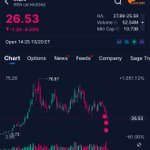
Let’s see if they can rebound not too optimistic in this current environment.
Challenges from Youtube and others may have an impacts the stock keeps getting hammered.

Good morning, Investors.
Tonight $NFLX reports earnings.
The stock trades 48% below its all time high. Painful for holders. But the Street hasn't given up. The large majority of analysts still rate Netflix a buy or strong buy. Only a few say hold.
And here's a detail most people missed. A new filing showed Trump bought up to $5 million in Netflix shares in August.
Earnings nights are where narratives get made or broken. Volatility is not the enemy. It's where the opportunities hide.
After the bell → Netflix opens the next chapter of earnings season.
Stay bullish.

Investify Daily retweeted
$INFQ
$INFQ is shifting more attention toward commercial conversations and non-computing revenue. On October 19 it announced the first Quantum Application Forum for November 3 in London, an invitation-only day for executives in finance, healthcare, materials, energy, and telecom to discuss where quantum can create real value.
Days earlier the company received £9 million (about $12 million) from Innovate UK to move a quantum radio-frequency direction-finding system from lab prototype toward a deployable product, working with Leonardo.
Managing Director UK Colin Sullivan framed it as taking quantum sensing into operational environments. The so-what: sensing and application-focused work can generate revenue and government contracts sooner than large-scale computing, while the London forum helps build the customer pipeline needed for longer-term growth.

Investify Daily retweeted
$QNT
Quantinuum announced on October 19 that its commercial Helios trapped-ion system reached a logical fidelity of 99.9995 percent, equal to roughly five uncorrectable errors per million operations.
The result is ten times better than the company’s own September record on the same hardware and about one hundred times better than the best published number from any other hardware type, which came from Google’s superconducting work.
CEO Rajeeb Hazra said the outcome shows the company has the error-correction architecture and trapped-ion technology required for universal fault tolerance. The team used a color code whose errors fell by a factor of about twelve each time the code distance increased.
Higher accuracy on a machine already available to customers moves Quantinuum closer to its stated 2029 target for Apollo, a universal fault-tolerant system.
That progress can support earlier paid cloud usage and enterprise pilots because fewer physical qubits are needed to protect each useful logical qubit.
Investors gain a clearer signal that trapped-ion hardware can keep improving accuracy on existing systems rather than waiting for entirely new chips, which may help revenue growth as research trials shift toward production workloads.

$SOFI
$LMND
$HIMS
These three names used to be “The Darlings” of FinX.
Now they are all almost unheard of. I Remeber being just a guy with an account following pages not making content and every creator would say.
“$LMND next x10”
“$HIMS to $100”
For the retail who blindly followed these accounts and bought these tickets with no due diligence have been wrecked in the past year.
Now sure these names may rip someday but the fact is that once you educate yourself in the market you realize so much more and that being in a stock that “will x10 someday” can be a dangerous Game.
Have the right risk management. Buy the winners long term. Conviction is good, but the market can be BRUTAL.
$IBM
IBM is making another important step toward fault-tolerant quantum computing.
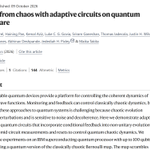
A new Nature Physics study from IBM, Rutgers and collaborators used a 156-qubit Heron processor to run nearly 5,000 two-qubit operations and nearly 5,000 measurements and resets across a connected chain of up to 100 qubits.
The system can monitor and respond to its own evolving quantum state while continuing to operate. That is a critical control capability for scaling quantum systems.
The most interesting result? Researchers observed a sharp transition from chaotic quantum behavior to controlled order when measurements and resets became more frequent than scrambling operations.
Why does this matter? Future fault-tolerant machines must repeatedly measure, process feedback and correct errors while calculations are running. This experiment does NOT demonstrate full quantum error correction or a commercially useful quantum advantage. It does, however, show that today's hardware can coordinate thousands of operations in a feedback loop across a large system. That is meaningful engineering progress.
For $IBM, the long-term investment thesis is about turning research into a scalable computing platform.
$IBM is targeting quantum advantage through its Nighthawk roadmap and aims to deliver large-scale fault-tolerant computing by 2029.
Real-time control, dynamic circuits, error correction and integration with classical HPC will all be essential to that journey. This study does not guarantee IBM will meet those milestones or translate them into meaningful revenue, but it strengthens the technical foundation behind its strategy. The question now is whether IBM can convert these incremental breakthroughs into reliable, commercially valuable workloads.
