

@JINSAdc Fellow for American Strategy. Usual caveats, all opinions my own.
Joined June 2012
- Tweets392
- Following911
- Followers427
- Likes7.2K




Jonathan Ruhe retweeted

Pulling out troops now like Piers & Joe Kent want means handing Iran the Strait of Hormuz, the Red Sea & unfettered ability to lob missiles at everything in between. It leaves Iran in control of oil prices & with a clear path to a nuke.
The only way to end the war is to win it.

'You think the best thing in the American interest right now is to attack again, only harder?'
Piers Morgan asks Blaise Misztal why he doesn't want to see the Iran War end.
Watch more 👇
📺 youtu.be/ToJzCtLjf0s
@piersmorgan | @BlaiseMisztal | @@joekent16jan19


Jonathan Ruhe retweeted
The race to lead the @UN is unlikely to alter the institution's anti-🇮🇱 biases, as “no candidate is going to become the next secretary-general by campaigning on reforming the U.N.’s institutional hostility to Israel,” says @JCB_Ruhe. @jewishinsider jewishinsider.com/2026/09/u-…

Jonathan Ruhe retweeted

“The Houthis are also very risk-acceptant and willing to tolerate losses that have compelled Iran and other proxies into ceasefires. U.S.-Israeli operations could likely exploit the Houthis’ latest advances, but Saudi air and naval power have never shown any serious capacity to degrade the Houthis militarily," said @JCB_Ruhe.
Full story from @mattsheareports:
ji.news/5it5g

Jonathan Ruhe retweeted
Why have the Houthis been able to sustain the fight when other Iranian proxies have been pushed toward ceasefires?
@JCB_Ruhe tells @jewishinsider that the Houthis’ risk tolerance, Iranian support and ability to focus on one foreign enemy at a time have given them an advantage.
jewishinsider.com/2026/09/ho…
Jonathan Ruhe retweeted
The Trump administration approved a potential $24B sale of F-35s to Saudi Arabia.
But @JCB_Ruhe tells @demarest_colin that Riyadh’s growing defense & tech ties w/ China demand firm guardrails before the deal moves forward.
“The F-35 is a microcosm of a much larger problem.”
@axios axios.com/2026/09/17/state-d…

Jonathan Ruhe retweeted
U.S. forces stationed in Israel during Operation Epic Fury were well-protected, and as @John_Hudson @sgreports & @noahjrobertson note, JINSA has been the lead advocate for improving the U.S.-Israel strategic partnership, including establishing a U.S. base in Israel.
In Sept 2024, fmr U.S. CENTCOM Commander Frank McKenzie’s paper warned of the threat Iran posed to U.S. bases in the Gulf and advised shifting them westward.
🔗jinsa.org/u-s-bases-in-the-m…
In Sept 2025, after Midnight Hammer, JINSA sent @JCB_Ruhe and a task force of 🇺🇸USAF generals to Israel to evaluate staging options for U.S. forces, identifying Ovda Air Base as suitable (built to U.S. specs & shielded by Israeli air defenses) and learned the Israeli’s would welcome U.S. forces there. 🔗jinsa.org/jinsa_report/base-…
In Feb 2026, the U.S. moved F-22s to Ovda, eventually support 6,000 U.S. personnel and 240 aircraft during Operation Epic Fury.
During the 40-day conflict with Iran, U.S. & Israeli militaries performed with unprecedented coordination and partnership, wtih Israel shouldering half the sorties and being a true partner in the conflict.
The U.S. has a true partner in Israel who is willing and capable of burden sharing.
🔗jinsa.org/jinsa_report/stren…

Exclusive: The Pentagon is evaluating its military footprint in the Middle East in an early sign of the Iran war’s potential to transform the U.S. presence in the region, according to people familiar with the matter. wapo.st/4qrSMFV

JINSA has been the first mover on why America's Middle East force posture should shift toward Israel. Today's @washingtonpost article cites our work in its analysis of how the United States is exploring new basing options in the region: washingtonpost.com/national-…
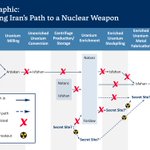
"Clarity through breadth." America will never solve the Iran nuclear problem, diplomatically or militarily, without a comprehensive view of Iran's ability to produce fissile material and build a bomb. My new JINSA report laying out this issue in detail:
jinsa.org/jinsa_report/a-new…

Jonathan Ruhe retweeted

When @SecWar testified the Iran war cost $37.5 billion, he priced replacing the munitions the US used. As @JCB_Ruhe and I argue in our new @jinsadc report, replenishment is not enough. The US must build a larger arsenal and sustain manufacturing, not just replenish after crises.

Jonathan Ruhe retweeted

“But the United States cannot escape its doom loop until it stops seeking a grand bargain with Iran.” | Johnathan Ruhe
thedispatch.com/article/iran…

A decade later, Obama’s Iran nuclear deal looms large over everything Trump tries to do, though he would be wise to end his own pursuit of a grand bargain with Tehran. My latest in @thedispatch thedispatch.com/article/iran…
Jonathan Ruhe retweeted
Iran's attacks on shipping were designed to demonstrate its control of the Strait of Hormuz.
The strategy “reflects longstanding Iranian practice, where it tries to gauge and erode US resolve” said @JCB_Ruhe via @TimesofIsrael timesofisrael.com/irans-stri…

The U.S.-Iran MOU commits to uphold Iran's "nuclear status quo" pending a final agreement. But this raises the risks of a bad deal, as we know dangerously little about the status of Iran's enrichment and bombmaking programs. My new JINSA Insight explains: jinsa.org/jinsa_report/how-t…

Jonathan Ruhe retweeted
The details of a deal between Iran and the United States is unclear.
What is clear, is that Iran has violated EVERY nuclear agreement they've signed on to.
@BlaiseMisztal explains to @MarkieMartin @NewsNation
Jonathan Ruhe retweeted
A formal U.S.-Iran 🇺🇸🇮🇷 deal may shift tensions temporarily from hot to cold, but this will only exacerbate and prolong a war that truly ends only once the Islamic Republic disappears.
Read @JCB_Ruhe latest for @thedispatch thedispatch.com/article/iran…
Trump wants a better Iran deal than Obama's, but Tehran won't play ball. My new piece in @thedispatch explains how the downsides of a grand bargain are even greater today than in 2015, and offers an alternative approach focused on regime collapse: thedispatch.com/article/iran…
Jonathan Ruhe retweeted
JINSA's @JCB_Ruhe warns @MatthewShea__ that the proposed U.S.-Saudi 🇺🇸🇸🇦 civil nuclear pact could undermine U.S.-UAE 🇺🇸🇦🇪 ties and “threaten the global nonproliferation regime and raise the risks of a regional proliferation cascade.”
via @jewishinsider jewishinsider.com/2026/06/tr…

Jonathan Ruhe retweeted
In response to media reports on the details of a near-final 60-day U.S.-Iran MOU, JINSA President and CEO @MichaelMakovsky encourages President Trump to reject it and issued the following statement:
If the reported details of a proposed U.S.-Iran MOU are broadly accurate, it would represent a loss of American nerve and damaging strategic reversal in recent American policy, abandoning many of President Trump’s prior redlines, undercutting many of the tremendous achievements of the military campaign, and undermining U.S. credibility.
I hope President Trump recognizes the enormous dangers posed by this reported MOU and rejects this disastrous arrangement. He should reverse course and restore American credibility by resuming military action that further weakens Iran’s conventional military and nuclear capabilities, ensuring the freedom of commerce through the Strait of Hormuz, maintains economic pressure on the Tehran regime, and supporting Iranians seeking to bring about the regime’s collapse, which is the ultimate strategic prize for the United States.
The U.S.-Israeli military campaign made major advances in curbing Iran’s ability to project power and weakening the regime, for which both countries’ militaries and political leaders are to be commended. However, rather than degrading Iran further, this deal would strengthen and enrich it, thereby prolonging its survival.
Comparisons to President Barack Obama’s 2015 JCPOA would be immediate and deserved. The United States would again be financially rewarding the Tehran regime to negotiate on its nuclear program while not addressing Iran’s missile capabilities or its aggressive regional activities.
In some respects, this agreement is worse than the JCPOA, since the United States would be relinquishing leverage accumulated through 38 days of direct military confrontation, strategic isolation, maritime pressure, and visible deterioration of Iran’s internal and regional position.
If Iran would not agree to acceptable American terms on its nuclear program during a ceasefire — while facing a blockade, economic strangulation, internal instability, and the credible prospect of renewed severe U.S.-Israeli military operations — there is no serious reason to believe lifting that pressure will produce a better outcome.
Without the complete, permanent, and verifiable dismantlement of Iran’s entire nuclear program, the regime’s pathway back to nuclear weapons capability is preserved and will restart, no later than after President Trump leaves office.
The Iranian regime and its supporters will rightly see this agreement as a victory over the United States, emerging not only intact but with new life thanks to the unfreezing of assets, the resumption of significant oil sales (mostly to China), and effective control over the Strait of Hormuz. President Trump would also be abandoning the Iranian population, with whom he has repeatedly expressed solidarity and support, by rescuing this brutal and corrupt regime from collapse.
It betrays Israel, our full-fledged partner in the war, which reportedly opposes this deal and was given little say in it. Israel will undoubtedly need to conduct another military action against Iran at some point to undo the damage from this deal. Israel also cannot be expected to adhere to any Iranian veto over Lebanon, and will be compelled to maintain its military action against Iran’s terrorist proxy Hezbollah that continues to threaten Israel’s northern towns.
The MOU also leaves exposed our Gulf Arab allies to an emboldened Iran as America retreats from the region.
The lesson for the rest of the world will be that America can be coerced through brinkmanship, defiance, and threats to maritime commerce and energy markets. China will take note and is a clear winner, and Taiwan a loser.
There should be no memorandum of understanding, interim deal, or partial arrangement with the Tehran regime, as it will not be worth the paper it is written on.
(1/2)
My prewar @jinsadc report with @AriCicurel gives context for recent NYT/WaPo exposés on the full extent of damage to U.S. bases. TL;DR: Iran can still impose major costs with short-range precision strikes, and will adapt its tactics for the next round:
jinsa.org/jinsa_report/irans…
