

Original peer-reviewed research & reviews #HeartSuccess @HFSA @JHeartFailureS @ElsevierConnect Co-EIC: @robmentz & @dranulala YouTube: https://xitter.cf/t.co/CZK2fadx45
Joined August 2013
- Tweets1.8K
- Following239
- Followers9.1K
- Likes1.5K



Pinned Tweet
We are proud of the progress reflected in this year’s Impact Factor of 9.9, but even more proud of what all of this represents.
A heartfelt THANK YOU to our entire JCF Family. Your engagement as authors, reviewers, readers, and mentors continues to drive this collective success.
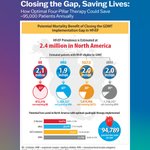
🫀 Quadruple guideline-directed medical therapy (GDMT) offers a profound mortality benefit, yet it remains severely underutilized across Heart Failure (HF) care today. Data from HF STATS 2026 reveals only 18% of patients with HFrEF receive all 4 foundational medication pillars.

In fact, fewer than 1% of newly diagnosed patients achieve target doses within a year. Closing this gap is a critical clinical imperative that could prevent nearly 95,000 deaths annually across North America.
🔗 Click here for more bit.ly/4yxpMif
#HFSTATS #HeartFailure

🥗🥘 About 30%–40% of patients with Heart Failure (HF) live with malnutrition — yet it remains one of the most overlooked challenges in inpatient and outpatient care today. Amanda Vest, MBBS, MPH, FHFSA, explains.
💬 How does your institution screen for nutritional risk in HF patients?
🎥 Watch the full clip, share for awareness, and click here to access the complete HF STATS 2026 report bit.ly/4jzqb04
#HFSTATS #HeartFailure #HeartHealth #Epidemiology #Nutrition #Healthcare
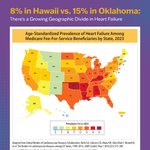
📍A patient’s zip code remains a powerful determinant of Heart Failure (HF) risk, care access, and survival. Our HF STATS 2026 Report highlights a stark geographic divide across the U.S. Click here for the full report bit.ly/3VYt8gO
#HFSTATS #HeartFailure #HeartHealth

While rural hospitalization rates declined between 2010 and 2022, this trend reflects widespread rural hospital closures and diminished healthcare access rather than improved patient health.
Rural patients face significant post-discharge barriers, receiving less GDMT, completing fewer cardiology visits, and suffering higher 30-day mortality at critical access hospitals (13.4% vs. 10.9%).
Click here to access the full HF STATS 2026 report bit.ly/3VYt8gO
Crucially, while rural hospitalization rates declined between 2010 and 2022, this trend reflects widespread rural hospital closures and diminished healthcare access rather than improved patient health.
Rural patients face significant post-discharge barriers, receiving less GDMT, completing fewer cardiology visits, and suffering higher 30-day mortality at critical access hospitals (13.4% vs. 10.9%).
Click here for the full HF STATS 2026 report bit.ly/3VYt8gO
🫀 All these insights and more in our HF STATS 2026 report. Click here for free access bit.ly/47oavW8
#HFSTATS #HeartFailure #HeartHealth #Cardiology #Cardiologist #Epidemiology #Healthcare


Heart failure care should not depend on your ZIP code.
I’m proud to co-author HF STATS 2026 from the @HFSA, published in @JCardFail, and to have drafted the updated section on hospitalizations alongside an outstanding writing group led by @EiranGorodeski
Three findings I’m highlighting:
• The burden is growing: an estimated 7.7 million U.S. adults have heart failure, projected to reach 11.4 million by 2050.
• Hospitalizations remain staggering: in 2023, there were approximately 1.27 million U.S. hospitalizations with HF as the primary diagnosis, and more than 6 million with HF as either a primary or secondary diagnosis.
• This is not just a disease of older adults: HF hospitalization rates among adults younger than 65 increased from 124 to 161 per 100,000 between 2010 and 2022, even as rates declined among older adults.
The regional disparities hit especially close to home. In 2023, age-standardized HF prevalence among Medicare fee-for-service beneficiaries was 15% in Oklahoma and 14% in Arkansas—among the highest in the country.
The rural findings also demand careful interpretation. Patients in rural settings had fewer cardiology visits after discharge and a lower likelihood of achieving optimal guideline-directed medical therapy. Declining rural hospitalization rates do not mean better outcomes: hospital closures, fewer available beds, and longer travel distances may contribute to fewer admissions.
For us at @MidAmericaHeart and @saintlukeskc this is a shared regional responsibility. Communities in neighboring Oklahoma and Arkansas are part of the broader region we support. We must continue strengthening partnerships with rural clinicians, improving timely follow-up and medication access, and bringing specialty expertise closer to patients’ homes.
Our goal is fewer preventable hospitalizations because patients are receiving better care, not fewer admissions because care is harder to reach.
doi.org/10.1016/j.cardfail.2…

📈 Heart failure (HF) mortality in the United States has reached a historic peak, reversing more than a decade of prior progress.
Read the full report here bit.ly/47oavW8
#HFSTATS #HeartFailure #HeartHealth #HeartHealthy #Healthcare #Cardiology
But it doesn't end here — early 2024 data suggest this HF mortality surge is worsening. These escalating numbers reinforce the critical need for early risk identification and aggressive implementation of evidence-based care.
🔗 Review more findings from our HF STATS 2026 report here bit.ly/47oavW8
🫀Racial and ethnic disparities in heart failure (HF) mortality and hospitalization remain severe, demanding urgent attention across clinical and research communities.
Findings from our HF STATS 2026 report highlight a stark reality bit.ly/4s4t8ro

📌 HF mortality among Black patients stands at 41.7 per 100,000 — more than 3x the rate seen in Asian patients (12.8 per 100,000).

Understanding these epidemiological patterns is critical for clinicians, scientists, and policymakers dedicated to advancing cardiovascular equity.
🔗 Click here to access the complete HF STATS 2026 report bit.ly/4s4t8ro
#HFSTATS #HeartFailure #HeartHealth #Cardiology
💊 How quickly did practice change after ARIES-HM3?
Aspirin use after HM3 fell from 90% in 2023 to 53% in 2025, yet persisted most in patients with vascular disease. Aspirin avoidance showed no excess thromboembolic risk. 💜 #HFSASimPub
🔗 bit.ly/4B5cdJm

