

Founder,tech,money & investing,writer,podcaster. The Purse #jointhepurse #womenandcapital #womeninvestors #genderlens #investor #crypto #LSE
Australia
Joined October 2007
- Tweets7.2K
- Following1.8K
- Followers1.4K
- Likes3.7K





Jana Hlistova retweeted

Marc Andreessen says the gap between what AI-native startups and incumbents think AI can do is the widest he’s ever seen:
"The AI-native early stage startups have just a completely different view on what they can do with AI than the typical incumbents in almost any industry, almost without exception."
"AI is just racing ahead in capability even week by week... There are going to be a lot of industries that are really up for grabs in a fundamentally more profound way than maybe has been the case in the past."
"The founders are gonna have a level of superpowers coming from the use of these tools and these technologies that they just simply haven't had in the past... Had I had Astra and Netscape in 1994, like, oh my God. Like, Ben, what would you and I have been able to do at Netscape?"
"Those entrepreneurs are gonna color way outside the lines. We already see this. They're not gonna think of themselves as like, 'I'm just a software company,' or, 'I'm just a hardware company,' or even, 'I'm just an AI company.'"
@pmarca @bhorowitz

Today, a16z Crypto is becoming a16z Frontier.
Since joining a16z in 2013, @cdixon has focused on technologies that look futuristic well before they reach the mainstream. Those themes led to investments in Oculus, Skydio, Zipline, Coinbase, Solana, and Uniswap.
Frontier expands that mandate beyond crypto to back "outer planet" founders who are building new technologies and creating markets that may take years to develop.
Chris joins @pmarca, @bhorowitz, and @eriktorenberg to discuss why crypto has become part of the broader tech landscape, why Frontier fills a hole in the firm's architecture, and why they'd rather be too early than too late.
They also get into why the gap between AI-native startups and incumbents is the widest Marc has ever seen, how AI could pull forward 20 years of frontier technology, why stablecoins may become the way AI agents pay each other, how AI is breaking the internet's business model, and why today's 18-year-olds are about to become superhumans.
0:50 Introducing a16z Frontier
2:49 Smartphone parts to drones and VR
4:47 Backing the "outer planets"
7:11 Good ideas that look like bad ideas
10:43 The JP Morgan photo in Marc's office
15:13 Good tech ideas eventually work
16:53 AI may pull tech 20 years forward
18:18 The widest AI gap Marc's ever seen
22:06 Workers adopt AI before companies do
26:32 Old use cases vs. AI-native ones
30:08 Beyond "product manager brain"
34:45 AI can reverse engineer any hardware
38:23 The case for open source AI
46:36 How AI breaks the internet's model
49:11 VR, homebrew hacking, multiplayer AI
54:00 If you're 18, study "modern alchemy"
YouTube: youtu.be/-9XQMHhpypc
Not an offer or solicitation. None of the information herein should be taken as investment advice; Some of the companies mentioned are portfolio companies of a16z. Please see a16z.com/disclosures for more information. A list of investments made by a16z is available at a16z.com/portfolio.
Jana Hlistova retweeted

Our latest research paper explores the growing connection between AI and digital assets and explains why broad AI adoption may drive new demand, utility and applications across the digital asset economy. blackrock.com/us/individual/…


Jana Hlistova retweeted
Venture exposure and venture returns are hardly the same sport:
- The top 1% of VC investors account for 57% of the industry's net profits
- The top 5% take 90%, and the other 95% split what's left
Full piece from a16z's @jkhamehl on the power law that runs through the funds: a16z.news/p/catching-the-ven…


Jana Hlistova retweeted

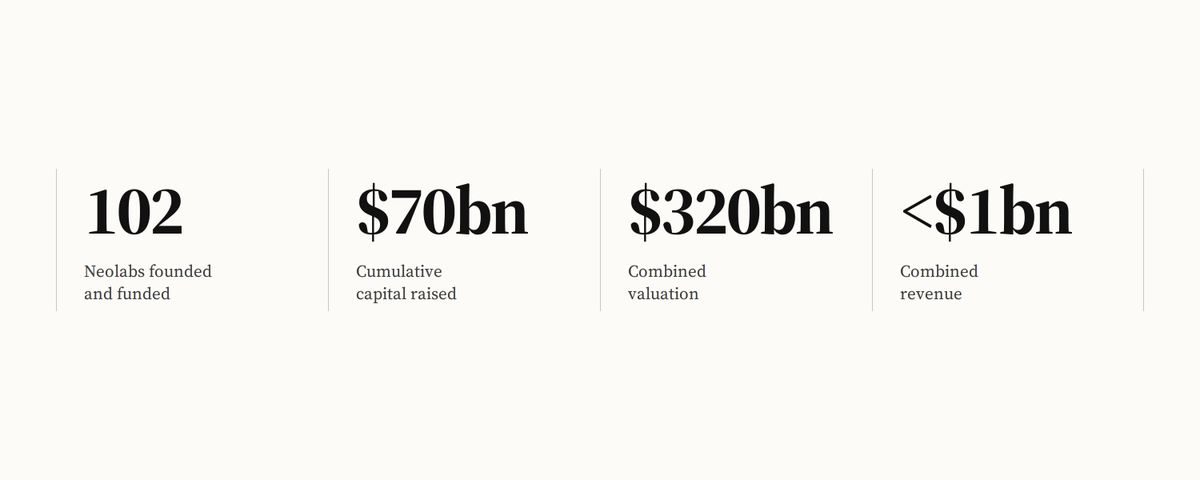
102 Neolabs. $70bn raised. $320bn combined valuation. Less than $1bn of revenue.
What the Great Neolab Trade actually implies:
Jana Hlistova retweeted
Humans are the minority user of AI
Agents burn nearly 5x the tokens people do, up 14x since February
Charts of the Week: a16z.news/p/charts-of-the-we…

Jana Hlistova retweeted

All of economics is built on one assumption... scarcity.
Hyperproductive AI and hyperproductive robots break that assumption because they dissolve the old material constraints and push prices across huge parts of the economy towards zero.
Which kills the scoreboard too. GDP is a sum of whatever gets bought and sold. But as abundance drags more and more prices towards zero a bigger share of what’s really happening stops showing up in the number.
Thats the heart of my Economic Singularity framework... and @DMattin explains it wonderfully in this clip. Its what all our work at The Exponentialist is focused on.
Jana Hlistova retweeted

As @cdixon said: "The Whatsapp moment for money is here"


Why stablecoins are the mobile phones of money.
To gain mass adoption, mobile phones first had to be compatible with landlines. They would have been useless otherwise (since you'd have no one to call).
Since they were compatible, you could call someone's house from your cell phone and it would be the same as any other call.
Then mobile phones eventually became the standard because a phone in your pocket was better than one attached to your house. And text messaging was cool.
This then produced a host of innovations that were hard to predict. Social media, Uber, mobile gaming, etc.
Stablecoin cards make stablecoins compatible with the traditional financial system.
To gain mass adoption, stablecoins had to be compatible with everyday merchants.
Well, stablecoin cards have made stablecoins compatible with 175M merchants worldwide.
With a @raincards card, you can spend a stablecoin balance, and to the merchant, it feels like any other transaction. Since stablecoin cards settle daily with Visa / Mastercard, and the merchant gets paid out in fiat.
Stablecoins will eventually become the standard because internet-native dollars that can move 24/7 anywhere in the world are better than dollars that run over 1970s-era back-office systems, confined to banking hours.
This will once again produce a host of innovations that are hard to predict.
What those will be will be fascinating to see play out over the coming years and decades (it is no coincidence we launched the Agentic Payments Alliance yesterday).
A take even @malekanoms might agree with :)
Jana Hlistova retweeted

A must read for anyone interested in how the financial guardrails of the economy will look with the merge of AI and crypto. Combine this with Yen intervention and today’s debt buyback news and you can see the old system vs the new system. Be ready.


Jana Hlistova retweeted
The data on what happened after GENIUS passed last year speaks for itself ↓
Now comes the rulemaking.
This week’s Treasury proposal begins defining the bounds of the U.S. stablecoin market: who is issuing here, who can offer stablecoins to U.S. users, and when a license is required.

Jana Hlistova retweeted

JUST IN: Wall Street giant Jane Street dropped a bombshell SEC filing:
They disclosed owning over $990 million in Bitcoin ETFs 🤯

Jana Hlistova retweeted
Stablecoins are increasingly being spent by card swipe.
Crypto payment cards have gone from a novelty to more than $750 million in monthly spend. These cards let people pay with crypto anywhere traditional card networks are accepted. Behind the scenes, the crypto — stablecoins, overwhelmingly — gets converted to local currency at the point of sale, so the payments look like any other card transactions to merchants.
Crypto cardholders don’t require a traditional bank account. Depending on the program, users either deposit stablecoins with a card issuer, or hold them directly onchain through self-custody. Crypto cards expand people’s access to U.S. dollar accounts globally, and they offer a convenient way for stablecoin holders to transact.




Jana Hlistova retweeted
BREAKING: 🇺🇸 $7.1 trillion Fidelity officially endorses the Senate to pass the Clarity Act.

Jana Hlistova retweeted

"We replaced Salesforce with a vibe-coded CRM built for our own workflows.
The custom system integrated our AI agents more effectively, worked better for the team, and made Salesforce unnecessary.
That decision cut a $600,000 annual software bill to zero."
Is this an anomaly or the start of a much larger trend @chamath @Avishai_ab @jasonlk @benioff


Jana Hlistova retweeted
Episode #164 with Dr Georgia Fleet, CEO & Co-founder at Zonova is live.
We talk about her mission to tackle one of healthcare's most persistent challenges: hospital-acquired infections, the pivot to a platform model, founder market fit, fundraising and what women investors bring to the table.
Please enjoy! Listen on Spotify+ (see links below).
Jana Hlistova retweeted

Finally, the web has native monetization. Ads were not the only way.

We're opening the waitlist for our Monetization Gateway, which will allow you to charge for any web page, dataset, API, or MCP tool behind Cloudflare. The charges will settle in stablecoins over the x402 open protocol. cfl.re/4eUFdt6

Jana Hlistova retweeted

“Loop engineering” is a hot buzzphrase after mentions of it by Boris Cherny (Claude Code’s creator) and Peter Steinberger (OpenClaw's creator) went viral on social media. Loops are now a key part of how we get AI agents to iterate at length to build software. In this letter, I’d like to share my 3 key loops, shown in the image below, for building 0-to-1 products. These loops guide not just how I build software, but also how I decide what software to build.
Agentic coding loop: Given a product specification and optionally a set of evals (that is, a dataset against which to measure performance), we can have an AI agent write code, test its work, and keep iterating until the code is bug-free and meets its specification. This idea of closing the loop took off around the end of last year, and it has been a game changer in enabling coding agents to work longer productively without human intervention. For example, over the weekend, I was building an app for my daughter to practice typing, and my coding agent could easily work for around an hour, using a web browser to check what it had built multiple times before getting back to me, without needing my intervention.
The engineering loop executes quickly. Every few minutes, the coding agent might build and test a new version of the software. I hear frequently from developers who are finding new ways to engineer more effective engineering loops. This is an active area of invention!
Developer feedback loop: In this loop, a developer examines the current product and steers the coding agent to improve it. Last year, a lot of developers (including me) were acting as the QA (quality assurance) function for our coding agents, manually finding bugs and then asking the agent to fix them. But with coding agents much more able to test their own code, the amount of time we need to spend on this function has decreased significantly. This allows us to make higher-level product decisions, such as what key features to offer, where the UI needs improvement, and so on.
The developer-feedback loop operates over time intervals between tens of minutes and hours — that's how frequently a developer might review a product and give feedback. In the case of the typing app, I changed my mind a few times about the visual design, what cat costumes she can unlock as she learns (she loves cats), and the user flow for a grown-up to log in and steer the child's learning experience.
When a developer has a clear vision for what to build, it is still a lot of work to translate that vision into a specification for a coding agent to implement. Further, after the developer has seen an implementation, they might update (or perhaps clarify) the spec to steer it toward what they want. If you find that the system repeatedly runs into certain problems, building a set of evals for the agent becomes useful.
AI-native teams are increasingly using AI to help shape product direction, for example, automating the gathering and analysis of usage data, summarizing written and verbal customer feedback, or carrying out competitive analysis. However, for pretty much all the products I’m involved in, I see humans as having a significant context advantage over current AI systems — we know a lot more than the AI system about the users and the context the product has to operate in — and thus humans play a critical role. Many people describe this human contribution as “taste,” but I prefer to think of it as humans having a context advantage, since that gives us a clearer path to helping AI systems get better. This also speaks to why this step can’t be automated: So long as the human knows something the AI does not, human-in-the-loop is needed to to inject that knowledge into the system.
External feedback loop: This includes a wide range of tactics like asking a few friends for feedback, launching to alpha testers, or putting the code into production with A/B testing. These tactics are usually slow, rarely taking less than hours and sometimes taking days or even weeks. This data informs the developer vision, which in turn continues to drive the detailed product spec, which in turn drives the coding agent.
With coding agents speeding up software development, more engineers are starting to play a partial product management role. For many engineers who are growing into this role, the hardest part is shaping the product vision and striking a balance between building (bridging the gap between vision and spec) and getting user feedback to evolve the vision. It is important to do both!
I will write more about how to do this in future posts, but for now, I find it encouraging that engineers are playing an expanded role (just as product managers and designers now do more engineering).
[Original text: The Batch]

Jana Hlistova retweeted

New from Stripe Economics: The Age of the Solopreneur
stripeeconomics.com/p/the-ag…


