
All-around cool guy.
3rd Planet from the Sun
Joined December 2010
- Tweets18.6K
- Following441
- Followers1.7K
- Likes19.1K




JoeCoolTrader retweeted
Our very sense of what we know as the United States is on the line. We are at the precipice of going full fascism and losing our liberty if Trump prevails. Look at Turkey to see what happens. $SPY $SPX $QQQ

🚨NEW: 4th Circuit unanimously rejects Trump request to halt proceedings in Mr. Abrego Garcia's case.
Reagan appointee Wilkinson writes that the Trump admin's position is "shocking not only to judges, but to the intuitive sense of liberty that Americans ... still hold dear."

ALT It is difficult in some cases to get to the very heart of the matter. But in this case, it is not hard at all. The government is asserting a right to stash away residents of this country in foreign prisons without the semblance of due process that is the foundation of our constitutional order. Further, it claims in essence that because it has rid itself of custody that there is nothing that can be done. This should be shocking not only to judges, but to the intuitive sense of liberty that Americans far removed from courthouses still hold dear.
JoeCoolTrader retweeted

JANE STREET JUST EXPOSED THEIR NEXT TARGET: ETHEREUM.
The same firm behind the daily 10 AM Bitcoin dump, the same firm sued for insider trading in the $40 billion LUNA collapse, and the same firm with $567 million frozen by Indian regulators could now be targeting Ethereum.
The data reveals a massive, coordinated exit from Bitcoin and a violent rotation into Ethereum.
IBIT : down 71% in a single quarter.
FBTC : down 60%.
Strategy $MSTR : down 78%.
Bitcoin miners IREN, Cipher, TeraWulf, Core Scientific: all cut.
Over $800 million in Bitcoin exposure erased in 90 days. Now look at what they were buying at the same time.
ETHA : nearly doubled.
FETH : sharply raised.
Galaxy Digital: from 17,000 shares to 1.5 million. That is an 8,700% increase in one quarter.
Total new Ethereum ETF exposure added: $82 million.
In Q4 2025, the quarter right before this dump, Jane Street increased their MSTR position by 473%. They loaded up aggressively and Then in Q1 2026 they cut 78% of it.
In India, SEBI documented this exact structure across 18 expiry days. Build the long position in the underlying first. Then set up the derivatives. Then move the market. The cash position is the setup cost and The options book is where the money gets made. And the options book is the one thing a 13F will never show you.
Ethereum is the easier target. Bitcoin futures open interest sits at $60 billion. Ethereum's is slightly more than half that at roughly $34 billion. A smaller market means a smaller amount of capital can move the price further.
In India, Jane Street moving the Bank Nifty index using stock purchases. Ethereum's market cap is $273 billion against Bitcoin's $1.6 trillion. That is a 5.8x size difference. The same amount of capital creates nearly 6 times the price impact in ETH.
The ETF market for Ethereum is also still early. Bitcoin ETFs hold roughly 6.67% of all circulating BTC supply. Ethereum ETF penetration is less than that, which means there is no institutional demand floor yet to absorb a coordinated sell.
They are not rotating into Ethereum because they are bullish on Ethereum. They are rotating into Ethereum because It is easier to move.


JoeCoolTrader retweeted
WARREN BUFFETT JUST SENT WHAT COULD BE HIS LAST MESSAGE TO BERKSHIRE HATHAWAY $BRK.B SHAREHOLDERS AS CEO OF THE COMPANY
Here is the full and entire 8 page press release Warren Buffett just released ⬇️⬇️
To My Fellow Shareholders:
I will no longer be writing Berkshire’s annual report or talking endlessly at the annual meeting. As the British would say, I’m “going quiet.”
Sort of.
Greg Abel will become the boss at yearend. He is a great manager, a tireless worker and an honest communicator. Wish him an extended tenure.
I will continue talking to you and my children about Berkshire via my annual Thanksgiving message. Berkshire’s individual shareholders are a very special group who are unusually generous in sharing their gains with others less fortunate. I enjoy the chance to keep in touch with you. Indulge me this year as I first reminisce a bit. After that, I will discuss the plans for distribution of my Berkshire shares. Finally, I will offer a few business and personal observations.
* * * * * * * * * * * *
As Thanksgiving approaches, I’m grateful and surprised by my luck in being alive at 95. When I was young, this outcome did not look like a good bet. Early on, I nearly died.
It was 1938 and Omaha hospitals were then thought of by its citizens as either Catholic or Protestant, a classification that seemed natural at the time.
Our family doctor, Harley Hotz, was a friendly Catholic who made house calls toting a black bag. Dr. Hotz called me Skipper and never charged much for his visits. When I experienced a bad bellyache in 1938, Dr. Hotz came by and, after probing a bit, told me I would be OK in the morning.
He then went home, had dinner and played a little bridge. Dr. Hotz couldn’t, however, get my somewhat peculiar symptoms out of his mind and later that night he dispatched me to St. Catherine’s Hospital for an emergency appendectomy. During the next three weeks, I felt like I was in a nunnery, and began enjoying my new “podium.” I liked to talk – yes, even then – and the nuns embraced me.
To top things off, Miss Madsen, my third-grade teacher, told my 30 classmates to each write me a letter. I probably threw away the letters from the boys but read and reread those from the girls; hospitalization had its rewards.
The highlight of my recovery – which actually was dicey for much of the first week – was a gift from my wonderful Aunt Edie. She brought me a very professional-looking fingerprinting set, and I promptly fingerprinted all of my attending nuns. (I was probably the first Protestant kid they had seen at St. Catherine’s and they didn’t know what to expect.)
My theory – totally nutty, of course – was that someday a nun would go bad and the FBI would find that they had neglected to fingerprint nuns. The FBI and its director, J. Edgar Hoover, had become revered by Americans in the 1930s, and I envisioned Mr. Hoover, himself, coming to Omaha to inspect my invaluable collection. I further fantasized that J. Edgar and I would quickly identify and apprehend the wayward nun. National fame seemed certain.
Obviously, my fantasy never materialized. But, ironically, some years later it became clear that I should have fingerprinted J. Edgar himself as he became disgraced for misusing his post.
Well, that was Omaha in the 1930s, when a sled, a bicycle, a baseball glove and an electric train were coveted by me and my friends. Let’s look at a few other kids from that era, who grew up very nearby and greatly influenced my life but of whom I was for long unaware.
I’ll begin with Charlie Munger, my best pal for 64 years. In the 1930s, Charlie lived a block away from the house I have owned and occupied since 1958.
Early on, I missed befriending Charlie by a whisker. Charlie, 6 ⅔ years older than I, worked in the summer of 1940 at my grandfather’s grocery store, earning $2 for a 10-hour day. (Thrift runs deep in Buffett blood.) The following year I did similar work at the store, but I never met Charlie until 1959 when he was 35 and I was 28.
After serving in World War II, Charlie graduated from Harvard Law and then moved permanently to California. Charlie, however, forever talked of his early years in Omaha as formative. For more than 60 years, Charlie had a huge impact on me and could not have been a better teacher and protective “big brother.” We had differences but never had an argument. “I told you so” was not in his vocabulary.
In 1958, I bought my first and only home. Of course, it was in Omaha, located about two miles from where I grew up (loosely defined), less than two blocks from my in-laws, about six blocks from the Buffett grocery store and a 6-7-minute drive from the office building where I have worked for 64 years.
Let’s move on to another Omahan, Stan Lipsey. Stan sold the Omaha Sun Newspapers (weeklies) to Berkshire in 1968 and a decade later moved to Buffalo at my request. The Buffalo Evening News, owned by a Berkshire affiliate, was then locked in a battle to the death with its morning competitor who published Buffalo’s only Sunday paper. And we were losing.
Stan eventually built our new Sunday product, and for some years our paper – formerly hemorrhaging cash – earned over 100% annually (pre-tax) on our $33 million investment. This was important money to Berkshire in the early 1980s.
Stan grew up about five blocks from my home. One of Stan’s neighbors was Walter Scott, Jr. Walter, you will remember, brought MidAmerican Energy to Berkshire in 1999. He was also a valued Berkshire director until his death in 2021 and a very close friend. Walter was Nebraska’s philanthropic leader for decades and both Omaha and the state carries his imprint.
Walter attended Benson High School, which I was scheduled to attend as well – until my dad surprised everyone in 1942 by beating a four-term incumbent in a Congressional race. Life is full of surprises.
Wait, there’s more.
In 1959, Don Keough and his young family lived in a home located directly across the street from my house and about 100 yards away from where the Munger family had lived. Don was then a coffee salesman but was destined to become president of Coca-Cola as well as a devoted director of Berkshire.
When I met Don, he was earning $12,000 a year while he and his wife Mickie were raising five children, all destined for Catholic schools (with tuition requirements).
Our families became fast friends. Don came from a farm in northwest Iowa and graduated from Omaha’s Creighton University. Early on, he married Mickie, an Omaha girl. After joining Coke, Don went on to become legendary around the globe.
In 1985, when Don was president of Coke, the company launched its ill-fated New Coke. Don made a famous speech in which he apologized to the public and reinstated “Old” Coke. This change of heart took place after Don explained that Coke incoming mail addressed to “Supreme Idiot” was promptly delivered to his desk. His “withdrawal” speech is a classic and can be viewed on YouTube. He cheerfully acknowledged that, in truth, the Coca-Cola product belonged to the public and not to the company. Sales subsequently soared.
You can watch Don on CharlieRose(.)com in a wonderful interview. (Tom Murphy and Kay Graham have a couple of gems as well.) Like Charlie Munger, Don forever remained a Midwestern boy, enthusiastic, friendly and American to the core.
Finally, Ajit Jain, born and raised in India, as well as Greg Abel, our Canadian CEO-to-be, each lived in Omaha for several years late in the 20th Century. Indeed, in the 1990s, Greg lived only a few blocks away from me on Farnam Street, though we never met at the time.
Can it be that there is some magic ingredient in Omaha’s water?
* * * * * * * * * * * *
I lived a few teenage years in Washington, DC (when my dad was in Congress) and in 1954 I took what I thought would be a permanent job in Manhattan. There I was treated wonderfully by Ben Graham and Jerry Newman and made many life-long friends. New York had unique assets – and still does. Nevertheless, in 1956, after only 1½ years, I returned to Omaha, never to wander again.
Subsequently, my three children, as well as several grandchildren, were raised in Omaha. My children always attended public schools (graduating from the same high school that educated my dad (class of 1921), my first wife, Susie (class of 1950) as well as Charlie, Stan Lipsey, Irv and Ron Blumkin, who were key to growing Nebraska Furniture Mart, and Jack Ringwalt (class of 1923), who founded National Indemnity and sold it to Berkshire in 1967 where it became the base upon which our huge P/C operation was constructed.
* * * * * * * * * * * *
Our country has many great companies, great schools, great medical facilities and each definitely has its own special advantages along with talented people. But I feel very lucky to have had the good fortune to make many lifelong friends, to meet both of my wives, to receive a great start in education at public schools, to meet many interesting and friendly adult Omahans when I was very young, and to make a wide variety of friends in the Nebraska National Guard. In short, Nebraska has been home.
Looking back I feel that both Berkshire and I did better because of our base in Omaha than if I had resided anywhere else. The center of the United States was a very good place to be born, to raise a family, and to build a business. Through dumb luck, I drew a ridiculously long straw at birth.
* * * * * * * * * * * *
Now let’s move on to my advanced age. My genes haven’t been particularly helpful – the family’s all-time record for longevity (admittedly family records get fuzzy as you work backwards) was 92 until I came along. But I have had wise, friendly and dedicated Omaha doctors, starting with Harley Hotz, and continuing to this day. At least three times, my life has been saved, each with doctors based within a few miles from my home. (I have given up fingerprinting nurses, however. You can get away with many eccentricities at 95 . . . . . but there are limits.)
* * * * * * * * * * * *
Those who reach old age need a huge dose of good luck, daily escaping banana peels, natural disasters, drunk or distracted drivers, lightning strikes, you name it.
But Lady Luck is fickle and – no other term fits – wildly unfair. In many cases, our leaders and the rich have received far more than their share of luck – which, too often, the recipients prefer not to acknowledge. Dynastic inheritors have achieved lifetime financial independence the moment they emerged from the womb, while others have arrived, facing a hell-hole during their early life or, worse, disabling physical or mental infirmities that rob them of what I have taken for granted. In many heavily-populated parts of the world, I would likely have had a miserable life and my sisters would have had one even worse.
I was born in 1930 healthy, reasonably intelligent, white, male and in America. Wow! Thank you, Lady Luck. My sisters had equal intelligence and better personalities than I but faced a much different outlook. Lady Luck continued to drop by during much of my life, but she has better things to do than work with those in their 90s. Luck has its limits.
Father Time, to the contrary, now finds me more interesting as I age. And he is undefeated; for him, everyone ends up on his score card as “wins.” When balance, sight, hearing and memory are all on a persistently downward slope, you know Father Time is in the neighborhood.
I was late in becoming old – its onset materially varies – but once it appears, it is not to be
denied.
To my surprise, I generally feel good. Though I move slowly and read with increasing difficulty, I am at the office five days a week where I work with wonderful people. Occasionally, I get a useful idea or am approached with an offer we might not otherwise have received. Because of Berkshire’s size and because of market levels, ideas are few – but not zero.
* * * * * * * * * * * *
My unexpected longevity, however, has unavoidable consequences of major importance to my family and the achievement of my charitable objectives.
Let’s explore them.
What Comes Next
My children are all above normal retirement age, having reached 72, 70 and 67. It would be a mistake to wager that all three – now at their peak in many respects – will enjoy my exceptional luck in delayed aging. To improve the probability that they will dispose of what will essentially be my entire estate before alternate trustees replace them, I need to step up the pace of lifetime gifts to their three foundations. My children are now at their prime in respect to experience and wisdom but have
yet to enter old age. That “honeymoon” period will not last forever.
Fortunately, a course correction is easy to execute. There is, however, one additional factor to consider: I would like to keep a significant amount of “A” shares until Berkshire shareholders develop the comfort with Greg that Charlie and I long enjoyed. That level of confidence shouldn’t take long. My children are already 100% behind Greg as are the Berkshire directors.
All three children now have the maturity, brains, energy and instincts to disburse a large fortune. They will also have the advantage of being above ground when I am long gone and, if necessary, can adopt policies both anticipatory and reactive to federal tax policies or other developments affecting philanthropy. They may well need to adapt to a significantly changing world around them. Ruling from the grave does not have a great record, and I have never had an urge to do
Fortunately, all three children received a dominant dosage of their genes from their mother. As the decades have passed, I have also become a better model for their thinking and behavior. I will never, however, achieve parity with their mother.
My children have three alternate trustees in case of any premature deaths or disabilities. The alternates are not ranked or tied to a specific child. All three are exceptional humans and wise in the ways of the world. They have no conflicting motives.
I have assured my children that they do not need to perform miracles nor fear failures or disappointments. These are inevitable, and I have made my share. They simply need to improve somewhat upon what generally is achieved by government activities and/or private philanthropy, recognizing these other methods of redistribution of wealth have shortcomings as well.
Early on, I contemplated various grand philanthropic plans. Though I was stubborn, these did not prove feasible. During my many years, I’ve also watched ill-conceived wealth transfers by political hacks, dynastic choices and, yes, inept or quirky philanthropists.
If my children simply do a decent job, they can be certain that their mother and I would be pleased. Their instincts are good and they each have had years of practice with very small sums initially that have been irregularly increased to more than $500 million annually.
All three like working long hours to help others, each in their own way.
* * * * * * * * * * * *
The acceleration of my lifetime gifts to my children’s foundations in no way reflects any change in my views about Berkshire’s prospects. Greg Abel has more than met the high expectations I had for him when I first thought he should be Berkshire’s next CEO. He understands many of our businesses and personnel far better than I now do, and he is a very fast learner about matters many CEOs don’t even consider. I can’t think of a CEO, a management consultant, an academic, a member of government – you name it – that I would select over Greg to handle your savings and mine.
Greg understands, for example, far more about both the upside potential and the dangers of our P/C insurance business than do a great many long-time P/C executives. My hope is that his health remains good for several decades. With a little luck, Berkshire should require only five or six CEOs over the next century. It should particularly avoid those whose goal is to retire at 65, to become lookat-me rich or to initiate a dynasty
One unpleasant reality: Occasionally, a wonderful and loyal CEO of the parent or a subsidiary will succumb to dementia, Alzheimer’s or another debilitating and long-term disease.
Charlie and I encountered this problem several times and failed to act. This failure can be a huge mistake. The Board must be alert to this possibility at the CEO level and the CEO must be alert to the possibility at subsidiaries. This is easier said than done; I could cite a few examples from the past at major companies. Directors should be alert and speak up is all that I can advise.
During my lifetime, reformers sought to embarrass CEOs by requiring the disclosure of the compensation of the boss compared to what was being paid to the average employee. Proxy statements promptly ballooned to 100-plus pages compared to 20 or less earlier.
But the good intentions didn’t work; instead they backfired. Based on the majority of my observations – the CEO of company “A” looked at his competitor at company “B” and subtly conveyed to his board that he should be worth more. Of course, he also boosted the pay of directors and was careful who he placed on the compensation committee. The new rules produced envy, not moderation.
The ratcheting took on a life of its own. What often bothers very wealthy CEOs – they are human, after all – is that other CEOs are getting even richer. Envy and greed walk hand in hand. And what consultant ever recommended a serious cut in CEO compensation or board payments?
* * * * * * * * * * * *
In aggregate, Berkshire’s businesses have moderately better-than-average prospects, led by a few non-correlated and sizable gems. However, a decade or two from now, there will be many companies that have done better than Berkshire; our size takes its toll.
Berkshire has less chance of a devastating disaster than any business I know. And, Berkshire has a more shareholder-conscious management and board than almost any company with which I am familiar (and I’ve seen a lot). Finally, Berkshire will always be managed in a manner that will make its existence an asset to the United States and eschew activities that would lead it to become a supplicant. Over time, our managers should grow quite wealthy – they have important responsibilities – but do not have the desire for dynastic or look-at-me wealth.
Our stock price will move capriciously, occasionally falling 50% or so as has happened three times in 60 years under present management. Don’t despair; America will come back and so will Berkshire shares.
A Few Final Thoughts
One perhaps self-serving observation. I’m happy to say I feel better about the second half of my life than the first. My advice: Don’t beat yourself up over past mistakes – learn at least a little from them and move on. It is never too late to improve. Get the right heroes and copy them. You can start with Tom Murphy; he was the best.
Remember Alfred Nobel, later of Nobel Prize fame, who – reportedly – read his own obituary that was mistakenly printed when his brother died and a newspaper got mixed up. He was horrified at what he read and realized he should change his behavior.
Don’t count on a newsroom mix-up: Decide what you would like your obituary to say and live the life to deserve it.
Greatness does not come about through accumulating great amounts of money, great amounts of publicity or great power in government. When you help someone in any of thousands of ways, you help the world. Kindness is costless but also priceless. Whether you are religious or not, it’s hard to beat The Golden Rule as a guide to behavior.
I write this as one who has been thoughtless countless times and made many mistakes but also became very lucky in learning from some wonderful friends how to behave better (still a long way from perfect, however). Keep in mind that the cleaning lady is as much a human being as the Chairman.
* * * * * * * * * * * *
I wish all who read this a very happy Thanksgiving. Yes, even the jerks; it’s never too late to change. Remember to thank America for maximizing your opportunities. But it is – inevitably – capricious and sometimes venal in distributing its rewards.
Choose your heroes very carefully and then emulate them. You will never be perfect, but you can always be better.

JoeCoolTrader retweeted

The argument for Bitcoin relates to the eventual destruction of fiat currency units (e.g., $USD)
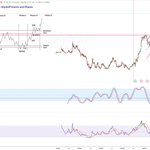
This chart on right plots price of Bitcoin $BTC in relationship to total U.S. money stock (M1). This ratio remains below the Dec 2017 high. Interesting to note similarities in chart structure to $DJIA during period of Great Stagflation of 1970s.
Some of you will deny existence of continuation inverted H&S - so I will discuss it here. Schabacker (1934) and Edwards and Magee (1948) acknowledge this pattern by name. If the ID is good enough for them, then it is good enough for me.


JoeCoolTrader retweeted

GOLDMAN adds $BA and $SPG to Convcition Buy.
On SPG, they say: “favorably positioned in a post-pandemic retail environment where its customers — retailers — are now looking to expand store footprints in response to consumers who are seeking experience-based consumption options.”

JoeCoolTrader retweeted

The Reverse Repo facility has seen $1 trillion drain out in just the last 6 months
What happens when it runs out?
Its important to remember what this account is for, and where this money came from in the first place 🧵👇🏼
When all the money printing started in 2020, this account was not in use. But the money printing flooded the banking system with deposits.
Whenever a dollar is spent, it goes from one bank account to another.
When a dollar is in a bank account, it is a liability for the bank. They “owe” this dollar back to you, and it costs them money to hold it. They have to do something to make money with it. So they buy an asset so that they have an asset to offset their liability.
From March 2020-March 2021, banks didn’t have to worry about this. They were not required to offset these liabilities. But starting in April 2021, that temporary suspension was lifted, and they had to get assets again.
If banks had gone out to buy up assets with these trillions of dollars, it would have pushed short term rates negative. There would have been too much demand and not enough supply for short term government debt.
So the Fed opened up the reverse repurchase facility so that banks could get their collateral straight from them instead of the open market.
The fed knew they would have to make the facility attractive enough, or else there would be no reason to use it. So they started offering a yield on any cash that came in: 0.05% higher than the bottom end of the fed funds rate. Just enough to make it enticing.
So banks got the collateral they needed and also got a tiny percentage paid on their cash straight from the fed.
As inflation fears roared, the fed started aggressively raising interest rates. But there were still trillions of dollars from the money printing that needed to be kept out of circulation.
So the fed had to keep raising rates on the reverse repo facility as well. This kept a floor under short term rates so that it would only leave for a sufficiently higher yield.
We are now seeing that play out. Government borrowing has accelerated so rapidly, that short term yields are now attractive enough for cash to leave the safe haven of the risk-free fed reverse repo, and get lent to the government instead
The more the government borrows at the short end of the curve, the more cash will leave the reverse repo facility.
And once it’s empty, the government will need a new slush fund to borrow from.
At about $1.3 trillion left in the facility, it may seem like this is a long way off. But just 6 months ago in April, this facility had $2.3 trillion in it.
So we’ve seen $1 trillion leave this facility in the last 6 months, and there is only $1.3 trillion left.
And government borrowing is accelerating.
There will be many unexpected consequences of this acceleration in this out of control deficit spending, but one consequence is very predictable.
Much, much higher rates.


JoeCoolTrader retweeted

In 2017, I interviewed with Elizabeth Holmes to be Head of Finance at Theranos.
I'm convinced I learned more in those 45 minutes than I did in 10 years of school and work.
Today, she reports to federal prison to serve out an 11 year sentence for fraud.
Time for a story 🧵:
JoeCoolTrader retweeted
BEAUTIFUL EXIT LIQUIDITY
$NVDA 412 (not there yet, I know) ;-)


JoeCoolTrader retweeted

$ENVX …. Why I’m a raging bull?…. In 1997 I observed that “Mega Cap” tech companies had a common set of attributes. Those being: 1) Large and growing TAM 2) Physics changing technology 3) Glow in the dark management team 4) No entrenched dominant competitor 5) Well capitalized 6) Experienced BOD.
JoeCoolTrader retweeted

A mysterious gambler shocked casinos around the world by doing the impossible: beating roulette trib.al/lq1sa9z
JoeCoolTrader retweeted

Mapped: Which Countries Have the Highest Inflation? 🎈
visualcapitalist.com/mapped-…
From @VCElements.


JoeCoolTrader retweeted

NEW FROM US:
Adani Group – How The World’s 3rd Richest Man Is Pulling The Largest Con In Corporate History
hindenburgresearch.com/adani…
(1/x)
JoeCoolTrader retweeted

1. Something strange is happening - people are starting to borrow from the Fed!
This only happens in moments of significant liquidity stress - like 2008 or 2020.
But supposedly the market is "awash" with excess liquidity right? So what is going on?👇👇


