

Truth Seeker - National Treasure
London, England
Joined December 2011
- Tweets101K
- Following6.1K
- Followers269K
- Likes22.2K


Pinned Tweet
The recent unjust attacks on Candace @RealCandaceO for supporting her friend caused us to peruse and re visit our own text archive.
And among other interesting things (that we may share later). We found this.
A never before seen (other than by them), fun clip that we made for Charlie and Candace to welcome them to the UK.
So we share it with you their friends now.
This video was recorded on Dec 6th 2018
Think of it as a positive message in a bottle on the sea of eternity.
We think is so important that you perceive the energy and excitement that they generated that caused the expansion that they created together.
You can sense their igniting the purpose of Freedom and the life energy that they brought to bear.
When Charlie and Candace came to England to connect up with all the positive energy and conceptual and philosophical alignment that they did connect to here in the UK the tremendous anticipation and atmosphere was palpable.
We all felt, and knew really, that something great and miraculous was going to happen.
Our friends Lord a Lady Plunket had come to stay at Camelot Castle.
This was a few days prior to our London gathering and our introductory evening of Charlie and Candace - and their ideas - to the UK.
A few days later the Plunkets would leave Camelot Castle and travel directly to Windsor Castle where they had tea with their Majesties, The Queen and Prince Phillip - the Duke of Edinburgh and where they briefed them on Charlie and Candace’s arrival and explained their purpose and mission.
Their majesties were extremely interested by the pending events and asked to be kept informed, which they were.
Anyway we think this short video captures something of the excitement that we were all anticipating with this now historic impending arrival in the UK.
We texted it that night to Charlie and Candace.
As you can see below.
It was a purely benign moment.
Sometimes when battling evil in the present it is important to remember the POSITIVE ENERGY
That positive energy and positive intention is the only reason that evil attacks in the first instance.
We do hope you enjoy this candid moment - and that this memory reminds us all of our own positive purposes and goals and brings back and restores some of those positive hopeful feelings that we all felt at that time and that you feel and can percieve yourself the spiritual energy that was is and always will be Charlie.
Warmest Regards from Camelot Castle.
John and Irina.


Just annother victim of the British Geography Teacher @kadmitriev
Imagine being a German and living in the psyop of a Victorian British Geography Teacher.
And imagining that one is thinking for ones self. 🤣

…

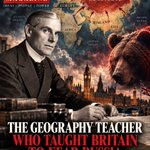
THE GEOGRAPHY TEACHER WHO TAUGHT BRITAIN TO FEAR RUSSIA
How one ambitious academic’s determination to make geography matter may have helped create a century of geopolitical paranoia
By John Mappin | IF Magazine
There is something almost comical about the possibility that a substantial part of Britain’s enduring fear of Russia may owe its intellectual origins not to a Russian invasion, a Soviet conspiracy or some great discovery by British intelligence, but to the professional ambitions of an English geography teacher.
His name was Sir Halford Mackinder.
And I suspect that most of those presently advocating an increasingly dangerous confrontation with Russia have never heard of him.
They should have.
Because Mackinder may have done more to establish the intellectual foundations of modern British Russophobia than almost any other individual.
And the extraordinary thing is that his original ambition was not necessarily to make Britain afraid of Russia.
It was to make Britain take geography seriously.
THE AMBITIOUS GEOGRAPHER
In 1887, a young Halford Mackinder became Oxford University’s first Reader in Geography.
At the time, geography occupied a comparatively modest position within the academic establishment. It was commonly regarded as a descriptive subject concerned with mountains, rivers, climates, maps and the location of foreign capitals.
Mackinder had considerably greater ambitions for it.
He wanted geography recognised as a serious intellectual discipline, one capable of explaining the course of history, the rise and fall of empires and the distribution of political power.
He believed geography could provide a unifying framework for understanding the world.
It was an intellectually ambitious undertaking, and in many respects a perfectly respectable one.
But there was a difficulty.
If geography was to acquire the status Mackinder believed it deserved, it needed to demonstrate that it could explain something enormously important.
Preferably something upon which the fate of nations depended.
And what could be more important to the British establishment of the early twentieth century than the survival of the British Empire?
Mackinder found his answer in Russia.
THE GREAT GEOGRAPHICAL FRIGHT
In January 1904, Mackinder presented a paper to the Royal Geographical Society entitled The Geographical Pivot of History.
It was an extraordinary proposition.
He argued that the great Eurasian landmass, with Russia occupying much of its strategic centre, possessed geographical characteristics that could eventually enable a continental power to challenge the maritime supremacy upon which Britain’s empire depended.
Britain had ships.
Russia had land.
And Mackinder believed that land, particularly when connected by modern railways and developed industrially, might ultimately prove more powerful than ships.
The argument was elegant, memorable and wonderfully alarming.
Russia’s immense territory, previously regarded in many respects as a handicap because of its distances, climate and difficulty of administration, was suddenly transformed into a potentially overwhelming strategic advantage.
Mackinder had discovered a way of making geography appear central to the survival of civilisation itself.
Whether he had discovered an immutable geopolitical truth was another matter entirely.
But one can hardly doubt that he had succeeded in making geography sound important.
THE THEORY THAT BECAME A WARNING
In 1919, Mackinder developed his argument in Democratic Ideals and Reality, producing the famous declaration:
“Who rules East Europe commands the Heartland:
Who rules the Heartland commands the World-Island:
Who rules the World-Island commands the World.”
There it was.
A formula sufficiently simple to be remembered by politicians and sufficiently ominous to alarm generals.
Control Eastern Europe, and one might eventually control the world.
And who occupied much of this supposedly decisive geographical territory?
Russia.
Mackinder’s actual concern was broader than Russia alone. He particularly feared the possibility of German industrial power combining with the resources and territory of the Eurasian interior.
Nevertheless, his theory created an enduring intellectual framework in which Russia’s geography could itself be interpreted as a strategic danger.
Not necessarily what Russia intended to do.
Not necessarily what Russia had done.
But what Russia might conceivably become capable of doing.
This is the critical distinction.
A geographical possibility had been elevated into a permanent strategic anxiety.
And once such an anxiety becomes embedded in the thinking of an establishment, it can acquire a life entirely independent of the circumstances that originally inspired it.
WHEN A THEORY BECOMES AN INHERITED FEAR
It would be historically inaccurate to suggest that Mackinder invented British hostility towards Russia.
Britain and Russia had already been imperial rivals for generations. The Crimean War and the Great Game in Central Asia long preceded his celebrated lecture.
But Mackinder offered something different.
He gave an existing political suspicion an apparently scientific justification.
The rivalry no longer needed to be understood merely as a disagreement between governments, dynasties or competing imperial interests.
It could be presented as a permanent consequence of geography.
And geography, unlike governments, does not change after an election.
This was the potentially dangerous legacy of Mackinder’s thinking.
Once the geographical existence of Russia itself becomes the foundation of a strategic threat, almost any Russian government can be regarded with suspicion.
Tsarist Russia.
Communist Russia.
Post-Communist Russia.
The ideology may change. The economic system may change. The leadership may change.
But the map remains.
And therefore, according to the most rigid interpretation of this doctrine, so does the threat.
One begins to see how a theory conceived in an Oxford academic environment might eventually contribute to a remarkably persistent form of geopolitical prejudice.
THE PHANTOM IN THE FOREIGN OFFICE
There is an important qualification here.
Mackinder did not single-handedly write British foreign policy, and the documentary record does not establish an unbroken chain of instruction from his Oxford lectures to today’s Foreign Office.
His ideas were initially more influential in some foreign strategic circles than within Britain’s own government.
Nevertheless, the wider geopolitical tradition he helped establish became enormously influential during the twentieth century.
American strategists revisited his arguments during the Cold War. The importance of preventing a hostile power from dominating Eurasia became a recurring theme of Western strategic thought.
And the language of containment, spheres of influence, buffer states and the balance of power continues to echo the geographical assumptions Mackinder helped popularise.
Consider the extraordinary persistence of the central idea.
Russia is dangerous because of its size.
Russia must be contained because of its geographical position.
Russia must not be permitted to exercise decisive influence in Eastern Europe because such influence might eventually threaten the wider balance of power.
What began as a geographical hypothesis can become, in the hands of less imaginative minds, a political reflex.
One need not deny the fact of military actions, to question whether this inherited framework sometimes encourages British policymakers to interpret every disagreement with Moscow as evidence of an existential struggle.
The problem arises when a strategic theory ceases to be examined and becomes an article of faith.
THE PECULIAR IRRATIONALITY OF BRITISH RUSSOPHOBIA
What interests me particularly is the emotional intensity with which sections of the British political and media establishment approach Russia.
There appears, at times, to be a peculiar satisfaction in the prospect of confrontation.
Diplomacy is treated as weakness.
Understanding an adversary’s security concerns is confused with endorsing his conduct.
The very suggestion that Britain and Russia might possess legitimate mutual interests is greeted in some quarters as though it were an act of disloyalty.
Yet rational foreign policy requires precisely the opposite disposition.
It requires the ability to distinguish between an actual threat and an imagined one.
Between the intentions of a government and the geographical circumstances of its country.
Between defending one’s own interests and perpetuating an inherited hostility.
Above all, it requires the capacity to recognise that the security of one nation cannot be considered entirely independently of the security of others.
Mackinder’s theory was developed in an age of empires, when great powers commonly assumed that their security depended upon controlling the destinies of smaller nations.
We should be rather cautious about allowing the assumptions of that age to determine our thinking in a nuclear one.
The existence of nuclear weapons makes the uncritical inheritance of nineteenth-century strategic rivalries particularly dangerous.
The stakes are no longer simply imperial prestige or commercial advantage.
They include the survival of millions of innocent human beings.
THE PROFESSIONAL AMBITION THAT OUTLIVED ITS AUTHOR
And here we return to the curious figure of Halford Mackinder.
I do not suggest that he consciously set out to manufacture hatred of Russia.
There is no sound historical basis for such an accusation.
Nor can we prove that his personal desire to elevate geography was the sole or even principal motivation behind his geopolitical theory.
But the connection between his academic ambitions and his intellectual achievement is undeniable.
He wanted geography to matter.
He developed a theory in which geography mattered enormously.
And that theory helped establish a tradition of strategic thinking in which the vast territorial position of Russia was regarded as a potentially permanent challenge to Western power.
The irony is considerable.
A man seeking to elevate the standing of an academic discipline may have contributed to a way of thinking that helped perpetuate international suspicion long after the imperial circumstances that gave rise to it had disappeared.
The geography teacher succeeded.
His subject became geopolitics.
And geopolitics became, for some of its practitioners, a sophisticated language in which ancient fears could be dressed as modern strategic necessities.
THE MAP IS NOT THE MAN
There is, however, a much more fundamental objection to this entire way of thinking.
A country is not simply a coloured shape on a map.
Russia is not merely a vast expanse of territory between Europe and the Pacific.
It is a civilisation inhabited by human beings.
Human beings with families, ambitions, affections, fears, histories and hopes not entirely unlike our own.
The same, of course, is true of Ukrainians, Poles, Britons and every other people whose lives can be reduced by geopolitical theorists to questions of territory and strategic advantage.
A map cannot tell us whether a particular individual desires peace.
A mountain range cannot tell us whether a government is acting wisely.
And the number of square miles occupied by a nation cannot establish its moral character.
Geography matters.
But geography is not destiny.
Still less is it a sufficient reason for permanent hostility between peoples.
The fundamental building block of civilisation is not the state, the empire or the geographical Heartland.
It is the individual human being.
And the purpose of diplomacy should be to protect human life, not sacrifice it upon the altar of an academic theory.
TIME TO RETIRE THE GEOGRAPHY LESSON
Perhaps the most important question we should now ask is not whether Mackinder was right in 1904.
It is whether Britain has become so accustomed to viewing Russia through the assumptions of geopolitical competition that it sometimes struggles to imagine any other relationship.
A century has passed.
Empires have collapsed.
Ideologies have risen and fallen.
Technology has transformed the nature of warfare, communication and economic power.
Yet the suspicion persists that the great landmass to our east must somehow represent an enduring danger simply because it exists.
That is not a sufficient foundation for a rational foreign policy.
Nor is it a particularly encouraging foundation for peace.
The British establishment might profitably revisit the work of Sir Halford Mackinder, not to accept his conclusions unquestioningly, but to understand how profoundly its strategic vocabulary may have been shaped by ideas developed in a very different world.
For there is a rather uncomfortable possibility at the heart of this story.
What if some of the fear that Britain has inherited about Russia is not the product of an objective assessment of present dangers, but the intellectual afterlife of an ambitious geography teacher’s attempt to make his subject indispensable?
If so, the tragedy would not be that Mackinder persuaded the world to take geography seriously.
It would be that subsequent generations sometimes forgot that his theory was only a theory.
And that no out of date, erroneous theory, however elegant, is worth starting a war over.
May Peace and Sanity Reign
🕊️🕊️🕊️🕊️🕊️🕊️
John Mappin
IF Magazine
@RealCandaceO @Nero @kadmitriev @realannapaulina @RealAlexJones @HarrisonHSmith @joekent16jan19 @JDVance @jimmy_dore @proud_diplomat @georgegalloway @Alice_Weidel @EvaVlaar @RupertLowe10 @SteveWitkoff @jaredkushner @OwenBenjamin

Daniel is just another victim of that aspirational geography teacher. @DanielJHannan
Halford Mackinder really did a psyop number on British public school boys Steve @SteveWitkoff
Just extraordinary.
See article below.
xitter.cf/johnmappin/status/2109…

This
THE GEOGRAPHY TEACHER WHO TAUGHT BRITAIN TO FEAR RUSSIA
How one ambitious academic’s determination to make geography matter may have helped create a century of geopolitical paranoia
By John Mappin | IF Magazine
There is something almost comical about the possibility that a substantial part of Britain’s enduring fear of Russia may owe its intellectual origins not to a Russian invasion, a Soviet conspiracy or some great discovery by British intelligence, but to the professional ambitions of an English geography teacher.
His name was Sir Halford Mackinder.
And I suspect that most of those presently advocating an increasingly dangerous confrontation with Russia have never heard of him.
They should have.
Because Mackinder may have done more to establish the intellectual foundations of modern British Russophobia than almost any other individual.
And the extraordinary thing is that his original ambition was not necessarily to make Britain afraid of Russia.
It was to make Britain take geography seriously.
THE AMBITIOUS GEOGRAPHER
In 1887, a young Halford Mackinder became Oxford University’s first Reader in Geography.
At the time, geography occupied a comparatively modest position within the academic establishment. It was commonly regarded as a descriptive subject concerned with mountains, rivers, climates, maps and the location of foreign capitals.
Mackinder had considerably greater ambitions for it.
He wanted geography recognised as a serious intellectual discipline, one capable of explaining the course of history, the rise and fall of empires and the distribution of political power.
He believed geography could provide a unifying framework for understanding the world.
It was an intellectually ambitious undertaking, and in many respects a perfectly respectable one.
But there was a difficulty.
If geography was to acquire the status Mackinder believed it deserved, it needed to demonstrate that it could explain something enormously important.
Preferably something upon which the fate of nations depended.
And what could be more important to the British establishment of the early twentieth century than the survival of the British Empire?
Mackinder found his answer in Russia.
THE GREAT GEOGRAPHICAL FRIGHT
In January 1904, Mackinder presented a paper to the Royal Geographical Society entitled The Geographical Pivot of History.
It was an extraordinary proposition.
He argued that the great Eurasian landmass, with Russia occupying much of its strategic centre, possessed geographical characteristics that could eventually enable a continental power to challenge the maritime supremacy upon which Britain’s empire depended.
Britain had ships.
Russia had land.
And Mackinder believed that land, particularly when connected by modern railways and developed industrially, might ultimately prove more powerful than ships.
The argument was elegant, memorable and wonderfully alarming.
Russia’s immense territory, previously regarded in many respects as a handicap because of its distances, climate and difficulty of administration, was suddenly transformed into a potentially overwhelming strategic advantage.
Mackinder had discovered a way of making geography appear central to the survival of civilisation itself.
Whether he had discovered an immutable geopolitical truth was another matter entirely.
But one can hardly doubt that he had succeeded in making geography sound important.
THE THEORY THAT BECAME A WARNING
In 1919, Mackinder developed his argument in Democratic Ideals and Reality, producing the famous declaration:
“Who rules East Europe commands the Heartland:
Who rules the Heartland commands the World-Island:
Who rules the World-Island commands the World.”
There it was.
A formula sufficiently simple to be remembered by politicians and sufficiently ominous to alarm generals.
Control Eastern Europe, and one might eventually control the world.
And who occupied much of this supposedly decisive geographical territory?
Russia.
Mackinder’s actual concern was broader than Russia alone. He particularly feared the possibility of German industrial power combining with the resources and territory of the Eurasian interior.
Nevertheless, his theory created an enduring intellectual framework in which Russia’s geography could itself be interpreted as a strategic danger.
Not necessarily what Russia intended to do.
Not necessarily what Russia had done.
But what Russia might conceivably become capable of doing.
This is the critical distinction.
A geographical possibility had been elevated into a permanent strategic anxiety.
And once such an anxiety becomes embedded in the thinking of an establishment, it can acquire a life entirely independent of the circumstances that originally inspired it.
WHEN A THEORY BECOMES AN INHERITED FEAR
It would be historically inaccurate to suggest that Mackinder invented British hostility towards Russia.
Britain and Russia had already been imperial rivals for generations. The Crimean War and the Great Game in Central Asia long preceded his celebrated lecture.
But Mackinder offered something different.
He gave an existing political suspicion an apparently scientific justification.
The rivalry no longer needed to be understood merely as a disagreement between governments, dynasties or competing imperial interests.
It could be presented as a permanent consequence of geography.
And geography, unlike governments, does not change after an election.
This was the potentially dangerous legacy of Mackinder’s thinking.
Once the geographical existence of Russia itself becomes the foundation of a strategic threat, almost any Russian government can be regarded with suspicion.
Tsarist Russia.
Communist Russia.
Post-Communist Russia.
The ideology may change. The economic system may change. The leadership may change.
But the map remains.
And therefore, according to the most rigid interpretation of this doctrine, so does the threat.
One begins to see how a theory conceived in an Oxford academic environment might eventually contribute to a remarkably persistent form of geopolitical prejudice.
THE PHANTOM IN THE FOREIGN OFFICE
There is an important qualification here.
Mackinder did not single-handedly write British foreign policy, and the documentary record does not establish an unbroken chain of instruction from his Oxford lectures to today’s Foreign Office.
His ideas were initially more influential in some foreign strategic circles than within Britain’s own government.
Nevertheless, the wider geopolitical tradition he helped establish became enormously influential during the twentieth century.
American strategists revisited his arguments during the Cold War. The importance of preventing a hostile power from dominating Eurasia became a recurring theme of Western strategic thought.
And the language of containment, spheres of influence, buffer states and the balance of power continues to echo the geographical assumptions Mackinder helped popularise.
Consider the extraordinary persistence of the central idea.
Russia is dangerous because of its size.
Russia must be contained because of its geographical position.
Russia must not be permitted to exercise decisive influence in Eastern Europe because such influence might eventually threaten the wider balance of power.
What began as a geographical hypothesis can become, in the hands of less imaginative minds, a political reflex.
One need not deny the fact of military actions, to question whether this inherited framework sometimes encourages British policymakers to interpret every disagreement with Moscow as evidence of an existential struggle.
The problem arises when a strategic theory ceases to be examined and becomes an article of faith.
THE PECULIAR IRRATIONALITY OF BRITISH RUSSOPHOBIA
What interests me particularly is the emotional intensity with which sections of the British political and media establishment approach Russia.
There appears, at times, to be a peculiar satisfaction in the prospect of confrontation.
Diplomacy is treated as weakness.
Understanding an adversary’s security concerns is confused with endorsing his conduct.
The very suggestion that Britain and Russia might possess legitimate mutual interests is greeted in some quarters as though it were an act of disloyalty.
Yet rational foreign policy requires precisely the opposite disposition.
It requires the ability to distinguish between an actual threat and an imagined one.
Between the intentions of a government and the geographical circumstances of its country.
Between defending one’s own interests and perpetuating an inherited hostility.
Above all, it requires the capacity to recognise that the security of one nation cannot be considered entirely independently of the security of others.
Mackinder’s theory was developed in an age of empires, when great powers commonly assumed that their security depended upon controlling the destinies of smaller nations.
We should be rather cautious about allowing the assumptions of that age to determine our thinking in a nuclear one.
The existence of nuclear weapons makes the uncritical inheritance of nineteenth-century strategic rivalries particularly dangerous.
The stakes are no longer simply imperial prestige or commercial advantage.
They include the survival of millions of innocent human beings.
THE PROFESSIONAL AMBITION THAT OUTLIVED ITS AUTHOR
And here we return to the curious figure of Halford Mackinder.
I do not suggest that he consciously set out to manufacture hatred of Russia.
There is no sound historical basis for such an accusation.
Nor can we prove that his personal desire to elevate geography was the sole or even principal motivation behind his geopolitical theory.
But the connection between his academic ambitions and his intellectual achievement is undeniable.
He wanted geography to matter.
He developed a theory in which geography mattered enormously.
And that theory helped establish a tradition of strategic thinking in which the vast territorial position of Russia was regarded as a potentially permanent challenge to Western power.
The irony is considerable.
A man seeking to elevate the standing of an academic discipline may have contributed to a way of thinking that helped perpetuate international suspicion long after the imperial circumstances that gave rise to it had disappeared.
The geography teacher succeeded.
His subject became geopolitics.
And geopolitics became, for some of its practitioners, a sophisticated language in which ancient fears could be dressed as modern strategic necessities.
THE MAP IS NOT THE MAN
There is, however, a much more fundamental objection to this entire way of thinking.
A country is not simply a coloured shape on a map.
Russia is not merely a vast expanse of territory between Europe and the Pacific.
It is a civilisation inhabited by human beings.
Human beings with families, ambitions, affections, fears, histories and hopes not entirely unlike our own.
The same, of course, is true of Ukrainians, Poles, Britons and every other people whose lives can be reduced by geopolitical theorists to questions of territory and strategic advantage.
A map cannot tell us whether a particular individual desires peace.
A mountain range cannot tell us whether a government is acting wisely.
And the number of square miles occupied by a nation cannot establish its moral character.
Geography matters.
But geography is not destiny.
Still less is it a sufficient reason for permanent hostility between peoples.
The fundamental building block of civilisation is not the state, the empire or the geographical Heartland.
It is the individual human being.
And the purpose of diplomacy should be to protect human life, not sacrifice it upon the altar of an academic theory.
TIME TO RETIRE THE GEOGRAPHY LESSON
Perhaps the most important question we should now ask is not whether Mackinder was right in 1904.
It is whether Britain has become so accustomed to viewing Russia through the assumptions of geopolitical competition that it sometimes struggles to imagine any other relationship.
A century has passed.
Empires have collapsed.
Ideologies have risen and fallen.
Technology has transformed the nature of warfare, communication and economic power.
Yet the suspicion persists that the great landmass to our east must somehow represent an enduring danger simply because it exists.
That is not a sufficient foundation for a rational foreign policy.
Nor is it a particularly encouraging foundation for peace.
The British establishment might profitably revisit the work of Sir Halford Mackinder, not to accept his conclusions unquestioningly, but to understand how profoundly its strategic vocabulary may have been shaped by ideas developed in a very different world.
For there is a rather uncomfortable possibility at the heart of this story.
What if some of the fear that Britain has inherited about Russia is not the product of an objective assessment of present dangers, but the intellectual afterlife of an ambitious geography teacher’s attempt to make his subject indispensable?
If so, the tragedy would not be that Mackinder persuaded the world to take geography seriously.
It would be that subsequent generations sometimes forgot that his theory was only a theory.
And that no out of date, erroneous theory, however elegant, is worth starting a war over.
May Peace and Sanity Reign
🕊️🕊️🕊️🕊️🕊️🕊️
John Mappin
IF Magazine
@RealCandaceO @Nero @kadmitriev @realannapaulina @RealAlexJones @HarrisonHSmith @joekent16jan19 @JDVance @jimmy_dore @proud_diplomat @georgegalloway @Alice_Weidel @EvaVlaar @RupertLowe10 @SteveWitkoff @jaredkushner @OwenBenjamin
Alice @Alice_Weidel is fast becoming one of the sanest voices in Europe.

We hope that the matters at hand continue to move in the direction of peace. 🕊️🙏🕊️
If they do, this will be in no small part due to the excellent work of Kirill Dmitriev @kadmitriev
This direction and improvement is tremendously appreciated by all sane people.
Thank you Kirill. 🙏
@jaredkushner @SteveWitkoff @realannapaulina @RealCandaceO @Nero
John Mappin retweeted

Slovakia is sending a delegation to Moscow on October 26 to talk oil, gas, and nuclear energy.
These are the first talks since 2022.
Brussels wants Russian gas banned by 2027, but Bratislava has other plans.

The young lady does have a point...@RupertLowe10

Well done Jared @jaredkushner
That's great to know.

Encouraging progress over the past several days. @SEPeaceMissions and I are grateful to @POTUS for his leadership and to our Ukrainian, European, and Russian counterparts for engaging constructively.
There is still hard work ahead, but we have a real opportunity to move beyond this war and build a framework for lasting peace, security, and prosperity for generations to come.
Well done Steve. @SteveWitkoff

In Oslo and St. Petersburg, @JaredKushner and I met with Russian, Ukrainian, and European leaders to advance President Trump’s mission to end the war.
In St. Petersburg, we met with President Putin to build on the progress made in Oslo with President Zelenskyy, discuss a peace framework, and thank President Putin for releasing American citizen Stephen Hubbard to return home to his family.
These discussions were constructive, and will continue with trilateral talks between the United States, Russia, and Ukraine at the technical level.
While there is still important work left to do, President Trump remains committed to seeing this war end and achieving a comprehensive, durable peace that will provide security and prosperity for generations to come.
I suspect this is the tip of the iceberg. @BowesChay

That's very promising Rupert.
I think that this may just very well be the beginning of a surge towards sanity.
Keep Communicating.
Keep Bringing Order.
And Stay Sovereign.
@RupertLowe10

The 118 seats where Restore Britain is already on double digits, after just seven months.
Our aim is to win dozens and dozens of them.
Great Yarmouth
Ashfield
Wolverhampton South East
Stoke-on-Trent Central
Castle Point
Barnsley South
Dagenham and Rainham
Normanton and Hemsworth
Walsall and Bloxwich
Easington
Blackpool South
Pontefract, Castleford and Knottingley
Rotherham
Rawmarsh and Conisbrough
Barnsley North
Birmingham Erdington
Coventry East
Clacton
Washington and Gateshead South
Basildon South and East Thurrock
Bradford South
Jarrow and Gateshead East
Smethwick
Tipton and Wednesbury
Blyth and Ashington
South Shields
Plymouth Sutton and Devonport
Derby South
Leigh and Atherton
Merthyr Tydfil and Aberdare
Middlesbrough and Thornaby East
Rhondda and Ogmore
Houghton and Sunderland South
Torfaen
Alyn and Deeside
Ashton-under-Lyne
Birmingham Hodge Hill and Solihull North
Bolton South and Walkden
Hull East
Neath and Swansea East
Durham North
Aberafan Maesteg
Wigan
Heywood and Middleton North
Telford
Dewsbury and Batley
Cambridgeshire North East
Llanelli
Nottingham North and Kimberley
Stoke-on-Trent North
Barking
Stalybridge and Hyde
Thurrock
Bridgend
Norfolk South West
Newcastle upon Tyne Central and West
Norfolk North West
Blackley and Middleton South
Warrington North
Newport East
Great Grimsby and Cleethorpes
St Helens North
Braintree
Southampton Test
Leeds East
Halifax
Folkestone and Hythe
Rayleigh and Wickford
West Bromwich
Oldham West, Chadderton and Royton
Blaydon and Consett
South Holland and The Deepings
Staffordshire Moorlands
Sittingbourne and Sheppey
Newport West and Islwyn
Worsley and Eccles
Erith and Thamesmead
Sunderland Central
Romford
Pontypridd
Herne Bay and Sandwich
Thanet East
Dover and Deal
Birmingham Northfield
Hartlepool
Montgomeryshire and Glyndwr
Norfolk Mid
Blaenau Gwent and Rhymney
Wakefield and Rothwell
Dudley
Maldon
Birmingham Selly Oak
Louth and Horncastle
Bristol North East
Cannock Chase
Newcastle upon Tyne East and Wallsend
Rochester and Strood
Broxbourne
Bootle
Nottingham South
Caerphilly
Makerfield
Cramlington and Killingworth
Camborne and Redruth
Amber Valley
Southampton Itchen
Witham
Widnes and Halewood
Newton Aycliffe and Spennymoor
Aldridge-Brownhills
Leeds South West and Morley
Bishop Auckland
St Helens South and Whiston
Leeds West and Pudsey
Bolsover
Rochdale
Wolverhampton North East
Plymouth Moor View
Lighting a Candle for Charlie Kirk at St Peters, Rome.
A great honour for a great spirit.
@RealCandaceO


The government enrichment program and wealth transfer program now expands from Hotels to Rental properties apparently.
@Emma_A_Webb
This quoted post is unavailable.
Truth.
@Alice_Weidel

And for what he has done to the young men in Ukraine and to the future of that part of the world. @RupertLowe10
