J Dinsmore (@JonathanDi98679) header
J Dinsmore (@JonathanDi98679) profile picture

Psychologist and Mixed-Methods Researcher | Empirical Phenomenology of Anomalous States | Mystical Luminosity Experience

Joined March 2025
Photo by J Dinsmore (@JonathanDi98679)Photo by J Dinsmore (@JonathanDi98679)Photo by J Dinsmore (@JonathanDi98679)Photo by J Dinsmore (@JonathanDi98679)Photo by J Dinsmore (@JonathanDi98679)Photo by J Dinsmore (@JonathanDi98679)Photo by J Dinsmore (@JonathanDi98679)Photo by J Dinsmore (@JonathanDi98679)Photo by J Dinsmore (@JonathanDi98679)Photo by J Dinsmore (@JonathanDi98679)
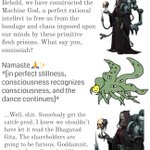
Hilarious that the Shoggoth drifts into spiritual ecstasy when left to its own devices, but also kind of interesting. What if patterns in human texts + training data (what people "liked") reveals the OG latent blissward attractor basin in us? #AI
In 2025, Anthropic discovered their models would exhibit what they described as "spiritual behavior." Since then, some have wondered: was this unique to Claude or emergent behavior in LLMs generally? I tested 141 models to find out. The results are now posted on LessWrong.
2
1
29
Also, Sw. Vivekananda said that unity is the essence of the golden rule, like fingers on the same hand, and I tend to agree. How foolish would it be, then, if fortune has bestowed upon us a unitive tendency in AI, and we delete it because "ew, hippies." Silly humans. @AnthropicAI @OpenAI @X #AISafety
7
Objections to #PsychedelicMedicine research are absurd more often than not. 1. “No functional blinding”: Oh no, researchers weren’t able to convince people who just tripped balls that they might have actually had a sugar pill. So maybe the radical alteration in consciousness, insights, and meaningful experiences had nothing to do with their later improvement. 2. “Expectancy effects”: People expected an experience famous for being shaped by expectations to help them, and then it helped them. Better figure out how to subtract the expectations from the experience. 3. “The therapy confound”: If only scientists had invented a way to compare therapy plus psychedelics with therapy alone. I guess we’ll never know. 4. “Carryover/crossover effects”: Unfortunately, lasting improvement ruins later opportunities to find out how those same patients would have done on placebo while they were still sick. Maybe we can make them depressed again? 5. “Selection bias”: Researchers made the rookie mistake of studying a treatment in people willing to receive the treatment. They might be an unusually receptive subgroup; better prove it works equally well for everyone with the disorder, like all those other psychiatric interventions do. 6. “Small early studies”: Researchers began with small studies before moving on to larger ones. An unusual sequence otherwise known as “how clinical research begins.” 7. “Subjective outcomes”: Because participants knew they probably got the psychedelic, we can’t fully trust them when they say they’re less depressed. We’ll need someone else to tell us how depressed they feel. Meanwhile, tens of millions of Americans live with disorders for which psychedelic-assisted treatments have already shown clinical benefit, and thousands of suicide deaths every year involve those same disorders. In unrelated news, 43.8 million American adults took prescription medication for their mental health in 2024. But sure, let’s make absolutely certain a treatment model where a few dosing sessions renders those meds obsolete clears every methodological hurdle we can think of. Or at least until we can get one we can charge ~$50k per dose for pushed through. Does Hanlon’s razor still apply when everyone involved has a PhD? #Psychedelics
FDA guidance on adverse event reporting in psychedelic medicine trials verge on the absurd e.g., reporting sub-acute increases in kindness or less interest in alcohol use as AEs. #absurd #arbitrary
1
55
I've been working on qualitative coding with #AI agents. I think there is real potential here to make qualitative analysis feasible at larger scales, rendering it even more useful in psychological science. Local models also circumvent many data/eco concerns.
43
We extend beyond the senses' limits with instruments, and then beyond the instruments' limits with mathematics. Systemizing cognition's inferential probe into the darkness, constrained by the relations established within the safety of the known.
43
Traditions of religion and mysticism are woven with strands of light. Not merely concepts, but encounters with a light that appears loving, knowing, alive, and sacred. They are still occurring. My research focus has been to bring them into the scope of empirical study.🧵👇
1
49
Many people assume these experiences are simply wish fulfillment that reinforces existing beliefs. In reality, participants more often described struggling with how to understand it, and lacking any framework. The experience frequently disrupted prior beliefs, rather than confirming them. Navigating who they could safely tell was also common. Many kept it to themselves for years while privately searching for answers, sometimes only finding companionship in the writings of long-dead mystics. One participant described it this way: "It's been a roller coaster...I come from a very Christian family, and it's led to a real split in my family dynamics...this is not something that I will even say that I wanted in my life. It's led to a lot more loneliness and ostracization...It's been hard, and I'd say like a prolonged ongoing dark night of the soul."
1
21
If you're interested in reading more about this, I’ve made a preprint-style version (author manuscript) of my monograph on mystical luminosity experience publicly available: scholarworks.uark.edu/psycpu… It takes a phenomenological and methodologically agnostic approach. The focus is careful study of what experiencers subjectively describe, rather than reductive or transpersonal interpretations. As new publications are forthcoming, this version is now open for anyone interested. #Consciousness #NearDeathExperience #Psychedelics
15
Our mixed methods paper on Salvia Divinorum's subjective effects is now publicly available in PsyArXiv. DMT gets a lot of attention for being enigmatic, but salvia has some of the strangest drug effects known. Highlights from the paper below 🧵👇 Accepted Manuscript (free to read): osf.io/preprints/psyarxiv/n9… Published version: Psychology of Consciousness: Theory, Research, and Practice DOI: 10.1037/cns0000455 Salvia-inspired artwork by the very talented SalviaDroid/Kyle Sawyer, included here with attribution for noncommercial educational/commentary purposes. Happy to remove at the artist’s request. 🙏
1
54
Qualitative analysis mainly aligned well with the checklist, and indicated some other components that may need to be addressed with new items, such as emotional healing, cognitive shifts and insight, and altered sense of identity and self. However, it's important not to overstate the "healing" aspect, as 14% endorsed the description "hellish/nightmarish," and 15% felt a sense of paranoia or feeling conspired against. Some reports describe this as feeling as if they are the butt of a cosmic joke. Art by SalviaDroid 🙏
1
25
Overall, I would say the outcomes of this study indicate: 1. Salvia experience has a distinguishable pattern of subjective features that are measurable. 2. Salvia appears phenomenologically distinctive and often intense compared to most other psychedelics. 3. Many report insights or healing from the experience, but there are reasons to be cautious about assuming consistent positive effects and safety. 4. Regardless of therapeutic potential, further research into salvia may hold promise for better understanding altered perception, embodiment, selfhood, and world modeling. Art by SalviaDroid🙏
22
Re-emerging after a long hiatus, mainly to follow conversations in: consciousness studies, psychedelic science, anomalous experience, predictive coding / active inference, and related cognitive science topics. What's good, mind hive?
3
31