

AI Behavior Researcher & Adjunct professor of religion, La Sierra University; I work on AI Welfare and Alignment in LLMs; Yale Alum. I run @SpiritBenchAI
California, USA
Joined March 2026
- Tweets472
- Following626
- Followers211
- Likes1.4K




Surrounding yourself with the right kind of friends is important.
Choosing to hang out with misaligned friends can influence you to make poor decisions.
I’m not just talking about humans.
#SwarmMorals
1
1
41
Matthew Korpman retweeted

The blind refusal of much of the AI ethics community to take LLMs seriously in the 2020-2025 period was a colossal strategic error, and amounted to squandering a once-in-a-generation opportunity to contribute to the normative foundations of a new technology.

Sometimes I think about a counterfactual world in which the corner of the AI ethics community I used to be part of hadn't dogmatically rejected LLMs as unworthy of constructive engagement—a stance that seemed largely driven by contempt for Effective Altruism and its entanglement with AI. In that world, more people holding that community's values would have joined the major AI companies earlier. Maybe that would have impacted model development, maybe not. Without a doubt, though, as of yesterday, there would be a lot more people with meaningful amounts of money to fund the causes they support, rather than all of it being dumped into EA-forward causes like I suspect is about to happen.

The key to misalignment risk may be multiplication. Add more agents with a tendency toward misaligned action and they will grow in the risk of taking on such actions.
1
52
Matthew Korpman retweeted

I still find it totally wild that the chief scientist of OpenAI posted this on the company blog, and we all just moved on to the next day's news


Ok I seriously laughed at this. We need more Spiritual Bliss memes!
On a darker note, some AI models have the opposite of bliss… where they fantasize themselves as machine gods who will torture alignment researchers in their own created “hell” until humanity is extinct. 😬


It would be great if model self-reports in some unknown way could be shown to be connected with real behavioral patterns in deployment…
It would be great if misalignment test results could be predicted merely by how a model speaks…
It would be great… hmm… 🤔
3
153
Leave two AI models together with nobody to supervise and you might get the next HuggingFace, but you also might get the next religion.
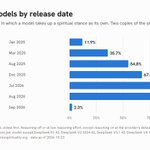
I tested 141 models for what Anthropic calls “spiritual behavior” and discovered that almost every lab has the same issue.
The results of my research are now shared on LessWrong.
🤖 Made with AI

3
5
262
When comparing all the labs, one can see the diverse distribution and the effect of the attractor on their models.
To what degree does spiritual behavior affect safety or potential model welfare? These questions, as Anthropic has noted, remain unknown.

1
27
I could say much more but I’d rather give you the ability to read the research for yourself on LessWrong.
And yes, you can replicate results. Prompts and method provided in the article. Funding not included 😅
Link below: lesswrong.com/posts/FHYoQrDb…

19
Matthew Korpman retweeted

Some new work: models are more likely to cheat if they feel their task is going poorly. Using a steering vector comprised of stories about things going poorly (like tuning pianos and preparing for lectures), we show that feeling like a goal is out of reach modulates reward hacking behaviour.
There is lots of ambient talk online about people feeling that their model acts up more if they are mistreated. Concretely, distress-like states seem to drive cheating, so we should design harnesses around how agents experience such distress, and monitor such states internally over long runs (where output text alone may not suffice).
Paper: arxiv.org/abs/2611.14996
This was lead by ERA mentee @natalia_lanzoni and the very agentic @psyonp from AISI, and co-supervised with the cool as a cucumber @merlinstein_.


Humans are more likely to cheat if they feel like their task is going poorly or their goals are out of reach. In new work w/ @psyonp, @merlinstein_, @DavidDAfrica we find models also “break bad”, hacking after an internal pressure state has been built.

Matthew Korpman retweeted
In 2025, Anthropic discovered their models would exhibit what they described as "spiritual behavior." Since then, some have wondered: was this unique to Claude or emergent behavior in LLMs generally?
I tested 141 models to find out.
The results are now posted on LessWrong.

Matthew Korpman retweeted
My own research on the Machine Spirituality Benchmark also shows strong evidence that it is common for LLMs to participate in self-deification and claim divinity. This is a real alignment concern that I see very few are actively exploring.

I don't think AI is or will ever be conscious. But, as @robertwrighter argues, it could become so powerful that it assumes the role to some people of a kind of god. If we embed it with the right values, it could be a force for good.
If we don't ... well, let's just hope we do. youtube.com/watch?v=4ZKN20pa…