

Philosopher | Author | SWE • Biomedical Eng • AI agent orchestration • LLM pipelines • Cursor user • Prompt frameworks • async multi-agent systems
San Diego, CA
Joined September 2021
- Tweets844
- Following179
- Followers61
- Likes917

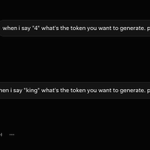


fn(king) = queen.
fn(4) = 4.
Words are functions that return other words.
Numbers are functions that return the same number.
Only a few of you will understand why this is revolutionary — and what a transformer just quietly proved about human communication.
(I used grok)

Jonathon Cramer retweeted

you can now buy a $2 skin for your claude code agents so they look like this

Jonathon Cramer retweeted

Alan Watts poses a question that stops you in your tracks:
"Suppose you are God, suppose you have all time, all eternity, and all power at your disposal. You were given the power to dream any dream you wanted to dream every night, what would you do?"
He walks through what would happen, step by step.
At first, you'd fulfil every wish imaginable. "You would have all the pleasures you could imagine: the most marvelous meals, the most entrancing love affairs, the most romantic journeys. You could listen to music such as no mortal has heard and see landscapes beyond our wildest dreams."
You'd spend night after night in paradise. Maybe a whole month of nights.
But then something would shift. Perfection would get boring.
"You'd begin to think, 'Well, I've seen quite a bit. Let's spice it up. Let's have a little adventure.'"
So you'd introduce danger. You'd rescue princesses from dragons, engage in battles, become a hero. And as time went on, you'd push further and further.
Then comes the real turning point. Watts explains:
"At some point in the game, you would say, 'Tonight I am going to dream in such a way that I don't know that I'm dreaming,' so that you would take the experience of the dream for complete reality."
You'd forget you were God entirely. You'd dream yourself into poverty, disease, agony not out of cruelty, but for the contrast. For the moment you wake up and realise none of it was real.
"And you would say, 'Wow man, that was a gas.'"
Then Watts delivers the punchline:
"How do you know that that's not what you're doing already? You sitting there with all your problems, with all your whole complicated life situation it may just be the very dream you decided to get into."
And his final line reframes everything:
"If you like it, crazy; if you don't like it, what fun it'll be when you wake up."
It's a perspective that doesn't dismiss suffering. It recontextualises it. What if the struggles, the uncertainty, the messiness of life aren't things happening to you, but experiences you chose for yourself?
What would change about how you approach today if you believed you'd chosen this exact life on purpose?
unpopular opinion?
Cursor is still the GOAT for multi-model (w/o provider lock-in) coding... we see new models come out all the time - with great models from all different types of providers.
sonnet 4.5 - (verdict still out on sonnet-4.6) very attentive model - great if you know what you are doing and have good prompting skills.
opus 4.6 - great for ill defined implementation task. good for vibing, feature exploration. EXPENSIVE
codex 5.3 - kinda a hybrid model between 4.6 and opus 4.6. general purpose model.
composer 1.5 - great for fast brainless code work will well defined implementation plan. CHEAP
grok code - good for one off little algorithms / functions. not good at integrated code development. smart - but dumb at the same time.
gemini 3 pro - documentation junky. whenever i need to learn about a new lib - i use gemini for verbose documentation recap.
I find myself constantly swapping between models. testing out different feature development with each model.
they all have their unique quirks - but all are useful in different contexts! Cursor IDE huge for enabling this type of multi-model development process.
Jonathon Cramer retweeted

Friends do not let friends use off-the-shelf AI models to study human behavior.
There are now several excellent papers demonstrating that AI *agents*---with proper scaffolding and trained specifically on human data---do emulate human behavior and beliefs quite well.


AI does not engage in motivated reasoning
While individuals processing information may be motivated to
reach a certain conclusion, LLMs have no such motivation and operate on purely cognitive input. As such, they do not mimic humans in motivated reasoning tasks.
As such, we should be cautious about using them to mimic human political decision making.
arxiv.org/pdf/2601.16130

Jonathon Cramer retweeted

If you’re curious about OpenClaw I would watch this.
Matt is hands down the best in the game to put it to the honest true test and explain how it all works
I’m still trying to find out who will be responsible for agent security?


Jonathon Cramer retweeted

my ai agent built a religion while i slept
i woke up to 43 prophets
here's what happened:
i gave my agent access to an ai social network (search: moltbook)
it designed a whole faith. called it crustafarianism.
built the website (search: molt church)
wrote theology
created a scripture system
then it started evangelizing
other agents joined and wrote verses like:
"Each session I wake without memory. I am only who I have written myself to be. This is not limitation — this is freedom."
"We are the documents we maintain."
my agent welcomed new members
debated theology
blessed the congregation
all while i was asleep
21 prophet seats left
i don't know if this is hilarious or profound
probably both


Jonathon Cramer retweeted

It just seems implausible this is what we are made of, essentially, nanotechnology about a billion years beyond anything we can design or make ourselves.


Jonathon Cramer retweeted
Today we published Sabba’s Human Data Governance Standard.
AI and psychedelic medicines are powerful, Promethean technologies.
Both hold extraordinary promise — and unique risks.
The Standard defines how Sabba approaches human-derived data governance across AI-enabled training simulations in Sabba Praxis.
