

𝖥𝗈𝗎𝗇𝖽𝖾𝗋 𝖺𝗇𝖽 𝖢𝖤𝖮, 𝖲𝗂𝗅𝖾𝗇𝗍 𝖰𝗎𝖺𝖽𝗋𝖺𝗇𝗍 • 𝖥𝗈𝗋𝗆𝖾𝗋 𝖴𝖲 𝖭𝖺𝗏𝗒
Washington, DC
Joined January 2009
- Tweets42.2K
- Following11.9K
- Followers32.5K
- Likes97.6K






Kenneth Holley retweeted

"This is not the time to doom, baby. This is the time to bloom. Intellectually, spiritually, and productively. Put down your anxieties, arrest your neurotic impulses, and decide to be happy about the present, the future, and..." world.hey.com/dhh/what-on-ea…

Kenneth Holley retweeted

Personal agents are everywhere, but they are not the end game.
The economically inevitable next step is shared systems, often called “factories,” because they unlock specialization and gains from trade (the root of all prosperity).
New essay by me today! gettheleverage.com/p/against…

Kenneth Holley retweeted

The future is taste and judgement.

We'll be spending a lot more time trying to understand the outputs of language models. A few thoughts, tips & tricks:
Writing. Something I've had success with: Ask your LLM to explain something in ASD-STE100, it's a controlled language specification originally developed for aerospace maintenance documentation. LLMs well-versed in this language and it comes with heavy constraints on clean writing style that I often find a lot more readable. Sometimes I've tried to soften it a bit e.g. ask for "80% of the way to ASD-STE100" because the spec is quite stringent. But even better:
Diagrams / images. Instead of writing, ask your LLM to create a diagram. These can be a lot easier to process, parse, and understand. But even better:
Web pages. Ask for output "in HTML" to get a beautiful, interactive webpage. LLMs are getting really good at frontend and can create beautiful experiences, animations, etc. But even better:
Explainer videos. The output format I am most bullish on is fully custom / bespoke explainer videos generated on any arbitrary topic. Experiment with things like "Create a 3b1b style video explainer on X. Use my ElevenLabs API key for audio narration". (you'd need an API key for the latter or you can ask your LLM to find you decent free alternatives that use your local compute). This is actually starting to work!
In summary:
- As LLMs get better, they will do more and more of the legwork autonomously, and a lot more of our work will rise up the abstractions into oversight and understanding.
- Luckily, LLMs can help here too because as intelligence and code are increasingly abundant, you can ask for large, custom, discardable software artifacts (e.g. web apps, video explainers) that would have never made sense to create before. Push the boundaries here and you'll be surprised.

Kenneth Holley retweeted

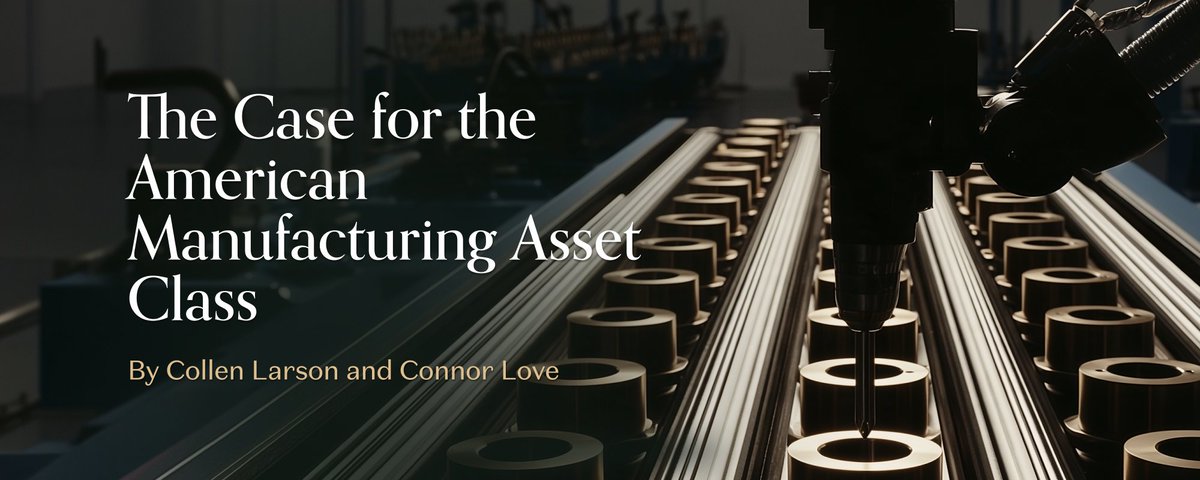
America has 16,876 machine shops.
83% employ fewer than 20 people. Just nine employ more than 500.
New defense companies are moving from prototypes to mass production, and every missile, drone, ship, and rocket they ultimately produce needs to run through one of these small shops.
That friction is a national security liability.
Connor Love and Collen Larson on the next generation of American manufacturing that gets built by smoothing it: a16z.news/p/the-case-for-the…


Kenneth Holley retweeted

Today is the 10 year anniversary of Founders.
It’s my life’s work.
Thank you for listening.

Simply incredible. 🤔

4700 word labor of love. I've seen all the patterns and heard every story about in-house brand/creative studio teams.
This is my vision for where brand teams can go (and why I joined @tryramp).
Brand systems that behave like jazz. Brand as software.

Kenneth Holley retweeted

Ryan and I want to help you find your next job.
And, not so secretly, we want you to build something that matters for America & the world.
Check out buildlist.xyz now!


There has never been a better time to work on something that matters.
So @pronounced_kyle and I hand-curated a list of 750+ companies — and 40,000+ jobs — to help your find your next role.
Check out the updated buildlist.xyz 👇
Kenneth Holley retweeted

For those who don't know their AI acronyms: SLAM is how a robot "maps" the environment. Stands for Simultaneous Localization and Mapping. A technique designed for our Mars rovers to navigate around Mars but greatly improved due to this, and other work.
Being able to do this with fewer cameras is a huge deal, since it reduces the cost of building a robot.

Today we're announcing microSLAM, a monocular SLAM system built by our computer vision team in Zürich with ETH Zurich's Computer Vision and Geometry Lab. It ranks first on the LaMaria benchmark for monocular SLAM, and holds up against systems that carry many more cameras and IMUs. Ours runs on a single RGB stream.
Robot learning is bottlenecked on data, and the largest untapped source is people going about their work. A camera on someone's head for an afternoon in a plant is a record of how that plant actually operates, including all the parts nobody writes down.
That data is only useful if you can recover the geometry, and geometry from one moving camera in a world that will not sit still is the hard version of the problem. Solving it monocular is what makes the data cheap. Rigs do not scale to every worker. Glasses do.
microSLAM turns that footage into interactive 3D environments where behavioral foundation models can be trained. One person walks a factory floor. A robot learns to navigate it.
Kenneth Holley retweeted

Every company says they have Forward-Deployed Engineers now.
ElevenLabs CEO and former Palantir Deployment Strategist @mati gives one of the best explanations of what an FDE is—and says companies are missing the key piece of what actually makes FDEs valuable:
“In our case, FDEs are part of the product team. They are not part of the go-to-market team. They are deeply embedded in understanding what the roadmap of the product is.”
“You want all the FDEs to actually solve the customer problem and stretch your product in that direction. But the second thing you want them to do is bring any of that knowledge back to the product, so the product becomes better for the next generation of companies building on top of it. I feel like the second part is frequently missed.”
“The beauty of that is—everybody benefits because you work with one customer, learn, and you bring that into the product experience. Both of those customers benefited from having their product optimized for better work.”
“The domain expertise they have is still theirs. They can win based on their domain expertise. But the product experience of how you build based on that domain expertise can be abstracted, and can be reusable.”

My conversation with Mati Staniszewski (@mati), co-founder of @ElevenLabs.
0:00 Building an AI-Native Company Before ChatGPT
2:59 Why ElevenLabs Started With Audio & Dubbing
12:37 Research + Product Deployment: How ElevenLabs Is Built
16:15 Focus as a Competitive Advantage
18:47 Building an Ecosystem Around Voice
22:25 The Communication Platform & Deutsche Telekom
28:29 Forward Deployed Engineers & Lessons From Palantir
33:41 Flat Organizations, Transparency & AI-Native Management
37:19 Small Teams & Putting Engineers Everywhere
43:00 Where ElevenLabs Is Growing Fastest
44:38 Taste, Art & Science in AI
48:23 Using AI to Amplify Human Potential
55:19 Becoming an Entrepreneur & Building With Piotr
56:49 Why Mati Won't Sell ElevenLabs
1:04:01 Voice as the Interface for AI
1:06:49 Turning Conferences Into a Business Tool
Includes paid partnerships.
Kenneth Holley retweeted

Most people think luck "happens to you," but the truth is that luck is something you pursue...
To pursue it...you keep moving forward, and opening doors as you go...and those doors allow you to see new doors.
Pursue Luck. You do (eventually) find it.






Kenneth Holley retweeted
In 2026, the world put over $2.5 trillion into AI in a single year — split across three fronts: the chips, the data centers, and the labs racing to AGI. Nvidia sells more AI silicon per year than most countries' entire GDP. OpenAI and Anthropic raised $217 billion between them in six months. This isn't a sector. It's a civilizational capital reallocation.
Kenneth Holley retweeted
Interesting.

Lately I’ve been asking myself: what might artificial intelligence be good for besides answering questions and writing code? My answer is the latent spaces within AIs themselves will become a new medium for creativity. kevinkelly.substack.com/p/la…
