

Measure anything in anything.
Joined July 2026
- Tweets658
- Following98
- Followers89
- Likes814






Liquid Charts retweeted
It's genuinely hard to find consumer products & services that don't outpace stated CPI inflation. Here's a chart of what we could find. It's generally grocery items and, for this time period, new vehicles.
liquidcharts.app/?assets=ban…

Liquid Charts retweeted
Why do the changes always drop stated inflation?
You can run this chart on nearly any core consumer good and see it run away from stated CPI inflation. Only MSRP of new vehicles and a few produce-grocery items buck the trend.
Oh, and wages. Wages hug the inflation line.

Liquid Charts retweeted
This checks. A home is up 32.5% vs US household income over the past 5 years.

Liquid Charts retweeted

I’d buy Pelosi 500 over the S&P500
Nancy Pelosi: +249.7%
Inverse Cramer: +220.7%
S&P500: +102.16%
Michael Burry: +70.6%
Warren Buffett: +69.5%
Hedge funds hire quants with PhDs to analyse markets 24/7
Nancy Pelosi doesn’t even know what a balance sheet is and still outperforms everyone?


Liquid Charts retweeted
Homes priced in local electricity prices. (Higher actually means you get more kWh per house, so the lower on teh list either means cheaper homes or more expensive electricity, or both)


Liquid Charts retweeted
Money's Great Unbundling
(Or why I believe the dollar is now only a unit of account)
Balaji Srinivasan states that economies, societies, and communities of all sorts go through periods of unbundling and rebundling. Economists often use analogies of evergreen trees that expand out and decentralize before re-centralizing, all the in ongoing pursuit of "up."
The specific section where he breaks this down comes a little after the two-hour thirty minute mark in this video (youtube.com/watch?v=qRao8xS_…)
Traditionally, the money has been defined as requiring three key attributes:
1. Store of value
2. Medium of exchange
3. Unit of account
While many would debate me on details, I'll posit that the US Dollar has been a pretty decent money as the globe's reserve currency since the Bretton Woods agreement post WWII about 80 years ago. It outlasted most other fiat currencies, has served as reserve currency not just in the United States but in dozens of countries globally, has adapted for e-commerce and digital transactions, and has inflated just little enough to keep people from revolting (which is actually a pretty good accomplishment for a fiat currency).
The Dollar Sucks Now
Despite this, I'm here to say that the US Dollar is no longer a viable currency for those willing to make some changes to how they define these things.
Store of Value
The US Government is spending $1.5 trillion on servicing the debt, exceeding many key roles and costs a government is supposed to handle. When we saw the establishment's visceral reaction to the DOGE initiative in early 2025, the writing was on the wall: We'll inflate before we cut spending.
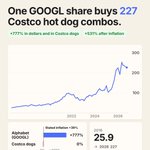
The US Dollar has lost 23.3% of it's purchasing power over the past 7 years when measured against Costco hot dogs.
liquidcharts.app/?assets=cos…
Even before COVID forced inflation to be a regular topic of conversation and front page news, inflation has been sneakier than many of us realize. The way in which government tracks inflation has gone through six comprehensive revisions since 1940, with every single change being a sleight of hand to mask costs. These changes included tricks to swap like products, so if steak got more expensive, replace it with chicken. Over the years, this resulted in steak being replaced with ground beef and consumers being told that the cost wasn't going up.
As you can see in the chart below, inflation is about 12% if we measure it using the same methodology as we did in 1980.
shadowstats.com/alternate_da…
The dollar isn't the worst store of value, but it isn't even close to the best with today's alternatives.
Medium of Exchange
While credit cards and digital commerce are certainly more convenient than carrying cash or bartering, it also has introduced a near-universal 3% tax on transactions, not to mention the dozens of other hidden costs baked into making sure digital dollars are exactly where they are supposed to be.
This process of making sure dollars are in the right place are why transactions don't settle on weekends, it takes days for your payroll to clear, you need to wait days after selling assets to send the money to your bank, and more.
Like store of value, the US Dollar isn't broken entirely as a medium of exchange, but there are finally alternatives that are instant, permissionless, and low-cost.
Unit of Account
Unlike the above, I believe that pricing assets is the core function of the dollar, now. It's too confusing to try to list prices in bitcoin, Ether, index funds, gold, or whatever asset merchants and consumers would prefer for their medium of exchange and store of value properties.
The dollar is still the world's preferred unit of account.
The money-attribute unbundling
Money attributes are already unbundled
So this is why I opened up with the concept of unbundling and rebundling. The very nature of money is going through an unbundling. Thanks to modern technology, mostly driven by blockchain, we are on the verge of the following scenario being a reality:
Paul takes payment for a contract and immediately converts it to their asset of choice, we'll say index funds in this case, to capture yields and protect from inflation. Then, when he needs to purchase something, he prices it in dollars and either swaps the requisite number of shares for stablecoins or borrows against the value of his asset and pays the merchant. The merchant can then choose to do the same thing, accept the payment in stablecoins or frictionlessly convert it to his asset of choice.
In this scenario, tokenized index funds serve as the store of value, decentralized exchanges (DEX) and blockchain is serving the role of medium of exchange, and transactions are facilitated by pricing the item in dollars without exposing either party to the two attributes that dollars now fall short in.
This may sound complicated, and it is for early adopters choosing to transact this way. But soon, this type of transaction will automatically take place in the background, and consumers won't even know it's happening. They just know they'll get better yield on their deposits and pay less in transaction fees at the register.
This scenario is one of the things that people don't yet understand about tokenized assets, but it's coming, and the infrastructure is already here to support it.
In summary, for those willing to be early adopters in modern tools, the dollar is already a mere unit of account and has ceded it's position as a medium of exchange an store of value. This is going to have weird and unpredictable outcomes in the near future.


Liquid Charts retweeted
This clip with @balajis is what inspired me to make @Liquid_Charts. I first heard this back in 2021 & tried several iterations before getting to the beta launched this month.
The Robinhood chain & tokenized stocks increase liquidity across asset classes.
If I can pay for my coffee at a Square POS in bitcoin & the merchant receives currency of their choosing, then how long until we can pay for coffee with $TSLA stock or $VOO index funds?
That's just the tip of the iceberg. This clip is from Tim Ferriss 547, link here (which should go to the 2:30 mark where they go into the DeFi Matrix concept): youtube.com/watch?v=qRao8xS_…