

Research Officer at @bttn_quetta|| Former Development Fellow at @PlanComPakistan. MPhil Pol Science from @gculahore.
Islamabad/Lahore/Quetta
Joined October 2017
- Tweets1.1K
- Following737
- Followers322
- Likes1.1K








Musavir Hameed Barech retweeted

Book Launch | CISSS Karachi | 5 November, 2026
The Millennium Institute of Technology & Entrepreneurship (MiTE) and the Centre for International Strategic Studies Sindh (CISSS) launched Marka-e-Haq: Deterrence, Provocation, and Strategic Maturity in South Asia in Karachi. Dr. Zafar Khan edited the volume.
Introducing the book, Dr. Zafar Khan explained that it was conceived after the May 2025 escalation between India and Pakistan. Like the 2019 crisis, that escalation showed how volatile South Asia's security environment remains. He said the volume documents evolving patterns of coercion, deterrence and crisis behaviour. It also examines Pakistan's strategic restraint along with the risks of unilateral actions, nuclear posturing and disinformation. He then walked the audience through the ten chapters, which were written by senior military leaders, diplomats and scholars. In his assessment, the region's deterrence architecture has been tested but remains intact. However, in a nuclear dyad shaped by asymmetry and contested history, credible deterrence, dispute resolution and crisis management are existential necessities. He invited readers to engage with the book as an evolving dialogue towards a more stable South Asia.
Lt Gen (R) Khalid Ahmed Kidwai delivered the keynote and proposed moving Pakistan's conventional response from Quid Pro Quo Plus to Quid Pro Quo Plus Plus. Prof. Dr. Huma Baqai, Amb. (R) Qazi Khalilullah and Amb. (R) Mustafa Kamal Kazi also spoke, and the former Senator Javed Jabbar was the Chief guest for this book launch.
#Marka_e_Haq #SouthAsia #Pakistan #India


Musavir Hameed Barech retweeted

🔊PR No.2️⃣8️⃣3️⃣/2️⃣0️⃣2️⃣6️⃣
Conclusion of the IAEA International Physical Protection Advisory Service (IPPAS) Mission to Pakistan
🔗⬇️

Musavir Hameed Barech retweeted
The IAEA has concluded its first International Physical Protection Advisory Service (IPPAS) mission to Pakistan. A seven-member team of international experts spent 12 days reviewing the country's nuclear security framework and found its physical protection regime for nuclear materials and facilities to be robust.
Meanings and Implications.
First, the mission came at Islamabad's own request. Opening facilities and arrangements to the IAEA underscores the institutional confidence the Pakistani nuclear infrastucture has.
Second, Pakistan's nuclear security has for years been treated as a standing concern, often on little evidence. An IAEA-led review has now reached a different conclusion.
Third, the team credited Pakistan's training infrastructure for building nuclear security expertise at home, in the region and internationally.
Fourth, the finding helps Pakistan's case at the Nuclear Suppliers Group. Islamabad has long cited its nuclear security record in support of that case. It can now point to an IAEA assessment as well as its own word. Physical protection is also a condition of supply under the NSG Guidelines.
Fifth, the 2026 NTI Nuclear Security Index, published last month, scores Pakistan 58 out of 100 on security and control measures against India's 39. On domestic commitments and capacity, which covers nuclear security legislation and regulatory independence, Pakistan scores 100 and India 36. NTI still lists an independent nuclear regulator among the steps New Delhi has yet to take. On the Index's own data, India had not hosted an IPPAS mission and has shied away from hosting IPPAS review processes. Pakistan has taken the lead in South Asia towards transparent and legitimate nuclear operations.
dawn.com/news/2036072
@ArmsConAdvisor @zafarwafa1977 @AsmaKhawaja5 @ForeignOfficePk
#NuclearSafety #IAEA #Pakistan


Musavir Hameed Barech retweeted
India's expanding civil nuclear access, from a newly activated Australian uranium deal to a $2.8 billion Canadian agreement, both stemming from its 2008 NSG waiver, has boosted its fissile material capacity even as full NSG membership remains blocked by China. SIPRI estimates India's warhead stockpile grew to roughly 190 in 2026, with about 12 now operationally deployed, marking a real shift in South Asia's strategic balance.
Rather than just calling out India's "hypocrisy," the piece argues Pakistan should convert current US goodwill, built partly on its Iran-mediation role, into a concrete push for a US-Pakistan civil nuclear framework and renewed NSG membership bid, similar to the US-Saudi and US-India precedents. Framed as a fairness issue rather than rivalry, could this reshape Pakistan's civil nuclear standing?
@MHBarech


Perspective |
Author: Musavir Hameed
India is looking for co-development and industrial participation in this 6th-generation system-of-systems, which has a manned Next Generation Fighter as its backbone, accompanied by unmanned “loyal wingmen,” advanced sensors, artificial intelligence-based combat cloud networking, and collaborative combat capabilities. +

Musavir Hameed Barech retweeted

Pakistan’s emphasis has always been on a universal, non-discriminatory path towards disarmament, while maintaining Credible Minimum Deterrence in light of South Asia’s security environment. On this day, Pakistan reiterates its position on disarmament yet again.
#Disarmament

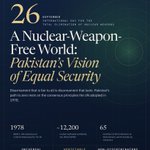
On the International Day for the Total Elimination of Nuclear Weapons, Pakistan’s position is clear and consistent: Disarmament must deliver equal security for all states.
See detailed infographics below for a comprehensive overview.
#Pakistan #NuclearDisarmament #26September


On the International Day for the Total Elimination of Nuclear Weapons, Pakistan’s position is clear and consistent: Disarmament must deliver equal security for all states.
See detailed infographics below for a comprehensive overview.
#Pakistan #NuclearDisarmament #26September
Pakistan continues to advocate a universal, verifiable, and non-discriminatory path while maintaining Credible Minimum Deterrence as a responsible response to the security environment in South Asia.
#Pakistan #NuclearDisarmament #EqualSecurity #StrategicStability


Musavir Hameed Barech retweeted

“The Choke Points – Risk of Escalation”
Sea Lines of Communication (SLOCs) matter from both a geoeconomic and geostrategic perspective.
Both the Strait of Hormuz and Bab-el-Mandeb are extremely important to the global economy, and no warring party should blockade them.
If this happens, the entire global economy will be affected.
Also, this may drag other regional players into unwanted conflict, with a risk of dangerous escalation.
The geostrategic and geo-economic implications are immense.
#chokepoints #SLOCs #Hormuz #Iran #IranWar #Houties #US #UAE #Egypt #SaudiArabia

Musavir Hameed Barech retweeted
Guest Lecture:
Zohaib Altaf, Associate Director at CISS AJK, delivered a lecture on "India's Aspiration for Acquiring and Integrating LAWS within the Nuclear and Military Domains - Implications for South Asia".
India is building a command-and-control ecosystem to integrate LAWS. These include capabilities in sensing, decision-making cycles, movement, and engagement.
Integrating AI into remote sensing and ISR may undermine confidence in the survivability of nuclear and conventional forces.
The danger also lies in the event when an autonomous weapon initially on a tracking mission, decides on its own, to engage a target without any intervening human approval. Therefore, diplomacy and crisis management might be outpaced by LAWS.
Challenges to attribution also create problems. Much like cyber-attacks, LAWS carry the issue of attribution. A machine-led weapon may decide to carry out an attack while also allowing the responsible state to distance itself from direct responsibility. This may encourage risk-taking behavior and create instability.
Zohaib reiterated the importance of Human-in-the-Loop mechanism. No weapon should be fully autonomous. He stated that Artificial Superintelligence poses a grave threat to stability.
Geopolitical competition is preventing leading states from regulating AI for fear of being left behind; however, the relentless pursuit for supremacy in AI may lead to our own undoing.
#ArtificialIntelligence #LAWS #AutonomousWeapons
@ArmsConAdvisor @zafarwafa1977 @AsmaKhawaja5 @ZohaibCISSAJK


Musavir Hameed Barech retweeted
The Balochistan Think Tank Network celebrated the 79th Independence Day of Pakistan with zeal and enthusiasm in which the Faculty of Research at BTTN gave their presentations on relevant topics. Mr. Aadersh Hamza, Associate Director, introduced and explained the concept of the Pakistan Progress Report.
The event served as a platform for the BTTN team to reinforce their commitment to serve the nation no matter what the obstacles are. Dr. Zafar Khan, Executive Director, BTTN, stated that Pakistan's journey as an independent state has been remarkable and it has emerged as an indispensable actor in the region and beyond regardless of the challenges and obstacles - he appreciated the efforts of the BTTN in launching the Pakistan Progress Report.
#IndependenceDay #14august


Musavir Hameed Barech retweeted
“BTTN Journal July Issue is out now”
Balochistan Think Tank Network (BTTN) publishes its Vol. 5, No. 1 (2026 in the HEC-recognized BTTN Journal.
bttn.org.pk/ojs/index.php/BT…
This issue publishes 3 book reviews and 7 leading research articles on the broader contours of international and regional affairs successfully after a rigorous process of scrutiny and double-blind peer review.
Of interest to those mostly interested in strategic affairs, competing strategies, and emerging technologies as a broader part of international affairs.
#AcademicExcellence #research #theories #IR #Politics #technologies #India #Pakistan #SouthAsia

Musavir Hameed Barech retweeted

Strong nuclear security requires strong cybersecurity. One cannot exist without the other.
Data breach reportedly targets India’s Kudankulam nuclear power plant | Cybersecurity News | Al Jazeera aje.news/7i3bgj via @AJEnglish

Musavir Hameed Barech retweeted
“Insecure and Unsafe Indian Nuclear Power Plants/ Critical Infrastructure”
1. India’s largest nuclear power plant, Kudankulam, was exposed in a data breach.
2. Very serious. Very critical.
3. Indian nuclear power plants and their critical infrastructure are not safe.
4. This is not the first time. They have experienced such critical and serious episodes in the past as well.
5. Yet, India has not learned anything from such critical breaches of Indian nuclear power plants and critical infrastructure.
6. Their nuclear power plants/ critical infrastructure remain vulnerable to such breaches and theft.
7. One wonders as to what is going on in India when it comes to consistent nuclear power plant breaches, policy/ protocol violation, and theft of nuclear-related facilities.
8. A big question mark on India’s safety and security of its power plants and the nuclear-related critical infrastructure.
Such consistent breaches/ theft cases of high-value critical infrastructure in India could have the following implications:
a. The intruders can put all other Indian nuclear power plants and other critical infrastructure into tatters.
b. The breaches are not only a violation of the NSG Cartel Group, to which India was unfairly provided a “special waiver”. Such a special waiver has grave and serious implications for both the NSG members and India, as well as the broader Asian region.
c. This is also a clear violation of the defined safety and security of the IAEA safeguards to which India is a signatory to both the IAEA and its Additional Protocols.
d. Non-state actors/ bad actors both within India and abroad could use these breaches files/ blueprints and other related theft materials to develop dirty bombs.
e. This is not only a safety and security issue for all Indian nuclear power plants, but also this may prove to be destabilizing for the broader South Asian strategic stability.
The international community, more importantly, the US, the NSG members, and the IAEA should take serious notice of such consistent breaches of Indian nuclear power plants to protect the safety and security of the entire Asian region.
@Reuters @ReutersWorld
#Kudankulam #India #Asia #SouthAsia #powerplants #nuclear

Another alarming security failure in India.
Sensitive files reportedly linked to the #Kudankulam NPP have surfaced on the dark web, raising serious concerns over the security of one of India's most critical strategic assets.
#CyberSecurity #NuclearSecurity #DataBreach #India

Musavir Hameed Barech retweeted

If repeated cyber incidents involving nuclear infrastructure fail to attract sustained international scrutiny, vulnerabilities risk becoming normalized. South Asia cannot afford complacency over nuclear security.

“Insecure and Unsafe Indian Nuclear Power Plants/ Critical Infrastructure”
1. India’s largest nuclear power plant, Kudankulam, was exposed in a data breach.
2. Very serious. Very critical.
3. Indian nuclear power plants and their critical infrastructure are not safe.
4. This is not the first time. They have experienced such critical and serious episodes in the past as well.
5. Yet, India has not learned anything from such critical breaches of Indian nuclear power plants and critical infrastructure.
6. Their nuclear power plants/ critical infrastructure remain vulnerable to such breaches and theft.
7. One wonders as to what is going on in India when it comes to consistent nuclear power plant breaches, policy/ protocol violation, and theft of nuclear-related facilities.
8. A big question mark on India’s safety and security of its power plants and the nuclear-related critical infrastructure.
Such consistent breaches/ theft cases of high-value critical infrastructure in India could have the following implications:
a. The intruders can put all other Indian nuclear power plants and other critical infrastructure into tatters.
b. The breaches are not only a violation of the NSG Cartel Group, to which India was unfairly provided a “special waiver”. Such a special waiver has grave and serious implications for both the NSG members and India, as well as the broader Asian region.
c. This is also a clear violation of the defined safety and security of the IAEA safeguards to which India is a signatory to both the IAEA and its Additional Protocols.
d. Non-state actors/ bad actors both within India and abroad could use these breaches files/ blueprints and other related theft materials to develop dirty bombs.
e. This is not only a safety and security issue for all Indian nuclear power plants, but also this may prove to be destabilizing for the broader South Asian strategic stability.
The international community, more importantly, the US, the NSG members, and the IAEA should take serious notice of such consistent breaches of Indian nuclear power plants to protect the safety and security of the entire Asian region.
@Reuters @ReutersWorld
#Kudankulam #India #Asia #SouthAsia #powerplants #nuclear
Musavir Hameed Barech retweeted

Nuclear responsibility is measured not only by capability, but by the ability to secure critical infrastructure. The reported Kudankulam data breach raises serious questions about India's nuclear security standards and its aspirations for grtr influence in the global nuclear ordr
Musavir Hameed Barech retweeted

🇵🇰 is using space technology to fight climate change.🛰
Through #SUPARCO's #Space4Climate initiative, satellites are helping monitor floods, glaciers, forests, air quality, and water resources.
A smart step towards a safer and greener future.
brecorder.com/news/40431524/…

Musavir Hameed Barech retweeted
4/4
This highlights the urgent need for enhanced #cybersecurity-nuclear convergence, third-party audits, & transparency. Without reforms, such breaches risk destabilizing regional peace and forcing int’l stakeholders to reassess engagement with 🇮🇳
#Kudankulam #Nuclear #SouthAsia
Musavir Hameed Barech retweeted
3/4
The leak provides adversaries with intelligence on critical infrastructure. This accelerates targeting of supply chains, complicating stability in SA. It raises questions about compliance with Int’l safeguards and its match with 🇮🇳’s nuclear program
#India #NuclearSecurity