@UCL Mullard Space Science Laboratory : Science and Technology that's out of this world.
Holmbury St. Mary, Surrey, UK
Joined July 2014
- Tweets1.5K
- Following99
- Followers2.8K
- Likes537
MullardSpaceScience retweeted
【News】The “Hinode-19 and SOLAR-C Science Meeting” was held at Nagoya University 🌞 Researchers from around the world gathered to review on 20 years of solar physics pioneered by Hinode and discuss the next generation of solar science that #SOLAR_C will explore.
MullardSpaceScience retweeted
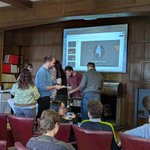
Our brilliant UCL Mullard Space Science Laboratory @MSSLSpaceLab team showcasing the work of department's researchers and technicians at the UCL200 celebration event! 🤩
#UCL200 #LoveUCL #science #SpaceScience #astronomy #MarsRover #PanCam #RosalindFranklin @Dr_Lucie
MullardSpaceScience retweeted
Dazzling 1st images from the Vera C. Rubin #Observatory mark the start of a 10-year mission to build a high-definition time-lapse record of the #Universe and help pin down what #DarkEnergy might be: ucl.ac.uk/mathematical-physi…
@MSSLSpaceLab
MullardSpaceScience retweeted
The first ever look at the #Sun's south pole has been captured by the #spacecraft #SolarOrbiter using a #telescope that researchers at the UCL Mullard Space Science Laboratory @MSSLSpaceLab helped design and build: ucl.ac.uk/mathematical-physi…
MullardSpaceScience retweeted
Congratulations to @MSSLSpaceLab Astro Group's Paola Pinilla for finding that planet-forming discs are much smaller than previously thought! ucl.ac.uk/news/2025/mar/plan…
MullardSpaceScience retweeted
"Ultimate discovery machine": @esa's space mission #Euclid, whose massive visible-light camera was built by @MSSLSpaceLab-led team, has released its first batch of data, including more than 380,000 galaxies catalogued thanks to AI and citizen science: ucl.ac.uk/mathematical-physi…
MullardSpaceScience retweeted
The @ESAGaia mission has delivered the best Milky Way maps to date and taken its last starlight before spacecraft retirement.
These new Gaia maps are the best reconstructed views of how our Milky Way galaxy might look to an outside observer. They show us our place in the Universe like no other mission has before👇
🔗esa.int/Science_Exploration/…
MullardSpaceScience retweeted
Exoplanets & the Ariel Mission - Searching for signatures of life on strange worlds, this Thursday 31st Oct, 5:30pm, online 🪐🛰️🎃
Our next 'Adventures in Planetary Science' public outreach event features the following line-up of fantastic experts... 👇👇
MullardSpaceScience retweeted
Students from @BlenheimEpsom and Fellow @rjwarrilow from @MSSLSpaceLab embarked on a fascinating project to identify regions on Mars that may have once harboured habitable conditions! Interested? Check out their conference video here! youtu.be/xvLNFnSNBig #OrbytsConference2024
MullardSpaceScience retweeted
Students from @StBernards_HS along with Fellow @ConnorJBallard from @MSSLSpaceLab have taken a significant step towards understanding the potential to identify life on Mars using microbialites from Lake Salda, Turkey🦠🔬Check it out! youtu.be/W2tLmVKlGck #OrbytsConference2024
MullardSpaceScience retweeted
A team led by @MSSLSpaceLab @uclmaps researchers designed and built a massive optical camera for the @ESA_Euclid space mission. That camera imaged 100 million stars and galaxies in just two weeks - watch the video to learn more 👇
MullardSpaceScience retweeted
The Jocelyn Bell Burnell Medal and Prize has been won by Dr Catherine Elizabeth Regan of @MSSLSpaceLab for exceptional leadership of the Eyes on Mars project, engaging diverse audiences and inspiring our next generation of scientists, alongside high-impact and novel research on Martian dust storms. 👏 #IOPAwards24
MullardSpaceScience retweeted
The @ESA_Euclid space mission has released the first piece of its great map of the Universe, showing the capabilities of the spacecraft’s massive optical camera which was designed and built by a team led by @MSSLSpaceLab @uclmaps researchers ucl.ac.uk/news/2024/oct/firs…
MullardSpaceScience retweeted
Today we release the first 1% of @ESAEuclid's cosmic map and it's jaw dropping! 😮
In just two weeks our #DarkUniverse 🕵️detective observed around 100 million sources: stars in our Milky Way and galaxies beyond.
Explore here 👉 esa.int/Science_Exploration/…
MullardSpaceScience retweeted
Congratulations to Dr @catherineregan0 @MSSLSpaceLab @uclmaps @WestVirginiaU on being awarded the Jocelyn Bell Burnell medal and prize for engaging thousands of school children in Mars exploration and for her research on Martian dust storms #IOPAwards24 ucl.ac.uk/news/2024/oct/ucl-…
MullardSpaceScience retweeted
How do we look for planets that could support life? 🌍✨
Angharad Weeks, a PhD student at the @MSSLSpaceLab, shares how scientists search for planets around other stars. By studying dips in a star’s brightness or its gravitational wobble, we can detect planets, and maybe even ones that could support life! 🌌
Join us in exploring space's biggest questions with insights from top industry experts! Learn more at iop.org/SpaceAdventure #MimiSpaceAdventure
MullardSpaceScience retweeted
The @esa planet-hunting mission Plato is a step closer to launch after a team led by Prof Alan Smith @MSSLSpaceLab @uclmaps delivered electronics for 24 of the satellite's cameras. The electronics will read the content of 80 million pixels per camera ucl.ac.uk/news/2024/sep/mile…
MullardSpaceScience retweeted
Beautiful new animation of the Rosalind Franklin @ESA_ExoMars rover working on Mars. Can’t wait for 2028 - go Rosalind!
Sometimes, to get to the heart of the matter, you need to dig deeper.
🍿 Episode 2 of the Rosalind Franklin rover series: Below the surface.
🔎 blogs.esa.int/to-mars-and-ba…
MullardSpaceScience retweeted
"It will leave a very impressive legacy": the first satellite of the @esa Cluster mission investigating Earth's magnetosphere, which involved Prof Andrew Fazakerley and others @MSSLSpaceLab @uclmaps, has safely returned to Earth after 24 years in space ucl.ac.uk/news/2024/sep/good…
MullardSpaceScience retweeted
With the reentry complete, we're hoping to learn more soon about the results of an airborne observation experiment. With the plane three hours from land, we wait patiently for further information.
We’ll be back tomorrow with an update. More info via our blog 👉 blogs.esa.int/rocketscience/…
For now, thank you for following and goodnight!