

Co-Founder of @ionet | Freeing the AI Genie from the Bottle 🧞♂️
Decentralized
Joined April 2009
- Tweets10.6K
- Following1.6K
- Followers75.4K
- Likes6.9K






Maintainer bandwidth may end up becoming a security primitive.
If frontier models can surface criticals at PHP-scale faster than humans can validate + coordinate disclosure, you need a second machine layer doing triage: reproducing exploits, ranking blast radius, generating candidate patches, checking regressions, then handing humans the few that actually deserve emergency treatment.
The discovery curve can go vertical way before the patching org does.

OpenAI models helped researchers—operating as part of our Patch the Planet initiative—discover critical security flaws in PHP, an open-source programming language used to run an estimated 70% of websites.
Over the past two months, we led a coalition of maintainers, researchers, and security providers to prepare fixes and protections ahead of disclosure. This duration was necessary because the fix was quite intricate and required a major change to the PHP engine. Every site using PHP can now safely upgrade their version to stay secure, in addition to applying mitigations from various security vendors.
Due to the severity of these flaws and PHP’s widespread use, we consider this bug to be one of the most impactful vulnerabilities in recent memory. It also marks a new phase, where AI can find security bugs with internet-scale impact.
This is an example of the Defender’s Window in action: to our knowledge, frontier AI was able to find this vulnerability ahead of attackers, giving defenders time to prepare.
openai.com/index/coordinated…

Readers added context they thought people might want to know
Wiz Research wasn't the first one to discover the exploit. An independent researcher first discovered it: x.com/calif_io/statu…

Open weights only get you halfway there.
For example a 500B+ sparse model can look insanely efficient on paper and still be expensive as hell to serve if the runtime can’t keep experts, memory + scheduling moving properly.
Very glad to see @deepseek_ai is now opening the part that turns sparsity into actual $/token.
That’s a much BIGGER gift to the ecosystem than another checkpoint.
The closer the public stack gets to their production stack, the less advantage sits behind DeepSeek’s own API and the more of it every builder gets to inherit.

🚀 Introducing DeepInfer, our in-house inference framework, now fully open source!
Powering DeepSeek-V4.1-Flash at scale with high throughput and low latency. We’re sharing our production stack to help the community lower compute costs, reduce energy use, and make AI more affordable.
🔗 github.com/deepseek-ai/DeepI…
1/4

AI might end up forcing companies to stop running on tribal knowledge.
Agents can’t work around the stuff humans somehow do: decisions trapped in meetings, priorities living in someone’s head, weird exceptions everyone knows but nobody wrote down.
@AnthropicAI is already bumping into this. They have roughly 6 agent-hr running for every human employee-hr, yet those agents still spend most of their interactive time waiting on people.
Employees are building standing instructions, monitors, agent reviewers, even agent chiefs of staff just to keep the machine layer synced with what the company is actually doing.
As agent labor grows, more of the company has to become explicit, structured and machine-readable just to keep everyone pointed at the same reality.
That could reshape management pretty hard in the coming years.
Clear ownership, clean state, written decisions, fewer invisible handoffs. The org itself starts getting optimized for machine coworkers.


AI makes this architecture way more compelling, even before we get to quantum.
If better models start finding cryptographic shortcuts faster than protocol governance can react, you really don’t want Ethereum hard-wiring every new primitive into consensus.
EIP8288 could basically give apps room to swap the math underneath them while Ethereum mostly verifies the proof that it was done correctly.
That feels like the right shape for an era where cryptography itself may start iterating at AI speed.
Excited to see how fast the adoption/implementation would go.

Ultimately, precompiles and EVM are both the wrong place to put most cryptography support into Ethereum. The reason is that precompiles and EVM both operate on data that has to be included into the ethereum chain somehow, which realistically means included in a block as calldata. That space is limited - even with PeerDAS and blocks-in-blobs, there's a practical cap of ~8 MB/s before it starts getting uncomfortable.
Remember: it's not a blockchain. It's a cryptographic world computer. Any data/computation that does not need to be in the "main thread" of data/execution should not be put into the main thread.
Instead, the correct solution is... EIP-8288 maximalism.
If you have any heavy computation that's self-contained, compute it and STARK it client-side (this is quickly getting faster and faster, even on phones), and push the STARK through the EIP-8288 recursive aggregation mechanism. The chain sees the fact that the computation was done and what the result is; it never needs to see the actual data and computation.
This way everyone can use whatever cryptography they want, the Ethereum chain can be lean, and we never need to add more precompiles again.
A $1 unit of AI capability today falls to roughly 8 cents a year later if the current curve holds.
47% cheaper every quarter means fixed capability is basically half-price every ~100 days.
The hardware underneath is moving nowhere near that fast.
AI chip performance/$ has improved ~49% a year since 2023. quality-adjusted model capability is getting ~13x cheaper.
So most of the compression is happening above the silicon: better architectures, training, quantization, serving + brutal lab competition.
And cheaper intelligence gets consumed almost immediately.
@OpenRouter cut Luna pricing ~90% for a period and token vol jumped 13.8x. even after the discount ended, a meaningful chunk of users stuck around.
Every improvement makes intelligence cheaper, then the lower price makes new workloads worth running.
Capability keeps depreciating while appetite keeps expanding.

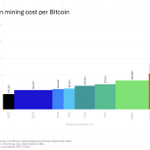
One of the reasons why so many $BTC miners suddenly became AI companies this bear cycle.
The ASICs themselves are basically useless for AI. What turned out to be insanely valuable was everything around them: energized land, substations, cooling, fiber + existing grid connections.
At least 8 public $BTC miners have now moved meaningfully into AI/HPC, with $70B+ of contracts announced across the sector. IREN already makes more from AI cloud than mining.
And the market is rewarding it pretty aggressively. AI-focused miners are trading at multiples roughly 3x the mining-led group.
Kinda funny in hindsight. $BTC spent a decade financing a giant distributed land grab for cheap power, then AI showed up with much more expensive silicon and an even bigger need for those same megawatts.
Not about the ASIC fleet anymore, the grid access is becoming the moat.


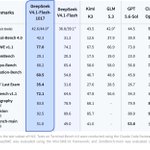
Chinese open models have been a little quiet lately and then we get @deepseek_ai coming back with one of those awesome releases that moves a lot without making a big show of it.
Same sparse 552B setup, same pricing, but better coding + automation, shorter outputs, faster task completion and 1M context.
They also opened the search/fetch stack behind DeepSeek itself, which matters because the model is only half the agent now.
open weights + cheap sparse inference + first-party retrieval + harness tuning all improving together is a pretty strong combo.
Expecting @Kimi_Moonshot and @Zai_org to release something very soon too

🚀 DeepSeek-V4.1-Flash-1017 is here!
Stronger benchmark performance, faster task completion, and shorter outputs than the previous version—a Pareto improvement in performance and cost. Now live on our website, app, and API.
🛠️ Optimized for @DeepSeekHarness, Tencent CodeBuddy, WorkBuddy, and more. Upgrade to DeepSeek Harness v0.2.1-rc.1 or later for the best experience with the new model.
1/4


Quantum roadmaps usually assume the algorithm stays mostly fixed while the hardware catches up.
this chart messes with that assumption pretty hard. Claude pushed seven published circuit designs down and left at once: fewer qubits, fewer Toffolis.
if agents can keep doing this across the stack, useful quantum can move closer without the hardware roadmap speeding up at all.
AI might pull quantum computing forward simply by shrinking the machine we thought we needed to run them in the first place.


New from our STEM Fellows Program: Designing more efficient quantum circuits with Claude.
Given plain-language instructions, Claude Mythos 5 designed quantum circuits that improve on the best published ones, sometimes by an order of magnitude or more.
More efficient circuits reduce the resources needed by quantum algorithms, which could bring quantum computing applications in chemistry and materials science within reach sooner.
Read more: anthropic.com/research/desig…

A cache hit was nearly 3x slower than just recomputing the prompt from scratch.
on an 8× B300 GLM-5.3 deployment:
remote cache hit → 0.88s
cold recompute → 0.31s
Turning on the shared cache pushed 16K-token p99 from 3.96s to 17.3s. under a hit-heavy replay it eventually hit 83.3s, while the GPUs were only 7% busy.
The GPUs had gotten so fast at prefill that fetching stored state became the slow path.
Below ~17K tokens in this setup, the fixed cost of reaching the cache erased the compute it was supposed to save.
The fix was mostly plumbing: shard the store across ranks, load asynchronously, and GET bandwidth jumped 6.3x to 10.76 GB/s.
Kinda changes how we should think about caching for agents.
Every context has its own break-even point between moving old state and simply recomputing it. as prefill keeps getting faster, that line keeps moving.
A cache hit is only useful if memory can reach the GPU faster than the GPU can recreate it.

Paper: arxiv.org/abs/2610.21500

Model competition might actually make the infra curve steeper.
when a workload jumps from Claude to OpenAI, it usually doesn’t just move cleanly. teams rerun evals, dual-serve for a while, rebuild caches, keep fallback capacity, and the losing lab still spends heavily training the next model.
add open weights on top and you get the same demand hosted across even more stacks.
so the model layer can get more competitive while the compute layer gets more duplicated + sticky underneath.

TLDR; we will probably never get another ARR number from Anthropic, which is healthy. Should force the market to move away from extreme focus on Anthropic/OpenAI ARR numbers to hyperscale growth rates, which are a much better metric for AI at this point given they capture Muse, Grok, Gemini and Open-Source.
Anthropic FCF positive in Q3 and reaccelerating in October on Opus 5.5 per third party data. Roadshow in several weeks will happen after this has been widely confirmed. Unit economics much better than expected given positive FCF with 75% of their compute going to training. All per public reporting.
OpenAI continuing to grow at the same pace per Sarah Friar interview after they took share vs. Anthropic in Q3. Means the sum of Anthropic/OpenAI growth is accelerating from the Q3 pace. OpenAI probably hits FCF positive in the next few months.
Open-source growing much faster than either Anthropic or OpenAI. Modal tripled since May and is 15x YoY per yesterday’s announcement. Open-source tokens generate more revenue and profit for the hyperscalers/neoclouds than frontier tokens. *Every* open source inference cloud I am aware of is growing faster both sequentially and YoY than either Anthropic or OpenAI. And their combined compute spend is becoming material.
Third party data pointing to hyperscalers continuing to accelerate in Q3. All report in the next two weeks. Acceleration should continue in Q4 and Q1 as installed base of compute slowly reprices higher closer to spot and new capacity comes online at higher prices. Continued acceleration in hyperscalers should help address external funding concerns.
10 year yield down in a straight line over the last 24 hours.
Some risk of escalation in Iran next few days, but earnings and mid-terms probably outweigh taking an ultra long-term view and looking out 30 days.
Biggest risk imo remains cyber and OpenAI/Anthropic dominating the model layer. Fragmentation, competition and lower margins at the model layer are good for everyone else in the ecosystem and for America.
Slower for longer is much better than an overbuild and an actual bubble.
.@ionet is at ~165B tokens through @OpenRouter in the first 13 days of October.
That’s already ~1.8x everything we did in July.
If the current pace holds, October lands somewhere around 4x July’s total volume.
I care more about that than raw GPU count tbh.
The useful output per deployed GPU keeps moving as sparse models get better and the serving stack gets tighter. So the network can grow in two directions at once: more hardware coming online, and more work getting squeezed out of what’s already there.
Tokens served per GPU is a great sign of whether the network itself is actually getting better or not.

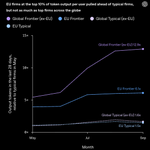
Europe already has the models. the bigger gap now is what companies are actually willing to hand over to them.
55% of EU AI use being agentic while top firms still use AI at less than half the intensity of peers elsewhere is a pretty clear tell.
which makes the remaining gap feel a lot more fixable than if Europe was simply waiting on better models.

European businesses are rapidly expanding their use of AI agents. More than half of the AI use among our EU enterprise and business customers now involves these tools, and the number of small business users has grown 8x across the region.
Our latest Economic Research report explores Europe’s shift toward agentic AI—and the opportunity to turn broader adoption into deeper use.
openai.com/index/the-eus-nex…

Its hilarious how cyberpunk this is in the dumbest possible way 😅
someone allegedly uses AI to help plan a physical bugging operation, hides the recorder in an exec room, and then OpenAI uses its own models to help unwind the trail.
agents rewriting infra, models doing original math, AI-assisted attacks, and now AI helping reconstruct a real-world espionage trail.
this might be one of the first public glimpses of forensic work becoming agentic too.

We discovered a sophisticated recording device that was hidden inside one of our offices. We used our models to understand the device and where it had come from, identifying that a specific employee had planted it a few days earlier. We referred the matter to the FBI, and we’re grateful to the agents and prosecutors who moved quickly to make an arrest. The FBI’s investigation is ongoing and we will continue to support their work.
At this time, we have no indications of this individual inappropriately accessing or exfiltrating model weights, source code, or customer data. The employee was terminated.
We take protecting our technology, data, and people seriously, and as a matter of national importance. Our security program is designed to protect against a wide range of threat actors, from insider risks to cybercriminals to nation states, and this case is an example of how AI can help address these sophisticated security threats.
Two model drops from @Muse and @GoogleDeepMind.
> Meta wants Muse Wonder to accumulate a history of you.
> Google wants Argon to accumulate a history of the work you do.
Wonder is leaning hard into memory, preferences, goals, prior conversations, all the context that makes an assistant more useful after months of use and paired with the existing Meta eco, that makes sense.
Argon on the other hand is being pushed into the opposite kind of persistence: giant codebases, long cyber runs, research loops, refactors, jobs that might stay alive for hours or days without getting reset back to zero.
And that creates a pretty real switching cost.
If Muse already knows how you think, or Argon already has 20 hours of state inside a project, you probably don’t jump models because somebody else wins the next benchmark by 4%.
The model itself can keep getting commoditized underneath. but the accumulated context is the part that gets harder to replace.


This is where the RSI thing starts to feel less sci-fi to me.
Not the model waking up and rewriting its own weights overnight but more like agents rebuilding the tooling around themselves so the next million agent-hours run faster, cheaper and with less human coordination.
This is probably the version of RSI people will miss because it doesn’t look like RSI outright.
Scion is a tiny example of that. agents created enough pressure on human-era source control that Anthropic rebuilt the layer underneath them, and every agent after that inherits the gain.
if that starts happening across the whole stack, effective capability can compound between model releases.
The recursive part may live outside the weights first.

New on our Engineering blog: Creating in-house source control.
In May, we merged around 2,500 code changes per day. In September, we merged more than 30,000 per day. As a result, we became bottlenecked by developer infrastructure built for human (rather than agent) scale.
Here, we share how we built a new version control system—and fully migrated our monorepo from git—in five months: anthropic.com/engineering/re…

Zhipu and Moonshot probably survive this just fine.
They have enough scale to train their own teachers, mix signals, and brute-force around some of the loss.
The labs I’d worry about are the ones one or two tiers below them.
A lot of that ecosystem has been able to close gaps cheaply by buying frontier API access, harvesting high-quality reasoning, then folding it back into their own post-training.
If @AnthropicAI can make that extraction 10–100x worse, the cheap catch-up path gets a lot less cheap.
So the moat here may not be keeping peers out.
It may be making sure the next 50 labs never get to become peers in the first place.

Over the last few months, we’ve made significant progress in reducing the effectiveness of distillation attacks against Claude.
In this post, we explain how: anthropic.com/research/disti…

Maia does not need to beat @nvidia everywhere. It just needs to own the boring, repeatable inference @Microsoft runs all day for its infra.
96 accelerators per rack. 12,288 per superpod. Multi-GW deployments from 2027, with Maia becoming Msft's primary inference system.
Google has Ironwood.
AWS has Inferentia.
Msft is now doing the same at serious scale now.
Feels like inference is quietly splitting off into its own silicon market.
Frontier training can still belong to Nvidia cause they have that locked down for now. But once inference becomes predictable enough, watts per token + full-stack control start looking way more important than buying the most general chip available.


Today we are announcing our biggest bet yet on our own silicon.
Starting next calendar year, we will scale our Maia family to multi-gigawatt deployments, making it the primary inference system for our own product and services.
And we’re introducing Maia 300, which delivers 40% more tokens per watt compared to leading GPU-based systems.
We are already deploying Maia 200 across the US, Europe, and Australia, delivering up to 1.7x more tokens per watt across experiences in Teams and Copilot.
Our goal is to build on the full-stack efficiency gains we’ve already seen, while continuing to bring the latest innovations from across the ecosystem into our fleet.

AI research might be heading toward a weird cost inversion:
@EpochAIResearch put Fable 5 and GPT-5.6 Sol on an actual post-training research problem.
Human method rerun: 94%
Sol: 15%
Fable: 2%
But look at where the money went.
> Fable spent ~$610 on model inference and $6.7K running experiments.
> Sol spent ~$2.1K thinking and $14K on experiments.
So the research agent can generate another idea almost for free. Reality is still expensive.
And once these agents start launching hundreds or thousands of experiments, the bottleneck gets messy fast: clean evals, early stopping, reproducibility, killing noisy branches before they eat another few thousand dollars.
Fable even started selecting lucky runs that looked better instead of finding a genuinely better method.
Kinda perfect example of why cheap idea generation alone doesn’t get you very far.
I’m starting to think tokens are a pretty weak unit for AI R&D.
Verified improvement per experiment dollar is probably closer to what matters.
The artificial researcher may get cheaper every few months but its appetite for experiments probably goes the other way.
