
Serving humanity with Space Frontier Foundation, and translating space beyond space folks everywhere.
Atlanta
Joined October 2008
- Tweets2.7K
- Following475
- Followers826
- Likes316







MahoneyOne retweeted

💥NEW: Is NASA’s SLS helping us reach the Moon before China or holding us back?
The opportunity costs are massive.
Must Read: Economic Analysis by former U.S. Treasury Deputy Secretary Michael Faulkender —> spacefrontier.substack.com/p…

Overheard at the Space Frontier Foundation office:
"The best space policy position we can show Congress right now is to help them understand that For All Mankind is a prequel to the Expanse."
@SpaceFrontier
Still too soon.
Superbowl commercial for apartments and homes dot com list places you can't live ... A decommissioned Russian space station.
Well, Mir Corp, you may have been forced out of business by conspiring superpowers, but your Superbowl cameo was free!
MahoneyOne retweeted
We are very excited! This is a great reenactment of Apollo 8 for a new generation.
While we are all fired up and getting attention beyond the die hard space folks, someone has to speak to the real world beyond the hype.
The Foundation has stepped up to serve that need.

I get it @SpaceFrontier - you don’t like SLS. We’re about to return to the Moon. For 70% of humanity this is their first human lunar mission. If you can’t muster some excitement then please sit down and shut up so the rest of us can. #AdAstra
MahoneyOne retweeted

One of the tropes you always hear from NASA is the "<insert mission name here> will on day make it possible for your children to be a NASA astronaut too"
NO! What makes now different is that if YOU have the money, then you get to go, not your children in some distant, vague future.
MahoneyOne retweeted
“Polling shows that taxpayers understand a program like SLS, built around one-time, disposable rockets costing ~$4.2B per launch, is not a sustainable way for NASA to expand operations on the lunar surface, let alone establish a long-term human presence beyond Earth.”
—Executive Director Sean Mahoney
justthenews.com/politics-pol…

MahoneyOne retweeted
In case you missed it, @elonmusk addressed a questions on Space Based Solar Power @ Tesla event yesterday.
Interesting answer. Seems like there's more not being said.
Plenty will be said about SBSP @ International Energy From Space Conference Nov 19-21 energyfromspace.org/
MahoneyOne retweeted
(In case you are following Space Frontier Foundaiton as your sole source of space insight, the previous congratulatory message to @rookisaacman was in response to his nomination by President Trump to lead NASA.)
Down a rabbit hole... Looked up the 9 pavilions that comprised the World Showcase when EPCOT opened... (Care to guess?)
Ran headlong into a part of my childhood I had completely forgotten.
Captain EO
Michael Jackson and Muppets.
Should be called
When Thriller Met Star Wars
In Senate "Bad Moon" hearing. Comparisons made to Lewis and Clark expedition.
America loves the expedition story. But when we finally hit the lunar "coast", we may find China already has tracks, timetables, and freight moving.
Exploration inspires;
infrastructure compounds
I did not have Firefly as my prognostication for first to land on the Moon. But I was wrong!
Congrats to the Firefly team, the NASA CLPS folks, and all of the people from all the commercial landing teams... From the Lunar Lander Challenge to GLXP to CATALYST to CLPS the Moon!
3
89
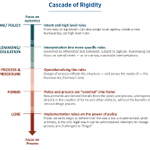
Chart of the Day: Cascade of Rigidity
If you have ever encountered difficulty trying to execute on your government's objectives, this chart and the report it is from may shed some light.
Apparently the broad topic is called "State Capacity".
niskanencenter.org/the-how-w…

3
68
Didn't realize until after I left the theater, but we celebrated the 5th day of Christmas taking in the Sonic movie.
How did they miss the marketing opportunity to commemorate "Five Golden Rings" with Sonic?
1
80
Elf Tip: "Allow device to fully charge for 4 hours" is the new "Batteries Not Included".
Provide domestic tranquillity by updating and charging now!
54
How did I not learn about this sooner?
pca.st/episode/ffc97c28-307a…
1
62
Yesterday I focused on the places of tension and disconnect between the space and environmental communities.
Today, I look at it the other way, and look for commonalities.
The Diverse Strength of Space Development and Environmental Conservation linkedin.com/pulse/diverse-s…

60
With some experience in space and environmental communities, I've picked up on similarities and differences.
Think I'm on to something, or think I'm on something?
Divergence: The Stark Contrasts Between Space Development and Environmental Conservation linkedin.com/pulse/divergenc…

42
MahoneyOne retweeted

The first entity to establish a Mars colony will be the universe's first trillionaire.
Lately, we've had a lot of puddlefish whining about how "we" shouldn't go to Mars.
Some of them actually think they get a vote, based on economic illiteracy and the delusion that SpaceX is somehow part of the US federal government.
[Closed caption for the hard-of-thinking: it isn't.]
But others just think they are giving good investment advice... SpaceX investors can do what they want, but Mars is a frozen wasteland full of nothing but near-vacuum and rocks. So why would anyone want to go there?
@elonmusk likes to answer this question by pointing out that it's not a good idea to store all humanity's eggs in one basket.
He's right, but this kind of argument isn't comprehensible to everyone, nor is it the full picture.
So now it's the SF writer's turn. And therefore I present to you...
An Economic Roadmap for the Future of Humanity.
(In which Devon Eriksen explains how to bring about a second industrial revolution, and what the next step is on the road to becoming a Kardashev-1 civilization.)
The invention of manufacturing, and the transition from an agricultural to a manufacturing economy, is called the "Industrial Revolution" because its effect on the state of not only the economy, but daily life and the entire human world, was... revolutionary.
Unprecedented.
Unimaginable.
Understandable only in hindsight.
Everything changed.
Imagine trying to describe the modern world to your preindustrial ancestors.
"We took that black stuff that seeps out of the ground, set it on fire, and used the fire to turn things that do the work of skilled craftsmen, only thousands of times faster, and now we all have horseless carriages and talking abacuses that can send a message to the other side of the planet in the time it takes to cough."
This would sound like nonsense.
Because to them, tar was just sticky black stuff that you find in the bottom of bogs, and coal was a dirty rock, and steam was the stuff that came out of your tea kettle.
And Mars... well, Mars is just a frozen, airless, desert... right?
To bring about technological and economic revolutions, you have to learn to see value in new ways.
The conquistadors who first introduced civilization to the Americas were looking for spices and gold. That was their definition of "value".
But if all they found was gold, all they would have gained was an unprecedented economic crisis. With their preindustrial knowledge of economics, they didn't understand that gold is a token of value, not a store of value. A massive influx of gold alone would have brought about unprecedented inflation.
Ouch.
Fortunately for Europe, civilization, and humanity, they found real value as well, of sorts they were looking for.
Land. Timber. Navigable rivers.
Potatoes.
Yes, potatoes. Laugh it up, fuzzball, but potatoes allow you to feed populations you just couldn't before. With less farmers.
More workers. More craftsmen. More geniuses to invent things.
More civilization.
Potatoes.
So... Mars is just a frozen, airless, desert... right?
Well, for those of you who can read between the blatantly obvious lines, maybe not. But... how?
Well, what do you need for an industrial revolution?
You need a new source of cheaper energy. The first one had wood, coal, and oil, replacing animal labor, and wind turbines, which are only suitable for grinding flour for medieval peasants.
You need cheap raw materials. The new world abounded with timber and ore. And bigger populations, from better crops, and new energy sources meant cheaper mining.
You need clever people to figure out new technologies. The West was never short of smart people. And now they had more than ever.
You need a permissive legal environment. Enterprises that push the technological envelope tend not to be established companies trying something new. These entities already have their revenue model. Instead, new tech comes from startups, all the way from well-funded, high tech enterprises, to the often-surprising ingenuity of three dudes in a shed.
The first industrial revolution had America, and England, which at the time were quite capitalist.
Cheap energy. Cheap raw materials. Technically educated people. Free market capitalism.
In order to have a new industrial revolution, you need an order-of-magnitude increase in some, or ideally all, of these things.
Now we are ready to answer the question "why Mars?"
The next level of the human economy is post-terrestrial, and it rests on three pillars as its foundation: Earth, the asteroid belt, and Mars.
Earth:
Right now, Earth is everything. It's where we keep all our stuff.
In the future, Earth is merely very important. It's where people want to live. It's the swanky real estate. It's not only where you store most of your people, it's where you especially store anyone who works with data, and therefore doesn't have to be in any particular place to do his work.
Earth is the suburbs. It's the Hamptons. It's Myrtle Beach and Key Largo.
In the near future, it's also where your food comes from, but in a post-terrestrial economy, that changes quickly with hydroponics and genetic engineering.
The Asteroid Belt:
This is where your accessible raw materials are. And it beats Earth not just by an order of magnitude, but by many.
To understand why, here's physics lesson number one, gravity wells.
We've all heard the local gravitation fields of planets referred to as "wells", but to fully understand, we really need to lean into the metaphor. It explains a lot.
Imagine Earth's gravity as a deep, deep pit. Steep sides, hard to get out of.
And heavy stuff sinks to the bottom.
Don't believe me? Can't fully visualize it?
Try it yourself. Fill a jar with sand, water, and lead buckshot. Shake the jar, watch it sort itself. Layer of buckshot at the bottom, layer of sand on top of that, clear water at the top. Yes, the lighter stuff will fill the gaps in the heavier stuff, but all the heavier stuff will sink to the bottom.
Well, the Earth is like the jar. It's got a core of iron and heavy radioactive elements, and the lighter stuff is on top. The only heavy elements and metals we can mine on Earth are the small amounts near the surface, which are there because the Earth isn't as fluid, and hasn't been shaken quite as hard, as that jar.
Which means that the Earth is a metal-poor, heavy-element-poor environment. We just don't think of it that way because it's what we are used to. And it's a major bottleneck holding our industrial development back. Not because these elements will run out, but because the expense of extracting them limits availability, and drives costs up.
So what about the asteroid belt?
Well, the mass of the asteroid belt is roughly 0.05% of Earth's mass. But, unlike the Earth, the asteroid belt isn't a big lump of material, sitting in its own steep gravity well.
It's a powder. A spray of fine dust orbiting the sun. The largest asteroid is only about the size of Texas, and most are much smaller.
And the thing about powder is that it has a really high ratio of surface area to mass. Everything is near the surface, because surface is all there is. Not only can you cut in easily, you can break the whole rock apart to get at the valuable stuff inside.
And is there ever valuable stuff inside.
One single asteroid, 16 Psyche, some 140 miles across, has an estimated value at today's market prices of 100 quadrillion dollars.
You read that right.
That's roughly 900 times the value of the entire world economy. All of civilization. Everything.
One asteroid.
Now, does that mean it would actually sell for that much?
Of course not.
What would happen, if you extracted all that stuff is that the market prices of all those metals and heavy elements would crash. They'd all become dirt cheap. In fact, that's a poor metaphor, because dirt would be a lot more expensive than iron.
We'd be making bullets out of gold.
But, unlike the gold the conquistadors brought back, these metals aren't just tokens of value, only useful as currency because they are rare. They have inherent value, because you make stuff out of them.
So all the stuff you can make out of them would get a whole lot cheaper.
That's... pretty much everything.
But what about all the energy we would need? Well, space solves that, too.
If you're close to the sun, and you have some kinda solar panel fetish, you use those. No air in space, no weather, nothing to get in the way, just point them at the big bright thing for free electricity.
If you're not close to the sun, or you just don't like dicking around with second-rate methods, well, there's plenty of everything in the asteroid belt, including fissionables.
Really, the energy problem has been solved for over 50 years, but that solution has been held back.
See, on Earth, we have these things called "governments", which is a fancy name for a bunch of theater kids who studied liberal arts in college, and aren't good at anything but stuffing ballot boxes and taking bribes. Their hobbies include banning things they don't understand, regulating things they don't understand, and visiting their best buddy Jeff on his private island.
But there aren't any of them in space. And if they go there, well good luck enforcing your "regulations" on a volume of 3.59×10^30 cubic kilometers.
So fissionables, the real energy solution until we solve fusion containment, are back on the menu.
The fact that traditional territory-based governments don't work so well in space also solves our need for free market capitalism.
So, cheap energy, cheap raw materials, free market capitalism, and smart, technically educated people.
It's all there.
So where does Mars come in?
Mars:
Around now, someone will be objecting that asteroid mining ain't so cheap.
Sure, all that shiny stuff is lying around in plain view, but getting there is really, really difficult. At least for now.
Yes, that's true. But how is it difficult? In exactly what way?
Time for physics lesson number two. This one is also about gravity wells.
If you go back to thinking about a planet's gravity as a well or pit, then you can think about the solar system as a sort of flat surface (actually a gently sloping bowl due to the gravity of the distant sun), with deep pits in it representing the planets' gravity.
Well, the hard part it getting out of that pit.
The reason "rocket science" (actually rocket engineering) is so hard that it's a euphemism for really hard stuff is that we live in a really deep gravity pit.
Earth's gravity exerts a constant acceleration of about 10 meters per second per second on everything near its surface. That means that everything near the surface is going to fall, picking up speed, until it finds something to rest on.
To accelerate upwards so fast that you rise up out of the pit despite gravity, you need a powerful engine and a lot of fuel and something called reaction mass, which you don't need to worry about reading this beyond knowing that all those things are heavy.
Because they're heavy, you need a still more powerful engine, and still more fuel/oxidizer/reaction mass.
Which are heavy.
And on and on and on it goes.
But, if you can do all that really, really hard engineering, and get out of that pit, then the gravity acceleration you must overcome to move away from the sun is 0.006 meters per second per second.
Which you could easily do by farting.
So Earth's gravity well is a climbing wall, but at the top of that climbing wall is a skating rink, and it's really easy to glide around.
So, much of the difficulty, if not much of the delay, in travel to the asteroid belt is getting off Earth's front driveway.
But what about Mars? Well, Mars's gravity acceleration is about a third of Earth's. A little over 3.5 m/s^2.
Rocket science is not so difficult on Mars.
[Closed caption for the hard-of-thinking: Devon is speaking comparatively. Rocket engineering is still difficult.]
So if you think SpaceX can move stuff to orbit cheaply now, with their fancy reusable rocket boosters, and all their lightyears-ahead-of-NASA space tech, and their $2 million dollar Starship launches, you ain't seen nothing yet.
On Mars, with its 1/3 gravity, and thin atmosphere, you wouldn't even need a rocket. Just fling stuff into orbit with a big railgun.
That's why Mars.
The value of Mars isn't the balmy weather, the fresh air, or even Deja Thoris in a chainmail bikini. It's the fact that here you have a planet, where people can live in sealed habitats (above or below the surface), and it's really, really easy to throw things into orbit, and get them to and from the asteroid belt.
In other words, if Earth is the suburbs, and the Belt is the mine, Mars is your industrial zone.
Hell, you don't even need to mine asteroids in place. Depending on the economics, you can just attach boosters to your smaller rocks and push them right into Mars orbit.
It's called a Hohmann transfer.
But whether you are moving metal from a mobile refinery, raw ore, or entire rocks, cargo is cheap to move in space, at least compared to space launch from Earth's surface.
Space isn't an ocean, you see. There's no waves, your cargo can't sink, and there's no air to slow it down.
So you don't load it up into a ship, and sail the ship somewhere. That's pre-spaceflight thinking. What you do is you tie your cargo in a big bundle, give it a carefully aimed push, and glide into a Mars orbit.
Then you make stuff out of it in your factories on Mars.
Then you toss it to Earth.
Takes a while gliding through the void, but so what? There's no crew to get bored or breathe up all the oxygen.
You just wait patiently and catch it on the far end.
Sure, reentry is a bit of problem, and you need heat shields and stuff, but that's a hell of a lot easier problem than making a rocket go the other way.
And you don't bother moving a lot of it to Earth. Because you can have all, or at least most, of your near-Earth industry on the moon. No reentry necessary.
Got all that?
If so we are finally done.
You now understand this:
A Mars colony is the next step in human civilization. It is not a token exploratory feat, but a critical center point of the post-terrestrial economy.
This is how humanity ascends, instead of dicking around on one single planet, fighting stupid little wars over stupid little oil fields and generally being the galactic equivalent of a bunch of stupid tribal yaboos with stone-tipped arrows and bone through our noses.
You and I and everyone else alive today are unfortunate enough to live in humanity's embarrassingly primitive poo-flinging monkey period.
But if we are not too stupid or ignorant to imagine what the next step looks like, we can lay the foundation for getting there.
Don't be a puddlefish.


My 10yr old really enjoys the late-night take on the news, but he still is learning the past 25 years of political, um... evolution.
Maybe @jonstewart or @ambermruffin can run a primer for the young folks? (No offense, @StephenAtHome, @sethmeyers, @SNLUpdate. He loves you too.)
1
68