

I work on multimodal understanding in AI | PhD student @siebelschool @UIUC_NLP | Prev. @Meta @RealityLabs @Amazon | @CapitalOne PhD Fellow
Champaign, IL
Joined May 2021
- Tweets1.4K
- Following1.2K
- Followers1K
- Likes6.1K




Pinned Tweet
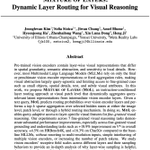
👀 What if better visual reasoning isn't about more pixels or more vision encoders, but knowing WHICH visual representations to use?
Excited to introduce Mixture of Layers (MoL), our work at #NeurIPS2026! 🎉
🧵 Here's how we make vision encoders work smarter:

Jeonghwan Kim @ NeurIPS 2026 (Atlanta) ✈️ retweeted

Can coding agents do Scientific Tasks?
We included physical experiments into Embodied First Exam:
- AutoBio
- LabUtopia
- Coming soon: our original Embodied Scientific Exam benchmark. Coding agents run physical/chemistry experiments like in a high school lab. Stay tuned.

Introducing Embodied First Exam:
One line of code to run coding agents in 1,090 embodied tasks across 31 simulation suites and 44 robots.
Can your agent go far beyond pick-and-place:
Puzzles with spatial constraints;
Olympic sports with multi-robot collab;
Real-time eval, where the world won't pause;
Dynamic, agile, whole-body control;
AutoResearch with sim2sim
Try your own agent:
harbor run -d embodied-first-exam -a <your_own_harness> -m <your_own_model>
Jeonghwan Kim @ NeurIPS 2026 (Atlanta) ✈️ retweeted
Game2Player: let AI build its own training ground.
- Builder agents turn web games into tasks. They read the game state, so every step is auto-checked.
- Player agents play them. Some write code. Some just watch the screen.
🔁 When a player finds a broken game, the builder fixes it.
Games get better. Players get better. No humans needed.
The scale:
- 568 games,
- 3,436 tasks,
- 1.56M steps of experience.
We then train a 9B model to learn from it and plays from screenshots alone. Its scores roughly double.
Experience, at scale, without humans.
Led by @RuiYang70669025 👇

Introducing Game2Player 🎮 Scaling gameplay experience for visual agents.
Instead of a handful of games or costly human play data, we use coding agents to turn 568 web games into 3,436 verifiable tasks, then collect 1.56M gameplay steps with both code policies and VLM policies.
🔁 Environments and players improve together: progress is checked from game state at every step, and any problem a player hits goes back to the builder agent for repair.
🧪 We also introduce PlayerBench: 50 held-out games, 287 tasks. Even GPT-6.1 Sol reaches only 62.6% progress.
📈 Our 9B VLM, trained from our gameplay data, plays from pixels alone. It lifts progress from 30.0 to 53.1 on GameWorld (ahead of Qwen3.8-Flash-Next) and more than doubles it on PlayerBench, from 14.3 to 31.2.
🌐 Website: game2player.github.io/
💻 Code: github.com/game2player/Game2…
🤗 Models: huggingface.co/game2player
🚀 More games and results coming soon. Stay tuned!
Jeonghwan Kim @ NeurIPS 2026 (Atlanta) ✈️ retweeted

New blog post on VLAs!
VLAs are one of the hottest topics in Robotics and for good reason. This blogpost walks through the recent advancements in architecture from RT1 to MolmoAct2, my thoughts on it.
Please do check it out, and RT/QT for the reach:)

Jeonghwan Kim @ NeurIPS 2026 (Atlanta) ✈️ retweeted

halloween reading.
anvilarth.github.io/rl-for-d…
anvilarth.github.io/rl-for-d…

Jeonghwan Kim @ NeurIPS 2026 (Atlanta) ✈️ retweeted

Good slides are extremely intentional. When someone presents a paper, the paper already has all the information. But the speaker would make deliberate choices about things like, what to say and what not to say, what to put on a slide and what to say only verbally.
What to frame as a "side note" and when to say "this is the part I found particularly exciting."
Even individual word choices, like the subject, verb, and adjective, and when to pause, are intentional.
In fact, a good speaker would never really give a talk about a paper, even when that's seemingly what they're doing.
They would talk about what they want to say, like the story they want to tell, the kind of research they like, the vision they have, etc. Then they use the paper to support / back up their message.
Some tools are perfectly fine to use. But some skills take so much time and efforts, like years, and some tools proactively prevents learning them.

my hypothesis for why AI-generated slides for technical presentations are so awful:
people who don't have a lot of experience presenting think that to make a talk you just put all of the stuff you want to talk about on the slides, then you go through each slide and say the stuff the slide says.
how you're actually supposed to prepare a presentation: you decide what to say, write it out as a rough script, then put maybe 3% of the text on the slide, plus a bunch of visual aides (e.g. plots that only include data you're planning to discuss).
AI-generated presentations are mostly the former. they have a ton of stuff the presenter never mentions, and the stuff that is most useful for the presenter is absent or not highlighted. they include enough content for a presentation 10 times longer than the actual presentation is supposed to be.
maybe try doing it the other way: first write the script for what you actually want to say, and make sure you can say all of it in the time you have. then prompt the model to create the slides based on the script. ask it to use as little text a possible, and a minimalist visual style rather than the claude house style. you can thank me later (I accept both venmo and zelle).
Jeonghwan Kim @ NeurIPS 2026 (Atlanta) ✈️ retweeted

world2vec: Mechanistic World Models through Latent Dynamics Learning
TL;DR: Learns continuous-time latent dynamics directly from pixels and actions without rewards or reconstruction. Achieves accurate long-horizon predictions, efficient control, and interpretable dynamics.
arxiv.org/abs/2610.40637

Jeonghwan Kim @ NeurIPS 2026 (Atlanta) ✈️ retweeted

Found a paper on end-to-end training of latent diffusion models.
After discussing it with @XiaoyuW9401147, we both think that although training DiTs on ImageNet feels like a toy experiment nowadays, the end-to-end training in this paper is still worth a look because it’s simple and elegant.
Since the release of REPA (arxiv.org/abs/2410.06940), the focus of the diffusion community has shifted from training large scale DiT to training DiT more efficiently. Motivated by the lack of generation ability of VAE space as it is designed for reconstruction, REPA-E (arxiv.org/abs/2504.10483) proposed end-to-end training the DiT and VAE for better input space that will speed up convergence. Its key finding is that diffusion loss cannot be backpropagated to VAE as it will cause latent space mode collapse.
RAE (arxiv.org/abs/2510.11690) revolutionized the training paradigm by proving that one can directly train DiT on representation space like Dinov2 or SigLIP2. Though semantic space itself is beneficial for generation, it cannot remove the need for two stage training (vision encoder, generator).
SpeeDiff proposed by this paper unlocks the secret of training end-to-end latent diffusion. All we need is a TPR loss, which computes a pixel-level reconstruction loss by decoding the predicted clean latent from an intermediate noisy state using Tweedie’s formula. With TPR loss, we can use the diffusion loss to update the VAE encoder from scratch, demolish the claims in REPA-E.
With the clean formulation of end-to-end training, we can now let the generative model itself to decide what is the best input space for generation. Looking forward seeing whether this will work on large scale text-to-image experiment or video generation.
But still, thinking from a broader picture, why does the community need end-to-end training of latent diffusion model? The existence of vision encoder means that the generation will always be lossy. Maybe the endgame is moving the noise before the encoder: diffusion happens in pixel space, the VAE becomes part of the denoiser, and end-to-end training decides how much to compress at each noise level.
Surprisingly this is last year CVPR paper, and it was released on arxiv four days ago🤯
arxiv.org/abs/2610.36419v1
Jeonghwan Kim @ NeurIPS 2026 (Atlanta) ✈️ retweeted

We are hiring for Tenure-Track /Tenured Positions in Computer Science and invite applications for multiple tenure-track/tenured positions at all levels (Assistant, Associate, and Full Professor) jobs.rutgers.edu/postings/28…
Jeonghwan Kim @ NeurIPS 2026 (Atlanta) ✈️ retweeted

Rumors I’ve been hearing. I’ll start with OpenAI, then Anthropic.
OpenAI: The internal model’s reasoning jump comes from more aggressive RL, including training in games and simulated environments. Strategies learned there transfer to research mathematics and other fields. Navier–Stokes and ETH show the scale of the improvement. The clue is in the Synthetic RL hiring: self-play, simulators, and synthetic feedback.
Anthropic: Same direction with its internal Claude model. It’s trained on long, difficult tasks in demanding environments, and the reasoning skills transfer to other fields. Its ETH result shows how far the improvement has gone. The earlier Universes listing and the RL hiring around mathematical reasoning align with that.
Musk’s Digital Optimus hiring explicitly calls for measuring transfer from games into general computer use. That’s why his game-playing AI push matters: games develop abilities that work far beyond the games themselves.
The interesting part is where those abilities show up. Each lab’s internal model applies reasoning developed through interactive training to mathematical problems that had resisted decades of work.
Jeonghwan Kim @ NeurIPS 2026 (Atlanta) ✈️ retweeted

How can a robot learn to handle delicate objects from vision?
Excited to share VisualForce, where we learn to infer force from the deformation of a soft gripper. We then train a policy to propose actions together with their predicted forces, allowing us to search for actions that apply the right amount of force.
This enables the robot to handle berries without crushing them and insert plugs without slipping, without force or tactile sensors at deployment.
visual-force.github.io/

Can a robot see how hard it is squeezing without force sensors?
VisualForce uses gripper deformation to learn force-aware manipulation—from handling berries to inserting plugs—without force or tactile sensors at deployment.
visual-force.github.io/
1/4
Jeonghwan Kim @ NeurIPS 2026 (Atlanta) ✈️ retweeted

How should a world model plan when the goal is out of sight? 🗺️🤔
Latent world models, like JEPA, commit to a single future — being deterministic by design! At #NeurIPS2026, we present EpicWorldModel 🌍✨: a stochastic latent world model that samples many futures and uses their disagreement as an exploration bonus in planning.
It explores where it’s uncertain 🔍 and commits once the goal comes into view🎯.
We achieve +22% over LeWorldModel on Visual PointMaze Giant 🏆, and in robotic navigation with a mostly hidden goal, success goes from 17 to 83% 🤖📈
Great work led by Bowen Feng, Julian Ost 🙌
Project Page: epicworldmodel.com
Paper: arxiv.org/abs/2610.05996
Jeonghwan Kim @ NeurIPS 2026 (Atlanta) ✈️ retweeted

Cornell CS is hiring tenured/tenure-track faculty. Come join us!
Emphasis in the areas:
- Systems,
- Artificial Intelligence (Natural Language Processing, Large Language Models, and AI for Science),
- Computer Vision, and
- Security
Link below:
Jeonghwan Kim @ NeurIPS 2026 (Atlanta) ✈️ retweeted

Do we really need so much real robot data to train a good whole-body loco-manipulation model? Can we use GPT-Astra to boost sim2real capability?
Excited to share Zero-HLM: Generalizable Humanoid Loco-Manipulation without Real Robot Data! 🤖
Our core insight: use real2sim2real to develop humanoid loco-manipulation skills that generalize—without collecting real-robot demonstrations.
📱 Capture real scenes with a smartphone
🌐 Build visually faithful, physics-ready digital twins with Astra
🦾 Generate whole-body demonstrations in simulation
🚀 Transfer learned policies directly to a real humanoid
With simulation-only task training, policies transfer zero-shot to a Unitree G1 across three long-horizon tasks. Across five generalization settings, pooled real-world success rises from 23% with real-data training to 69% with our simulation data.
Ground simulation in reality, scale experience in simulation, and bring the skills back to the real world.
Proud of the team behind this work!
🔗 Project: young-bit.github.io/zero-hlm… and paper: arxiv.org/abs/2610.35075
Jeonghwan Kim @ NeurIPS 2026 (Atlanta) ✈️ retweeted

Vision foundation models like DINO and SigLip now power much of robot learning.
But they are built for RGB. What about depth?
Introducing DeFM: a foundation model for depth images, built for robotics.
🌐 de-fm.github.io
Weights, code, and demo are out today 🧵
Jeonghwan Kim @ NeurIPS 2026 (Atlanta) ✈️ retweeted

Introducing ThinkWorld 🌍
Chain-of-Dynamics (CoD) reasoning gives a shared motion language. We reinforce this reasoning by comparing resulting imagined futures with observed outcomes.
🌐 thinkworld-project.github.io…
🧵 The ideas, training, and results, step by step ↓
Jeonghwan Kim @ NeurIPS 2026 (Atlanta) ✈️ retweeted

We are hosting the tutorial Failure Modes in Agentic AI at #EMNLP2026 in room P3
As agents start to challenge human intelligence, the least to do is to know when they fail before we cannot understand how they succeed
So sad I can't join in person but I'll present via zoom. Come join us @ZoeyLi20 @HennyJieCC @ManlingLi_ @qiancheng1231 !

Jeonghwan Kim @ NeurIPS 2026 (Atlanta) ✈️ retweeted
Welcome to our EMNLP Tutorial:
Failure Modes in Agentic AI
Location: Room P3, Budapest
Time: Oct 28 2026 9:00-12:30
Website: failure-mode-agent.github.io

Jeonghwan Kim @ NeurIPS 2026 (Atlanta) ✈️ retweeted

Can state space models track states?
In principle, some can: expressivity results show which state-tracking rules they can represent. In practice, they still lose track on long inputs. In our NeurIPS 2026 paper, we argue that the missing piece is 𝗲𝗿𝗿𝗼𝗿 𝗰𝗼𝗻𝘁𝗿𝗼𝗹: whether a model can correct the errors that build up in its hidden state.
We prove that affine recurrences, a class that includes SSMs and linear attention, 𝗰𝗮𝗻𝗻𝗼𝘁 𝗰𝗼𝗿𝗿𝗲𝗰𝘁 𝗲𝗿𝗿𝗼𝗿𝘀 along the directions that separate symbolic states once they preserve those states. They learn finite-horizon solutions instead.
On group state-tracking tasks, the point where the ratio of within-class spread to between-class separation crosses the readability threshold 𝗽𝗿𝗲𝗱𝗶𝗰𝘁𝘀 𝘄𝗵𝗲𝗻 𝗮𝗰𝗰𝘂𝗿𝗮𝗰𝘆 𝗳𝗮𝗶𝗹𝘀, while state-dependent RNNs keep tracking to the longest length we tested.
Joint work with Heechan Choi and Seon Joo Kim. (1/6) 🧵
📄 Paper: arxiv.org/abs/2605.07755
👾 Code: github.com/JiwanChung/rethin…
🌐 Project page: jiwanchung.github.io/rethink…
Jeonghwan Kim @ NeurIPS 2026 (Atlanta) ✈️ retweeted

Chain-of-thought transformed AI reasoning, but it is limited to words.
What's the physical-world analogue?
Introducing Ψ-0.6, one model that reasons in *streams of thought*: words, depth, motion, camera pose, and imagined scenes. And it learns when to use which! 🧵
Jeonghwan Kim @ NeurIPS 2026 (Atlanta) ✈️ retweeted

Does every multimodal AI model need a massive LLM at its core?
Diffusion language models are gaining momentum. But diffusion/flow models could play an even broader role: enabling multimodal generation without putting language at the center.
Our MUNI & MUNITE projects explore this direction. 🧵
