Domicide, Urbicide, Educide, Medicide, Culturicide, Ecocide – Gaza’s Sixfold Assault on Society
Documenting the deliberate destruction of Palestinian homes, cities, schools, hospitals, culture, and environment.
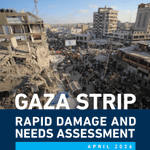
Rapid Damage and Needs Assessment, Gaza Strip (20 Apr 2026)
The joint World Bank/EU/UN assessment quantifies Gaza’s destruction and recovery needs after 24 months of war. It estimates $71.4 billion in reconstruction needs over a decade (with $26.3 billion in the first 18 months). Physical damage is enormous: roughly $35.2 billion in direct infrastructure losses and $22.7 billion in lost economic/social output. The hardest-hit sectors are housing, health, education, commerce and agriculture. The report finds 371,888 housing units destroyed or damaged (well over half of Gaza’s housing stock); more than 50% of hospitals are non-functional and almost all schools are “unsafe or gone”. Gaza’s economy has contracted by 84% and per capita human development has been set back 77 years. At least 1.9 million people were displaced (many repeatedly), with over 60% of the population losing their homes. Vulnerable groups – women, children, persons with disabilities – bear the greatest burden. The methodology combined satellite damage assessments and field surveys with sector analysis. The report notes that these findings draw on official data (e.g. Palestinian ministries) and sector experts. Limitations include difficulty accessing Gaza and rapidly evolving conflict. No legal analysis is attempted; it simply documents destruction and need.
“Domicide: Mass destruction of housing and civilian infrastructure…” (HRC, Feb 2026)
This Special Rapporteur’s report to the UN Human Rights Council documents Gaza’s “unprecedented” campaign of urban destruction. It finds that between October 2023 and October 2025 an estimated 92% of Gaza’s housing units were either fully destroyed or damaged. Over 90% of the population was internally displaced, and more than 86% of Gaza’s territory was placed under evacuation orders or declared militarized zones. In short, “the majority of Gaza’s population [was rendered] homeless” and Gaza was made almost uninhabitable. These acts include deliberate airstrikes, shelling and demolitions of homes, even in humanitarian zones. The report concludes these violations (attacks on homes, forced displacement, destruction of civilian infrastructure) “may amount to war crimes, crimes against humanity, and may be considered as part of the crime of genocide”. The Special Rapporteur emphasizes that such widespread, systematic destruction – which he terms domicide – violates the right to adequate housing. The report is based on UN sources (communications, UN agency reports, media) and the Rapporteur’s communications with Israel, but notes he was denied access to Gaza. It frames its findings in international law (IHL/IHRL) and urges states to hold perpetrators accountable. It does not purport to reach judicial conclusions, but calls for recognition of “domicide” as a distinct crime and for international action to prevent further destruction.
Health conditions in the occupied Palestinian territory, including East Jerusalem (WHO EB158/25, Jan 2026)
This WHO Director-General report (to the Executive Board) assesses Gaza’s health crisis and infrastructure destruction as of mid-2025. It documents mass casualties and collapsed health services. From 7 Oct 2023 to 31 Aug 2025, Palestinian authorities reported 63,557 total deaths and 160,660 injuries in Gaza, of which 18,004 deaths and 52,281 injuries occurred in Jan–Aug 2025 alone. The report highlights 335 separate attacks on health care facilities in Gaza during Jan–Aug 2025, causing 112 deaths (including health workers) and 329 injuries. It notes that the health infrastructure is virtually nonfunctional: of Gaza’s 36 hospitals, 34 (94%) were damaged by Aug 2025, and only 18 (50%) were partially functioning. Likewise, roughly 95% of hospitals and 91% of primary care clinics were hit by the conflict, resulting in an estimated $6.3 billion in lost health sector capacity (including $1.3 billion in damaged facilities and equipment). The report also underscores ancillary health impacts: famine was officially declared in Gaza, with forecasted acute malnutrition for tens of thousands of children (42,000 severely malnourished by mid-2026). Water and sanitation have collapsed: WHO notes that 69% of Gaza’s water and hygiene facilities are in militarized zones or under siege, leaving almost no safe water access. Limited disease surveillance, destroyed labs and lack of supplies mean outbreaks go unchecked (e.g. postponed polio campaign). Thus the report concludes Gaza’s population faces catastrophic health and humanitarian conditions. It uses official health ministry data, WHO monitoring and crisis surveys. Its legal framing observes that the targeting of medical facilities contravenes IHL.
UNICEF Education Situation Update (30 April 2026)
UNICEF’s Gaza education sector update (May 2026) paints a picture of near-total devastation of schooling. It reports that nearly 98% of Gaza’s school buildings are damaged by conflict and 93% need major rehabilitation or complete reconstruction. More than four out of five schools were directly hit. As a result, about 700,000 children (all school-aged 4–17) have missed formal schooling for almost three academic years. Roughly 420,000 children – some 60% of Gaza’s student population – now have no face-to-face learning at all. UNICEF notes that remaining “temporary” learning spaces serve only a fraction of students. Massive rubble (some 60 million tons blocking roads) and unexploded ordnance make any return to school buildings dangerous. Supplies and teachers are also lacking. The report cites these figures and conditions to stress a “generation out of school.” It draws on UNICEF and education cluster assessments and field surveys. There is no legal analysis (e.g. on the right to education), but the findings implicitly underline violations of children’s rights.
Environmental Impact of the conflict, Gaza Strip (UNEP, Sep 2025)
UNEP’s second damage assessment (23 Sep 2025) surveys Gaza’s ecological collapse. It finds widespread contamination and ecosystem loss. By May 2025, remote-sensing data indicate that 97.1% of Gaza’s tree crops were lost, 82.4% of annual crops, 95.1% of shrubland, and 89% of grassland. Soils are heavily polluted by bomb fragments, artillery metal, fuel and chemical residues. Loss of vegetation and massive earth compaction (from tanks and shell craters) have impaired soil structure, reducing water infiltration and risking long-term erosion. Coastal and marine environments are likewise devastated: untreated sewage now flows freely into the Mediterranean (since all Gaza wastewater treatment plants are non-operational by April 2025), and fishing livelihoods have all but vanished. Water resources are dire: UNEP reports an 84% drop in storage and pumping capacity (only 9 of 54 water pumps still active), leaving desalination plants running at only ~30% capacity (energy permitting). Heavy rains increasingly wash debris and contaminants into aquifers. Air quality is degraded by fires and dust, further spreading toxins (asbestos, heavy metals from rubble) even far from battle zones. The report stresses urgent needs: environmental risk assessments, hazardous waste management, and remediation planning. It provides detailed technical analysis (water testing, soil surveys, satellite imagery) and policy recommendations, but makes no legal determinations. The key conclusion is that Gaza’s natural environment – soil, water, flora, fauna – has been turned into a “toxic wasteland” by conflict, with contamination “threatening human health and ecosystems for decades” (as summarized by Oxfam citing UNEP).
Sources: Official documents and assessments from
@UN,
@OHCHR,
@WHO,
@UNICEF,
@UNEP,
@UNDP /World Bank/EU, etc., as cited below (all linked in text). Where terms like domicide or culturicide appear, we attribute them to the source (e.g. OHCHR or authors); they are not independent legal conclusions. These summaries reflect each report’s scope, data and findings faithfully, citing paragraphs/sections from the full texts.
Inventory of relevant reports
Several substantive reports by UN bodies and affiliated agencies document Gaza’s environmental and infrastructure devastation. Below are key documents (with title, authoring entity, date, UN symbol if any, link and scope):
Rapid Damage and Needs Assessment, Gaza Strip (April 2026) – Joint report by World Bank, European Union and UN (“Final Gaza Rapid Damage and Needs Assessment”, 20 April 2026). No UN document symbol; full PDF published by the partners. Scope: comprehensive sectoral damage analysis after 24 months of conflict, including housing, health, education, commerce and agriculture. Link:
palestine.un.org/en/314090-f… |
palestine.un.org/sites/defau…
“Domicide: Mass destruction of housing and civilian infrastructure in Gaza…” (A/HRC/61/43/Add.3, Feb 2026) – Report by the UN Human Rights Council’s Special Rapporteur on Adequate Housing (Balakrishnan Rajagopal), issued 26 Feb 2026. Symbol A/HRC/61/43/Add.3. Scope: documents the “unprecedented” systematic destruction of homes and civilian infrastructure in Gaza (and other conflicts), with extensive displacement; it analyzes violations of the right to housing under IHL and IHRL. Link:
ecoi.net/en/file/local/21420…
“Health conditions in the occupied Palestinian territory, including East Jerusalem” (EB158/25, Jan 2026) – Report by the WHO Director-General to the Executive Board (158th session, 20 Jan 2026). Symbol EB158/25. Scope: public-health impact of Gaza war as of mid‑2025, including casualties, attacks on health infrastructure, disease and malnutrition trends, and environmental health risks. Link:
apps.who.int/gb/ebwha/pdf_fi…
UNICEF Humanitarian Situation Update – Education (30 April 2026) – UNICEF State of Palestine report, published May 2026 (pdf). Scope: status of Gaza’s education system after conflict; includes data on school destruction, student access and learning conditions. Link:
unicef.org/media/180596/file…
“Environmental Impact of the Escalation of Conflict in the Gaza Strip” (Sep 2025) – UNEP, 23 Sep 2025 (Second Environmental Damage Assessment). Scope: analysis (at the request of the Palestinian authorities) of war-related pollution and ecological damage in Gaza (water, soil, air, waste) with recommendations. Link:
doi.org/10.59117/20.500.1182…Israel has committed war crimes and crimes against humanity in the Occupied Palestinian Territory amid continuing genocide in Gaza, UN Commission of Inquiry finds
The Independent International Commission of Inquiry (COI) presented its report to the
@UN General Assembly on 26 October 2026 (A/81/430), examining state violence in the Occupied Palestinian Territory since 7 October 2023. The Commission found that despite a ceasefire in October 2025, Israeli forces “continued to commit war crimes, crimes against humanity, and the crime of genocide” in Gaza. It noted over 75,000 Palestinian deaths (including 21,500 children) since October 2023, and documented new killings and harm to civilians after the ceasefire. In Gaza, Israel had “continued to expand its territorial control”, killing and injuring Palestinians (including children) who approached the demarcated lines. By contrast to UN assurances that the truce was holding, the Commission found “continuous harm to civilians” post-ceasefire. In short, the report reconfirms that Israel’s campaign in Gaza remains genocidal in character even after October 2025.
In the West Bank, the Commission documented a severe deterioration. Since October 2023, coordinated Israeli military operations and settler violence formed “a coordinated attack against Palestinians,” with objectives of expanding settlements, annexing more territory, and forcibly displacing Palestinians. It concluded that Israel committed multiple crimes against humanity in the West Bank: extermination, torture, rape and other sexual violence, and persecution. Israeli forces’ permissive rules of engagement were applied in a “discriminatory manner” exclusively to Palestinians. Overall, the Commission characterized these actions as part of “a broader strategy to exterminate and displace Palestinians and impose conditions of life that are unlivable”. In effect, the report finds that large-scale, state-sponsored violence in the West Bank is an extension of the same policy of Jewish settlement expansion that drives the Gaza campaign.
The report further details targeting of civilians and gendered violence. It notes age-based persecution of Palestinian children beyond Gaza: deliberate attacks on children also occurred in the West Bank. Sexual and gender-based violence by Israeli forces is extensively documented. The Commission cites acts such as rape, gang rape, forced nudity, cavity searches and genital violence against Palestinian women and girls, finding these amount to torture used to displace and subjugate the population. In Gaza, such sexual violence is portrayed as part of a genocidal campaign to destroy the Palestinian group; in the West Bank it is depicted as collective punishment in a systematic attack on civilians. Victims were targeted because they were Palestinian, often also on grounds of political association, gender or sexual orientation.
Importantly, the report situates these findings in a historical and structural context. It concludes that Israel’s violence is rooted in long-standing policies dating to the 1947–48 war. Israel “has striven to expand territorially and displace Palestinians” since then. Its stated policy of seizing maximum land while minimizing Palestinian presence has persisted for decades, leading to “excessive and discriminatory” lethal force, repeated displacement, and chronic insecurity for Palestinians. In other words, the current atrocities are seen as a continuation of a decades-old occupation strategy rather than isolated incidents.
The report also reviews abuses by Palestinian authorities. It found that since October 2023, Palestinian security forces in the West Bank increasingly used “unnecessary or disproportionate force” against Palestinians. The Palestinian Authority (PA) has largely failed to investigate or remedy killings by its forces, and has even targeted activists and human rights defenders. The Commission urged the PA to cease repression of dissent, to conduct independent investigations into abuse, and to provide remedies to victims.
Finally, the COI made robust legal recommendations. It calls on Israel to comply with international law and the July 2024 advisory opinion of the
@CIJ_ICJ International Court of Justice (ICJ): end the occupation of Palestinian territory, evacuate all settlements, and lift obstacles to Palestinian self-determination. Most urgently, Israel must “end the commission of international crimes” including the ongoing genocide in Gaza. Third states have corresponding obligations: they must not aid or abet Israel’s occupation. The report insists States must refrain from providing military, economic or diplomatic support that sustains illegal settlements and must use “all means” to prevent and punish genocide. It specifically urges governments to cooperate with and support the
@IntlCrimCourt International Criminal Court (ICC), especially in light of recent U.S. sanctions against the Court.
In sum, the COI’s advance report (A/81/430) concludes that Israeli leaders have perpetrated grave international crimes across the OPT since October 2023, in Gaza and the West Bank, under policies of occupation and settlement expansion. These findings are formal determinations by a UN inquiry, pending any judicial process. They underscore the Commission’s view that accountability is required – including criminal investigations and cooperation with the ICC – even as ceasefire arrangements and diplomatic initiatives are pursued.
ohchr.org/en/press-releases/… |
ohchr.org/sites/default/file…