

Economist & engineer; Asst Dir & Policy Fellow, State & Local Gov Init @HooverInst; Prev: JEC, Mercatus, OSU; Views expressed are mine & you can't have them.
Stanford University
Joined May 2012
- Tweets10K
- Following591
- Followers1.2K
- Likes20K




Pinned Tweet
File this under "Yet more evidence that firm location decisions are based on region-specific advantages, not economic development subsidies"
wral.com/why-geography-doome…

Michael D. Farren retweeted

As Joel Mokyr once said: "The responsibility of economic historians is to remind the world what things were like before 1800."
Read this review to see how bad it was . . .
Spoiler: really bad!
Plague, gruel and bad teeth: why do people idealise the olden days? economist.com/culture/2026/1…

Michael D. Farren retweeted

UC Berkeley imported French inequity economists who nearly tanked California's venture capital economy, and Robert Reich was there to help.
nationalreview.com/article/a…


Michael D. Farren retweeted

The monopsony argument is the biggest motte and bailey in the minimum wage debate.
"Maybe firms are slightly monopsonistic in general"
"This can be solved by a blanket $25 minimum wage in every industry and locale across the country with no disemployment effects"
Michael D. Farren retweeted
The large decline in NVIDIA's stock price suggests that the marginal product of at least some CEOs is extremely high--often well above their compensation which can be restrained by norms.
Michael D. Farren retweeted

Very glad to see the NYT editorial board endorse BAAJA, the bipartisan permitting reform bill.
Key points from the article:
1. "Democrats who call climate change an emergency should not defend a permitting system too slow to build the clean energy that would address it."
2. "[BAAJA] would make it easier to build solar energy farms, battery storage, power lines and more. As a result, it would reduce energy prices. The status quo is expensive, dirty and unstable. The country needs to build a lot of big, new things to make its future cheaper and cleaner."
3. "The bill’s Democratic skeptics are making a mistake. President Trump would almost certainly veto a follow-up bill next year. And time matters, especially for the climate. Congress should pass this bill now. It can then return next year and pass other bills that would do even more good."
4. "Today, it typically takes between 5 and 13 years to build a long-distance power line, like the one that transports clean hydropower from Quebec to New England. That line took about a decade to finish, and opened in January. It has enough capacity to meet about one-fifth of Massachusetts’s electricity demand, and it’s projected to save consumers $50 million a year."
5. "A more robust, cleaner grid would make American energy more reliable and less dependent on hostile foreign nations. No country can embargo the wind."
6. "[BAAJA] would force data center operators to pay the full costs of the electricity they use, protecting the average electricity consumer."
7. "On net, the bill would cut greenhouse gas emissions from power plants by as much as 18 percent by 2040. It would do so in part by nearly tripling the construction of high-voltage transmission lines."
8. "Anyone who cares about climate change should cheer this bill. And a party that just won an election on affordability should not pass up a chance to start delivering immediately."

Michael D. Farren retweeted

In an imagined letter penned by Hoover Senior Fellow Ross Levine, Adam Smith recalls his treasured intellectual friendship with David Hume, and what it taught him about cherishing our worthy opponents.
Read the full piece in Freedom Frequency: thefreedomfrequency.org/p/le…

Michael D. Farren retweeted

So much disaffection that leads to economic populism would go away if people understood this simple fact. Housing costs are high when the government doesn’t give enough permits or allow building. Emphasizing any other explanation is scapegoating and a political diversion tactic.

A 🧵 on housing construction and rent data. Across the 100 largest U.S. metro areas, the 25 metros that permitted the most new homes from Jan 2024 through Sept 2026 saw rents rise a median 3.2%, while those that permitted the fewest saw rests rise 13.1%! Austin, with the sixth-most permits per resident, saw rents fall 6.6%. San Francisco, among the lowest permitters, had the biggest increase in rents at 19.7%. 1/3 @ReasonFdn

Michael D. Farren retweeted
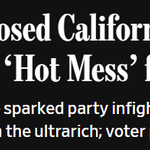
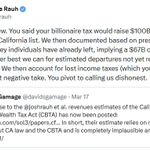
California voters have rejected the Billionaire Tax Act, which would have imposed a one-time 5 percent tax on residents holding more than $1 billion in assets.
A team of Hoover Institution scholars who studied the measure's flaws, including Senior Fellow @JoshRauh and Research Fellow Benjamin Jaros, welcomed the decision.
They found that the proposal had already pushed several billionaires out of California and that the tax would have raised far less than its proponents claimed.
Read more here: hoover.org/news/hoover-schol…


Michael D. Farren retweeted

One alarming dynamic in U.S./China relationship is the absence of moderating voices on the Chinese side. There are only “America hawks” in the Chinese system, Matt Turpin of @HooverInst told me—“no ‘America doves.’” That’s even more pronounced under Xi’s consolidation of power, where the internal incentive is always to be tougher on the U.S., never softer. Read more in today’s WSJ China newsletter
wsj.com/world/china/beijing-…

Michael D. Farren retweeted
Thirty-nine years after Ronald Reagan challenged Mikhail Gorbachev to tear down the Berlin Wall, Hoover Distinguished Policy Fellow @P_M_Robinson reflects on the address he wrote as a White House speechwriter and sets out to trace its influence on the democratic movements that outlasted the Cold War.
Read more in Freedom Frequency: thefreedomfrequency.org/p/th…

Michael D. Farren retweeted
With government spending reaching 57% of GDP in France and approximately 45% in the US, Hoover economist @JohnHCochrane argues that high taxes, extensive regulation, and social benefits that discourage work contribute to economic stagnation.
Watch more: thefreedomfrequency.org/p/ca…

Michael D. Farren retweeted

This textbook has the correct take on price gouging and responding with moral outrage isn’t a counterargument.


Michael D. Farren retweeted
You can debate the magnitude of people who move for tax reasons. But if you debate the existence you lose all credibility with me. I could easily name more than a dozen people I know who have moved from high-tax jurisdictions to low-tax jurisdictions to reduce their taxes.
Michael D. Farren retweeted

Big congratulations to @joshrauh who showed you can communicate trade offs and arcane tax policy in a way that resonates with voters. A little hope economic populism isn't our future.
teapawt.org/gabriel_zucman/status/…

After spending $400 million to defeat the California billionaire tax—the largest sum ever spent by one side in a ballot initiative or midterm election—Silicon Valley billionaires have won this battle.
But they will lose this war.
It’s only a matter of time, and the Democratic wave may well accelerate this shift. 🧵

Michael D. Farren retweeted

In 1910, the infant mortality rate was 10% and life expectancy was in the 50s.
I'm so sick of this braindead nonsense.
This quoted post is unavailable.
