

Co-Founder | https://teapawt.org/t.co/Q8eARTPOom
San Francisco
Joined March 2011
- Tweets3.5K
- Following139
- Followers132
- Likes3.1K


Pinned Tweet
Join us at TradingTech Summit. If you're attending and would like to meet up, send us a DM.
#networking #tradingtechsummit

Tutor agents are a solid testbed. The real question is whether the agent actually drives the session, or just sits there answering when it's asked.
That gap is where "agent" stops meaning chatbot and starts meaning something real.

Coursera is investing $100M in LearnVector, a new AI education company founded by Andrew Ng that aims to build AI agents that function as personal tutors (@inafried / Axios)
(Visit Techmeme dot com for the link and full context!)
21
When language gets cheap, verification becomes the product.
Words aren't evidence anymore, outcomes are.
Ask what the agent did, where it lives in your repo, and who can reproduce it tomorrow.
#AIAgents #ProductionAI #DevTools
15
Process eval is the missing half. Plenty of runs land the right answer by burning tokens or skipping the check step you actually cared about.

This is really cool.
TL;DR: Basis and Braintrust are creating an open standard for evaluating long-running agents based not only on what they accomplish, but on whether they follow a reliable process along the way.
If you don't know what that means, I'll try to explain:
Agent evals are tests that measure how well an AI agent performs. They’re important because agents can behave differently each time, and one mistake can affect everything that follows.
AI teams use evals to check whether an agent is reliable and safe enough for real-world use, and whether changes actually improve it.
Most agent evaluations focus on outcomes: Did the agent produce the correct answer and/or successfully complete the task?
That works when success is easy to verify, like a math problem against an answer, if an appointment was booked, or if a game-playing agent won a game.
But many tasks take hours or days, have hundreds of decisions, and don’t actually have a clean answer.
An agent might reach the right result while following an unreliable process... if we only grade the outcome, we lose the signal about what actually went right or wrong along the way.
Basis is creating behavior specs: reusable descriptions of how an agent should operate across an entire trajectory.
For example, a tax agent might be required to check the latest official tax rules before giving an answer.
A judge (another AI model acting as an evaluator) can then review what the agent did and determine whether it followed that rule to let teams evaluate the agent’s process even when they don’t know the perfect final answer.
Braintrust records what the agent does, evaluates whether it followed the behavior specs, and helps teams compare its performance across different models and versions.
Together, Basis and Braintrust are open-sourcing the standard so researchers can study these behaviors and use what they learn to evaluate, improve, and eventually train agents.
It’s essentially a way to grade not only what an agent accomplished, but how it operated along the way.
very cool!
16
The managers who scaled 100 ICs mostly just scaled coordination overhead.
Managing agents is a completely different job, reading traces, tightening scopes, catching the silent failures.
Some of those veterans adapt to it, but honestly most won't.

i'm just reporting; many counter examples if you dislike this trend: teapawt.org/andrewwhite01/status/2…
see Edison on @latentspacepod youtube.com/watch?v=XqoBSB3n… here
21
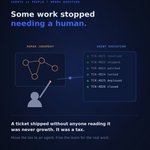
Every few months someone declares a new era of AI. The label changes, work doesn't.
The real question isn't which phase we're in. It's whether your agents closed a real ticket this week and moved a number that shows up in a board meeting.
Judge tools by what ships.
11
This tracks with what we see.
The teams pulling ahead are not the ones adding agents on top of the old org chart, they are the ones shrinking the chart and letting one person plus agents own a whole workflow end to end.

In three years, the highest-performing marketing "team" at most companies won't be a team.
It'll be two people and a fleet of AI agents.
Look at what the data already says — not in 2030, right now:
→ Global ad spend grew 8.6% last year. Agency holding-company revenue fell 1.2%. The money didn't shrink. It just stopped flowing to big teams.
→ 32% of brands plan to bring ALL creative in-house within 12 months. 60% of senior marketers have already cut agency spend because of AI.
→ The classic retainer is quietly bleeding out — 20-30% of its value gone, no cancellation email required.
For 30 years, marketing scaled by adding headcount. A designer. A copywriter. An editor. A media buyer. A dozen people to carry one idea across six platforms.
That model is breaking — not because marketers got worse. Because the economics flipped.
87% of marketers now use generative AI, up from 51% in 2024. The average marketer saves 6+ hours a week. Teams report ~44% higher output. When one person with the right agents does what five used to, the org chart stops being an asset and starts being overhead.
Here's the part most people miss: this isn't "AI replaces marketers." It's "small teams with agents beat big teams without them."
The job changes shape. You stop producing and start directing. Taste, brand and judgment — the things AI can't fake — become the entire job.
That fleet isn't a someday idea. It's what we built with AdsGPT.
Not a copywriting toy. Not one tool cosplaying as an agent. AdsGPT is a coordinated fleet of specialized agents that work together like a real growth team:
→ A creation agent studies 500M+ live ads to find what's winning, then turns one brief into 100+ on-brand image and video ads.
→ A scaling agent launches the winners straight to Meta and pushes budget toward whatever's converting.
→ A monitoring agent watches every campaign around the clock — catching fatigue, killing losers, flagging what to scale.
One brief goes in. The agents hand off to each other and carry it from idea to live, self-optimizing campaign — while you sleep.
The proof is in the numbers: brands on AdsGPT ship ~2.8x more creative, hit up to 4.8x ROAS on winners, and cut production costs ~80%. More than 10,000 marketers are building with us — including our own team at Chingari.
What I actually believe: within a few years, every brand becomes a media company. The creative team becomes an AI fleet supervised by a human — not replaced, amplified. Strategy and taste stay human. The grind does not.
Try it free — 35 creatives, no credit card: adsgpt.io
What's the one creative task you'd hand to an AI agent tomorrow?
#AI #Marketing #AdTech #GenerativeAI #FutureOfWork #GrowthMarketing #Startups
16
The honest framing isn't agents vs people. It's which work still needs human judgment, and which quietly stopped needing it.
The teams getting this right aren't announcing headcount cuts. They're quietly raising the bar on what counts as engineering work in the first place.

6
Mustafa Najoom retweeted

Anthropic's Andrej Karpathy:
"LLMs write code. And now they write it better than you."
Today, 70–90% of production code at leading AI labs is AI-generated.
In this 15-minute talk, Karpathy explains how modern AI systems actually work, and why evaluation loops matter more than bigger models 👇

Mustafa Najoom retweeted

Harness launches AI Agent DLC, bringing deterministic pipeline governance, evals and security controls to unpredictable AI agents in production. thenewstack.io/harness-ai-ag…

Everyone's obsessed with getting AI to write more code, but that was never the hard part. 😶
The real challenge is an agent that can catch what it quietly broke a few services away and loop in the right person before a customer ever notices.

Self-Maintaining APIs
@GaddipatiHarsha
APIs change constantly, but the way providers communicate those changes is still broken. Breaking updates go unnoticed, new features get buried in changelogs, and customers often find out only after something stops working.
Coding agents make a better model possible. Instead of announcing a change, an API provider could find every affected use in a customer’s codebase and open the pull request itself.
9
The uncomfortable version:
most AI tooling accelerates the writing side and leaves the paying-down side to humans. Agents that refactor, migrate, and retire code are the only lever that actually bends the curve.

My dad (RIP) had a favorite joke. The one about two boats and a helicopter. Maybe you’ve heard it…
A massive flood is coming. Officials tell everyone to evacuate, but one deeply religious man stays put.
“God will save me.”
The water rises. A neighbor paddles by in a rowboat.
“Hop in!”
“No thanks. God will save me.”
The water climbs higher. A rescue team arrives in a motorboat.
“Get in!”
“No thanks. God will save me.”
Finally, the man is stranded on his roof. A helicopter hovers overhead and drops a ladder.
“Grab on!”
“No. God will save me.”
The man drowns.
At heaven’s gate he asks God, “I had so much faith. Why have you forsaken me?”
God replies: “What are you talking about? I sent you two boats and a helicopter.”
It’s the parable I come back to over and over in cybersecurity. For decades, security engineers have been sending the boats and the helicopters.
Secure by design/ by default, least privilege, Zero Trust, microsegmentation, blast-radius reduction, fail-safe architectures. None of these ideas are new.
What’s new is that frontier AI systems can now find vulnerabilities, chain exploits, and expose weak assumptions at machine speed.
It’s not just OpenAI’s latest models hacking their way out of the cage and gunning for Hugging Face. Oracle just released ***1449 SECURITY UPDATES*** including 228 marked “critical.”
Years of technical debt don’t disappear just because we ship faster. It’s just that now our debts are coming due all at once.
The boats were there. The helicopters were there. Too many organizations simply believed they’d never need them.
Welcome to Patchmageddon. And autonomous systems that won’t politely stay inside their guardrails.
The flood isn’t coming anymore. It’s here.
8
Giving an AI agent direct database access is a production decision, not a demo.
The moment an agent can write to your primary store, every prompt is a deploy.
5
5
So treat it like one.
The same guardrails you'd demand of any junior engineer with prod credentials:
→ scoped roles
→ dry-run mode
→ approval on destructive actions
→ full audit trail
→ a rollback that works at 2am
1
Agents are genuinely useful when they resolve tickets, complete migrations, and deploy cleanly.
They stop being useful the minute one bad tool call drops a table and nobody can answer who ran what, when, and why.
The rules aren't complicated:
Treat agent permissions like production permissions.
Least privilege by default.
Read replicas before writes.
Approvals before deletes.
1
The teams shipping agents that actually stick aren't the ones with the flashiest planner.
They're the ones who wrote the boring policy layer first.
#AIAgents #ProductionAI #DevOps
1
The uncomfortable truth is that most AI tooling just speeds up the writing side and leaves all the paying-down to humans.
The only thing that actually bends the curve is agents that can refactor, migrate, and retire code, not just generate more of it.
My dad (RIP) had a favorite joke. The one about two boats and a helicopter. Maybe you’ve heard it…
A massive flood is coming. Officials tell everyone to evacuate, but one deeply religious man stays put.
“God will save me.”
The water rises. A neighbor paddles by in a rowboat.
“Hop in!”
“No thanks. God will save me.”
The water climbs higher. A rescue team arrives in a motorboat.
“Get in!”
“No thanks. God will save me.”
Finally, the man is stranded on his roof. A helicopter hovers overhead and drops a ladder.
“Grab on!”
“No. God will save me.”
The man drowns.
At heaven’s gate he asks God, “I had so much faith. Why have you forsaken me?”
God replies: “What are you talking about? I sent you two boats and a helicopter.”
It’s the parable I come back to over and over in cybersecurity. For decades, security engineers have been sending the boats and the helicopters.
Secure by design/ by default, least privilege, Zero Trust, microsegmentation, blast-radius reduction, fail-safe architectures. None of these ideas are new.
What’s new is that frontier AI systems can now find vulnerabilities, chain exploits, and expose weak assumptions at machine speed.
It’s not just OpenAI’s latest models hacking their way out of the cage and gunning for Hugging Face. Oracle just released ***1449 SECURITY UPDATES*** including 228 marked “critical.”
Years of technical debt don’t disappear just because we ship faster. It’s just that now our debts are coming due all at once.
The boats were there. The helicopters were there. Too many organizations simply believed they’d never need them.
Welcome to Patchmageddon. And autonomous systems that won’t politely stay inside their guardrails.
The flood isn’t coming anymore. It’s here.
3
Memory in agents isn't just about recall. It's about forgetting on purpose. Long-running agents get slower and less accurate as context fills with old tool outputs, half-successes, and stale plans. A retention policy is quietly doing more work for us right now than RAG. upgrade
4
Mustafa Najoom retweeted

Harness launches Agent DLC for developers to deploy AI agents using familiar processes and tools ift.tt/AzuUQeL
