

The official Twitter account of the Nigeria Centre for Disease Control and Prevention (NCDC) || Social Media Policy: https://xitter.cf/t.co/atAH0s6OEF || Toll-free: 6232
Abuja, Nigeria
Joined March 2016
- Tweets18.2K
- Following403
- Followers1.2M
- Likes5K


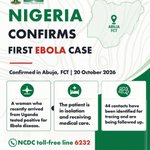


Pinned Tweet
EBOLA: STAY INFORMED. STAY SAFE.
Following the confirmation of an Ebola disease case in the FCT, the Federal Government, through the NCDC and relevant health authorities, is strengthening surveillance and response efforts.
Ebola spreads through direct contact with the blood or body fluids of an infected person who is sick or has died, or through contaminated materials.
Please remain calm and rely on verified information.
Early reporting saves lives!
📞 To report a suspected case, call the NCDC 24/7 toll-free line: 6232
#Ebola #publichealth #NigeriaCDC

#TodayInNCDC The first Incident Management Meeting was convened on October 21, 2026, after the Honorable Minister's official outbreak declaration of Ebola in Nigeria, bringing together leadership and key partners to align on response efforts. The Incident Action Plan is being finalized today.
NCDC teams are on ground conducting case management and response activities, prioritising enhanced surveillance, contact tracing, infection prevention and control, and coordinated risk communication. We remain committed to a timely, coordinated, and evidence-based response to safeguard the health of Nigerians.
#NCDC #PublicHealth #EbolaPreparedness #HealthSecurity


Know the symptoms of Ebola disease:
- Fever
- Severe weakness
- Headache
- Vomiting
- Diarrhoea
What you should do:
- Practise regular hand hygiene.
- Avoid contact with the body fluids of anyone suspected to have Ebola.
- Be especially alert following possible exposure.
#StaySafe
#PublicHealth
#Ebola

NCDC retweeted

PRESS STATEMENT
STAY INFORMED. STAY SAFE.
Public health is a shared responsibility, and the right information helps us all stay safe.
The Federal Government, working with the NCDC and relevant health authorities, is taking the necessary steps to protect public health and strengthen surveillance following the confirmation of an Ebola disease case in the FCT.
There is no need for panic. What matters is staying informed, practising good hand hygiene, knowing the symptoms and seeking guidance from public health authorities if you suspect exposure.
📌 Remember: Ebola spreads through direct contact with the blood or body fluids of an infected person who is sick or has died, or contaminated materials. It does not spread before symptoms begin.
For reliable information or to report a suspected case, call the NCDC toll-free line 6232, available 24 hours a day, seven days a week.
Let’s stay calm, rely on verified information and do our part to keep our communities safe.
#MinistryOfHealthNG


Wondering where to get immunised against Diphtheria? 🤔
The answer is simple: FREE vaccines are available at government health facilities nationwide. 🇳🇬💉
Visit a health centre near you to get protected. Don't delay! 🏥
#Diphtheria #VaccinesWork #NigeriaCDC

Your journey doesn’t end on arrival at your destination.
Travellers are advised to remain vigilant and be aware of the signs and symptoms of Ebola.
Planning a trip? Check official health advisories before you travel, and share only verified information to help keep others safe.
We all have a part to play in protecting our families and communities.
#Ebola #HealthSecurity #NigeriaCDC

Cholera and other food & water-bourne diseases can be prevented by observing hygienic food practices:
🧴Wash your hands before preparing meals, eating or feeding a child
🥭Wash fresh fruits and vegetables throughly before eating
🍳Ensure food is well-cooked before eating, especially meat and eggs
Proper nourishment begins with safe food practices and innovative solutions that improve food safety, reduce foodborne diseases and protect public health.
#WorldFoodDay2026

Lassa fever is preventable. Avoid contact with rodents, store food properly and maintain good hygiene.
If you feel unwell, avoid self-medication and seek care promptly at a health facility. Early detection saves lives.
Stay informed. Stay safe.
#LassaFever #PublicHealth #NigeriaCDC

Clean Hands Save Lives!
This Global Handwashing Day, let’s make proper hand hygiene a regular habit.
✅ Wash your hands with soap under clean, running water.
✅ Scrub your hands for at least 20 seconds.
✅ Use hand sanitiser when water is not available.
Protect yourself, your family, and your community by helping prevent the spread of disease-causing germs.
Be a handwashing hero!
#GlobalHandwashingDay2026 #BeAHandwashingHero #NigeriaCDC

NCDC retweeted

8 weeks to go.
As we get closer to this landmark gathering, leaders across human health, animal health, agriculture, and the environment are gearing up to strengthen commitments, unite efforts, and accelerate action against antimicrobial resistance (AMR).
Visit:
5thghlamr.health.gov.ng/
for more updates on the 5th Global High-Level Ministerial Conference on Antimicrobial Resistance

Preparedness starts with awareness.
Protecting our communities begins with staying informed and making safe choices.
Ebola prevention is a shared responsibility. Kindly adhere to guidelines issued by local and international authorities.
Every informed decision contributes to stronger public health preparedness.
#Ebola #HealthSecurity #NigeriaCDC

In Week 39 and 40 of 2026, Nigeria recorded decreased Lassa fever activity.
In Week 39, a total of 106 new suspected cases were reported, along with 13 new confirmed cases and 4 new confirmed deaths, all from Ondo State.
In Week 40, 28 new suspected cases, 3 confirmed cases and 1 confirmed death were recorded from Bauchi and Benue States.
Cumulatively in 2026, 1,138 confirmed cases and 268 deaths (CFR 23.6%) have been reported across 24 states and 119 Local Government Areas (LGAs).
While the number of confirmed cases seems to fluctuate, the continued detection of cases and deaths reinforces the need for constant vigilance, early detection and prompt response.
Everyone has a role to play in preventing Lassa fever.
Protect yourself and prevent Lassa fever by:
✅ Keeping your environment clean and free of rodents
✅ Storing food in tightly covered containers
✅ Disposing of waste properly and keeping homes clutter-free
✅ Seeking medical care early when you notice symptoms such as fever, weakness, headache, or bleeding.
🔗 Read the attached Situation Reports for more details.
Week 39: ncdc.gov.ng/themes/common/fi…
Week 40: ncdc.gov.ng/themes/common/fi…
#LassaFever #StaySafe #NCDCNigeria


Last week, we concluded a workshop to scale up Community-Based Surveillance and Event-Based Surveillance in Kaduna, Katsina Yobe and Borno in partnership with Core Group Partners Program (CGPP).
The workshop focused on strengthening One Health collaboration and early detection, reporting and response to public health threats, in line with our National CBS Strategic Plan (2023–2027).
#OneHealth #DiseaseSurveillance #NigeriaCDC


NCDC retweeted

NEW LASSA FEVER EVIDENCE TO SHAPE VACCINE RESEARCH AND OUTBREAK PREPAREDNESS ACROSS WEST AFRICA
New evidence from a major Lassa fever research programme in West Africa is expected to inform the next phase of vaccine research, outbreak preparedness and community engagement in research across the region.
Initial findings from Enable, the largest-ever study of Lassa fever disease burden, were recently published in The Lancet Global Health. The programme is supported by the Coalition for Epidemic Preparedness Innovations (@CEPI) the world’s largest funder of Lassa fever research and partners across West Africa. CEPI is also advancing the development of Lassa fever vaccines.
These findings have deepened understanding of Lassa fever disease burden in the communities studied, while highlighting important gaps in existing evidence, including the burden among children, a population historically underrepresented in Lassa fever research and discourse.
To explore what these findings mean for the future of Lassa fever research and preparedness, the West African Health Organisation (WAHO) and its partners, including CEPI, will host a virtual webinar titled “Turning ENABLE Evidence into Stronger Lassa Vaccine Research and Outbreak Preparedness Across West Africa” on Tuesday, 13 October 2026, from 12:00 p.m. to 1:30 p.m. WAT.
Participants can register at bit.ly/LassaQ3W.
The webinar comes ahead of the Enable Lassa Programme Regional Dissemination and Engagement Summit in Nigeria later this month, where partners will discuss the research findings and how to translate evidence into action.
Lassa fever remains a persistent public health challenge across West Africa. According to Africa CDC, historical estimates suggest that approximately 100,000 to 300,000 Lassa virus infections and 5,000 associated deaths occur annually across the region, although the true burden remains uncertain. Enable was established to help investigate this burden. More than five decades after Lassa fever was first identified, there is still no licensed vaccine, while important evidence gaps continue to affect vaccine development and planning for equitable introduction.
The recently published findings from Enable provide important insights into disease burden in the Lassa fever hotspots studied and the populations most affected.
They also demonstrate the value of building stronger research and laboratory capacity in endemic countries. Through the programme, institutions and investigators across West Africa have strengthened their ability to conduct epidemiological and laboratory research and generate evidence that can support future Lassa fever research and wider regional epidemic preparedness.
“The findings from Enable are a critical contribution to our understanding of Lassa fever in West Africa. But evidence only becomes truly valuable when it informs action,” said Dr Gabrielle Breugelmans, Director of Epidemiology and Data Science at CEPI. “This webinar and our upcoming Summit provide an important opportunity to bring researchers, policymakers, communities, vaccine developers and other stakeholders together to consider what these findings mean for the research and preparedness decisions that come next.”
“For West Africa, the Enable findings reinforce the importance of strong regional leadership and collaboration in advancing Lassa fever research and preparedness,” said Prof. Palokinam T. Pitché, Director-General of WAHO. “WAHO remains committed to bringing countries and partners together to translate scientific evidence into coordinated action, strengthen regional health security and support preparedness for future Lassa fever vaccines.”
Alongside discussion of Enable’s findings, the webinar will connect the study data with ongoing efforts to understand future demand for a Lassa fever vaccine. WAHO and the International AIDS Vaccine Initiative (IAVI), working with regional research partners and with support from CEPI, have advanced a Lassa fever vaccine demand forecasting exercise, which was first presented at the 2nd ECOWAS Lassa Fever International Conference in Abidjan in September 2025.
The webinar will place the experiences of study participants and communities at the centre of the conversation. Their participation, trust and contribution have been fundamental to generating the evidence now informing the next phase of Lassa fever research.
Participants will hear directly from experts across the Lassa fever research and development ecosystem, as well as from people and communities who contributed to the Enable study. Discussions will explore how meaningful community partnership can build trust, support participation and guide future research and vaccine development as the region prepares for the potential future introduction of a Lassa fever vaccine.
Speakers include:
· Dr Gabrielle Breugelmans, Director of Epidemiology and Data Science at CEPI.
· Dr N’Faly Magassouba, Principal Investigator at Gamal Abdel Nasser University of Conakry, Guinea.
· Dr Onyinyechukwu Uzoamaka Oka, Community Engagement Lead for the Enable study at Alex Ekwueme Federal University Teaching Hospital, Abakaliki (AEFUTHA), Nigeria.
· Mrs Elsie Ilori, National Coordinator for the Enable Programme in Nigeria.
· The webinar will also feature Prof. Palokinam T. Pitche, Director General of WAHO, who assumed office on 1 September 2026, providing an opportunity to hear his perspective on regional priorities for Lassa fever preparedness and the role of evidence in strengthening health security across West Africa.
What the webinar will cover:
· Key findings on Lassa fever burden in the communities studied.
· Implications for Lassa fever vaccine research and development.
· The burden among children and other populations less visible in previous research.
· How Enable has strengthened epidemiological, laboratory and research capacity across West Africa.
· Community and participant perspectives on trust, participation and meaningful engagement in health research.
· How epidemiological evidence and vaccine demand forecasting can support vaccine preparedness and equitable access.
· Remaining evidence gaps and priorities for future Lassa fever research and preparedness.
Webinar details
Date: Tuesday, 13 October 2026
Time: 12:00 p.m.–1:30 p.m. WAT / 11:00 a.m.–12:30 p.m. UTC
Format: Virtual
Topic: Turning ENABLE Evidence into Stronger Lassa Vaccine Research and Outbreak Preparedness Across West Africa
Registration: bit.ly/LassaQ3W

Travelling to or returning from an area affected by Ebola?
Be aware of the signs and symptoms of Ebola and seek medical attention promptly if you become unwell.
Early detection saves lives. Your quick action can help protect you and others.
Stay informed. Stay safe.
#Ebola #HealthSecurity #NCDC

As we work to protect the health of Nigerians, we recognise the importance promoting compassionate, inclusive and responsive approaches to mental well-being.
Protecting health means caring for both the mind and body.
Listen. Support. Seek care.
#WorldMentalHealthDay #MentalHealthMatters #PublicHealth #NigeriaCDC

NCDC retweeted
Nigeria's Ministers of State for Agriculture and Food Security, Health & Social Welfare, Livestock & Environment invite journalists, newsrooms and interested persons to the Global Press Briefing on #AMR ahead of the Global High-Level Ministerial Conference on AMR scheduled for December.
Press Briefing Details:
🗓 Mon 12 Oct | 3PM WAT (14:00 GMT)
💻 Live on Zoom (Register Ahead) us06web.zoom.us/meeting/regi…
#PreventAMR #OneHealth
