





Dave O'Callaghan retweeted

A model tells you what’s possible.
The product around it decides how much of that possibility you actually get.
Use the same model across a few AI tools and the difference becomes hard to miss. In one place, the work just clicks. Somewhere else, you spend half your time getting the model back on track.
That difference is becoming one of the most interesting parts of AI product design for me.
This is what happens when you focus on output without quality input

Dave O'Callaghan retweeted

We keep hearing about 10x or 100x productivity gains in engineering and knowledge work.
But outside the model labs, I haven’t seen the corresponding 10-100x revenue growth across the market or increase in quality.
So where is the productivity going?

Dave O'Callaghan retweeted

The simplest mental model you can develop for AI:
AI is giving the fast movers the advantage.
If little companies move faster they can compete with big companies using AI.


Dave O'Callaghan retweeted

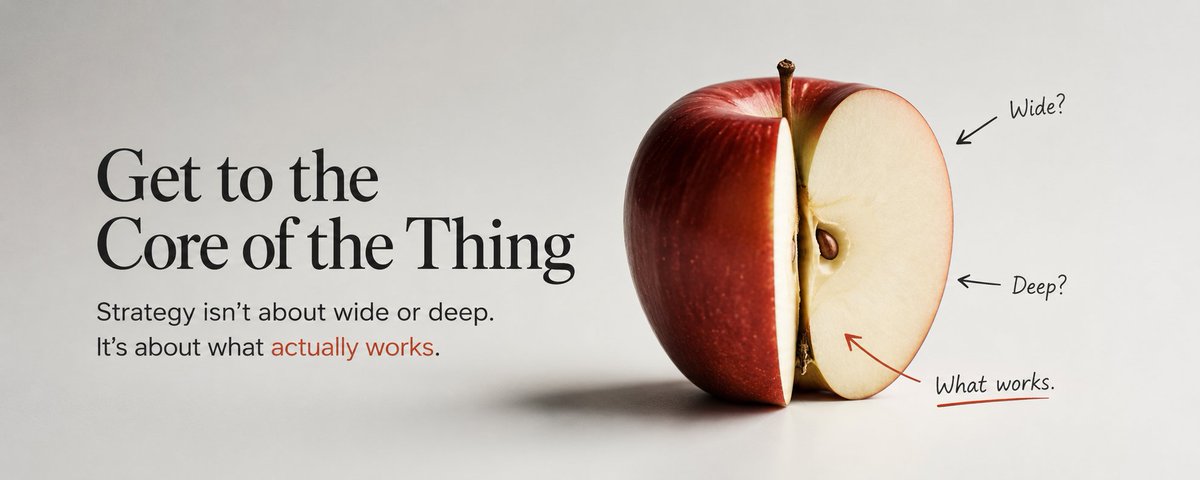
The most important jump in a design problem is getting from “problem” to “outcome.”
A problem alone doesn’t tell you when you’re done. An outcome alone doesn’t tell you where to start.
A good frame — problem to outcome — is a vector.
Dave O'Callaghan retweeted

Building a "sidecar mode" for Toss - if you already use Granola, Fathom, Otter, etc. for meeting notes, Toss can sit on top and handle the automation piece.
Keep your note-taker, let Toss do the follow-ups: create the tickets, send the Slack messages, update your CRM.
Would you use this?

Dave O'Callaghan retweeted

Many people like using the end of the year to reflect back on the past 12 months. For whatever reason that's always felt foreign to me. All that's done. The effort's behind. I put it all out there already and experienced it fully in the moment. No need to revisit, no replays necessary,
For me, the end of the year is all about the potential of the next one. Reflecting ahead, rather than behind, is what energizes me. 2026 is an open book, 2025 is closed.
Dave O'Callaghan retweeted
looking for 5 beta testers for Toss
it's a meeting tool that catches what you commit to on calls and turns them into one-click actions — Linear issues, Slack messages, calendar events, Cursor prompts
ideal if you:
- have 3+ meetings/week
- use Linear, Slack, or Cursor
- hate forgetting follow-ups
DM me or reply if interested
Been playing around with Toss for a little while and I honestly don't know what I'd do without it now. Would defo recommend having a play

Dave O'Callaghan retweeted

the old way of scaling teams is dead:
we used to hire specialists – designers, engineers, PMs – each in their lane, scaling by adding more people. but when Cursor can take you from idea to code in minutes, execution isn't the bottleneck anymore. taste and judgment are.
what matters now: people who can see the full stack, move between layers, but specialize deeply in something AI can't replicate yet. T-shaped but way wider – conversant across domains, expert in one thing.
AI doesn't just make you faster. it ties teams together differently. no more waterfall – designer codes the prototype, engineer extends it, both work in the same medium. the gap between disciplines disappears.
this raises individual ceilings. i'm a designer who built ryOS entirely in Cursor – couldn't have done that before. but i'm not replacing engineers, i'm just removing execution barriers while keeping my design taste and systems thinking.
you're not hiring for roles anymore. you're hiring for breadth + depth, taste, systems thinking, learning velocity. 5 people who can work across code/design/product beat 20 specialists coordinating handoffs.
the new bottlenecks are deeply human: taste, vision, judgment, context. AI explores options, but can't tell you which is right. that's where specialization matters now – in judgment, not execution.
small teams, fluid boundaries, everyone working in the same tools. roles still matter but as overlapping concerns with different depths, not separate silos. tools handle execution, you handle vision.
this is what we're building at Cursor – closing the gap between idea and reality. so your taste becomes the main thing, and teams have more freedom to explore crazy ideas.
Dave O'Callaghan retweeted

One way I think about this is:
You get a certain amount of "credits" to spend to create visual hierarchy. Size, color, space, weight, typeface, etc.
The goal is to create a clear design while spending as few credits as possible.
Some designs over-spend and things feel messy.
Some designs under-spend and there's not enough hierarchy to latch onto.
A good practice is to start by spending a single credit, see how it feels, and only spend more if it's not clear yet.
For example, if you are trying to create visual hierarchy between two pieces of text, try changing only the weight instead of changing both the weight and size at the same time.


Been reflecting on the difference between working on an early stage start up vs one further down the line.
We ship significantly more with just a few people.
Here's everything we designed last week with a design team of 1 (Including all the states / use cases required - some of it got shipped to production).
Imo the key to speed is getting clarity on needs from customers, coupled with people who make product decisions are the same people who talk to customers, design & code.
Smaller, focused teams are the future 🚀


