

archGen | popGen | finmath We stand on our own feet because of those who rest beneath them
E-V13/U5a1a1
Joined January 2025
- Tweets1.8K
- Following76
- Followers319
- Likes4.1K




Pinned Tweet
Skin, eye and hair color in 63 Illyrian, Thracian and Mycenaean BA/IA genomes, inferred with HIrisPlex-S. Pastebin with sample IDs, cultural labels, phenotype calls, probabilities, and full classifications:
pastebin.com/DYnjFrSd

vict retweeted

1/10
It’s not all about polygenic scores.
Some striking population differences involve particular variants, whole-gene deletions or extra gene copies.
Here are examples involving appearance, alcohol reactions, digestion and parasite defence. 🧵
vict retweeted

Y-DNA and MtDNA of Early Medieval Saxony-Anhalt Slavs.
Although migration period sampling is very scarce these represent the main patrilineages of Prague-Korchak upon arrival.
Chart style inspired by @Maptysk


vict retweeted

Data is available.
"Genetic genealogy meets ancient DNA: resolving genealogical uncertainty and identification in the case of the medieval King William II of the Roman Empire"
ebi.ac.uk/ena/browser/view/P…

vict retweeted
There will be a aDNA study on the Greek/Eastern Mediterranean component in Italy with 500 new samples.
iris.uniroma1.it/handle/1157…

vict retweeted
Reconstructed face of a 2,000 years old Roman soldier.
Who was this brutally murdered man? The researchers think he was more likely to have been a regular soldier than an officer.
At around 1.90 metres, the man was surprisingly tall for the time and very muscular. Archaeologists in the early 1980s therefore suggested that he might have been a Frisian. The latest dating methods led the team to a different conclusion: isotopes in the man’s tooth enamel indicate a childhood spent in Southern Europe.
universiteitleiden.nl/en/new…


vict retweeted
Early Gravettian genomic data from Western Europe reveal population movements before the LGM
science.org/doi/10.1126/scia…

vict retweeted
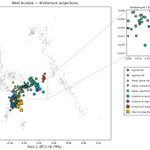
PCA Projection of the main Imenkovo clusters taken from Leonid Vyazov’s video essay and qpAdm BA-IA Modeling
Cluster A is closest to what Early Kiev would’ve looked like although it and B have excess Iranic ancestry possibly from the preceeding Late Sarmatian burials in the area


vict retweeted
Contrasting demographic impacts of Roman colonization and early medieval migrations in the Iberian Peninsula
Highlights
• 245 ancient genomes revealing Roman and early medieval Iberian diversity
• Roman rule transformed Iberia into a genetically diverse population mosaic
• Eastern Mediterranean and North African ancestry spread widely in Iberia
• Migration period elites contributed ancestry without major population replacement
cell.com/cell/fulltext/S0092…

vict retweeted
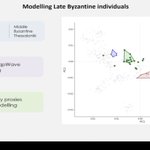
Late and Middle Byzantine samples from Thessaloniki has been presented at 10th Balkan Symposium on Archaeometry.
youtube.com/live/xonJcE1Y55M


vict retweeted

A simplified phylogenetic tree schematic to visually represent the recent findings on the emergence of modern humans.
– It also shows ancient source components relevant for later groups (e.g. OOA-like, European or East Asian HGs, ANE, etc.), not modern populations...

vict retweeted
Distribution of Slavic sites in Romania and Moldova during the Migration Period.
These groups are the result of Prague-Korchak and Penk'ovka diffusing into the region and fusing into a homogeneous horizon, although ethnically these are identified mainly as Antes.

vict retweeted

Yamnaya, Corded Ware and Bell Beaker haplogroup similarity.
20 / 135 (14.8%) of Corded Ware have a clade from Yamnaya
156 / 179 (87.2%) of Bell Beaker have a clade from Corded Ware
Using a clade depth of 11 from the first 3 digits


vict retweeted

David massively revised his preprint. Check out the new version!
Some highlights are more evidence for why range expansion specifically works better than an admixture pulse and what genes may have been inherited from the expanding "mode 3" population
biorxiv.org/content/10.64898…


vict retweeted

1) Ancient DNA comes often with bad coverage. You can fill the gaps statistically using GLIMPSE fairly standard practice. The obvious worry however is does that quietly drag the ancient genome toward the moderns you borrowed from in Admixtools? So I tested it. 🧵

ALT PCA of Imputed Genomes side by side with regular capture data.
Gregor Mendel, the godfather of genetics, carried Y-DNA R1a and mtDNA H1c1. On smartPCA, he falls between West Slavs and Northern/Western Europeans, typical of eastern Germans and Austrians. Distal qpAdm: 46.7% Samara Yamnaya, 40.4% Barcin ANF, 12.9% Loschbour WHG (p=0.301).


vict retweeted
Not surprising on the result of new Sintashta samples, but nevertheless always great with new samples.
Ancient DNA analysis identified the Y-chromosome haplogroup R1a1a1b2a (Z94).
Also evidence of a well-healed intravital trepanation was identified, which in terms of the technique (scraping), has the closest analogies among people of the Middle Volga Abashevo culture.
nav.jvolsu.com/index.php/en/…

vict retweeted
This paper argues that Scandinavian Mesolithic hunter-gatherers, particularly Early Mesolithic groups in Denmark, may have hunted with poisoned arrows, and that this could explain the prevalence and design of their tiny microlithic projectile points.
sciencedirect.com/science/ar…

vict retweeted

Napoleon was not only a military genius but a polymath who was elected to France’s premier intellectual institution. He could pick up almost anything: his literary criticism impressed Goethe, he could debate mathematical theory with Laplace, and his knowledge of music impressed Berlioz.

