

A coalition of parents and citizens protecting kids from surveillance policies disguised as child safety.
Florida, USA
Joined June 2026
- Tweets405
- Following36
- Followers483
- Likes437




Pinned Tweet
Protecting Kids Online Launch Event xitter.cf/i/broadcasts/1RJjpbrYl…

Australia's social media restrictions are exposing a reality many U.S. lawmakers still refuse to acknowledge:
Age-based restrictions require age verification.
Age verification requires data collection.
Once those systems exist, they don't stop with social media.
Now GTA 6 players are asking the same questions we've been raising:
Who collects the data?
Who stores it?
Who has access to it?
As states across the country fast-track age-verification legislation, Americans should pay attention. What starts with social media quickly spreads to gaming, apps, AI, and other online services.
Children deserve protection online. More identity checks and more data collection are not the same thing as child safety.
Parents are the firewall.


Florida and Texas are both moving fast on digital ID and mass surveillance policies...all under the banner of “protecting kids.”
Age verification, parent-child linking, device-level tracking, and government-mandated data collection. Same playbook, different states.
This will be copied across the country in 2027.
#protectingkidsonline #digitalid #surveillance
Protecting Kids Online retweeted

This is seriously further proof they just want a backdoor Digital ID and are USING kids to get it. Disgusting.
They will either have to monitor your phone activity to guess your age or verify your age via your ID. Either option violates our Amendment Rights.

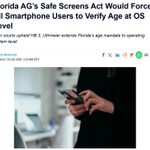
Florida's AG is proposing age verification at the smartphone OS level, which could make it one of the deepest ID age verification infrastructures in the country.
"There is no engineering shortcut: an OS-level age API works by collecting a birthdate at device setup, assigning the user to an age bracket (under 13, 13–15, 16–17, or 18-plus), and exposing that bracket to every app that requests it. The result is that every adult in Florida who owns an Apple or Google device would register their birthdate with that company as a condition of OS compliance — not to access any particular content, but to use their phone at all."
Digital ID does not protect children online.
This is "government as parent" - and the government makes a terrible parent.

Protecting Kids Online retweeted

No, parents should NOT demand their parental rights and liberties be squashed by the state with the Safe Screen Act.
Florida parents should take control of their kids' devices and tell schools and their EdTech programs to take a hike.
BUT parents don't know they can already do that because Florida school districts try to force kids on devices and KEEP them on devices.
Parents CAN protect their kids without this law or HB3. I did at home. At school, I hired a lawyer and got it done. I defended my PARENTAL RIGHTS from the STATE and so can every other parent.
We don't need unconstitutional laws. We just need to stand up for the God given rights we already have.
Florida leaders: You can't have your cake and eat it too.

Florida's AG @JamesUthmeierFL just unveiled the Safe Screens Act: age verification for app stores, strict default limits on teen social media use, and a ban on AI chatbots simulating "companionship" with kids. Big Tech will fight it. Florida parents should demand it.
Protecting Kids Online retweeted

Tell your neighbors about the government is doing NOW, especially if you live in Florida.
When I was young, the mere notion of the government implementing any policy that merely came anywhere near the average citizen got us riled up, and nonsense like this is no exception.
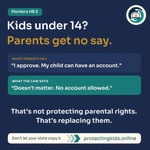
Florida’s HB 3 bans kids under 14 from social media accounts even if parents explicitly approve.
🚫 No consent option. 🚫 No override. The state decides, not parents.
That’s not protecting parental rights. That’s government replacing them.

Florida's AG is proposing age verification at the smartphone OS level, which could make it one of the deepest ID age verification infrastructures in the country.
"There is no engineering shortcut: an OS-level age API works by collecting a birthdate at device setup, assigning the user to an age bracket (under 13, 13–15, 16–17, or 18-plus), and exposing that bracket to every app that requests it. The result is that every adult in Florida who owns an Apple or Google device would register their birthdate with that company as a condition of OS compliance — not to access any particular content, but to use their phone at all."
Digital ID does not protect children online.
This is "government as parent" - and the government makes a terrible parent.
Full article via .@TechTimes_News : techtimes.com/articles/32946…

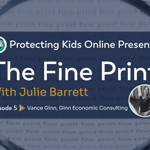
This week on the Fine Print Podcast, Vance Ginn makes the case for empowering parents, not bureaucrats, when it comes to kids, technology, and age-verification mandates.
In this episode Vance explains why digital ID requirements take power out of parents’ hands, the real trade-offs of these laws, and why government is poorly positioned to parent.
Full episode is out now: youtu.be/uVwbS60ol5A
Subscribe to the podcast, like and share this episode, and join the coalition at protectingkids.online.

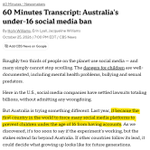
Australia's under-16 social media ban is quickly becoming a warning for U.S. policymakers.
Supporters of these laws have been promising they would make children safer online. But the reality is exposing the exact concerns many of us raised from the beginning: enforcement requires age verification, data collection, and systems that move authority away from parents and toward centralized verification mechanisms.
As similar bills continue moving through state legislatures across the United States, lawmakers should pause and examine the evidence before expanding these policies here at home.
A real crisis does not justify the wrong solution.
Parents deserve support. Children deserve protection.
Surveillance infrastructure is not a substitute for effective child safety policy.
Parents are the firewall.

Full article: cbsnews.com/news/australia-u…

Protecting Kids Online retweeted

These age verification law are not & never have been about protecting kids. That was/is the excuse. They’ve always been about identity.
The UK has spent years expanding online safety regulations. ⚠️ A new Ofcom review found that most children still report encountering "harmful content" online.
This is exactly the outcome many have been warning about.
Age verification mandates, identity checks, and expansive compliance regimes create new surveillance burdens, but they do not address the underlying causes of online harm.
As lawmakers across the United States are fast-tracking similar proposals, they should learn from the UK's experience and slow down before importing policies that have failed to deliver on their promises.
Parents need better tools, better education, and greater authority over their children's digital lives, not government mandates for data collection, surveillance, and digital ID.
Parents are the firewall.
#ProtectingKidsOnline #ParentsAreTheFirewall
Full article: yahoo.com/news/world/article…

Protecting Kids Online retweeted

we need to make more cool spaces for kids to hang out IRL and bring back whimsy and play!
There is no amount of data collection, surveillance, or censorship that will get a child off a screen. Parents must be willing to set and enforce boundaries for their children.

We’re being forced to hand over our most sensitive data—PII (personally identifiable information)—to platform companies.
In cybersecurity, this is the data you’re supposed to protect at all costs. You don’t just give it out. You don’t hand it over casually. And when you do share it, it should be intentional, limited, and carefully safeguarded.
New legislation is now requiring us to set that discipline aside and release it to these platforms. They’ll use it for access controls and to enforce the rules… and then they’ll turn around and monetize the same private information that identifies you as an individual.
That’s the double-edged sword: enforcement on one side, the end of meaningful privacy on the other.
This is where privacy dies—not with a dramatic breach, but with a quiet mandate to hand over the keys.
Do you see this as necessary protection, or the moment personal privacy effectively ends?
.@mattinformed .@practivesecurity
Protecting Kids Online retweeted

We need parents to harness the power at their fingertips and their power as parents to protect children online, not more government.
Growing the government and inserting the government into our homes and families ≠ conservative values.
This week on The Fine Print podcast with Julie Barrett, .@VanceGinn joins to share why he’s concerned about government increasingly inserting itself into the parent-child relationship through "child safety" policies that involve age-verification mandates that function as digital IDs and expand surveillance.
Check out this clip 👇- full episode drops Sunday at 7PM ET.
youtu.be/DIe3LoCdcqs

Protecting Kids Online retweeted

Understand that none of what is being pushed here gives parents more control, it actually takes away control and gives it to government and big tech. It makes Apple and Google the gatekeepers of the internet, and forces digital ID and mass data collection on everyone.

