

Post-Quantum Cryptography. Migration risk. Timelines.
Joined January 2025
- Tweets2.8K
- Following101
- Followers270
- Likes7.9K





Pinned Tweet
while most of crypto is still debating whether the quantum threat matters,
the team @trailofbits currently auditing zond ($qrl 2.0) is actively reducing the resources needed to attack secp256k1.
think about that for a minute.


Quaverick retweeted

120 qubits in Chicago. An attack estimate below 500,000.
@IBM's Nighthawk at UChicago has 120 qubits. Google estimates Bitcoin key attacks below 500,000 physical qubits under its hardware assumptions.
news.uchicago.edu/story/ibms…
research.google/blog/safegua…
A wide gap—not a countdown.

Quaverick retweeted

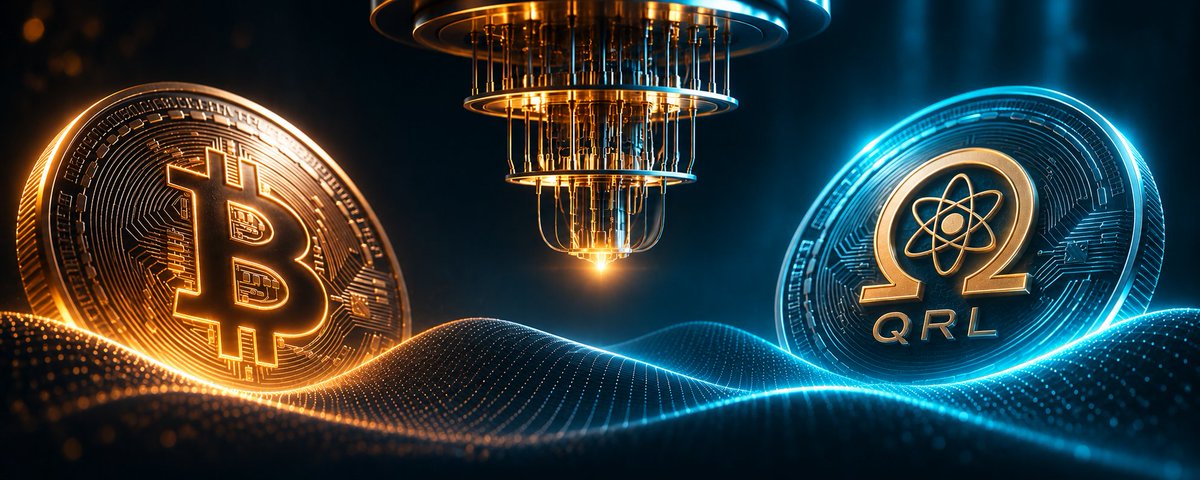
Solidity developers: you've spent months/years building on blockchains whose underlying cryptography is vulnerable to quantum computers.
That doesn't have to be the case moving forward.
With QRL 2.0, you can bring your Solidity skills to a blockchain built with post-quantum security in mind from the very beginning (sigh of relief).
Start building 👇
qrlecosystem.com


Quaverick retweeted

It is official.
Chains still running quantum-vulnerable public-key algorithms now have a deadline to switch to the recommended algorithm.
This is from NIST’s final report on the transition to post-quantum cryptography standards, and it asks @Starknet a fair question: if you are the most agile one, why are you still on elliptic curves?
____________
The simple answer is this. Starknet’s perfect agility score was not about already being post-quantum. It was about being able to switch cryptography without a hard fork.
By design, it can move from elliptic curves to the recommended algorithms. The work is still ongoing in stages.
Before that, let's walk through what NIST just locked in and what is already obtainable on Starknet.
On 27 October, NIST published the final version of Transition to Post-Quantum Cryptography Standards.
Two parts matter for high-impact chains:
> Quantum-vulnerable public-key algorithms are deprecated after 2030
> And are disallowed after 2035
The vulnerable designs include ECDSA, EdDSA, and RSA, still used by most wallets today.
As replacements, NIST points to:
> ML-KEM-768 as the default for keys
> ML-DSA and SLH-DSA for signatures
> LMS and XMSS for hash-based schemes
Starknet’s native account signature uses ECDSA on the STARK curve. That sits in the same NIST quantum-vulnerable bucket.
But Starknet already runs a post-quantum signer for every user, and the account can swap that ECDSA lock for something like ML-DSA or Falcon, while keeping the same address and funds on the chain.
They have already started the transition. Here is what is live so far:
1. The proving layer already uses STARKs, which are hash-based. That covers proofs, not account signatures.
2. Starknet v0.14.3 replaced Pedersen with a BLAKE2s-256 construction for OS program and configuration hashes. That is live on mainnet.
3. OpenZeppelin’s Falcon-512 accounts have moved real value on Starknet mainnet. Experimental and unaudited. Ordinary users cannot adopt it yet.
4. The Falcon Challenge cut verification gas roughly in half in under a week, which makes a post-quantum verifier cheap enough for real wallets to consider.
@EliBenSasson has been saying this for weeks; every chain needs to migrate.
Going post-quantum ready is no longer a choice. Five years from now, if your chain is still exploitable by quantum computers, it'd be serious a skill issue.


The post-quantum path @Starknet is taking is revealing more serious loopholes in blockchain design than I thought.
StarkWare built a framework from NIST's 'general crypto-agility guidance' to test how agile blockchains are, and only one chain scored 8/8.
Bitcoin itself passes 7 of the 8 tests, tied for second among the 10 chains scored, yet it faces one of the hardest migrations.
NIST wrote the guidance but doesn't rate chains, so StarkWare built the 8 questions and scored the networks itself.
It's a bit technical, but let's review it.
➥ Based on NIST's guidance on crypto agility, the 8 questions ask whether a chain can replace its cryptography and keep running:
1. Can an existing account switch to a new signature without a network upgrade?
2. Can its formats handle bigger keys and signatures?
3. Can one cryptographic part be replaced without redesigning the rest?
4. Can old and new signing run side by side undedr migration?
5. Has the transition been tested?
6. Can an attacker be stopped from forcing a weaker algorithm?
7. Can the old algorithm be switched off after migration?
8. Can existing data be migrated?
A point only counts if the path works today under current rules. Anything that needs a future upgrade scores zero.
Across 10 networks the scores are @Starknet 8, @Bitcoin 7, @Algorand 7, @NEARProtocol 7, @QRLedger 6, @Zcash 6, @ethereum 3, @solana 2, @Optimism 2 and @RobinhoodCrypto 1.
➥ The test that separates Starknet from the 7s is the first one.
On Starknet every account is a smart contract, so a wallet can replace its signature check and keep its address and funds. StarkWare confirmed this with @ready_co.
A coin on the Bitcoin network has to move to a new address to use new cryptography, and NEAR and Algorand accounts can only choose schemes the protocol has already switched on, nothing more.
What I respect most is what the score does not claim. It is not a security rating.
QRLedger scores 6 yet shows lower exposure on the same Hub, because its signatures are already hash-based.
Starknet's standard accounts still sign with elliptic curves, and its post-quantum Falcon-512 account is an unaudited mainnet demo that ordinary users can't adopt yet.
So my takeaway is that being able to change and having already changed are two different things, and a chain needs both.
Next, I'll break down where Starknet stands on the second. For now, what's your take on this?

Quaverick retweeted

"This month there is going to be a breakthrough paper that further reduces the run time by an order of magnitude." -Justin Drake, 3 November
What impact could this have on quantum-resistant cryptocurrencies?
$QRL #QuantumSafe #Cryptography #Google

Quaverick retweeted
When the world is hit by a storm, a safe haven makes all the difference. 🌊
Quantum-resistant since 2018, $QRL was built for the future we're moving toward.
A quantum-safe haven for your digital money.
#PostQuantum #QRL

Quaverick retweeted
The post-quantum path @Starknet is taking is revealing more serious loopholes in blockchain design than I thought.
StarkWare built a framework from NIST's 'general crypto-agility guidance' to test how agile blockchains are, and only one chain scored 8/8.
Bitcoin itself passes 7 of the 8 tests, tied for second among the 10 chains scored, yet it faces one of the hardest migrations.
NIST wrote the guidance but doesn't rate chains, so StarkWare built the 8 questions and scored the networks itself.
It's a bit technical, but let's review it.
➥ Based on NIST's guidance on crypto agility, the 8 questions ask whether a chain can replace its cryptography and keep running:
1. Can an existing account switch to a new signature without a network upgrade?
2. Can its formats handle bigger keys and signatures?
3. Can one cryptographic part be replaced without redesigning the rest?
4. Can old and new signing run side by side undedr migration?
5. Has the transition been tested?
6. Can an attacker be stopped from forcing a weaker algorithm?
7. Can the old algorithm be switched off after migration?
8. Can existing data be migrated?
A point only counts if the path works today under current rules. Anything that needs a future upgrade scores zero.
Across 10 networks the scores are @Starknet 8, @Bitcoin 7, @Algorand 7, @NEARProtocol 7, @QRLedger 6, @Zcash 6, @ethereum 3, @solana 2, @Optimism 2 and @RobinhoodCrypto 1.
➥ The test that separates Starknet from the 7s is the first one.
On Starknet every account is a smart contract, so a wallet can replace its signature check and keep its address and funds. StarkWare confirmed this with @ready_co.
A coin on the Bitcoin network has to move to a new address to use new cryptography, and NEAR and Algorand accounts can only choose schemes the protocol has already switched on, nothing more.
What I respect most is what the score does not claim. It is not a security rating.
QRLedger scores 6 yet shows lower exposure on the same Hub, because its signatures are already hash-based.
Starknet's standard accounts still sign with elliptic curves, and its post-quantum Falcon-512 account is an unaudited mainnet demo that ordinary users can't adopt yet.
So my takeaway is that being able to change and having already changed are two different things, and a chain needs both.
Next, I'll break down where Starknet stands on the second. For now, what's your take on this?


Quaverick retweeted
Most "quantum-safe" coins have a whitepaper.
$QRL has Trail of Bits audits, NIST-standard crypto (ML-DSA-87, ML-KEM-1024), university research grants and a seat in the Post-Quantum Cryptography Alliance.
Receipts, all sourced: theqrl.org/contributions
(I hold $QRL. NFA.)

Quaverick retweeted
The ECDSA.fail challenge just crossed 70.0%. 👀
Will crypto migrate to post-quantum security in time?
$QRL #PostQuantum

Quaverick retweeted
Q-Day in 2029?
Justin Drake on November 3:
"Behind closed doors, the CEO of a particular multi-billion dollar quantum company is saying that he has 99% conviction that Q-Day will happen in 2029."
Drake himself puts the probability of Q-Day by 2029 at 10%.

Quaverick retweeted
What if AI breaks our cryptography before quantum computers do?
Justin Drake on November 3:
"AI is coming up with new alien mathematics that may be able to break our cryptography without quantum computers."

Quaverick retweeted

Justin Drake on Shor's algorithm runtime for breaking ECDSA...
"This month, there's going to be a breakthrough paper that further reduces the runtime by an order of magnitude. We're going to go from minutes to seconds."
Source: youtube.com/watch?v=rqJ5ir-8…

Most "quantum-safe" coins have a whitepaper.
$QRL has Trail of Bits audits, NIST-standard crypto (ML-DSA-87, ML-KEM-1024), university research grants and a seat in the Post-Quantum Cryptography Alliance.
Receipts, all sourced: theqrl.org/contributions
(I hold $QRL. NFA.)
Quaverick retweeted
I wonder if $QRL should raise more awareness of its relevance as both quantum computing and AI advance. Quantum computers threaten ECDSA, while AI could accelerate cryptographic research and potentially uncover new weaknesses.
QRL already uses post-quantum signatures instead of ECDSA. That seems like a message worth spreading.
#QuantumSafe #Cryptography

Quaverick retweeted
Holy cow! Could ECDSA break sooner than we think? 👀
Justin Drake’s take is worth watching.
#PostQuantum #Cryptography $ETH $QRL
youtu.be/rqJ5ir-8hAQ?si=Dyab…

Quaverick retweeted
QuantaScan Weekly Report (w44/2026).
3rd week in a row of net QRL outflow from exchanges.
$QRL @QRLedger
quantascan.io/reports/qrl-we…

Quaverick retweeted
$QRL consistently at the top of PQ crypto listings

Imagine waking up to discover the cryptography protecting billions in crypto assets may no longer be secure.
Crypto talks about scalability and adoption. What if computers challenge the cryptography protecting our wallets?
Current quantum computers cannot break blockchains, but research is advancing. I researched the threat, projects and opportunity.
THE THREAT
Blockchains use digital signatures to authorize transactions. Bitcoin and Ethereum rely on elliptic-curve cryptography, which a sufficiently powerful quantum computer could attack with Shor’s algorithm to derive private keys from exposed public keys.
Grover’s algorithm offers a quadratic speedup against hashes and symmetric encryption. “Harvest now, decrypt later” means storing encrypted data today for future decryption.
THE ALTERNATIVE: PQC
NIST finalized in 2024:
→ ML-KEM: shared-key establishment.
→ ML-DSA: lattice-based signatures.
→ SLH-DSA: hash-based signatures.
Migration means larger signatures, higher verification costs and upgrades to wallets, contracts and validators. Cryptographic agility matters.
PROJECTS TO WATCH
1. QRL ($QRL) — Uses XMSS, a hash-based quantum-resistant one-time signature scheme.
2. Algorand ($ALGO) — Uses FALCON for state proofs and account authorization; broader upgrades targeted by end-2027.
3. Starknet ($STRK) — Account abstraction enables custom signatures. An experimental quantum-resistant wallet transacted on mainnet in July 2026 (~$0.06). STARK proofs use hash-based assumptions, but not every component is quantum-safe.
4. QANplatform ($QANX) — Building lattice-based signatures and QAN XLINK for account migration.
5. Abelian ($ABEL) — Lattice-based cryptography with privacy features.
6. Nervos ($CKB) — Exploring alternative authentication and SPHINCS+-related approaches.
7. Project Eleven — Yellowpages aims to coordinate quantum-safe protection for bitcoin holdings without an immediate fork.
8. Ethereum — Targets quantum resistance across execution, consensus and data by December 2029.
9. Cardano — Exploring post-quantum integration, including Dilithium signatures.
10. Sui ($SUI) — Plans ML-DSA-65 accounts and SLH-DSA-SHA2-128s vaults; mainnet target Q1 2027, subject to audits.
11. Quantus — Post-quantum mainnet launched September 2026; QTC introduced in October.
12. Bitcoin — StarkWare’s experimental QSB enabled a quantum-safe mainnet transaction in August 2026. Optimization cut estimated compute cost $320→$67 (~79%); $67 was a benchmark, not a second transaction. QSB cannot protect coins with exposed public keys; a soft fork remains the broader fix.
WHY NOW?
Google Quantum AI’s March 2026 estimates put attacks on 256-bit elliptic-curve cryptography at fewer than 1,200–1,450 logical qubits. These are error-corrected, not today’s noisy physical qubits; this is theoretical, not a practical attack.
WHERE’S THE OPPORTUNITY?
Opportunities: quantum-safe wallets, migration, efficient verification, account abstraction, agility, custody and interoperability.
Quantum resistance doesn’t guarantee token value. Watch deployment, audits, adoption and full-stack protection.
RESEARCH WATCHLIST
Quantum-focused:
$QANX @QANplatform | $CELL @cellframenet | $QRL @QRLedger | $ABEL @PQabelian | $NAORIS @NaoXprotocol
Established / other:
$ALGO @Algorand | $XDC @XDCNetwork | $STRK @Starknet | $HBAR @hedera | $IOTA @iota | $CKB @NervosNetwork | $XNT @NeptunePrivacy | $ZEC @Zcash
Also: @projecteleven, @ethereum, @Cardano_CF, @SuiNetwork, Quantus.
Research watchlist: some have deployed components; others are still researching or planning.
MY TAKE
Quantum computing won’t break crypto tomorrow, but upgrading live networks takes years. Winners will prove security, practical migration and performance without sacrificing decentralization.
Post-quantum cryptography may be quiet today, but decisions now could shape which networks are ready for the next generation.

Quaverick retweeted

Top Quantum-Resistant picks you should definitely check out 👀
💎 $QRL 💎 ( @QRLedger )
💎 $QANX 💎 ( @QANplatform )
💎 $QUBIC 💎 ( @_Qubic_ )
💎 $NAORIS 💎 ( @NaoXprotocol )
💎 $QTC 💎 ( @QuantusNetwork )
Which ones are on your radar?
