
Founder of Cambridge BioPartners, Inc.
Cambridge, MA USA
Joined March 2009
- Tweets46.1K
- Following7K
- Followers10.7K
- Likes186K



Pinned Tweet
New Journal of Clinical Oncology @JCO_ASCO paper estimated potential savings of $661.8M for US taxpayer-funded Medicare if replace current Medicare Part D median formulary prices w/ @costplusdrugs pricing for 7 generic oncology drugs. ascopubs.org/doi/full/10.120… h/t @RuchikaTalwarMD

Pearl Freier retweeted

I cannot remember any single day with SO MANY critical security breaches / disclosures, which would impact so many sites/companies/users
And have to admit that the two big labs (and especially Ant) has been warning of THIS type of thing happening, since Mythos announcement


Pearl Freier retweeted

If you wanted to know all the jobs that AI will produce, look no further than cybersecurity. This is going to become one of the biggest investment areas for enterprises going forward.
And even as the work becomes more agentic and autonomous you will need more talent to point the agents at the most critical work, review findings, patch systems, respond to incidents, and more.
Lots of opportunity right now for the systems that protect data and enterprises, as well as the professionals that are deploying them and protecting organizations.
It’s going to only get more wild out there.

So basically, today PHP got two critical bugs that let anyone run code on your server without even logging in, which is bad, and then the details leaked before the patch was even out, which is worse, and it works on WordPress and MediaWiki and Magento and Joomla and Laravel, and Censys says like 1.5 million servers are running a version with no fix, so the NSA was like "take your system offline," and the FBI was like "take your system offline," and CISA and the UK and CERT-EU were all like "take your system offline," and then the Prime Minister of Japan, the actual Prime Minister, posted at 5:55 in the morning telling 48.8 million people to take their system offline, so everyone took their system offline, like the Dutch cybersecurity agency took its own website offline, and the Dutch parliament went offline, and the Port of Rotterdam went offline, and Finland and France and Denmark started pulling government sites, and Wikipedia went down, and Archive.org went down, and Asana and GOG and Something Awful went down, and the University of Vienna's webmail went down for some reason, and that's just PHP. Because GitLab also dropped a CVSS 10.0, which is the highest score they give out, for a bug that's been there since 2014, so that's every self-hosted GitLab for twelve years, and then LiteLLM 1.107.0 got hijacked and shipped a credential stealer and a remote access trojan in every single wheel and the Docker images, including latest, and you didn't even have to import it, just installing it was enough, and it's the second time this year, and then Railway paused every deployment on the entire platform because someone got into the environment variables, so now everyone has to rotate every secret they've ever stored there, and TiDB Cloud said someone was walking around inside with stolen credentials for basically a month and an extortion group says they took 10.6 terabytes, and Zeabur got breached for the second time in two months and is just shutting down, like the whole company, and Node.js patched remote code execution and a TLS bypass, and CISA says Plex is being actively exploited, and someone took over 300 Tor exit relays to steal SSH passwords, and SafePay ransomware has hit over 600 critical infrastructure orgs, and India's biggest bank filed a data loss incident, and Japan has been in an official state of emergency in cyberspace since October 9, which honestly explains the 5:55 AM post. Oh, and eMudhra, a certificate authority that's issued over 60 million certificates, whose entire job is proving websites are who they say they are, was supposed to be using private keys that are random numbers over a hundred digits long, and one of them was 4. Just 4. And the others were like 66 and 237. Anyway, it's Wednesday.
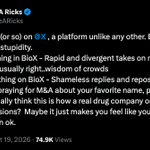
Lilly CEO @DaveARicks marks his first 30 days of “going direct” on X & shares his opinion of the BioX community so far (see his post). Which biopharma CEO do you think will be next? $XBI $IBB $BBC $NVO $LLY
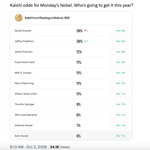
48%Novo's Mike Doustdar
9%Amgen's Bob Bradway
20%Regeneron's Len Schleifer
23%AZ's Pascal Soriot
65 votes • Final results
Explanation for why Muse & other AI agents are blocked at Schwab (& JPM): "CEO asks who’s liable if an agent moves money. When an AI agent makes a mistake, causes financial harm, exposes private information or breaks the law, who's responsible?....AI agents aren't legal persons.....If a company gives an AI agent access to confidential information, financial accounts or computer systems, that company remains responsible for the decisions it made about access, permissions, security controls and supervision. Whether it must compensate someone depends on the applicable law, contracts and circumstances."

Meta’s Muse is blocked at Schwab. Its CEO asks who’s liable if an agent moves money. When an AI agent makes a mistake, causes financial harm, exposes private information or breaks the law, who's responsible?
The answer isn't complicated. AI agents aren't legal persons. They're software created, configured, authorised and deployed by people and companies.
US law has recognised autonomous software since 2000. The federal E-SIGN Act explicitly defines an "electronic agent" as software capable of acting without human approval at the time of each action. The law recognises transactions conducted through automated systems.
If a company gives an AI agent access to confidential information, financial accounts or computer systems, that company remains responsible for the decisions it made about access, permissions, security controls and supervision. Whether it must compensate someone depends on the applicable law, contracts and circumstances.
If an agent transfers money without authorisation, accesses confidential records or attacks another company's infrastructure, investigators should examine who configured it, what instructions it received, what permissions it had, who authorised those permissions and what its activity logs show.
Schwab can't blame an agent for acting independently, any more than they can blame an Excel macro.
The difference between an AI agent making a mistake and a company being legally liable for that mistake is important. But neither changes who's responsible for deploying the software.
Biotech & drug manufacturing news below from the president:

Trump: "If the Republicans win, the Department of War will be investing $100 million in the pharmaceutical company Anthea to revitalize a gigantic drug manufacturing facility in Winchester, Kentucky"
Pearl Freier retweeted

My @grok @bot found a clinical trial for my stage 4 lung cancer an hour from my house. I never would have known about it on my own.
I'd been interested in a trial for a new ALK drug called TRI-611, but not if it meant flying across the country over and over. In September the trial added the University of Cincinnati as a site, and my bot caught the change. It also flagged an eligibility question for me to take to my oncologist.
Before this I was passive. Maybe I'd stumble on something on X, maybe my oncologist would mention something (he hasn't), and my ALK+ patient group on Facebook was probably the most reliable source. Nothing was guaranteed, and I definitely wasn't hearing about trials adding new locations.
Now it checks for me every morning, and I'm tracking more than 25 options, from personalized vaccines to next-gen ALK drugs, sorted by how relevant they are to me and when they'd make sense. The whole game is curation...the more it knows about your diagnosis, the more it finds signal instead of noise.
1. Teach it your diagnosis. Mine knows my cancer type, stage, every treatment I've had, my biomarkers, and how far I'm willing to travel. Trials include or exclude people based on exactly these things.
2. Tell it what to do. Mine checks clinical trial listings, FDA decisions, conference abstracts and company news, compares it all against the day before, and only pings me when something new and sourced shows up.
3. Review what it finds. I read the source, then run it past Grok, which both know my history, to decide whether it's useful and when. Then it goes into my tracker in Notion (below). More on that part in another post soon.
It gives me hope, too. Even when I'm not eligible, seeing new companies form and new trials open every week reminds me how fast this field is moving.
I turned my setup into a template so any patient or caregiver can build their own. It asks about the diagnosis, travel limits, and where to keep results, then builds the watch around the answers: x.ai/bot
Thank you @SpaceXSI @elonmusk for building this.

ALT My Notion treatment tracker for stage 4 ALK+ lung cancer. It lists more than 25 options, including lorlatinib, personalized mRNA and peptide vaccines, next-gen ALK drugs like TRI-611 and neladalkib, and antibody-drug conjugates, each tagged by personal relevance, status, timing, and evidence level.

ALT My Grok Bot, Cancer Curer. It runs a private daily watch for new treatments, trials, approvals, and cancer-cure companies matched to a patient's own cancer profile, and stays quiet unless something new and sourced turns up.
Pearl Freier retweeted

This beautiful 7-year-old girl is part of our rare disease community. She lives with CASK syndrome and was critically injured in the horrific shooting at Silver Rail Elementary School in Bend, Oregon.
She is currently in the hospital fighting for her life. Her family is facing an unimaginable situation and needs support right now.
If you’re able, please consider donating to help them through this time.
gofundme.com/f/support-famil…

Pearl Freier retweeted

BREAKING via AP
President Trump puts new Russia sanctions passed by Congress on hold, saying a waiver is in the US national interest.

Pearl Freier retweeted

In-vivo CAR-T is the rage and it may work, but it is not clear it has the durability or long-term efficacy of ex-vivo. In general, I bet ex vivo in multiple applications will get cheaper and will win in some big verticals.

Big pharma committed about $6.6 billion to in vivo CAR-T in roughly seven months last year.
@abbvie bought @capstantx for $2.1B. @AstraZeneca bought EsoBiotec for up to $1B. @bmsnews paid $1.5B for Orbital. @KitePharma picked up Interius for $350M.
EsoBiotec and Interius both run on lentiviral vectors. So does @UmojaBiopharma, which AbbVie partnered with before buying Capstan.
Which is why today's news from @AsimovBio and @LonzaGroup caught my attention.
In ex vivo cell therapy, the lentivirus is a tool. You use it in a lab to engineer a patient's cells and you're done with it. In vivo flips that. The vector goes into the patient. As @alectricity put it, the vector becomes the drug.
That makes manufacturing the hard part. Most lentivirus is still made by transfecting cells with multiple plasmids, batch after batch. It's expensive, variable, and tough to scale.
Asimov's LV Edge Producer lines build all the lentiviral genes into the host cell itself. No transient transfection, no GMP plasmid bill, and titers above 1E9 TU/mL for CAR constructs, about 10x what they saw before.
Lonza brings the process development, analytics, scale-up and GMP manufacturing. Putting the two together at the cell line stage means manufacturability gets designed in early, before a program hits scale-up and finds out the hard way.
If in vivo CAR-T works the way pharma is betting, the bottleneck moves to making enough clean, consistent vector at a cost that works for big indications. That's the problem this collaboration is going after.
Alec first spoke at @SynBioBeta in 2018, back when Asimov was a genetic circuits startup. Soren Flygenring Basset from Lonza joined us on stage in San Jose this May. Fun to see these two worlds connect.
Congrats to @alectricity, Imroz Ghangas and the @AsimovBio team, and to Daniel Palmacci, Thomas Fellner and Soren at @LonzaGroup.

Pearl Freier retweeted

Lots is happening in the world of clinical trial reform!
I decided to put together a list - all of this was announced since June - and shared some thoughts:
abundanceandgrowth.org/p/is-…


Pearl Freier retweeted
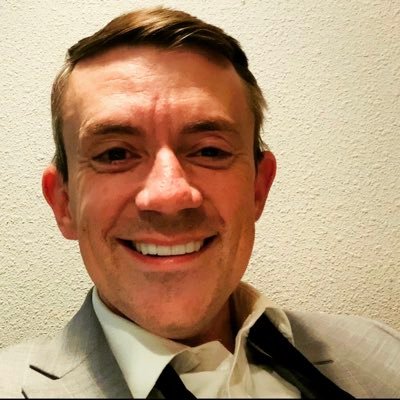
This man saved my life as a pancreatic surgeon
His career has now taken him from the operating room to being the inaugural dean of a medical school!
Congrats Dr. Ott! (And I’m so glad you got a fresh white coat — so sorry for vomiting bile on the other one when I was unwell 😬)


BREAKING: The BYU School of Medicine has received preliminary accreditation from the Liaison Committee on Medical Education (LCME), authorizing the school to recruit and admit students and launch its MD program.
@byumedschool will welcome its first students in July 2027 and will begin accepting applications in the coming weeks following activation of its listing on the American Medical College Application Service (AMCAS).
The BYU Board of Trustees has also approved plans for the school's future home, a 275,000-square-foot building on BYU's West Campus, just east of Intermountain Health's Utah Valley Hospital—the School of Medicine’s primary clinical affiliate. Construction is expected to begin in 2027.


The line of the week in biotech comes from Roivant CEO @gline during #statsummit. He also appears to be throwing some shade at the debate in the AI community about AI consciousness, a topic that has also raised safety concerns. $ROIV $XBI $IBB

Pearl Freier retweeted

The man arrested for planting a secret recording device at OpenAI's headquarters is a Venture Partner of a VC firm alongside the son of a senior Saudi intelligence official:


Pearl Freier retweeted

We discovered a sophisticated recording device that was hidden inside one of our offices. We used our models to understand the device and where it had come from, identifying that a specific employee had planted it a few days earlier. We referred the matter to the FBI, and we’re grateful to the agents and prosecutors who moved quickly to make an arrest. The FBI’s investigation is ongoing and we will continue to support their work.
At this time, we have no indications of this individual inappropriately accessing or exfiltrating model weights, source code, or customer data. The employee was terminated.
We take protecting our technology, data, and people seriously, and as a matter of national importance. Our security program is designed to protect against a wide range of threat actors, from insider risks to cybercriminals to nation states, and this case is an example of how AI can help address these sophisticated security threats.
Pearl Freier retweeted

I had no idea that Helen Branswell was ill. I'm deeply saddened to hear of her passing. When I became CDC director, a very astute member of the CDC press office told me that I wasn't ready for a briefing unless I was ready for questions from Helen Branswell. Her questions were always thoughtful, knowledgeable, and fair. Her reporting showed us where we needed to improve and informed the public about health. We need more reporters like her. I'll miss her.
statnews.com/2026/10/13/hele…

Pearl Freier retweeted

We are devastated STAT over the loss of our beloved colleague @HelenBranswell
statnews.com/2026/10/13/hele…
Pearl Freier retweeted

Devastated by the loss of Helen Branswell, one of the finest health reporters of our generation and a mentor and friend to many. Her incisive reporting was vital to understanding our greatest health crises and she was always committed to science and truth.
statnews.com/2026/10/13/hele…
Pearl Freier retweeted

Character AI has gone bankrupt.
The AI startup announced its Chapter 11 filing through a late-night newswire press release

Pearl Freier retweeted
Cyberattack on French supermarkers. Someone remotely took over refrigeration controllers and made them to defrost. Target temperature set to 50°C. Staff opening freezers in the morning were hit by a wave of hot air. Millions of euros lost. France spent years debating food sovereignty to depend on a firmware update? bfmtv.com/economie/consommat…
