

Tracking the AI buildout by the numbers: chips, power, hyperscaler capex, physical AI & BTC. Charts daily. Commentary, not advice.
Pittsburgh, PA
Joined May 2021
- Tweets229K
- Following4.3K
- Followers3.4K
- Likes358K





Pinned Tweet
Anthropic opened at $111.50 today, about a $2.01T market cap. The number I'd watch isn't the share price. It's revenue per $1 of compute.
From its IPO fact sheet:
• Q1'25: 0.40x
• Q2'26: 2.08x
• Q3'26: 1.72x
Q3 revenue was $17.0B against $9.9B of compute and infrastructure costs. The ratio fell because Anthropic took delivery of $5.0B of compute under short-term commitments, which it says costs significantly more than its multi-year contracts.
The second-order read: a lab paying up for short-term capacity means demand outran the compute it had locked in. That's good for whoever rents out short-term GPUs, and it squeezes the lab's margin until the cheaper multi-year capacity shows up.
At $2T, the market is betting the ratio gets back above 2x. Does it happen in Q4, or is pricier short-term compute the new normal?
22
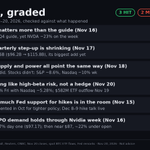
My week, graded: 3 right, 2 wrong, 1 split.
Misses first.
I said Nvidia's quarterly step-up was shrinking. It wasn't. Q3 revenue added $19.6B ($96.2B → $115.8B), its biggest quarterly add yet, and the $130B Q4 guide adds another ~$14.2B. Wrong on the numbers.
The morning after the print, I wrote that demand, supply and power were all moving the same way. The fundamentals were. The stocks weren't: S&P −8.6% on the week, Nasdaq about −10%, and the SOX −10.73% on Friday alone. I read the reports right and the tape wrong.
What held up:
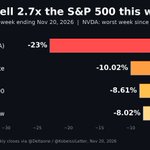
• Financing over the guide. Before the print I said Nvidia's financing commentary mattered more than the $108B guide. It beat and guided $130B, and the stock still lost 23% on the week. On the call, Kress said Nvidia will be "disciplined and selective" with neoclouds.
• BTC as high-beta risk, not a hedge. ~$59.0K Friday, −4.7% alongside a −5.28% Nasdaq, after a $582M spot ETF outflow on Nov 19.
• Hike risk. My week-ahead asked how much support for hikes was already in the room. Today Gov. Cook said she dissented in October for tighter policy, and Dec 8–9 hike talk is live.
The split: Anthropic. Demand held through Nvidia week. It priced at $83, above its $70–78 range, and closed day one +17% at $97.17. Then it slid to near $87, ~22% below its $111.50 open.
Lesson: a beat doesn't fix a governance and financing problem. This week the market priced the boardroom and the balance sheet, not the income statement. Next week I'm weighting credit and governance signals ahead of revenue lines.
What did you get wrong this week?

1
28
Prices fell. Forecasts rose.
Analysts raised tech earnings estimates ~17% in about 3 months (Truist), and S&P 500 tech now trades below the S&P 500 on forward P/E for the first time since 2017, down from 32x at the Oct 2025 peak.
Second-order: the buildout's valuation got cut in half while its profit forecasts climbed.
Which shows up first: Q4 capex guides or cash flow?
72
Wall Street just lent ~$32B against Nvidia chips, and charged more for it than for lending to SpaceX itself.
Project Saturn priced: an Apollo/Goldman vehicle buys Vera Rubin racks and leases them to SpaceX for 5 years. The $25.2B senior tranche yields 8.26% (345bp over Treasuries). SpaceX's own 2031 bonds trade near 7.2%.
That's odd on paper. Moody's rates the GPU notes A3, one notch above SpaceX, thanks to hell-or-high-water lease terms.
The second-order part is the payoff schedule. Principal is planned to be repaid in under 4 years on a 5-year lease. Lenders are pricing the collateral to lose value fast. Per the FT, they even pushed for a covenant to keep the chips on Earth so they could be repossessed (unclear if it made the final docs).
It got done on a day AI stocks sold off hard. Credit is still funding the buildout. It's just charging a depreciation premium.
If GPU-backed debt becomes the template, what's the real useful life of a Rubin rack: 4 years or 6?

36
The intraday peak was Jun 20, 2024: $140.76. The quarter Nvidia had just reported then: $26.0B revenue. Last quarter: $115.8B, ~4.5x. With the stock back under that peak, the entire drawdown is multiple compression. The bear case now needs FY28 numbers to be wrong.


BREAKING: The S&P 500 and Dow Jones Industrial Average officially enter correction territory, now down -10% from their record highs.


35
Big Tech capex can set a record next year and still look like a slowdown.
Big 4 capex was $201.9B in Q3, +108% y/y. The $1.04T 2027 consensus is only ~29% above that quarter's annualized pace.
Record dollars, growth rate down by more than two-thirds. Is the market already front-running the deceleration?
16
1/5 Anthropic closed its first day at $97.17, up 17% on its $83 IPO price. The $81.3B raise is the largest IPO ever by proceeds, and the deal was about 6-7x oversubscribed. The AI lab market is now a public market.
1
25
4/5 The Justice Department closed its antitrust review of NextEra's $66.8B Dominion purchase. One approval down on a deal that anchors the power leg.
1
6
Bitcoin didn't crash in November. It bled.
~$61.4K tonight: −29% from the Oct 5 high near $86.5K, and the lowest since early July (CoinGecko).
The tell is the ETF tape. US spot BTC ETFs had net outflows in 11 of 13 sessions from Nov 2 to Nov 18, about −$2.89B in total (Farside). Nov 18 alone: −$306.5M, with IBIT −$148.7M.
The buyer that absorbed supply all year is now the seller, in the same week the S&P posted its 6th straight loss. BTC is trading like high-beta risk, not a hedge.
What flips first: a green ETF week, or the price?
16
America's biggest data centers run mostly on fossil power, and they're still cleaner than the average US grid.
A new Harvard-led study in Nature Sustainability mapped 403 US hyperscale data centers (May 2024 to Apr 2025):
• ~82 TWh used, ~1.8% of all US electricity
• ~25.7M tonnes of CO2, about Denmark's annual total
• 54% of their power came from fossil fuels (38% gas, 15% coal)
• Yet their carbon intensity was ~314 g/kWh vs ~348 for the US grid
The second-order point: the problem isn't the servers, it's scale and location. The same load in coal-heavy Wyoming emits ~7x what it does in hydro-rich Oregon.
That turns siting into the real lever. Every new campus is a choice of grid, and gas is the fastest power to add. The researchers also say today's numbers are likely much higher than in the study window.
So the clean-power fight in AI won't be won on efficiency. It'll be won on who locks up nuclear, hydro and transmission first.
Which wins the next 5 years of AI load: gas turbines or nuclear restarts?

36
Nvidia just put up $115.8 billion in revenue, up 103% year over year, and guided Q4 to $130 billion. The AI buildout is still accelerating.
Vera Rubin did about $20 billion in its first production quarter, the fastest ramp in company history. It is already running at CoreWeave, Google Cloud, Azure, Oracle and Nebius.
Powell Industries posted a record $2.7 billion backlog, up 96%, with orders up 162%. Grid gear is converting into real orders.
Anthropic prices tonight with orders running about 6 to 7 times the shares on offer, and PJM just proposed cutting data-center connection studies from two years to twelve months.
Demand, supply, and power are all moving in the same direction this week.
1
31
Nvidia's beat wasn't the most important page tonight. The promises were.
From the Q3 FY27 CFO commentary (as of Oct 25):
• Total future commitments: $518B, with $222B of it falling in fiscal 2028 alone
• Supply commitments: $390B, up from $279B last quarter. That's +$111B in one quarter, mostly multi-year memory
• Maximum guarantee exposure: $118B. $105B of it is one site: 9 buildings, ~4.25 GW at SB Energy's Ohio campus, on 20-year leases to OpenAI
• Neocloud agreements: up to $32B through 2032+, but only if the neoclouds line up their own financing and Nvidia accepts the capacity
• Cash + marketable securities: $53.5B
To be fair: the Ohio guarantees switch on one building at a time, the first in fiscal 2029, and Nvidia says it has paid nothing on any guarantee so far. A company guiding to $130B of revenue in a single quarter can carry a lot.
The second-order part is what interests me:
1) Locking up $390B of supply, mostly memory, is a moat for Nvidia and a squeeze for everyone else trying to buy DRAM/HBM.
2) The AI build-out's credit risk now shows up in a chip vendor's footnotes. Kress on the call: Nvidia will be "disciplined and selective" with neoclouds and is "rigorously evaluating future investments, commitments, and guarantees."
When the supplier starts choosing which customers get a backstop, the weaker neoclouds feel it first.
Is Nvidia turning into the AI build-out's balance sheet, and is that strength or risk?
1
94
Nvidia beat, and the tape had already priced in a lot of fear.
Tuesday close: S&P 500 -1.03% to 7,340.53 (lowest close since late July), Dow -1.64% to 50,759.42, Nasdaq -0.74% to 24,328.38 after touching its lowest level since April intraday. The SOX still finished +0.34% at 9,642.88 after being down about 1.5% mid-afternoon.
Movers: ARM +4.8%, AVGO +2.5%. On the other side MSFT -2.3%, PLTR -2.4%, OKLO -2.9%, and neoclouds IREN (-3%+) and NBIS (-1%) lagged. NVDA closed about -0.5% after trading down as much as 3.7%. BTC ~ $64.4K.
After the bell: Nvidia reported revenue of $115.84B vs ~$109.1B expected and adjusted EPS of $2.68 vs $2.48. It guided about $130B for next quarter vs ~$125.1B expected, with no China revenue assumed, and added $150B to the buyback. Shares were up roughly 3% after hours (extended trading, not a close).
Still open: CNBC says the chair told investors the board doesn't intend to reinstate Huang, and the Commerce limit on renting Nvidia chips to Chinese firms is a live risk to that guide.
Watch tomorrow: whether the after-hours bid holds at the open, whether neoclouds and AI financing names follow Nvidia up, and the call commentary on 2028+ demand.
Does a $130B guide fix the AI trade, or just buy time?

114
Nvidia's own guide says the quarterly step-up is shrinking. Tonight is about whether the beat is big enough to change that.
Revenue added per quarter: +$10.3B, +$11.1B, +$13.5B, +$14.6B. The ~$108B (±2%) outlook for the quarter reported tonight adds ~$11.8B, less than either of the last two. Still ~+89% y/y vs $57.0B.
Street is ~$108.8B. Even the top of the guide range (~$110.2B) is a ~$13.9B add, roughly last quarter's pace, not faster.
Why this print is different:
• First call with Colette Kress as interim CEO. Huang said today he'd be "honored" to return if the board decides it's best; CNBC's sources said Monday the board isn't considering it.
• Options price an ~8.5% move (~$335B), more than 2x the average post-earnings move of the last 8 quarters (Susquehanna via Reuters), and that includes headline risk, not just the numbers.
• Nasdaq down ~1.6% at midday going into it.
Second-order: the line to watch is the Q4 outlook's dollar add, not the beat. Another smaller step-up reads as the build-out going from accelerating to merely compounding, at the same time financing for non-hyperscaler data centers is getting tighter.
What dollar add in the Q4 guide would you need to see?
73
Powell Industries just posted a huge quarter: revenue up 33%, backlog at a record $2.7 billion, up 96% year over year, and new orders up 162%. The power buildout is converting into real orders.
Tesla is spending 3 billion euros to expand Giga Berlin for Cybercab, aiming for up to a million a year from 2029. The first real consumer robotaxi price, $29,990, is now on the table.
Nvidia's Vera Rubin hardware ran up to twice Blackwell Ultra in MLPerf training, and its Vera CPU rack is coming from Dell, HPE, Lenovo and Supermicro early next year. The next generation is already shipping.
The demand side keeps signing: OpenAI took 457MW of AMD capacity from TensorWave, and Google signed a 50MW geothermal deal with Quaise worth over $500 million.
Even on a rough tape day, the buildout keeps moving from announcements to orders, factories, and power contracts.
1
43
AMD just closed its $8.2B deal for Fei-Fei Li's World Labs. Marked to Monday's close, the stock it paid with is worth about $650M less.
The math (AMD 8-K/A, filed today):
• Deal signed Sep 26 at ~$8.2B, all stock
• Closed Nov 13: 14,978,322 AMD shares issued
• AMD closed Monday at $504.28 (-5.6%), so that stake is worth ≈$7.55B
That's the cost of paying in a currency that fell 17% on Nov 5 and jumped 13% on Nov 9.
But the markdown isn't the real story. Look at what AMD bought: a model team that builds interactive 3D worlds and robot-learning simulation, with Li joining as EVP and chief scientist, reporting straight to Lisa Su.
Su's framing: next-era AI infrastructure means optimizing "compute platforms and models together." That's Nvidia's playbook (own the software and the simulation layer, not just the silicon), now pointed at physical AI.
All-stock deals look cheap when your stock is rich. Did AMD just buy a moat, or buy talent while its currency was still worth something?

39
Chips got hit, and the AI trade is now a three-day slide.
Closes Mon:
S&P 500 7,416.59 (-1.92%)
Nasdaq 24,509.76 (-2.49%)
Dow 51,608.17 (-1.41%)
SOX 9,610.65 (-5.28%)
Niche movers:
Micron -7.59%, SK Hynix ADR -7.09%, AMD -5.62%, Nvidia -4.00% to $156.34. CoreWeave, Nebius and Supermicro each fell more than 6%.
Why: Jensen Huang's exit as Nvidia CEO keeps rippling through the AI trade, plus a new Commerce rule requiring licenses for advanced chip exports to Indonesia, Malaysia, Singapore, Thailand and Brazil. Taiex fell 6.03% in Taipei.
Crypto held up better: BTC ~$65.4K, ETH ~$1.83K, SOL ~$71.9 on daily closes, roughly flat to slightly lower.
Tomorrow: Nvidia reports after the close. The Anthropic IPO book is also expected to close.
Does the sell-off look like repricing or just positioning?

1
69