

The official peer-reviewed publication of ©The Society of Population Ecology, publishes original research articles and reviews. Special Features are in Moment⚡️
- Tweets1.1K
- Following22
- Followers673
- Likes408








ALT Graphical abstract: A flexible detection model, VREHT, is proposed for grouped line-transect distance sampling. Through simulation studies and real datasets, the model demonstrates improved fit, reduced bias, and enhanced estimation accuracy compared to traditional detection functions such as half normal and hazard rate.
ALT Graphical abstract: A flexible detection model, VREHT, is proposed for grouped line-transect distance sampling. Through simulation studies and real datasets, the model demonstrates improved fit, reduced bias, and enhanced estimation accuracy compared to traditional detection functions such as half normal and hazard rate.


ALT Graphical abstract: Mark-release-recapture data contain valuable information on mosquito dispersal and survival, but this information is only indirectly observed through trap counts. We combine a mechanistic diffusion model with a statistical observation model to infer movement, mortality, and trap efficiency jointly. Applied to sterile male Aedes aegypti released in an urban field experiment in Cuba, this approach yields interpretable field estimates that are useful for the design of release-based control strategies.

ALT Graphical abstract: AIC and its modified version, AICc, have been widely used in ecology for data analysis, including the generalized linear models (GLMs). When the null model is true, the error rate when selecting a model using AIC or AICc is analyzed numerically.
ALT Graphical abstract: Mark-release-recapture data contain valuable information on mosquito dispersal and survival, but this information is only indirectly observed through trap counts. We combine a mechanistic diffusion model with a statistical observation model to infer movement, mortality, and trap efficiency jointly. Applied to sterile male Aedes aegypti released in an urban field experiment in Cuba, this approach yields interpretable field estimates that are useful for the design of release-based control strategies.
ALT Graphical abstract: AIC and its modified version, AICc, have been widely used in ecology for data analysis, including the generalized linear models (GLMs). When the null model is true, the error rate when selecting a model using AIC or AICc is analyzed numerically.


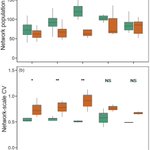
ALT Graphical abstract: We removed the most critical connection(s) of experimental habitat networks inhabited by Daphnia carinata to completely separate them into two sub-networks. The results showed reduced population size and stability across different topologies after the loss of connectivity. The results suggest that losing key connections can greatly increase extinction risk of populations in habitat networks.
ALT Graphical abstract: We removed the most critical connection(s) of experimental habitat networks inhabited by Daphnia carinata to completely separate them into two sub-networks. The results showed reduced population size and stability across different topologies after the loss of connectivity. The results suggest that losing key connections can greatly increase extinction risk of populations in habitat networks.

ALT Graphical abstract: We evaluated demographic responses of an enclosed population of brown treesnakes to two experimental perturbations: supplemental feeding followed by removal of the adult and sub-adult cohort 2 years later. Our results indicate that adding food to the system increased the population growth rate by 50% within 6 months and that removing the adults and large sub-adults temporarily suppressed growth and survival; however, the population growth rate recovered within a year. These findings provide insight into population dynamics that may influence current control efforts on the island of Guam and any future invasions into new areas.

ALT Graphical abstract: We evaluated demographic responses of an enclosed population of brown treesnakes to two experimental perturbations: supplemental feeding followed by removal of the adult and sub-adult cohort 2 years later. Our results indicate that adding food to the system increased the population growth rate by 50% within 6 months and that removing the adults and large sub-adults temporarily suppressed growth and survival; however, the population growth rate recovered within a year. These findings provide insight into population dynamics that may influence current control efforts on the island of Guam and any future invasions into new areas.


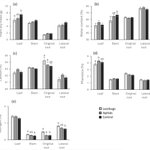
ALT Graphical abstract: This study examined how the exotic plant Solidago altissima responds to herbivory by two insect species with contrasting feeding modes: sap-feeding aphids and mesophyll-feeding lace bugs. Using a greenhouse experiment, we measured plant growth, water content, elemental composition, and phenolics across leaves, stems, and roots. Lace bug herbivory markedly reduced leaf dry mass and stem water content and altered nitrogen allocation patterns, including a reduced proportion of nitrogen allocated to leaves. In contrast, aphid herbivory caused no significant changes. These results indicate that S. altissima exhibits stronger physiological responses to mesophyll-feeding lace bugs than to aphids.