

Post-Soviet Affairs publishes theoretically informed, empirically grounded research on the politics, economics, societies, and IR of Eurasia and Eastern Europe.
Joined February 2026
- Tweets38
- Following20
- Followers169
- Likes8






Some papers have excellent data and careful analysis but never explain why readers outside a specialist niche should care - and never get published.
Associate Editor Ian Garner on getting the conclusion right in a submission to Post-Soviet Affairs 👇🧵

Don't just use the conclusion to summarize. Explain: What changes because we know this? What bigger debate does it speak to? How could another scholar build on or test what you've found?
What makes a journal article worth reading for a non-specialist audience? Associate Editor Mariya Omelicheva shares what she looks for in manuscripts submitted to Post-Soviet Affairs 👇🧵

Second, distinguish explanation from prescription. Establish what happened and why, using theory and evidence, before turning to what governments or others ought to do. Policy recommendations should follow from analysis, not substitute for it.
How do you get published in a journal like Post-Soviet Affairs? Over the next 4 days, our team is sharing advice based on the many submissions we read!
First, Editor Tomila Lankina on originality, evidence, and the abstract. 👇🧵

New, author-gathered evidence can make a real difference: interviews, archives, fieldwork or original survey data. Existing datasets aren't off-limits, but your evidence needs to let you say something distinctive—and support it convincingly.
Attending CEECON in Berlin next week? Hear from our Editor, Tomila Lankina, at a panel on publishing in uncertain times on October 8 @ 12:00
ceecon.de/en/program/publish…
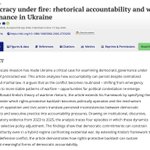
How does democracy function in wartime Ukraine? What constrains Zelensky's administration? Is there democratic accountability?
Discover all in Pavlo Otamas' new article in Post-Soviet Affairs ⬇️

The full article, "Democracy under fire: rhetorical accountability and wartime governance in Ukraine"
tandfonline.com/doi/full/10.…

Why did Central Asian states bring home citizens linked to ISIS when so many other governments refused?
Elena Zhirukhina's brand new article has the answer ⬇️❗️tandfonline.com/doi/full/10.…

One from our archives, from 1993: "Russia, Ukraine, and the Imperial Legacy"
tandfonline.com/doi/abs/10.1…
Post-Soviet Affairs retweeted

New OA article in @PostSoviet31355 with @J_neafie, C.McGarry, A.Aibassova. Developing our 2024 @barometer_ca report, we move beyond accounts of #CentralAsia’s Sinophobia to ask what drives support for and opposition to #China’s presence in the region. tandfonline.com/doi/epdf/10.…

Why did Russia's "muscular mediation" in Nagorno-Karabakh fall flat?
Check out this new article from Post-Soviet Affairs to find out ⬇️
tandfonline.com/doi/full/10.…
Post-Soviet Affairs retweeted

More on Patrushev:
- Putinism Beyond Putin: The Political Ideas of Nikolai Patrushev and Sergei Naryshkin in 2006-20 || @PostSoviet31355
researchgate.net/publication…
- Ukrainophobic Imaginations of the Russian Siloviki: The Case of Nikolai Patrushev, 2014-23 doi.org/10.13140/RG.2.2.3655…

Post-Soviet Affairs retweeted

In @PostSoviet31355, @sashkovska and @HussOksana examine how local Ukrainian communities (hromadas), formed during the decentralization reforms from 2015 to 2020, cope with the internal displacement crisis caused by the Russian invasion.
