

Real estate consumer advocate, rewarding DIY homebuyers & sellers w/ moneysaving menu since 1995. Compare buyer agent rebates to Redfin, propose your own fee
Cambridge, MA
Joined April 2007
- Tweets34.1K
- Following7.1K
- Followers5.9K
- Likes41.7K






Pinned Tweet
$125K over ask? Is “This is what housing scarcity looks like” or what greater fool’s housing market looks like?
Pls share details on brokerage(s) involved
Was corporate RELO or other “funny money” involved that juiced bidding war?
Time to leave MA or try #ProactHH? #MassExodus


Bill Wendel retweeted

BREAKING: US Pending Homes Sales collapsed -7.3% in September, to their lowest level on record in data going back to 2001.
The West saw the steepest decline of -9.2%, while sales in the South, the biggest home-selling region, fell -8.2%.
The housing market is frozen.

Bill Wendel retweeted

I asked Grok:
If the marriage rate continues as is or further declines, & the birth rate doesn’t increase, & we build a ton more houses to address the housing shortage in the short term, what do you predict will happen with the housing market in the US when the Boomers (people age 70+) pass away and their homes become available?
Oversupply of larger homes & downward pressure on prices in many markets, especially from the 2030s onward.
Key trends supporting this
Recent data shows the US total fertility rate at record lows around 1.6 (or slightly under), with marriage rates continuing to decline (median age at first marriage ~30 for men and ~28 for women). Married-couple households are down to roughly 47% of all households, while one-person households have risen to about 29%.
Baby Boomers/Silent Generation currently own/occupy roughly 36.7 million homes. Realtor.com projects they will release about 13.9 million of these between 2026 and 2036 (avg. ~1.4 million per year), with the pace accelerating and Boomers dominating after ~2029. Critically, most are not starter homes: only ~0.38 million are 0–2 bedroom units, while ~9.9 million are 3–4 bedroom “family” homes and ~3.6 million are 5+ bedrooms.
How the factors interact
• Building a large volume of new homes now reduces the current shortage in the near term (which is estimated in the millions of units). This increases the permanent housing stock.
• Persistent low marriage and fertility rates mean smaller cohorts of young adults entering prime household-formation years, more delayed household formation, more singles and cohabiting couples, and fewer large families needing multi-bedroom houses. Demand shifts toward smaller units or rentals rather than the suburban family homes Boomers disproportionately own.
• Boomer/Silent Generation release then adds a large, gradual wave of mostly larger existing homes (many paid-off, in established suburbs). This is not a sudden “tsunami” but a rising annual flow that peaks later than 2036.
The combination points to supply outpacing demand growth for much of the single-family market. Recent analyses already flag that slower demographic growth + continued construction can produce downward pressure on prices in some markets if household formation lags.
Likely outcomes
• Prices: Softening or real declines in many suburban & less-dynamic markets, particularly for larger homes. High-amenity coastal areas, strong job centers, and places with sustained immigration or in-migration are more likely to hold up. Starter/small homes may remain relatively tighter because few of the released Boomer homes fit that category.
• Inventory & composition: Much higher availability of 3–5+ bedroom houses. Some older stock may need significant updates or struggle to compete with newer builds. A portion will convert to rentals, increasing rental supply & moderating rents in some areas.
• Regional variation: Areas with aging populations, weaker job growth, or net out-migration (parts of the Midwest/Northeast) face the highest risk of excess inventory and price pressure. Sun Belt and high-growth metros are more resilient if they continue attracting people.
• Broader effects: Greater ownership accessibility for younger buyers in many places, but also potential issues with negative equity for recent purchasers if prices correct. Vacancy rates could rise in weaker markets. Overall housing construction needs would fall relative to the recent past once the current shortage is addressed.
Important caveats: Immigration is the biggest wild card—if net immigration remains high, it can absorb a substantial share of the released and newly built homes. Economic conditions, interest rates, zoning/policy changes, and preferences (e.g., more urban living or multigenerational households) will also matter. Aging in place is already strong, so the release is gradual rather than abrupt.

Bill Wendel retweeted

America appears in a homebuyer recession.
Mortgage purchase applications are down 60% from their pandemic peak, per Redfin.
Demand is now back near 1995 levels, lower than at any point during the 2008–2012 housing crash.
It comes as mortgage rates sit above 7%, pending home sales hover near record lows, and a record 14% of September deals were canceled.
Bill Wendel retweeted

America's home sellers now outnumber buyers by 63% - the biggest gap since the housing crash trib.al/vb6colD

Bill Wendel retweeted

A large headwind on U.S. real estate right now is the differential in cost between buying and renting.
In October 2026 the typical mortgage payment is $2,886 inclusive of taxes/insurance.
Meanwhile, the cost to rent is $1,950/month.
The result is a 48% premium ($936/mo) to buy versus rent. The largest such premium since the previous housing bubble in the mid-2000s.
Which is a stark contrast from the 2010-2021 period.
Back then, the cost to buy and rent was identical, which served as jet fuel for homebuyer demand.
Now, not so much. Mortgage Payments have grown 96% over the last seven years, with rents up just 38%, and wages 37%.
Meaning that households are saving money by renting instead of buying.
And thus, they're content to rent.
Check to see Buy v Rent Differential in your Market on Reventure today: reventure.app/map/LZ9BqPcSlh

Bill Wendel retweeted
The U.S. housing market is experiencing one of the worst homebuyer demand recessions in history.
Mortgage purchase applications have collapsed 60% from their pandemic peak.
Demand is now back near 1995 levels, and even lower than at any point during the 2008-2012 housing crash.
Think about that. There are fewer mortgage purchase applications today than during the worst years of the foreclosure crisis.
Homebuyers have effectively gone on strike.
And that's a big problem for sellers.
Because roughly 70% of home purchases are financed with a mortgage. And that's likely to put even more downward pressure on home prices.
The silver lining?
It's a great time to make low ball offers, and pick up houses at big discounts in late 2026.
To see where mortgages have dropped most, search your ZIP on Reventure: reventure.app/map/jYRFYxGKsw

Bill Wendel retweeted

UPDATE: As of this morning, 43.4% of all US homes for sale are now undergoing price cuts.
This is the highest read all year, up an additional 70 basis points from this time last week.
Two tiers continue to emerge at the top of price cutting behavior.
Tier 1 (highlighted in white) - Danger zone:
Oregon: 52.3% (+96 basis points week on week)
Colorado: 52.1% (+1.2% week on week)
Tier 2 (highlighted in blue) - Elevated on watch zone:
North Carolina: 49.1% (+82 basis points week on week)
Indiana: 48.9% (+62 basis points week on week)
South Carolina: 48.4% (+20 basis points week on week)
Texas: 48.2% (+62 basis points week on week)
Utah: 47.8% (+20 basis points week on week)
Arizona: 47% (flat week on week)
Notably, the rate of acceleration in the tier 1 danger zone states of Oregon and Colorado is outpacing tier 2.

Bill Wendel retweeted

BREAKING: @SenWarren just launched the Trumpflation Tracker.
Spoiler alert: Americans are seeing higher prices, shrinking paychecks, and suffocating household debt.
Bill Wendel retweeted
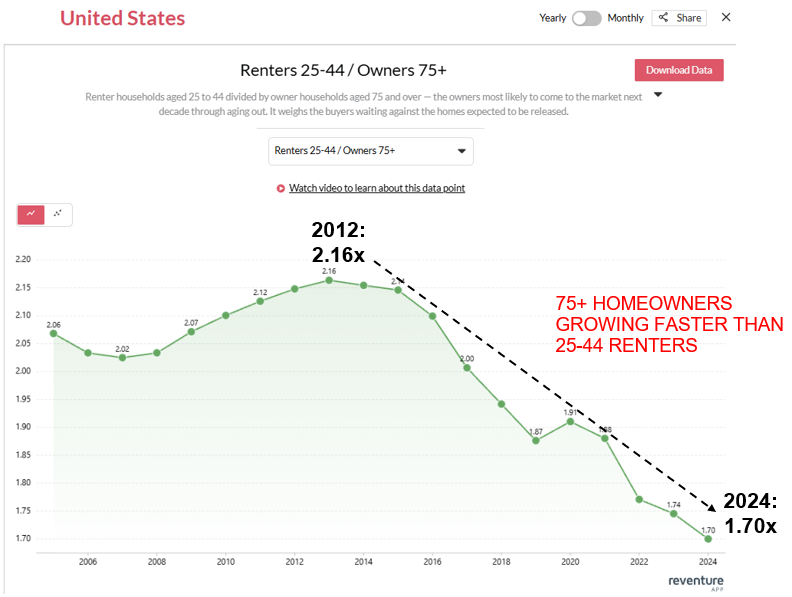
A structural shift is taking place underneath the surface of the U.S. Housing Market.
And it could unleash a lot of pent-up housing supply.
Over the last 12 years, the number of 75+ Homeowners has grown significantly gaster than 25-44 year old renters.
As a result, the ratio of 25-44 renters to 75+ homeowners has dropped from 2.16x in 2012 to just 1.70x in 2024.
And some states are already below 1.00x.
Meaning there aren't enough future first-time buyers to absorb the future supply from senior homeowners aging out.
Check the 75+ Owner to 25-44 Renter metric for your ZIP: reventure.app/map?geo=county…
Bill Wendel retweeted
Is the problem in U.S. housing right now home prices or mortgage rates?
The answer is clear when looking at data back to 1890.
It's real home prices that are way out of line with historical norms, roughly 90% above the long-term average.
Meanwhile, 7% mortgage rates are well within the realm of normal.
In fact, mortgage rates in the 1990s were 8-9%, and the market was healthy.
The reason that home sales are at 2008 levels right now is because prices are too high, not because rates are north of 7%.
Lower the home prices, and buyers will come back into the market.
Check to see if prices are already dropping your ZIP at reventure.app/map.

Bill Wendel retweeted
A mass homebuyer exodus is hitting Miami.
Transactions have fallen 47% from their pandemic peak.
From 3,600 in August 2021.
To only 1,900 in August 2026.
This represents the lowest sales activity Miami-Dade has seen since the end of the last housing crash.
In fact, sales today are about 25% below pre-pandemic norms.
The reason this is happening is because locals in Miami cannot afford the prices.
The typical mortgage payment in Miami-Dade, inclusive of taxes and insurance, is $5,000/month.
While the local median income is only $80,000.
The math simply doesn't make sense, and buyers are locked out as a result.
Zoom in to your ZIP to see sales and price data at reventure.app/map?geo=county…

Bill Wendel retweeted
U.S. Mortgage Applications just fell back to the lowest level since 1995.
And are now down 50% from the pandemic peak.
Demand to buy with a mortgage today is shockingly at the same level as 31 years ago, even though U.S. population is 30% higher.
The reason demand is so low is due to sky-high home prices, which are in a massive bubble.
To go along with sky-high prices, mortgage rates are now back to normal at 7%.
Meaning the vast majority of buyers can't afford it, with the typical household needing to spend nearly 40% of their gross income on house payments.
This historic demand collapse will not improve until home prices drop meaningfully.
And the situation is becoming especially dire in America's highest cost markets.
Check your ZIP on Reventure to see where your market ranks: reventure.app/map?geo=county…

Bill Wendel retweeted

People keep saying Trump term II is the most corrupt administration ever, so I built a model to find out if it was true.
I took the UN's definition of corruption, turned it into eight criteria and 100 points, and scored the leaders history remembers for looting their countries: Marcos, Suharto, Mobutu, Abacha, Obiang, Putin.
Then I put every president since Eisenhower on the same scale, both parties, with every exoneration counted right alongside the convictions.
Nixon scored 41 and no other American President scored over a 25.
Trump's second term scored a 91, which ties him with Suharto and Mobutu and puts him above Marcos and Abacha.
So he is not only the most corrupt president in American history. At this pace he finishes his term level with the most corrupt rulers of the last hundred years.
PSA: don't come in my comments arguing about the results if you haven't read the full article, because ignorance is a choice.
Full article is up now on my Substack (link in bio) and it's free.

Bill Wendel retweeted

Trump is a failing authoritarian whose approval ratings are tanking. Like any bully, when he feels humiliated, he lashes out.
But what he doesn’t realize is that his authoritarianism and his bullying are waking up America’s great sleeping giant.
Bill Wendel retweeted
America is getting dangerously close to having more seniors than children.
In 2005, there were 2.1 Americans under 18 for every person over 65.
Today, there are only 1.2.
And by 2030, the ratio will dip below 1.0, indicating the U.S. will be in organic population decline.
(in fact, states like Florida are already there)
This means fewer young people entering their prime homebuying years.
And more aging homeowners downsizing and passing homes to their estates.
In other words: fewer future buyers competing for a growing number of homes owned by older Americans.
Almost nobody in housing is paying attention to this yet.
Check the demographic ratio for your ZIP on Reventure: reventure.app/map?geo=county…

Bill Wendel retweeted

"The most powerful people in the world are preparing for the end of the world, an end they themselves are frenetically accelerating. Indeed, in a strange twist on the Old Testament tale, the oligarch class, having arrogated godlike powers to themselves, aren’t content to just build the arks. They appear to be doing their best to cause the flood"
- END TIMES FASCISM - And the Fight for the Living World, by Naomi Klein and Astra Taylor. Coming Sept 15.

Extremely severe extinction events happen every 100M years or so and just switching to sustainable energy will not be enough to stop them.
Space satellites to control temperature and massive geo-engineering will be needed or it will be game over.
grok.com/share/bGVnYWN5_dfaa…

Bill Wendel retweeted

I’ve been sounding the alarm on AI for a long time
Bill Wendel retweeted

BREAKING: Senator Elissa Slotkin just signed onto the End Trump’s Tariff Tax Act which would take a sledgehammer to Donald Trump's ability to levy tariffs and provide rebates to the American people. We need to pass this now.

Bill Wendel retweeted
Don't look now, but U.S. Housing Inventory is now almost back to pre-pandemic levels.
Aug 2019 supply: 1.24 million listings
Aug 2026 supply: 1.14 million listings
Meaning the U.S. is now within 8% of its pre-pandemic supply.
Current supply levels are also 17% above the August average since 2017.
And it's possible by next year, that the U.S. Housing Market will hit above pre-pandemic supply
(it already is in the South and Western parts of U.S.)
Meaning no 'housing shortage' anymore.
There's plenty of homes for sale in most markets.
They're just too expensive.
Check updated inventory metrics for your city here: reventure.app/map?geo=county…
