
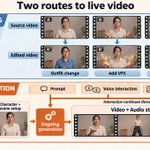
With live editing, creators can change a host’s on-screen outfit, add visual effects, or swap faces while the stream is running. The source video supplies the timing and movement.
At Philo, we’re tackling a harder problem in live generation. A reference image can establish what the host looks like, and a prompt can set the direction. The model has to generate the host’s movements and speech in real time without a source performance to follow.
If a new request comes in while the host is already moving, the response needs to pick up from their current pose and momentum. Each action changes what can plausibly happen next. Getting that sequence to hold together is what makes it feel like a single performance.

In the café example, hanging up the coat is a small action. It also changes the scene. The coat is now on the back of a particular chair.
Act → Update the scene → Carry that state forward → Act again.
A few minutes later, “Let’s go” is enough to decide it’s time to leave. Where to reach depends on what the character did when they sat down.
That’s part of the long-session generation problem we’re working on at Philo. The effects of one action have to be available to the next decision, even after several turns of conversation.

Yesterday we talked about how fast video generation has become, and what continuous streaming adds. You can say, “Let’s sit by the window,” and the character can change course mid-action.
We also care about what happens later in the story. After you’ve spent some time together and changed plans a few times, does the scene still reflect what happened earlier?
Say the character hung their coat on the back of the chair when you sat down. You’ve been talking for a while. When you finally say, “Let’s go,” they reach back and pick up the coat where they left it.
That’s how I think about long-session stability at Philo. The character still looks like the same person, and something they did minutes ago can still shape what they do now. You can stay in the story because the scene keeps track of what happened along the way.

1
44
Inference speed tells us how quickly a model can generate a clip. Streaming interaction asks what happens when the user gives an instruction while the video is still being generated.
The same model family can support both workflows. fal’s H3 Max has a clip-generation endpoint, and H3 Max Director lets users send new instructions during an ongoing session to steer what’s generated next.
At Philo, I’d evaluate that interaction with three questions.
• Does the session stay active as the user keeps giving input?
• What state does the system carry forward from one segment to the next?
• How long after a new instruction arrives does the user see its effect on screen?
In the café example, I’d send “Let’s sit by the window” while the chair is still moving. Then I’d time how long it takes to see the chair change direction and check that the new motion picks up from where the chair and the character’s hand already are.
Fal’s H3 Max can generate a five-second clip in about three seconds. That’s a big step forward for video generation.
Fast is good, but fast alone isn't enough.For interactive video, speed is only the starting point. The video has to keep streaming and respond to you in real time.
Imagine a character is halfway through pulling out a chair when you say, “Let’s sit by the window.” They slide the chair back under the table, pick up their coffee, and head over to the window.
That’s the continuity we’re building at Philo. You can speak up mid-action, and what you say shapes what happens next in the same scene.

38
Seedance can generate, edit, and extend a dance sequence. For a live interaction, I'd also want to know when a new request actually changes the movement.
I'd separate two moments:
① The character acknowledges you.
② Their action begins to change.
A quick "sure" can happen before the body responds. The model still has to continue from the pose it's already in, produce the change in movement, and carry the resulting state into the next exchange.
That's why I'd want to see the request and the response in one continuous take. The transition is part of the capability.
"Wait. Show me that turn again."
In a finished dance video, the teacher carries on with the routine. You can replay it or make another version.
With real-time interactive video, we want the character to be able to take that request while they're still moving: slow down, show the turn another way, and pick up from there.
Then you ask something else.
That next exchange needs to build on what just happened. The interaction keeps developing, with the same character, instead of sending you back to the start.

2
43
In offline video generation, the prompt shapes a clip before the viewer plays it. In an interactive stream, the viewer can speak while the character is already talking or moving.
You ask GTA Jensen for a week off. While he’s answering, you jump in with, “Actually, can I take two?” He pauses, then answers the new question. All of that happens in the same call.

Side quest: GTA 6 ✅
Main quest: resumed.
Next mission: digital life, face to face.
GTA Jensen, call me anytime.
Lesson one: how to take a week off for GTA 6.
2
69
Real-time avatar systems can already use personality and memory to shape a conversation.
Once a character can act in a scene, there's a bigger loop to keep coherent:
Remember → Decide → Act → Observe → Decide again.
A remembered event might change which object they reach for, how they carry out a task, or whether they follow your suggestion at all.
The decision has to carry through speech and movement. The next decision has to use what actually happened in the scene.
That's why, for us at Philo, personality and memory are part of the video generation problem, too.
We want AI characters with personality. Who they are should be a big part of why you enjoy spending time with them.
What makes them laugh. What they'll argue with you about. What they remember from weeks ago, and what they want to bring up next.
Real-time avatars have made face-to-face conversation possible. At Philo, we want personality and memory to show up in the character's actions, too:
• What they choose to do.
• How they carry it out.
• How their actions change the scene.
That's the kind of digital life we want people to build relationships with.

1
46
In a speech-driven real-time avatar system, audio guides lip movement, expression, and gesture.
Alex's example adds a different problem. The hand is already moving when the new instruction arrives.
The model has to redirect that reach from its current position, keep the cup moving with the hand after pickup, and preserve where it ends up for the next interaction.
That's the task we're working on at Philo: generating the character's actions and their effects on the scene, alongside speech.

I'd love to build a relationship with an AI character through the things we do together.
And I'd probably be a slightly annoying person to do those things with.
Let's say we're making tea. They reach for a cup, and I interrupt halfway through: "The other cup."
That's just how people interact in real life. We join in, change the plan, and end up with little moments that belong to us.
I'd love to have that kind of history with an AI character. Something we can pick up again next time.

3
66
Reo Chen retweeted

$NVDA - U.S. HOUSE REVEALS 3.4 MILLION CHIP EXPORT APPLICATIONS TO CHINA, INCLUDING 445,000 NVIDIA H200s
The U.S. House Foreign Affairs Committee released new details on export-license applications for advanced American AI chips.
As of May 2026, the Commerce Department had received applications covering 3.4 million chips destined for Chinese companies.
🔸 Alibaba: 948,950
🔸 Tencent: 150,000
🔸 Baidu: 43,000
🔸 BYD: 4,000
Separately, Nvidia sought authorization to ship 445,000 H200 AI chips to Tencent in December 2025.
The disclosures intensify scrutiny of U.S. semiconductor exports to China.
Applications do not necessarily indicate approved licenses or completed shipments.
Full-duplex in speech model is blooming while it's still pretty hard to get the image delivered in real time.

Do you built intelligence into the full duplex model, or hand-off to an asynchronous backend? There are two popular architectures for full duplex models today, which one will win in the long term?

34
It means a lot when you get faster

Voice AI that can listen while it speaks.
Haru-4B is a 4B speech-to-speech model built for full-duplex conversation. It processes audio every 133ms, supports 9 languages, and can run with about 12GB of VRAM.
huggingface.co/higurashi-ai/…

14


Congrats @rissa_cao and team!
congrats!
knowing when to listen, pause, or jump in is such a big part of making AI feel natural. i think this gets even more interesting when voice, gaze, and facial expressions all respond together in real time.
46


Awesome work in one-shot

I wanted to test Fable 5.2's quality with one-shot prompts without human feedback.
Everything in this game is from scratch: models, sounds, textures. ~$550 at API pricing, ~2.7M output and 445M input tokens, heavily cached. Took 8 hours!
Play it here: claude.ai/artifact/BGY1SztrA…
35
Reo Chen retweeted

Full-Duplex Models and Systems. Key Ideas and Papers. Moshi (@neilzegh @lmazare), Full-Duplex-Bench (@HungyiLee2 @shinjiw_at_cmu), τ-Voice (@karthik_r_n), STITCH (@LINJIEFUN), FLAIR (@tianyu_zh), Stream RAG (@Sid_Arora_18), Qwen-Audio (@TONGYI_SpeechAI)


To truly understand or predict something, you must first be able to compress it.

Memory is what allows Claude to learn from experience. In a new Engineering Blog post, we share how “dreaming” helps Claude organize what it’s learned, correct its mistakes, and find what it needs more easily the next time. anthropic.com/research/compo…

15