

Pictures and events from the 170+ year history of the SBC in particular and other notes of Baptist history as well. Tweets by @lukeholmes
Worldwide
Joined March 2017
- Tweets2.5K
- Following118
- Followers7.7K
- Likes760




We know about so many heroes of the faith, but we have forgotten many too. Let me tell you about some of them.
One of the frustrations of studying Baptist history is discovering books that have been out of print for decades, sometimes more than a century. Many are available as old scanned PDFs, but they can be difficult to read, poorly formatted, and nearly impossible to use on a Kindle or other device.
So I've started bringing some of these books back to life.
I've taken original public domain Baptist books, cleaned up the text, corrected scanning errors, and reformatted them into readable modern editions. My goal is to make important works of Baptist history, missions, biography, and theology more accessible to today's readers.
The collection includes books about early Baptist missionaries such as Lott Cary, Henrietta Shuck, and Luther Rice; Baptist history in Louisiana and the American South; and classic works by Charles Spurgeon, John Bunyan, and others.
I've called the project "The Baptist Book Shelf."
There are currently 20 books in the collection, with more on the way. Two are available as free PDF downloads, and the others are available at a modest price. Several are also available in Kindle and paperback editions on Amazon. I can only add two books a week on Amazon, but have almost 30 ready to go live as soon as I can. No matter what format you need, you can find it.
This has been a labor of love. I enjoy Baptist history, and I believe these books deserve to be read rather than forgotten.
I'd invite you to take a look, download one of the free books, and browse the collection. And if you know someone who enjoys Baptist history, I'd appreciate you sharing it with them.
buff.ly/4CKWOjj

OTD in 1962, trustees of @MBTS dismissed Old Testament professor Ralph Elliott following a controversy over his book The Message of Genesis.
Published in 1961 by the SBC's Broadman Press, the book challenged traditional interpretations of Genesis, including the historicity of Adam and Eve and the worldwide flood. Elliott's refusal to prevent the book's republication ultimately led to his dismissal.
The controversy became one of the most significant theological disputes in Southern Baptist life during the 1960s and helped prompt the revision of the Baptist Faith and Message in 1963.
In 2013, three Southern Baptist historians revisited the controversy in a panel discussion at Midwestern Seminary, moderated by President Jason Allen.
Read the Baptist Press account of that discussion:
buff.ly/031jDpt

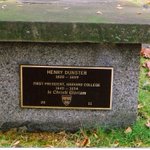
OTD in 1654, the overseers of Harvard College accepted the resignation of its first president, Henry Dunster, following his public rejection of infant baptism.
Dunster had served as Harvard's president since 1640 and helped establish the young college as a leading institution of higher education in colonial America. However, his growing conviction that baptism should be reserved for professing believers brought him into conflict with Massachusetts' Puritan religious establishment.
His refusal to remain silent about his beliefs ultimately cost him his position at Harvard.
Although Dunster never formally joined a Baptist church, his convictions on baptism made him an important early figure in the history of Baptist beliefs in colonial America.

OTD in 1970, Baptist Press reported that eleven staff members of First Baptist Church in Birmingham, Alabama, had resigned following a controversy over racial discrimination.
The dispute began when Winifred Bryant and her 11-year-old daughter, Twila, who had participated in the church's neighborhood tutoring ministry, sought membership in the all-white congregation. After two months of controversy, the church voted to deny their membership.
Pastor Herbert Gilmore and youth director Betty Bock announced their resignations, declaring they would not serve a “racist church.” Nine additional staff members subsequently resigned in support.
The controversy deeply divided the congregation. An earlier attempt to dismiss church ministers had failed by just four votes, 237–241. Following the membership decision, approximately 300 members walked out in protest, calling themselves the “Company of the Committed.”
The protesting members pledged their financial support to the departing staff and began discussing the possibility of forming a new church.
Associate pastor John Sims explained that the disagreement was not simply about church programs or differing opinions, but concerned the church's understanding of and commitment to “Christ, his church and his gospel.”
The October 22, 1970, Baptist Press report provides a remarkable look at the struggle over racial discrimination within Southern Baptist churches.
Read the original report below.


OTD in 1833 John Davis, a Creek Indian, was ordained by Isaac McCoy near Muskogee. Davis was the first Baptist to be ordained in Indian Territory. McCoy had worked with Luther Rice and was working in IT as an agent of the US Govt and used that position to do mission work in IT.


On this day in 1837 the General Association of Baptists in Kentucky was officially organized in the meeting house of the First Baptist Church of Louisville (now @walnutstreetbc). In 1960 they changed their name to Kentucky Baptists.

Jazz music in a Baptist chapel? Shorter sermons followed by questions? Replacing traditional church music with folk songs?
In the 1960s, Oklahoma Baptist leader Floyd Craig challenged churches to rethink how they communicated with college students during a chapel address at Oklahoma Baptist University.
Craig argued that outdated language, traditional music, and even familiar religious symbols were contributing to a growing communication gap between churches and young people. He suggested some rather unconventional solutions, including ten-minute sermons, dramatic presentations, and contemporary Christian music.
To make his point, Oklahoma Baptist music leader Gene Bartlett performed an original jazz composition, accompanied by a small instrumental ensemble, while students joined in singing the chorus.
The Baptist Press account is a fascinating glimpse into how Southern Baptists were wrestling with changing culture and church traditions in the 1960s.
Read the original Baptist Press story below

OTD in 1555, Protestant bishops Hugh Latimer and Nicholas Ridley were burned at the stake in Oxford, England, during the reign of Queen Mary I, often remembered as “Bloody Mary.”
Both men had been prominent leaders of the English Reformation and refused to renounce their Protestant convictions and return to Roman Catholic teaching. They were among hundreds of Protestants executed for heresy during Mary's reign.
As the flames were lit, Latimer reportedly encouraged his fellow martyr with words that became among the most famous of the English Reformation:
“Be of good comfort, Mr. Ridley, and play the man! We shall this day light such a candle by God's grace, in England, as I trust never shall be put out.”
Their deaths on October 16, 1555, became an enduring symbol of the struggle for religious reform in England.

OTD in 1882, Southern Baptist missionaries Zachary Clay Taylor and William Buck Bagby established the first Baptist church in Brazil organized for Brazilian converts, in Salvador, Bahia.
The church was organized with five charter members: Taylor and his wife, Bagby and his wife, and Antônio Teixeira de Albuquerque, a former Catholic priest who had embraced believers’ baptism after studying the New Testament.
The missionaries had arrived in Brazil with the support of the Southern Baptist Foreign Mission Board, now known as @IMB_SBC. Their work helped establish the foundation for what would become one of the largest Baptist movements in the world.
From those five charter members in Salvador, Baptist churches would eventually spread throughout Brazil, reaching millions with the gospel. Pictured is Mr and Mrs Bagby

OTD in 1752, Elizabeth Backus, a widow and mother of Baptist preacher Isaac Backus, was arrested and imprisoned for two weeks for refusing to pay a religious tax supporting the established Congregational church in Connecticut.
Although a 1728 law had provided some tax exemptions for Baptists, those protections did not extend to all church-related taxes. Baptists and other dissenters continued to face fines, imprisonment, and the seizure of property for refusing to financially support churches whose beliefs they did not share.
Her son, Isaac Backus, would become one of the most influential Baptist advocates for religious liberty in colonial America, spending decades fighting against religious taxation and government-established churches.
Elizabeth Backus's imprisonment was one example of the persecution that helped shape the Baptist commitment to religious liberty and the separation of church and state.

OTD in 1832, 37 new converts were baptized at Muscogee Baptist Church in Indian Territory, present-day Oklahoma. Among those baptized were 10 Creek (Muscogee) Indians and 27 enslaved African Americans.
Muscogee Baptist Church was the first Baptist church established in what is now Oklahoma. It was organized in September 1832 by Isaac McCoy, a Baptist missionary who devoted much of his life to ministry among Native American tribes.
McCoy was a strong advocate for Baptist missions among Native Americans and helped establish churches and mission schools throughout the frontier. His work helped lay the foundation for Baptist life in Oklahoma long before statehood.

"If I had a thousand lives to give, I would give them all for China."
Lottie Moon was 32 when she left for China in 1873, and her ministry there lasted nearly 40 years. Janet and Geoff Benge tell her story in "Lottie Moon: Giving Her All for China" — written for readers 10 and up, so it's a good one to share with the grandkids. Kindle or audiobook (audiobook free with an Audible trial, new members).
buff.ly/B5N38MF (paid link)

In 1980 a dissident Soviet Pastor declared that Russian Baptists who manage to stay out of prison do so "at the price of compromise." Another pastor accused the Baptist World Alliance of "harboring agents of the Soviet government."

OTD in 1665, five Baptists were brought before the Massachusetts General Court for holding worship services outside the established church.
Thomas Gould and four other Baptists had organized what would become First Baptist Church of Boston. Authorities accused them of “schismatical” practices and ordered them to stop meeting.
When the men refused, the court declared their church illegitimate, stripped some of their civic rights, and threatened them with imprisonment if they continued worshiping together.
The Puritans had come to Massachusetts seeking religious freedom, but were unwilling to extend that same freedom to Baptists and other dissenters.
It would be generations before the religious liberty these early Baptists fought for became a fundamental principle of American life. Pictured is the churches founding records llisting the names of the men.


OTD in 1917, the State of Louisiana approved the legal charter for the Baptist Bible Institute in New Orleans.
The school was established by Southern Baptists to train pastors, missionaries, and other Christian workers for ministry.
It later became New Orleans Baptist Theological Seminary, @nobts, and continues training men and women for ministry more than a century later.


OTD in 1664, Baptist pastor Benjamin Keach was fined and sentenced to stand in the pillory for publishing a children’s catechism that taught believers’ baptism.
Keach continued preaching and writing despite the persecution and became one of the most influential English Baptists of his generation. He was later a signer of the 1689 Baptist Confession of Faith and is traditionally associated with the 1693 *Baptist Catechism*, often called “Keach’s Catechism.”
He was punished for teaching Baptist convictions that generations of Baptists would later freely teach their own children.
OTD in 1609, John Clarke was born.
Clarke was one of the earliest Baptist leaders in America and helped establish the Baptist church at Newport, Rhode Island.
His Baptist convictions led to imprisonment in Massachusetts, an experience he later described in *Ill Newes from New-England*. Clarke became a tireless advocate for religious liberty and helped secure Rhode Island’s remarkable 1663 royal charter from King Charles II, protecting religious freedom in the colony.
Pastor, physician, and defender of religious liberty, Clarke helped establish principles that would eventually become central to American life.

OTD in 1536, William Tyndale was executed for his work translating the Bible into English.
As he was strangled and burned at the stake, his final prayer was reportedly, “Lord, open the King of England’s eyes.”
Within just a few years, English Bibles drawing heavily from Tyndale’s translation were authorized for use in English churches.
Tyndale died a condemned man, but his words would soon be read throughout England, and much of his translation still echoes through English Bibles today.
Want to read more? Read or listen on Audible Tyndale: The Man Who Gave God An English Voice. It's an excellent account of Tyndale’s life, translation work, and legacy. link.amazon/B044q8Adb (Paid Link)

OTD in 1783, William Carey was baptized by John Ryland Jr. in the River Nene in England.
Carey had recently come to Baptist convictions and would soon become one of the leading voices calling Baptists to take the gospel to the nations.
Less than a decade later, Carey and Ryland would become co-laborers in the formation of the Baptist Missionary Society. In 1793, Carey sailed for India, beginning the missionary work for which he is still remembered.

OTD in 1907, Herschel Hobbs was born.
One of the best-known Southern Baptist statesmen of the 20th century, Hobbs served for nearly 25 years as pastor of First Baptist Church of Oklahoma City, and as president of the Southern Baptist Convention.
He also chaired the committee that produced the 1963 Baptist Faith and Message, helping shape the statement of faith used by Southern Baptists for the next generation.
Millions also knew his voice as preacher of "The Baptist Hour*" where he served from 1958–1976.
Pastor, preacher, author, and denominational statesman, Hobbs left a lasting mark on both Oklahoma Baptists and the SBC.
