





SOLO retweeted

“why do banks share data with @SOLOAPI” is the most common question I get

Could banks earn money from identity checks they’ve already paid to complete?
“You can capture the economics or a data middleman can.”
@georginamerhom, founder and CEO of @SOLOAPI, speaks with @katieeperry on This Week in Fintech Partnered about the incentives behind reusable KYC.
One institution could get paid for its verification work. Another uses those checks to onboard a customer, provided they meet its compliance standards.
Listen in: youtu.be/Bcv76SAbQTo
Sponsored episode, produced in partnership with @SOLOAPI.
SOLO retweeted
You gave permission to share your data. Did you lose control of it, too?
“It kind of just enters a void and the customer forgets who has what.”
@georginamerhom, founder and CEO of @SOLOAPI, speaks with @katieeperry on This Week in Fintech Partnered about the fear behind data sharing: your information being used against you.
They discuss consumer control, reusable identity verification and KYC. If one bank has already verified who you are, why should you have to start again?
And as AI agents start making payments, who controls identity and permission?
🎧Listen in: youtu.be/Bcv76SAbQTo
Sponsored episode, produced in partnership with @SOLOAPI.
KYC Certificate: @georginamerhom
✓ human
✓ verified owner + authorized representative of @SOLOAPI
✓ verified in person by @BankTechVC, @CoastalBankWA, @Clear + 16 others
✓ attested to by @ransomthoughts, @bthamilton, @kgilliamsolo + 54 others
If additional evidence is required, you may contact the furnishers directly.

someone came up to me today and confessed he’s spent the last two years assuming I was an AI-generated character created to promote @SOLOAPI
SOLO's GraphQL is live — any bank, fintech, or data provider can now issue and query credentials, verifications, and furnish customer data through one open, customer- permissioned graph.
Credential and data acceptance are governed by each querier’s own policy standards, with auditability, provenance, and evidence preserved for everything published to the network.
GraphQL makes it possible to move verified processes, not just customer data. Enabling interoperability without forced uniformity on policy standards.
Read more on how the GraphQL works, and request access
solo.one/blog/graph-ql
SOLO retweeted

i’ve made numerous posts about the idea of a shared KYC/KYB layer, where users don’t have to complete the same verification process over and over every time they sign up for a new app.
a lot of people ripped into me, saying it wasn’t possible, wouldn’t work, or would never get adopted.
so i’m very happy to announce someone has built exactly that:
@georginamerhom is the CEO of @SOLOAPI, a shared identity network that lets banks and fintechs reuse KYC/KYB that has already been completed instead of starting the entire verification process from scratch every time.
the network already includes 10 sponsor banks and 240+ fintech programs.
when a customer has already been verified by one institution, another institution can reuse that verification as long as it meets its own compliance standards.
this is pretty much exactly what i’ve been talking about when i say KYC should become reusable infrastructure rather than something every financial app has to redo from scratch.
really cool to see Georgina and her team actually turn this into real word infra.
SOLO retweeted

Re-usable KYC is finally getting traction in the US.
Customers don't want the friction of submitting their documents multiple times to open new accounts. Ideally, they could securely share proof that they've done so before.
Well. Now they can. Recent Federal banking regulator and FinCEN FAQ guidance clarified how this process works, and they ran a working pilot with large financial institutions.
This has been something @SOLOAPI has been working at for years with sponsor banks and fintech companies, but now they're opening their graph to any financial institution and accounting firms too.
Georgina Merhom explains how it works below 👇
SOLO retweeted
Great read. Thank you for the generous write up on @SOLOAPI!

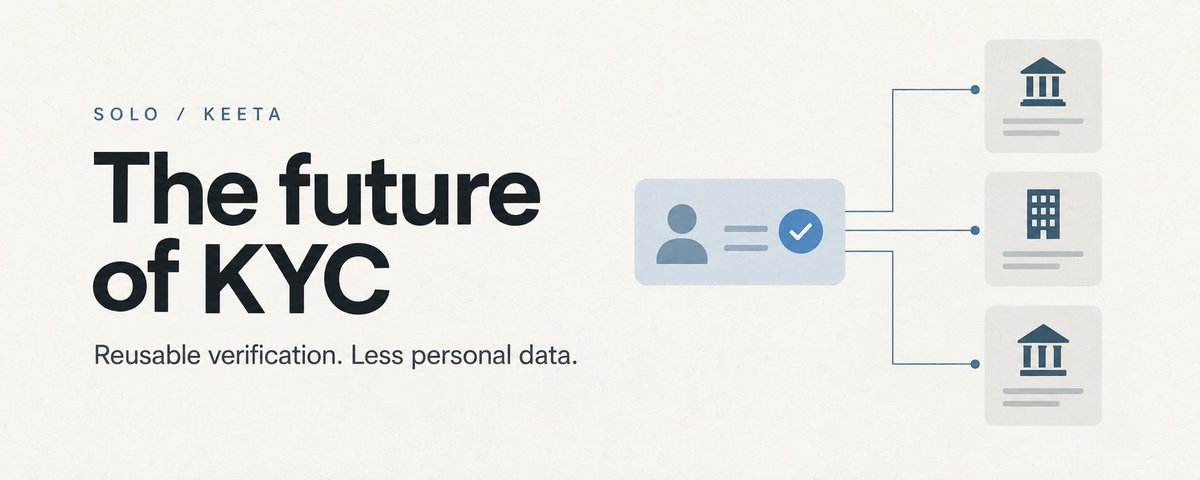
Hester Peirce’s comments on the future of KYC got me thinking about what @SOLOAPI and @KeetaNetwork are building. I think there’s a big opportunity for these two to take things further together. Here’s why.
The most instructive finding in this Conversion Scorecard is not the winner or the loser. It’s what happened at @Novo_HQ, @relayfinancial, and @rhobusiness
All asked for document-based KYC and KYB: an ID document upload, a selfie check, and an articles of incorporation upload.
They still landed in the upper half of the pack, but left all of this work on the table for the customer to do. Not just once. But with every provider in almost the exact same method.
If any of the fintechs implemented a KYC or KYB credential that let the customer skip the uploads and the liveness checks they’d already completed elsewhere, while still satisfying their own existing CIP and CDD policy, they would move up the rankings immediately.
Fewer uploads, less manual entry, fewer screens, and 4-10 minutes off total application time.
More on their opportunity at solo.one/blog/business-banki…
Insights from the loser: @Truist scored a 22.3, a record low for the scorecard, with a nonfunctional application experience.
A service-unavailable error appeared at the end, and never cleared.
This came after 31 manually entered fields across 10 screens, with no pre-fill of any kind, and after the applicant had apparently reached a pending-decision state.
The flow re-asked address, phone and SSN across screens, and repeatedly prompted a login to a Truist account the applicant did not have.
As of this review, the application's fate is unknown.
Get the full scorecard review and category rankings, plus more info on the industry wide opportunities that still exist, at solo.one/blog/business-banki…

We have a new winner (and a new loser) on conversion for business bank account applications.
Taking the top spot: Lili scored an 87.2 out of 100 with our Conversion Scorecard. Beating last episode’s winner, @Square for the top spot.
And last place: @truist unseating Slash with a score of 22%.
Watch the full review and see where the rest of the new players ranked at solo.one/blog/business-banki…
Insights from our winner: Lili’s experience took 6:47 total from the first field to an active, funded account. Why didn’t they score 100%?
A significant amount of manual data entry still existed across 20+ fields and 13 screens.
Additionally, from the applicant's seat, Lili asked for no ID document upload, no biometric check, and no document-based verification of the operating address.
This usually means those steps were delayed until later in the customer lifecycle — a pattern we see often when a fintech wants to ‘game’ the funnel, but regulated sponsor banks and their compliance requirements still sit behind the program.
The cost is that the same friction reappears after the money has been spent to open the account, and becomes a reason for closure rather than abandonment.
Had Lili pre-filled their application + fulfilled KYC / KYB steps with certificates issued by a fintech or bank that already did that work, rather than put the burden on the customer, we would see their score even higher.
Banks vs. Fintechs: how big is the customer experience gap at account opening?
This week’s Conversion Scorecard on Consumer Deposit Accounts revealed that both segments have largely solved for a frictionless consumer application. Our winner, @current, scored an impressive 86/100.
All 6 applications performed well, especially compared to our findings on business banking account experiences. Most were completed within 5 mins or less.
However, an approved application doesn’t equal an active account. Which is one of our requirements for full conversion.
Drop off still happens when you ask someone to get their ID from the other room, re-enter information you should already know, or connect an external account with a method that fails more than half of the time.
Our findings: delayed friction isn’t removed friction, and it can still cost a fintech or bank the unit economics of their funnel.
View our full Scorecard, plus real customer insights for operators preparing their customer experiences for upcoming raised bar CIP requirements at solo.one/blog/consumer-depos…
Which fintech’s application scores the highest and lowest for conversion?
Our category loser @slashapp scored 41/100.
With 56+ data fields and 8 document uploads, Slash has by far the most rigorous CIP policy we encountered.
Unfortunately these requirements shifted burdens to the customer in a way we did not experience with the other six in the category.
A standout example: a required proof of good standing necessitated account creation and payment to a government registry. Even after multiple documents, including those proving operating activity, were supplied.
Conversion should not come at the expense of compliance.
Our review of Slash’s application and where they have an opportunity to turn existing networks into onboarding infrastructure to fast pass a customer instead adding friction below:
Which fintech’s application scores the highest and lowest for conversion?
Starting with our category winner. @Square won with a score of 81/100.
How? They asked for the least amount of user effort. We were able to get a business checking account by filling out just 20 data fields without a single document upload or additional task.
This application, though quick to complete in less than 5 minutes, highlights what is a theme across fintech:
Conversion is often viewed at odds with diligence. For regulated products, removing verification steps to acquire customers is simply not an option - nor should it need to be.
We scored 7 business banking onboarding flows start to finish: Mercury, Square, Stripe, Brex, Ramp, Flex, and Slash to see which fintechs are winning on application conversion.
Top score: 81%. Losing score: 41%.
Every one solved decision speed. None truly solved the application.
The biggest driver of rank was how much CIP the customer was made to carry — which means strong KYC and KYB policies are currently being translated as friction to customers.
Fintechs still have a massive opportunity to turn KYC/KYB checks, seen as a burden today, into a ‘breeze through’ experience for customers by relying on policy-compliant verifications that have already been performed to fully remove that task for their customer.
See all the scores and our category review: solo.one/blog/business-banki…