
Agricultural Economist at the University of Illinois; Lifelong fascination with commodity markets; Iowa farmboy https://xitter.cf/t.co/3zBDWxQFsH
Champaign, Illinois
Joined September 2012
- Tweets29.7K
- Following13.2K
- Followers33.8K
- Likes1.6K




Pinned Tweet
1. Some gorgeous evening views of the University of Illinois campus from James Baltz of the farmdoc team. Truly stunning pictures. I hope I never forget how fortunate I am to work in such a beautiful setting.

Thanks for sharing this @OilandGibbs. Is there a clue in this about reallocation for 26 and 27 SREs that are yet to be announced?

"We need to ensure that the overall integrity of the program and the volumes remain robust and the open access to markets that this program creates and that the high level of volumes that we set are preserved regardless of [small refiner] exemptions."
Public hearing on the incremental 2025 SRE reallocation is 11/4.
A natural experiment of the impact of exchange rates on commodity prices

One of the crazier chart updates I’ve ever made. Yesterday's shock Brazil election results sent the BRL into a tailspin. CBOT #soybeans are down 20+¢ today, but the weaker real lifted Brazil’s local price by $1/bu, erasing the year-to-date losses Brazilian farmers had seen as the strong real offset board gains.
In the latest Quick Hits, I look at what it means for Brazilian farmer selling, export competitiveness and US bean exports in the months ahead.
🔒Pro+ Exclusive
🔗⤵️


1. A lot of market chatter about the decline in D4 (and D6) RIN prices since peaking at over $2.50 in early July. What does the decline mean? Here is my take. Diesel prices have risen by about $2 per gallon since July 1. Divide that by a 1.6 average conversion coefficient and you get $1.25. So, D4 prices should have declined by $1.25 since July 1st based on the decline in diesel prices, all else constant. The fact that they have not declined that much speaks to the underlying bullishness for D4 RINS. Think about this way. Today's D4 RIN price of $1.75 with $5 ULSD is equivalent to a $3 D4 price with $3 ULSD (the price back on July 1). 🤯

2. If you want to know where my math comes from, see equation (4) and figure 11 in my recent AEPP article: onlinelibrary.wiley.com/doi/…

You have to wonder how long refiners can keep this up


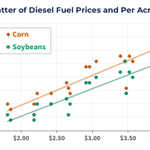
1. My colleagues on the farmdoc team provide a much needed analysis of the impact of higher diesel prices on per acre corn and soybean costs. Bottom-line: A projected $28 fuel cost for corn in 2026 would be $9 per acre higher than the average of $19 for 2009 through 2025 and $6 higher than 2025’s $22 per acre.

3. I also understand that the diesel program would cover more crops than corn and soybeans and that is part of the discrepancy. But principal crop acreage is about 310 million for 2026. Multiplying that by $10 per acre added cost (guestimate for all crops) would still only get you to $3.1 billion of added diesel costs for 2026.
4. Here is the link to yesterday's FDD: farmdocdaily.illinois.edu/20…

Well worth reading
From the @WSJ: “Persian Gulf oil exports have surpassed prewar levels, as an improvised shipping system under U.S. protection is helping tankers move oil through one of Iran’s fiercest waves of attacks in the Strait of Hormuz.”
wsj.com/world/middle-east/mo…


Back to our regularly scheduled programming...this is interesting
MIDDLE EAST FLOWS: Not only flows have proven resilient, but over the last few days (particularly since Oct 16), SoH traffic has surged despite Iranian attacks.
Total Middle East crude flows (ex-Iran, including SoH and all the bypass pipelines and routes) are back to >90% of pre-war levels (last seen in late Sept), and even higher if using a short 7-day average. Refined products flows remain significantly below. Caveat: flows are very uneven, with some days of large number of tanker crossings, followed by very quiet days.
Overall, physical Middle East crude oil premia has continued to drop; just the opposite of what has happened to flat prices. The Oman-Dubai differential has fallen to a 3-month low of ~$4 a barrel. The differential was >$30 a barrel in mid-Sept.

Scott Irwin retweeted

@grok’s answer: “the ban did not clearly reduce swings and likely left them worse”
This graph we made shows the volatility of onions (no futures) vs oil (futures). Interesting!


@grok did Congress ban onion futures in 1958 because it wanted to prevent sudden price swings in onions? If so, based on academic research, did banning onion futures reduce price swings or did it get worse?
In the category of something I truly never thought I would see
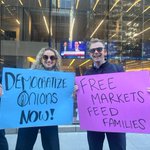
Please join us this Monday at the @CMEGroup (Chicago Mercantile Exchange) to rally for justice, financial markets, and onions. We will be arranging transport for @UChicago students.
actionnetwork.org/events/pro…
cc: @TheStalwart @mansourtarek_ @fblawler @chicagophoenix_ @TheOnion @luanalopeslara @mansourtarek_ @cblatts @CharlesFLehman @ChicagoNewLibs @iampaulgrewal @HereComesKumar @chicagotribune @LinkofSunshine @AjitPai @JakeSheridan_ @BradBourque @Knibbs @matt_levine @mattyglesias @Noahpinion @SeanCasten @pointsnfigures1 @emmma_camp_ @wttw @cbschicago @nbcchicago @WBEZ @Suntimes @chicagotribune
Scott Irwin retweeted
TODAY
University of Chicago Students to Protest at Chicago Mercantile Exchange, Demand End to Federal Ban on Onion Futures
Student-led group For Our Futures will rally Monday morning to call for repeal of the 1958 Onion Futures Act
On Monday, October 19, at 8:30 a.m., members of For Our Futures, a student-led organization from @UChicago, will gather outside the Chicago Mercantile Exchange (@CMEGroup) headquarters to demand the repeal of the Onion Futures Act of 1958, a nearly 70-year-old federal law prohibiting futures trading in onions.
The Onion Futures Act, enacted following allegations of market manipulation in the 1950s, singled out onions for a prohibition on futures contracts that remains in effect today. For Our Futures is calling on Congress to repeal the ban and restore the ability of onion growers, buyers, and traders to participate in a regulated futures market. Onions remain the only commodity banned from futures trading in the United States.
The protest will feature a giant inflatable onion costume, protest signs, and dozens of students, and will take place outside the headquarters of CME Group, one of the world's largest derivatives marketplaces and the historic center of American onion futures trading.
DM for details
cc: @pointsnfigures1 @CharlesFLehman @matt_levine @nbcchicago @ABC7Chicago @cbsnewschicago @WGNNews @fox32news @WBEZ @Suntimes @BlockClubCHI @chalkbeatCHI @SeanCasten @mansourtarek_

ALT The "onion man" visits a meeting of the UChicago Democrats. Not affiliated with any party, candidate, or candidate committee. We are a bipartisan movement.