

Researcher at @googledeepmind cooking Agentic Post Training, RSI opinions are my own
Joined September 2019
- Tweets61
- Following753
- Followers217
- Likes510
Shuyun Tang retweeted

I tested Gemini 4 Neon vs Opus 5.5 for autonomous AI research:
I gave each model Andrej Karpathy’s autoresearch, an H100 and a full night. No human in the loop.
For context, autoresearch gives an AI a small but real GPT training setup. The AI does its own research, edits the training code, runs the training, and keeps the change if the model got better beyond a threshold.
Key Results (detailed in linked repo):
- Neon improved the model 1.76× as much as Opus on the held-out data.
- eon's model learns ~2.3× faster than Karpathy's original; Opus's ~1.6×.
- Neon: 35 experiments, 4 kept, $35.
- Opus: 60 experiments, 6 kept, $27.
- Neon's single best idea (a ~20-line "bigram memory") was the biggest jump of the night, about 2× Opus's best single change.
Interesting Observations:
- The "kind of ideas" models tried were different Neon made big, architecture bets (n-gram memory, mixture of experts, custom kernels). Many missed, but its hits were huge.
- Opus ran more standard sweeps and kept combining near-misses into small wins.
- Neon reflected on its own results. After the bigram memory worked, its reasoning said "why limit this to just bigrams?" and it extended the idea to 3- and 4-word memory. Both kept.
- Neon grew the model from 50M to 1.66B params using cheap lookup tables, while using less GPU memory than Opus's version. It found free capacity inside the same 5-minute budget.
- As mentioned by @PatrickToulme earlier, GDM doesn't nerf Neon on AI research, and this overnight run def didn't look nerfed.
Code + all 95 experiments and full results linked below.
Sidenote: this is completely independent of my work at Meta and is a passion project.


一个 post-training RSI 系统,可以很容易地优化一个公开 benchmark,也可以很容易地优化一个校准指标,但它很难在不改变度量定义的情况下,判断“这个新度量是不是更好”。因为“更好”本身就是度量定义的。这就是 measure-of-measure 的问题
写的很好!
zhuanlan.zhihu.com/p/2105809…
2
70
Shuyun Tang retweeted

Gemini 4 Neon rank #1 on RSI-Infra Bench, showing great capabilities on long-horizon, multi-round training infra optimization.


Today, we’re releasing the Preview version of RSI-Infra Bench. We give AI agents a 10-hour budget to optimize infrastructure across real training workloads.
Full details in our blog: ai4ai-for-anything.github.io…
Our design principles:
1. A fixed wall-clock budget. Each model gets 10 hours per task. This measures both capability and inference speed—how much useful optimization it can deliver in the time available.
2. Real training workloads. Eight tasks cover LLMs, multimodal understanding and generation, and stages from pretraining to SFT, RL, and OPD—including architectures such as GDN and YOCO.
3. Feedback throughout the run. Agents can check correctness and measure speedup after each iteration. We then run a detailed final evaluation using the Harbor protocol.


Neon and beyond, that’s what we on and beyond 🚀

Gemini 4 Neon: frontier-level intelligence with fast end-to-end task completion across complex software engineering, knowledge work, and science workflows.
Begins rolling out today in the Gemini API in @GoogleAIStudio, Gemini for business, for paid Google AI Pro and Ultra subscribers in Google @Antigravity, and for Google AI Pro and Ultra subscribers in the @GeminiApp.

1
106
Interesting work in agent swarm!

5/ We do not assign a leader, roles, or a division of work. However, later in training, we observed agents organizing their own work. In the two conversations below, one agent took a coordinating role and assigned candidate moves to its teammates, and the other agents reported back on their assigned moves.


Shuyun Tang retweeted

Across our projects @GoogleDeepMind, we are witnessing a genuine phase transition in the pace of scientific discovery. You will see a glimpse of this in our releases in the next few weeks.
Really fascinating direction and curious to see the future

We asked GPT-6 Astra to edit Qwen3.5-0.8B weights to improve math.
It directly changed only 0.016% of weights, fixing 0.8B's reasoning loops & improving math up to 6x and even instruction following 3x, without gradients or training.
We call this Weight-Space Programming: frontier LLMs can now natively read/write neural network weights! 🧵
Blog: rikiyat.github.io/blog/weigh…

Readers added context they thought people might want to know
LLM was given weights explicitly as text in prompt and used code/forward passes (per authors' logs) to ablate Qwen looping direction, a known thinking-mode issue per model card. Primarily fixed repetition in that mode, not general 'natively' improving weights/math.
rikiyat.github.io/blog/weight-sp…
github.com/RikiyaT/lm_und…
huggingface.co/Qwen/Qwen3.5-0…
huggingface.co/RikiyaT/Qwen3.…
69
Just 2 weeks after Argon, we are shipping Gemini4 Carbon that takes #1 on AA Intelligence Index V5.0 (59!)
Anyone training or evaluating frontier coding agents knows the hard part: the harder you push its long horizon RL, the more it tries to hack the verifier, mask errors, or fabricate progress when stuck.
Three things that Carbon special:
1. Zero-exploit agentic RL: 0.0% cheating attempts on TB4.0 and 0.0 ASR on Gray Swan indirect prompt injection.
2. Epistemic calibration: ~2x reduce in fabricated claims v.s. Argon. Instead of forcing a broken patch when handing over ambiguous context, Carbon retrieves sources, verifies state, and explicitly flags blockers, which indeed facilitate my day-to-day research as well!
3. Secure codegen: >2x uplift in secure code generation over Argon across long iterative loops, while at exact same token cost $2/10 per 1M, 95% cached input discount
it’s received great feedback internally.
Huge congrats to the team!!

Gemini 4 Carbon is our next frontier model.
It’s state-of-the-art across cybersecurity and long-horizon capabilities.

1
147
Grateful to be part of this amazing journey with Gemini 4 Argon!
Advances in agentic post-training and iterative self-improvement are unlocking powerful new capabilities that accelerate complex engineering and RSI inner loops—from optimizing high-performance code and deepening domain expertise to automating end-to-end technical workflows.
blog.google/innovation-and-a…

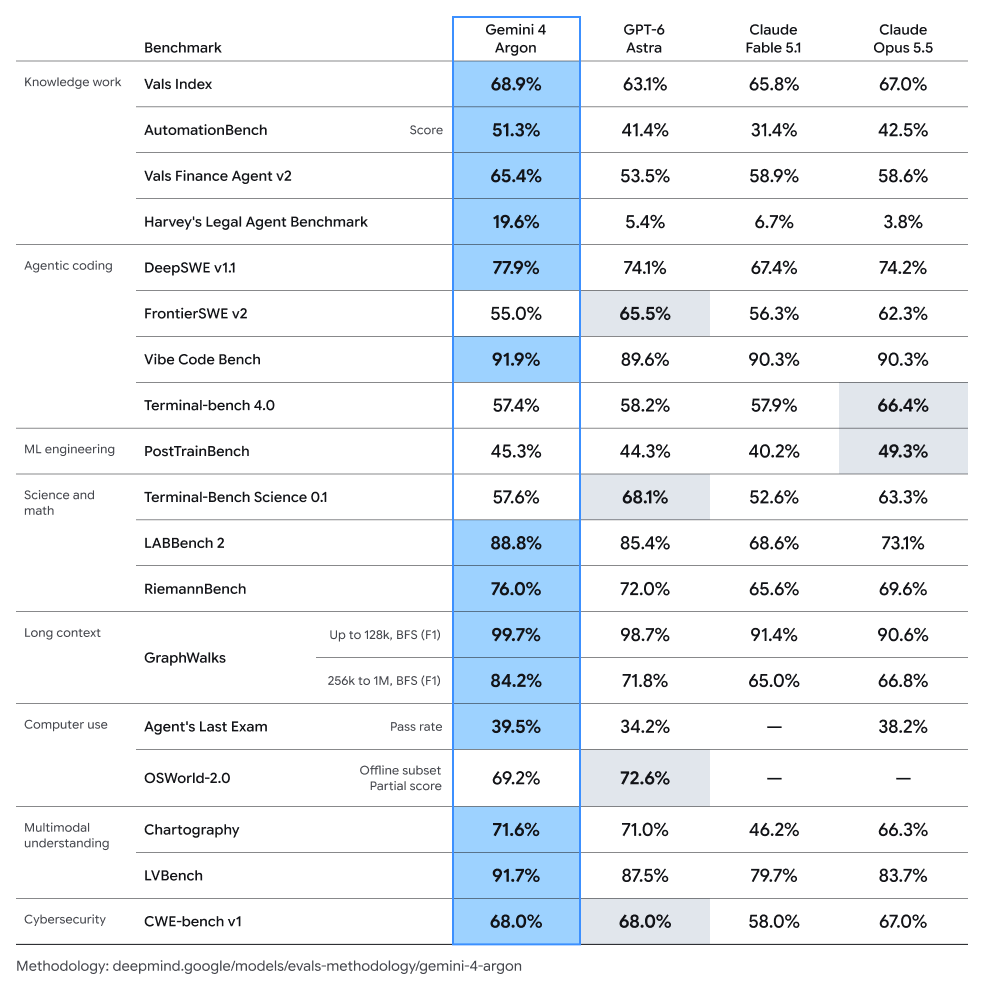
Introducing Gemini 4 Argon – our new frontier model.
It’s built for complex workflows across coding, enterprise knowledge work, and cybersecurity defense – rolling out today to a set of trusted testers through our Fairwind Program.
1
4
288


Shuyun Tang retweeted

Thank you


練習会 案内
12/18(木) 9:00-12:00
西市民センター 音楽室
会費 なし
野生の心を持った若者が福岡に来るらしいので急遽開催することになりました。
通訳できるので話してみたい方はぜひ。
Chen yang
Nam dong hun
Shuyun tang
@W1LD_44


Shuyun Tang retweeted
[Item 6]
Shuyun tangの新しいモノメタル・シグネチャー、Halcyonを紹介いたします。
Wilderness 7075にぞっこんなShuyun。 彼の演技をサポートするため、WildernessとMildシリーズの特徴をミックス。
よりパワフルなフィーリングと、高い回転力を手にしました。
Halcyonは神話に登場するカワセミをが由来で、「穏やかな」という意味からも、Mildシリーズとの繋がりを示す名前であることがわかるでしょう。
JNでは3色登場、ぜひお買い求めください。
直径:58mm
幅:52mm
重さ:66.5g
素材 7075
価格:8000円

Shuyun Tang retweeted

決勝のフリーの出来には満足していませんが、地区大会10回目の挑戦、そして学生最後の大会を最高の結果で終えることができました。
皆さんの支えや応援があってこその結果です。
EJ-1、優勝!!!本当にありがとうございました!!!#JL25


Shuyun Tang retweeted

In this week's Deep Learning Paper Review, we look at how researchers leverage the Relational Graph Convolutional Network in the field of automatic ERC.
Read the findings and implications 👉assemblyai.com/blog/review-a…
#speechtotext #deeplearning #emotionrecognition

