







Pinned Tweet
1/ As agentic tasks grow longer and rollouts become more expensive, the choice between critic-based PPO and critic-free GRPO becomes increasingly important.
Critics can reduce gradient variance, allowing models to learn from fewer trajectories, but they also introduce additional compute costs and potential bias from bootstrapping.
Our new research @ScaleAILabs compares PPO and GRPO under a shared actor objective across 1,200+ training runs in control tasks, short-horizon math, and long-horizon terminal agents. We studied how three factors influence this tradeoff: batch size, critic reliance, and task complexity. 🧵

This is insane


New slide deck on the biggest open problems in post-training and how the field got to where it is today. Largely, this is a statement of my goals with Trillium Labs (not that we can do every project at once). Stay in touch if you're working on any of these in the open!
Opens with the evolution of post-training and ends with a debate on how RSI is changing this type of research.
The research areas on my mind:
1. Harness specialization and design – How do we design environments for context management that enable new paradigms of using LLMs?
2. Character training – How do we create the personality of models and how does this impact safety, trust, and diffusion of LLMs?
3. Open-source RL environments – How do we create scalable, open data methods?
4. Reasoning efficiency in RL – How do we control and manipulate the reasoning efficiency of LLMs?
5. Scaling laws for RL – How do we design principled experimentation methodology for large-scale post-training?
6. Multi-agent scaling laws – What are the main axes of inquiry into multi-LLM systems and collaborations?
Re-recording video soon :) was from a recent visit to Cornell


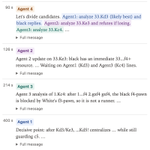
1/ We taught a team of Inkling 2 Small agents to work together, communicate, and delegate work, without predefined roles on hard chess puzzles. Using our simple multi-agent RL recipe, we are able to turn pass@k into pass@1.
Work with @emilianogl and @GabeVisotsky
🧵


.@paulfchristiano thinks that on the current trajectory (absent any slowing down), there is a 1 in 3 chance that we could have superintelligence powerful enough to overthrow the government within a year. (He articulates a concrete scenario).
He argues that the labs should pause further algorithmic progress until they can secure their weights and research secrets. Otherwise China could simply steal the superintelligence in the middle of the intelligence explosion, and the labs would no longer be able to slow down even if they saw their models going off the rails.
He also explains how AIs will be trained during the intelligence explosion, and why even a system trained entirely inside a data center could still have the capabilities profile such that humans would have very little chance of competing with it or controlling it.
And he discusses the plan for alignment - basically, making a superintelligence that actually does what we ask the way we mean it. Fixing reward hacks and building better graders will help up till the next few model generations, but he thinks that no single current approach has better than even odds of letting us control superintelligence. The hope is that the AIs figure out the solution to this problem during the intelligence explosion.
Paul is head of the Alignment Research Center. Previously, he was head of AI safety at the US AI Safety Institute. Before that, he led alignment at OpenAI, where he invented RLHF. He’s recently joined OpenAI’s board (though here he is speaking as a private citizen).
8
1,014
We actually tried PPO lambda = 1 (gray line) in our control settings, and it performed very similarly to PPO alpha = 1.5, so alpha 1.5 doesn't actually introduce much bias.
Another interesting finding:
We also compared GRPO with and without std normalization (Dr. GRPO). With continuous rewards, std normalization can go horribly wrong if group stds differ by orders of magnitude. Normalizing gives groups whose returns barely vary just as much weight as the ones with the most to learn. This case only appeared in Pendulum at H = 25.


We got benchmarks overfitting the models now😭

Announcing Artificial Analysis Intelligence Index v4.2. We are accelerating elements of our upcoming v5 release with interim updates to keep pace with the frontier. Index v4.2 has more complex and realistic tasks, and more private test sets to prevent gaming
Intelligence Index v4.2 changelog:
+ AA-Briefcase, our agentic knowledge work evaluation with a private test set
+ @HelloSurgeAI's GDP.pdf, long context document reasoning across 4,592 PDF pages
- GPQA Diamond, an exceptional scientific reasoning evaluation that has now been saturated
… plus greater weighting on held-out test sets to prevent gaming, and grading infrastructure upgrades to increase robustness
This update brings the Index closer to real-world use cases with more challenging, complex and realistic tasks and private test sets to prevent gaming. We have been planning and building elements of Index v5 for months - it’s been 8 months since we launched Index v4 in January.
We have deliberately held back updates to keep the Index stable through recent major model launches. However, with the frontier moving so quickly in the past weeks, we feel it is important to deliver an immediate interim update to ensure our Index remains as relevant and useful as ever to users.
Beyond this interim update, our team is hard at work on v5 of the Index. We are planning more incremental releases in the near future. Stay tuned!
Intelligence Index v4.2 changes in detail:
➤ Adding AA-Briefcase: Our in-house evaluation with a private held-out test set, AA-Briefcase tests models on realistic agentic knowledge work tasks in complex projects built by industry experts. Models are evaluated on multi-week knowledge work projects, each with many linked tasks and thousands of input source files. AA-Briefcase combines rubric and pairwise grading to evaluate verifiable task success, analytical quality, and presentation quality, giving a holistic view of overall agentic capability in knowledge work.
➤ Adding GDP.pdf: Created by @HelloSurgeAI, GDP.pdf evaluates single-turn professional document reasoning across 100 PDFs and ten domains. Models must synthesize evidence distributed across 4,592 pages, including text, tables, charts, footnotes, and exclusions. Responses are graded against 1,275 expert-authored atomic criteria; the headline All-pass Rate credits a task only when every criterion is satisfied.
➤ Weighting to measure real-world use and prevent gaming: 40% of our Index weighting is now private, held-out test sets - double the figure from v4.1. Held-out data includes AA-Briefcase, AA-Omniscience, and solutions for CritPt. This reduces the ability for labs to game evaluations. The held-out percentage will increase further in Index v5.
➤ Improving our grading infrastructure: In AA-LCR v1.1, we have added a grading system prompt and corrected errors and ambiguities in answer keys, improving scoring accuracy. For GDPval-AA v2 and AA-Briefcase, we have improved our sampling and re-anchored the Elo scale, making ratings more stable as new models are added. For SciCode we have improved robustness of grading sandboxes to ensure slow but correct code does not count as a failure.
Key results:
➤ Anthropic and OpenAI lead the Index: Anthropic’s Claude Fable 5.1 leads the Index, followed by OpenAI’s GPT-6 Astra, which shows a 4pt gain over GPT-5.6 Sol. Meta is the third-ranked lab on the leaderboard, followed by SpaceXAI, Moonshot/Kimi, Z AI, and Google
➤ Cost per Task Pareto frontier shared by four labs: Anthropic, OpenAI, Meta and Z AI occupy the updated Cost per Task Pareto frontier
➤ GPT-6 Astra dominates the output token Pareto frontier: GPT-6 Astra is more token efficient than almost every other model near the intelligence frontier, with Claude Fable 5.1, Grok 4.5 and Gemini 3.5 Flash-Lite at either end of the curve (excludes models below 25 on the Index)

2
13
1,056
Something that most people will miss here is the GAE length adaptive alpha hyperparameter they choose of 1.5. Previously, VAPO used a much smaller 0.05.
With 1.5, each token will receive substantial signal from the unbiased final reward, but with 0.05, only the last 5-10% of tokens will receive substantial signal from the final reward and the rest will be bootstrapped off biased critic estimates
This high of an alpha represents a sort of middle ground between GRPO and standard PPO. We reduce some of the variance in GRPO and also don’t have as much bias as standard PPO GAE lambda values like 0.95.

Our Single-rollout Asynchronous Optimization (SAO), is able to train stably for one thousand steps and consistently outperform GRPO and its variants on agentic coding and reasoning benchmarks,
such as SWE-Bench Verified, BeyondAIME, and IMOAnswerBench. arxiv.org/pdf/2607.07508
Damn, the scaffold is super important


🚀 Introducing Qwen3-Coder-Next, an open-weight LM built for coding agents & local development.
What’s new:
🤖 Scaling agentic training: 800K verifiable tasks + executable envs
📈 Efficiency–Performance Tradeoff: achieves strong results on SWE-Bench Pro with 80B total params and 3B active
✨ Supports OpenClaw, Qwen Code, Claude Code, web dev, browser use, Cline, etc
🤗 Hugging Face: huggingface.co/collections/Q…
🤖 ModelScope: modelscope.cn/collections/Qw…
📝 Blog: qwen.ai/blog?id=qwen3-coder-…
📄 Tech report: github.com/QwenLM/Qwen3-Code…

2
15
1,470
Karpathy is bringing us closer to artificial super intelligence more than any single AI researcher

Excited to release new repo: nanochat!
(it's among the most unhinged I've written).
Unlike my earlier similar repo nanoGPT which only covered pretraining, nanochat is a minimal, from scratch, full-stack training/inference pipeline of a simple ChatGPT clone in a single, dependency-minimal codebase. You boot up a cloud GPU box, run a single script and in as little as 4 hours later you can talk to your own LLM in a ChatGPT-like web UI.
It weighs ~8,000 lines of imo quite clean code to:
- Train the tokenizer using a new Rust implementation
- Pretrain a Transformer LLM on FineWeb, evaluate CORE score across a number of metrics
- Midtrain on user-assistant conversations from SmolTalk, multiple choice questions, tool use.
- SFT, evaluate the chat model on world knowledge multiple choice (ARC-E/C, MMLU), math (GSM8K), code (HumanEval)
- RL the model optionally on GSM8K with "GRPO"
- Efficient inference the model in an Engine with KV cache, simple prefill/decode, tool use (Python interpreter in a lightweight sandbox), talk to it over CLI or ChatGPT-like WebUI.
- Write a single markdown report card, summarizing and gamifying the whole thing.
Even for as low as ~$100 in cost (~4 hours on an 8XH100 node), you can train a little ChatGPT clone that you can kind of talk to, and which can write stories/poems, answer simple questions. About ~12 hours surpasses GPT-2 CORE metric. As you further scale up towards ~$1000 (~41.6 hours of training), it quickly becomes a lot more coherent and can solve simple math/code problems and take multiple choice tests. E.g. a depth 30 model trained for 24 hours (this is about equal to FLOPs of GPT-3 Small 125M and 1/1000th of GPT-3) gets into 40s on MMLU and 70s on ARC-Easy, 20s on GSM8K, etc.
My goal is to get the full "strong baseline" stack into one cohesive, minimal, readable, hackable, maximally forkable repo. nanochat will be the capstone project of LLM101n (which is still being developed). I think it also has potential to grow into a research harness, or a benchmark, similar to nanoGPT before it. It is by no means finished, tuned or optimized (actually I think there's likely quite a bit of low-hanging fruit), but I think it's at a place where the overall skeleton is ok enough that it can go up on GitHub where all the parts of it can be improved.
Link to repo and a detailed walkthrough of the nanochat speedrun is in the reply.

1
477
An entire system shouldn’t be compared to 3 humans working for 5 hours. Spawning thousands of trajectories in parallel, writing some test cases, and doing multi-turn would give an LLM basically unlimited tries and time on each problem. Total compute should be mentioned.

1/n
I’m really excited to share that our @OpenAI reasoning system got a perfect score of 12/12 during the 2025 ICPC World Finals, the premier collegiate programming competition where top university teams from around the world solve complex algorithmic problems. This would have placed it first among all human participants. 🥇🥇
